Notes on Memoidealism (1.4)

May 1st, 2009

Urstoff of Anaximenes is Air much like Memory in memoidealism. How do concrete objects develop from invisible Air? Through the process of condensation and rarefaction, quality arises from quantity (reduction process). Eternity of Urstoff is one of the main features of Milesian philosophers and memory religion. No additional worlds are possible in their philosophies. They are “materialists” because of their material Urstoff. Memoidealists are “idealists” because of their ideal notion of Memory.

- Dmitry Vostokov @ DumpAnalysis.org -

Heap corruption, module variety, execution residue, coincidental symbolic information and critical section corruption: pattern cooperation

May 1st, 2009

This is a synthesized dump analysis of many similar print spooler crashes in multi-user terminal service environments where old printer drivers are used that were tested only in single-user environments or insufficiently tested in multi-threaded environments. Many such crashes result from dynamic memory corruption of a process heap:

(40dc.4278): Access violation - code c0000005 (!!! second chance !!!)
eax=00000079 ebx=00000001 ecx=0008bff8 edx=00107898 esi=07d7522a edi=00107890
eip=7c8199b2 esp=0155fc14 ebp=0155fc44 iopl=0 nv up ei pl nz na po nc
cs=001b ss=0023 ds=0023 es=0023 fs=003b gs=0000 efl=00010202
ntdll!RtlpLowFragHeapFree+0×30:
7c8199b2 8b4604          mov     eax,dword ptr [esi+4] ds:0023:07d7522e=????????

0:017> kL
ChildEBP RetAddr 
0155fc44 7c819770 ntdll!RtlpLowFragHeapFree+0×30
0155fd1c 77c87a2b ntdll!RtlFreeHeap+0×5c

0155fd30 77c87a02 RPCRT4!FreeWrapper+0×1e
0155fd3c 77c821c2 RPCRT4!operator delete+0xd
0155fd50 77c8047b RPCRT4!LRPC_SCALL::FreeBuffer+0×77
0155fd9c 77c80353 RPCRT4!RPC_INTERFACE::DispatchToStubWorker+0×192
0155fdc0 77c811dc RPCRT4!RPC_INTERFACE::DispatchToStub+0xa3
0155fdfc 77c812f0 RPCRT4!LRPC_SCALL::DealWithRequestMessage+0×42c
0155fe20 77c88678 RPCRT4!LRPC_ADDRESS::DealWithLRPCRequest+0×127
0155ff84 77c88792 RPCRT4!LRPC_ADDRESS::ReceiveLotsaCalls+0×430
0155ff8c 77c8872d RPCRT4!RecvLotsaCallsWrapper+0xd
0155ffac 77c7b110 RPCRT4!BaseCachedThreadRoutine+0×9d
0155ffb8 77e64829 RPCRT4!ThreadStartRoutine+0×1b
0155ffec 00000000 kernel32!BaseThreadStart+0×34

Although any module could corrupt the heap and either Gflags or Application Verifier is recommended to enable full page heap, sometimes we need to point to some print drivers to eliminate or upgrade them in the meantime. When there are many of them we can point to the oldest one:

0:017> lmt
start    end        module name
[...]
010d0000 010d8000   PrintDriver1  2007
01260000 01272000   PrintDriver2  1999
01290000 012da000   PrintDriver3  2009
012f0000 01302000   PrintDriver4  2003
01310000 01320000   PrintDriver5  2004
01320000 01332000   PrintDriver6  2004
01340000 01353000   PrintDriver7  2005
01360000 0139e000   PrintDriver8  2007
013b0000 013c3000   PrintDriver9  2004
013d0000 013e0000   PrintDriver10 2005
013e0000 013f3000   PrintDriver11 2005
01400000 01413000   PrintDriver12 2006
01420000 0146b000   PrintDriver13 2007
01480000 01488000   PrintDriver14 2003
017f0000 0181e000   PrintDriver15 2004
01920000 0192d000   PrintDriver16 2008
01930000 01936000   PrintDriver17 2008
01950000 01959000   PrintDriver18 2008
01960000 01969000   PrintDriver19 2008
01f80000 021e8000   PrintDriver20 2004
032f0000 03514000   PrintDriver21 2003
03cd0000 03cd6000   PrintDriver22 2008
32100000 32148000   PrintDriver23 2008
3ea40000 3ea46000   PrintDriver24 2007
3f000000 3f03d000   PrintDriver25 2009
3f100000 3f133000   PrintDriver26 2009
[…]

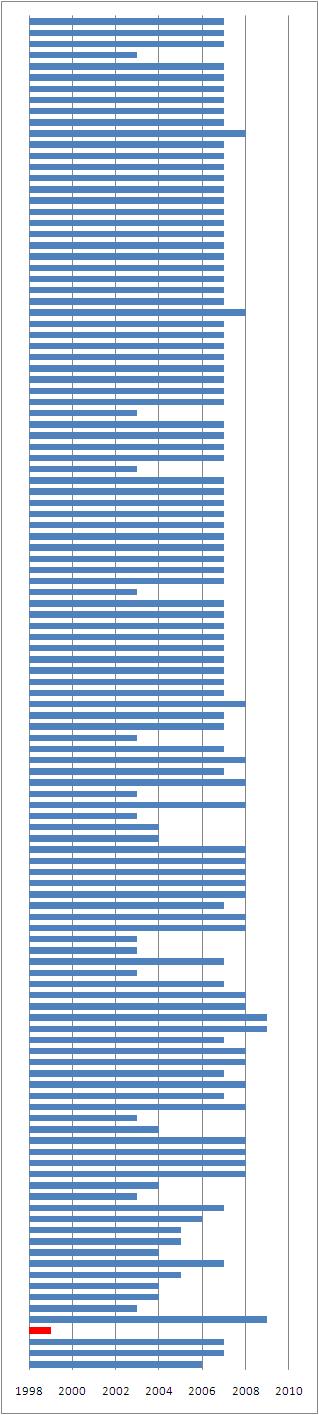
The age distribution among 121 modules can be visualized on a CAD diagram:
 

Alternatively we can look at the execution residue on a raw thread stack:

0:017> !teb
TEB at 7ffa9000
    ExceptionList:        0155fd0c
    StackBase:            01560000
    StackLimit:           01550000
    SubSystemTib:         00000000
    FiberData:            00001e00
    ArbitraryUserPointer: 00000000
    Self:                 7ffa9000
    EnvironmentPointer:   00000000
    ClientId:             000040dc . 00004278
    RpcHandle:            00000000
    Tls Storage:          00000000
    PEB Address:          7ffd8000
    LastErrorValue:       0
    LastStatusValue:      8000001a
    Count Owned Locks:    0
    HardErrorMode:        0

0:017> dds 01550000 01560000
01550000  00000000
01550004  00000000
[...]
01554e78  00000000
01554e7c  00000000
01554e80  01554ecc
01554e84  7c82d1bb ntdll!RtlFindActivationContextSectionString+0xe1
01554e88  01554ea4
01554e8c  01554efc
01554e90  00000000
01554e94  020a0018 PrintDriver20!Callback+0×5c88
01554e98  7ffa9c00
01554e9c  00000000
01554ea0  01554ed4
01554ea4  7c82dd6c ntdll!RtlEncodeSystemPointer+0×45b
01554ea8  00020000
01554eac  01554ec8
01554eb0  01554ec8
01554eb4  01554ec8
[…]
01555eb4  0040003e
01555eb8  01556854
01555ebc  00000000
01555ec0  0000003e
01555ec4  0208003e PrintDriver20!GetValue+0xb37fe
01555ec8  00000000
01555ecc  43000000
01555ed0  0000003e
01555ed4  01555ffa
01555ed8  01555fbc
01555edc  01555fa8
01555ee0  001190d8
01555ee4  7c81990d ntdll!RtlpLowFragHeapAlloc+0×210
01555ee8  7c819962 ntdll!RtlpLowFragHeapAlloc+0xc6a
01555eec  0008bff8
01555ef0  00000000
01555ef4  00080000
[…]

The first address 020a0018 seems to be coincidental because its disassembled code is not good:

0:017> ub 020a0018
                 ^ Unable to find valid previous instruction for 'ub 020a0018'

0:017> u 020a0018
PrintDriver20!Callback+0x5c88:
020a0018 048b            add     al,8Bh
020a001a c7              ???

020a001b ebe8            jmp     PrintDriver20!Callback+0×5c75 (020a0005)
020a001d 8d4e28          lea     ecx,[esi+28h]
020a0020 e8d9960100      call    PrintDriver20!DlgProc+0×86ee (020b96fe)
020a0025 8d4e28          lea     ecx,[esi+28h]
020a0028 e87b930100      call    PrintDriver20!DlgProc+0×8398 (020b93a8)
020a002d 8b4618          mov     eax,dword ptr [esi+18h]

However the second address code 0208003e seems sound: cmp is followed by jne:

0:017> ub 0208003e
PrintDriver20!GetValue+0xb37e5:
02080025 8d442414        lea     eax,[esp+14h]
02080029 8b4b2c          mov     ecx,dword ptr [ebx+2Ch]
0208002c 50              push    eax
0208002d e8ce3a0000      call    PrintDriver20!GetValue+0xb72c0 (02083b00)
02080032 8b38            mov     edi,dword ptr [eax]
02080034 8b4c2410        mov     ecx,dword ptr [esp+10h]
02080038 8b41fc          mov     eax,dword ptr [ecx-4]
0208003b 3947fc          cmp     dword ptr [edi-4],eax

0:017> u 0208003e
PrintDriver20!GetValue+0xb37fe:
0208003e 751b            jne     PrintDriver20!GetValue+0xb381b (0208005b)
02080040 8bc8            mov     ecx,eax
02080042 8b742410        mov     esi,dword ptr [esp+10h]
02080046 c1e902          shr     ecx,2
02080049 f3a7            repe cmps dword ptr [esi],dword ptr es:[edi]
0208004b 750e            jne     PrintDriver20!GetValue+0xb381b (0208005b)
0208004d 8bc8            mov     ecx,eax
0208004f 83e103          and     ecx,3

But this is not a function call resulted in saved return address so we can still consider it as a coincidence. However, on the raw stack we also see a large chunk of ASCII data pointing to the same driver in a textual form:

[...]
0155d360  6f742064
0155d364  696e6920
0155d368  6c616974
0155d36c  20657a69
0155d370  61636562
0155d374  20657375
0155d378  75732061
0155d37c  62617469
[...]

0:017> da 0155d360 0155d734
0155d360  "d to initialize because a suitab"
0155d380  "le PrinterDriver20 inf file was ”
[…]

This reinforces our belief in PrinterDriver20. Finally, when looking at critical section list we see corruption signs pointing to the same driver addresses:

0:017> !cs -l -o -s
DebugInfo          = 0x0014bc60
Critical section   = 0x020f7140 (PrintDriver20!DlgProc+0×46130)
LOCKED
LockCount          = 0xFF85EA7F
WaiterWoken        = Yes
OwningThread       = 0×8b0c244c
RecursionCount     = 0×8BFFFBB4
LockSemaphore      = 0×83182444
SpinCount          = 0×088908c4

WARNING: critical section DebugInfo = 0x00000008 doesn't point back
to the DebugInfo found in the active critical sections list = 0x0014bc60.
The critical section was probably reused without calling DeleteCriticalSection.

Cannot read structure field value at 0x0000000a, error 0
ntdll!RtlpStackTraceDataBase is NULL. Probably the stack traces are not enabled.

DebugInfo          = 0x0014bc88
Critical section   = 0x020f7110 (PrintDriver20!DlgProc+0×46100)
LOCKED
LockCount          = 0×1E7245FF
WaiterWoken        = No
OwningThread       = 0xccccc304
RecursionCount     = 0xC483FFFD
LockSemaphore      = 0×158638B9
SpinCount          = 0xff96e902

WARNING: critical section DebugInfo = 0x0f712068 doesn't point back
to the DebugInfo found in the active critical sections list = 0x0014bc88.
The critical section was probably reused without calling DeleteCriticalSection.

Cannot read structure field value at 0x0f71206a, error 0
[...]

- Dmitry Vostokov @ DumpAnalysis.org -

ManagementBits update (April, 2009)

April 30th, 2009

Monthly summary of my Management Bits and Tips blog:

Flattening My Management

Strategic and Tactical Personal Learning

Customer Relationship Martyr 

- Dmitry Vostokov @ DumpAnalysis.org -

LiterateScientist update (April, 2009)

April 30th, 2009

Monthly summary of my Literate Scientist blog:

Young Stalin

General Chemistry

Evolution: The First Four Billion Years

More Than a Theory

Understanding the Infinite

Conceptual Mathematics

The Coming of the Third Reich

Comrades

- Dmitry Vostokov @ DumpAnalysis.org -

Notes on Memoidealism (1.3)

April 29th, 2009

Indeterminate infinite Urstoff, out of which emerges the plurality of worlds that come and go, is the foundation of Anaximander philosophy. In memoidealism, Memory is indeterminate in the sense that it doesn’t represent determinate material substance. It is actually infinite too. The crucial feature of memoidealistic notion of memory is the fact that coming into existence plurality doesn’t perish. It is saved. In some sense Memory is apeiron of memoidealism.

- Dmitry Vostokov @ DumpAnalysis.org -
Dining Chicken

April 29th, 2009

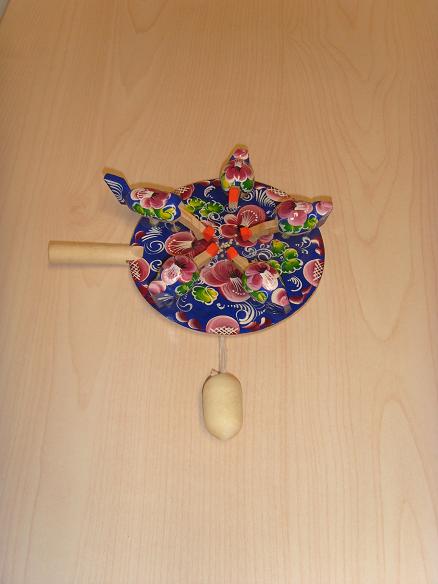
To illustrate preemptive multitasking orchestrated by a central processor I use a Russian toy that reminds me of the dining philosophers problem that usually opens any textbook on concurrency:

Here is the video (you need to download and install Xvid MP4 codec if your computer doesn’t play it):

Download DiningChicken.avi (1.2 Mb)

- Dmitry Vostokov @ DumpAnalysis.org -
Viewing Problem Artifacts from Different Angles

April 28th, 2009

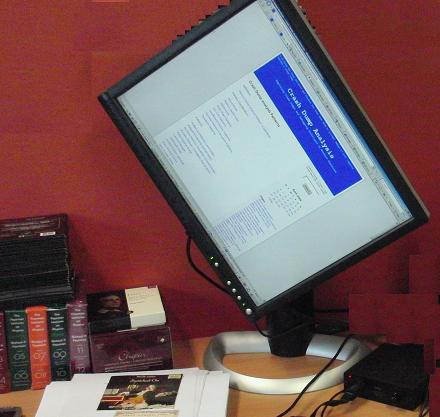
I often say or write something like this: “I looked at the dump|trace file from different angles”.

- Dmitry Vostokov @ DumpAnalysis.org -

Null data pointer, incorrect stack trace, changed environment, hooked functions and coincidental symbolic information: pattern cooperation

April 28th, 2009

One application was constantly crashing in a highly dynamic multi-user environment with various value-added GUI-enhancing hooking and patching 3rd-party products. The dump was analyzed and it shows the data NULL pointer access violation:

0:000> r
eax=05503ff0 ebx=05503f10 ecx=6bb7da25 edx=00000000 esi=02203c10 edi=00000000
eip=6b542ba3 esp=04f6f860 ebp=04f6f87c iopl=0 nv up ei pl zr na pe nc
cs=001b ss=0023 ds=0023 es=0023 fs=003b gs=0000 efl=00010246
gui_plugin!entry+0xe63:
6b542ba3 8b0f            mov     ecx,dword ptr [edi]  ds:0023:00000000=????????

Unfortunately due to the lack of gui_plugin symbols the stack trace is incorrect:

0:000> kv
ChildEBP RetAddr  Args to Child             
WARNING: Stack unwind information not available. Following frames may be wrong.
04f6f87c 00000000 000003b9 00000690 00000d20 gui_plugin!entry+0xe63

We do not attempt stack trace reconstruction here but show one of troubleshooting methods to eliminate possible effects of the changed environment. We look for any code patching modules by examining hooked functions:

0:000> !chkimg -lo 50 -d !kernel32 -v
Searching for module with expression: !kernel32
Will apply relocation fixups to file used for comparison
Will ignore NOP/LOCK errors
Will ignore patched instructions
Image specific ignores will be applied
Comparison image path: c:\mss\kernel32.dll\4791A76Ddb000\kernel32.dll
No range specified

Scanning section:    .text
Size: 835001
Range to scan: 76701000-767ccdb9
    7670a672-7670a676  5 bytes - kernel32!MoveFileW
 [ 8b ff 55 8b ec:e9 89 59 80 09 ]
    7671c5c8-7671c5cc  5 bytes - kernel32!DeleteFileW (+0×11f56)
 [ 8b ff 55 8b ec:e9 33 3a 80 09 ]
    76721070-76721074  5 bytes - kernel32!MoveFileExW (+0×4aa8)
 [ 8b ff 55 8b ec:e9 8b ef 83 09 ]
    7678ff3f-7678ff43  5 bytes - kernel32!ReplaceFileW (+0×6eecf)
 [ 68 b4 03 00 00:e9 bc 00 7a 09 ]
Total bytes compared: 835001(100%)
Number of errors: 20
20 errors : !kernel32 (7670a672-7678ff43)

0:000> u 7670a672
kernel32!MoveFileW:
7670a672 e989598009      jmp     7ff10000
7670a677 6a02            push    2
7670a679 6a00            push    0
7670a67b 6a00            push    0
7670a67d ff750c          push    dword ptr [ebp+0Ch]
7670a680 ff7508          push    dword ptr [ebp+8]
7670a683 e8c4690100      call    kernel32!MoveFileWithProgressW (7672104c)
7670a688 5d              pop     ebp

0:000> u 7ff10000
7ff10000 e99b1e94f5      jmp     3rdPartyHook!MoveFileW (75851ea0)
7ff10005 8bff            mov     edi,edi
7ff10007 55              push    ebp
7ff10008 8bec            mov     ebp,esp
7ff1000a e968a67ff6      jmp     kernel32!MoveFileW+0×5 (7670a677)
7ff1000f 0000            add     byte ptr [eax],al
7ff10011 0000            add     byte ptr [eax],al
7ff10013 0000            add     byte ptr [eax],al

We see lots of references to 3rdPartyHook on the thread raw stack:

0:000> !teb
TEB at 7ffd5000
    ExceptionList:        04f6ff70
    StackBase:            04f70000
    StackLimit:           04f6c000
    SubSystemTib:         00000000
    FiberData:            00001e00
    ArbitraryUserPointer: 00000000
    Self:                 7ffd5000
    EnvironmentPointer:   00000000
    ClientId:             00001790 . 000017d0
    RpcHandle:            00000000
    Tls Storage:          7ffd502c
    PEB Address:          7ffd8000
    LastErrorValue:       0
    LastStatusValue:      0
    Count Owned Locks:    0
    HardErrorMode:        0

0:000> dds 04f6c000 04f70000
[...]
04f6cf28  00440042
04f6cf2c  04f6d2d4
04f6cf30  77179834 ntdll!_except_handler4
04f6cf34  003ce48e
04f6cf38  fffffffe
04f6cf3c  7719d584 ntdll!LdrpResSearchResourceInsideDirectory+0x80f
04f6cf40  7719cf9d ntdll!LdrpResSearchResourceMappedFile+0x521
04f6cf44  6b920002
04f6cf48  00000000
04f6cf4c  000bf000
04f6cf50  6b9d9000
04f6cf54  6b9200f8
04f6cf58  00000000
04f6cf5c  01f6d1d4 <Unloaded_D3D9.DLL>+0x12d1d4
04f6cf60  00000003
04f6cf64  04f6cf88
04f6cf68  04f6d370
04f6cf6c  04f6d340
04f6cf70  771d8fb2 ntdll!_SEH_epilog4_GS+0xa
04f6cf74  7719d018 ntdll!LdrpResSearchResourceMappedFile+0x781
04f6cf78  73d77612
04f6cf7c  6b920002
04f6cf80  000bf000
04f6cf84  00000000
04f6cf88  00000001
04f6cf8c  00000000
04f6cf90  00000000
04f6cf94  00000000
04f6cf98  00000000
04f6cf9c  04f6d44c
04f6cfa0  75851c2f 3rdPartyHook+0×1c2f
04f6cfa4  04f6d1e8
04f6cfa8  00000000
04f6cfac  00000000
04f6cfb0  00000000
04f6cfb4  00000000
[…]

The symbolic references point to valid and sound code:

0:000> ub 75851c2f
3rdPartyHook!GetData+0x22d:
75851c1d c20c00          ret     0Ch
75851c20 8b4dfc          mov     ecx,dword ptr [ebp-4]
75851c23 5f              pop     edi
75851c24 5e              pop     esi
75851c25 33cd            xor     ecx,ebp
75851c27 33c0            xor     eax,eax
75851c29 5b              pop     ebx
75851c2a e8590f0000      call    3rdPartyHook!__security_check_cookie (75852b88)

0:000> u 75851c2f
3rdPartyHook!GetData+0x23f:
75851c2f 8be5            mov     esp,ebp
75851c31 5d              pop     ebp
75851c32 c20c00          ret     0Ch
75851c35 cc              int     3
75851c36 cc              int     3
75851c37 cc              int     3
75851c38 cc              int     3
75851c39 cc              int     3


We also see the other 4th-party module that we know as patching from our past experience:

[...]
04f6f850  00000000
04f6f854  00000000
04f6f858  00000000
04f6f85c  00000000
04f6f860  1000c200 4thPartyHook!Shared+0×80
04f6f864  00000000
04f6f868  04f6f87c
04f6f86c  00000001
04f6f870  00000000
04f6f874  00000000
04f6f878  00000000
04f6f87c  0000006c
[…]

The address 1000c200 looks suspicious and coincidental as the set of flags. However, when we disassemble the address, we see the valid and sound code and the module seems to be loaded at 0×10000000 address:

0:000> ub 1000c200
4thPartyHook!Shared+0x80:
1000c1e8 e8234effff      call    10001010
1000c1ed a160020710      mov     eax,dword ptr [10070260]
1000c1f2 83c418          add     esp,18h
1000c1f5 8b750c          mov     esi,dword ptr [ebp+0Ch]
1000c1f8 85f6            test    esi,esi
1000c1fa 7530            jne     1000c22c
1000c1fc 85c0            test    eax,eax
1000c1fe 742c            je      1000c22c

0:000> u 1000c200
4thPartyHook!Shared+0x80:
1000c200 8b08            mov     ecx,dword ptr [eax]
1000c202 8b5004          mov     edx,dword ptr [eax+4]
1000c205 53              push    ebx
1000c206 8bd9            mov     ebx,ecx
1000c208 0bda            or      ebx,edx
1000c20a 5b              pop     ebx
1000c20b 741f            je      1000c22c
1000c20d f6400801        test    byte ptr [eax+8],1

0:000> !dh 10000000
[...]
File Type: DLL
FILE HEADER VALUES
     14C machine (i386)
       5 number of sections
       0 file pointer to symbol table
       0 number of symbols
      E0 size of optional header
    2102 characteristics
            Executable
            32 bit word machine
            DLL
[...]
OPTIONAL HEADER VALUES
     10B magic #
    8.00 linker version
   62000 size of code
   15000 size of initialized data
       0 size of uninitialized data
   3E1B6 address of entry point
    1000 base of code
         ----- new -----
10000000 image base
    1000 section alignment
    1000 file alignment
       2 subsystem (Windows GUI)
    4.00 operating system version
    0.00 image version
    4.00 subsystem version
   7A000 size of image
    1000 size of headers
[...]

0:000> lm
start    end        module name
00400000 00425000   App        
[...]
10000000 1007a000   4thPartyHook
[...]
 

The recommendation I usually give in such cases it to remove or disable 3rd- and 4th-party products that do code patching to see if this resolves the problem. This makes the module list internally clean and if the problem persists then we should look for another causes and restore 3rd- and 4th-party products.

- Dmitry Vostokov @ DumpAnalysis.org -

Bugtation No.89

April 28th, 2009

On the great divide in modern software factories:

“We have in fact, two kinds of” engineers, “side by side: one that” design, “but do not” code, “and another that” code, “but seldom” design.

Bertrand Russell, Sceptical Essays

- Dmitry Vostokov @ DumpAnalysis.org -

Trace Analysis Patterns (Part 1)

April 28th, 2009

After coming back to engineering I decided to expand the domain of my research and start the new series of posts called Trace Analysis Patterns. In addition to Citrix CDF / Microsoft ETW traces I plan to cover other variants based on my extensive software engineering background in the past where I used tracing in software products ranging from soft multi-platform real-time systems to static code analysis tools. Connection with memory dump analysis will be covered too because sometimes the combination of static and dynamic data leads to interesting observations and helps to troubleshoot and resolve customer problems especially when not all data can be collected dynamically.

In fact, stack traces and their collections are specializations of the more general traces. Another example is historical information in memory dump files especially when it is somehow timestamped.  

In this part I start with the obvious and to some extent the trivial pattern called Periodic Error. This is an error or a status value that is observed periodically many times:

No     PID  TID   Date      Time         Statement
[...]
664957 1788 22504 4/23/2009 17:59:14.600 MyClass::Initialize: Cannot open connection “Client ID: 310″, status=5  
[…]
668834 1788 19868 4/23/2009 19:11:52.979 MyClass::Initialize: Cannot open connection “Client ID: 612″, status=5 
[…]

or 

No     PID  TID   Date      Time         Statement
[...] 
202314 1788 19128 4/21/2009 16:03:46.861 HandleDataLevel: Error 12005 Getting Mask
[…]
347653 1788 17812 4/22/2009 13:26:00.735 HandleDataLevel: Error 12005 Getting Mask
[…]

Here single trace entries can be isolated from the trace and studied in detail. 

Be aware though that some modules might report periodic errors that are false positive, in the sense, that they are expected as a part of implementation details, for example, when a function returns an error to indicate that bigger buffer is required or to estimate its size for a subsequent call. It merits its own pattern name and I come to it next time with more examples.

I also created a page where I’ll will be adding all tracing patterns:

Trace Analysis Patterns   

- Dmitry Vostokov @ TraceAnalysis.org -

Notes on Memoidealism (1.2)

April 27th, 2009

Memoidealism is characterized by the unity of philosophy and (computer) science. It has deep roots in practical memory (dump) analysis. The interpretation of observations as memory snapshots (universal memory dumps) leads to the declaration of Memory to be the One (or the First Principle) like Water in Thales practical scientific philosophy. We also observe that processes are memory snapshots as well, through their observational data. We try to understand the plurality of experiences through the unity of memory (the so called Unity in Difference).

- Dmitry Vostokov @ DumpAnalysis.org -

Looking for abnormal: case study

April 27th, 2009

I’m RARE rule #5 says:

“Provide appropriate explanations and narrative in the cases where analysis is inconclusive”.

Here is the typical example of such case when a kernel dump was taken with the vague description about server problems. The dump file analysis revealed the following abnormal conditions warranting further troubleshooting steps:

The AppA.exe, the part of the customer product, is about 1Gb in size when its typical size should be no more than 200Mb. Perhaps we have a memory leak here. We can suggest to take a few consecutive memory dumps of the growing memory and analyze it later as described in a heap leak pattern. This can also be a .NET leak too if unmanaged AppA.exe happened to load any managed components through 3rd-party DLLs. It could be also  some unknown loaded component reserved and committed large portion of virtual memory space.

0: kd> !vm
[...]
0eec AppA.exe        241366 (    965464 Kb)
03c0 svchost.exe      10304 (     41216 Kb)
0230 lsass.exe         8764 (     35056 Kb)
0298 svchost.exe       6402 (     25608 Kb)
01f4 winlogon.exe      5787 (     23148 Kb)
[…]

We can confirm the absence of handle leaks:

0: kd> !process 0eec
Searching for Process with Cid == eec
Cid Handle table at fffffa80014d6000 with 794 Entries in use
PROCESS fffffade6e601860
    SessionId: 0  Cid: 0eec    Peb: 7efdf000  ParentCid: 0eb8
    DirBase: b10fa000  ObjectTable: fffffa8000c39170  HandleCount: 865.
    Image: AppA.exe
    VadRoot fffffade68d7e580 Vads 1961 Clone 0 Private 237843. Modified 77. Locked 1.
    DeviceMap fffffa8001221580
    Token                             fffffa8001fdebe0
    ElapsedTime                       6 Days 22:18:09.271
    UserTime                          00:23:00.406
    KernelTime                        00:27:31.281

    QuotaPoolUsage[PagedPool]         106968
    QuotaPoolUsage[NonPagedPool]      19055186
    Working Set Sizes (now,min,max)  (240529, 50, 345) (962116KB, 200KB, 1380KB)
    PeakWorkingSetSize                240671
    VirtualSize                       1244 Mb
    PeakVirtualSize                   1246 Mb
    PageFaultCount                    244053
    MemoryPriority                    BACKGROUND
    BasePriority                      8
    CommitCharge                      241366

Kernel and user times seem high (about 30 minutes) but it correlates with almost 7 day extensive application usage that involves constant database access.

Looking further at running processes we see that the crucial AppB and AppC applications that were supposed to be running to serve user requests are orphaned:

09e8 AppB.exe            0 (         0 Kb)
09c0 AppC.exe            0 (         0 Kb)

Were they closed normally, forcefully terminated after being hang or crashed? These questions should be asked and appropriate measures taken to capture crash dumps in case event logs reveal access violations.

- Dmitry Vostokov @ DumpAnalysis.org -

Bugtation No.88

April 27th, 2009

On the deliberate practice to become a Debugging Expert:

“Of all days, the day on which one has not” debugged “is the one most surely wasted.”

Nicolas Chamfort, Maximes et Pensées

- Dmitry Vostokov @ DumpAnalysis.org -

Bugtation No.87

April 26th, 2009

“A” fix “can break a” bug “in two.”

The Talmud

- Dmitry Vostokov @ DumpAnalysis.org -

Bugtation No.86

April 25th, 2009

“It is easier to know” programming “in general than to understand one” program “in particular.”

François de La Rochefoucauld, Maxims

- Dmitry Vostokov @ DumpAnalysis.org -

Review of and Notes on The Developer’s Guide to Debugging

April 24th, 2009

I finally read this book from cover to cover and I must say it is the very sound book and presents a consistent approach to debugging real-life problems with user-land C and C++ code on Linux environments.

The Developer’s Guide to Debugging

Buy from Amazon

Although it uses mainly GDB for illustrations and provides Visual C++ equivalents when possible it doesn’t cover Debugging Tools for Windows and its main GUI debugger, WinDbg. To rectify this I created extensive notes while reading.

Additional reader audience for this book might include a Windows engineer who needs to debug software on Linux or FreeBSD so a quick GDB crash course is needed. It would also serve as an excellent debugging course or as a supplemental course to any C or C++ course. Highly recommended if you are a Linux C/C++ software engineer. Even if you are an experienced one, you will find something new or make your debugging more consistent. If you need to teach or mentor juniors, this book helps too.

- Dmitry Vostokov @ DumpAnalysis.org -

Unusual in Windows 7

April 24th, 2009

Noticed UnusualBoost in !process WinDbg command output from the complete memory dump taken from Windows 7 Beta which I’m evaluating for the purposes of memory dump analysis:

THREAD 852b5d48  Cid 071c.0950  Teb: 7ff9c000 Win32Thread: fe1fc008 WAIT: (WrUserRequest) UserMode Non-Alertable
    853e0690  SynchronizationEvent
Not impersonating
DeviceMap                 8f909fc8
Owning Process            8538a030       Image:         explorer.exe
Attached Process          N/A            Image:         N/A
Wait Start TickCount      47057          Ticks: 9460 (0:00:02:27.812)
Context Switch Count      61            
UserTime                  00:00:00.000
KernelTime                00:00:00.046
Win32 Start Address WINMM!mciwindow (0x73942761)
Stack Init 904b9fd0 Current 904b9a60 Base 904ba000 Limit 904b7000 Call 0
Priority 13 BasePriority 10 UnusualBoost 0 ForegroundBoost 2 IoPriority 2 PagePriority 5
Kernel stack not resident.
ChildEBP RetAddr 
904b9a78 8268951d nt!KiSwapContext+0×26
904b9abc 826cf460 nt!KiSwapThread+0×57b
904b9b10 8268ccaf nt!KiCommitThreadWait+0×340
904b9be8 8e50c768 nt!KeWaitForSingleObject+0×3ee
904b9c44 8e50c575 win32k!xxxRealSleepThread+0×1d7
904b9c60 8e508379 win32k!xxxSleepThread+0×2d
904b9cb8 8e50cf9a win32k!xxxRealInternalGetMessage+0×4b2
904b9d1c 8269066a win32k!NtUserGetMessage+0×3f
904b9d1c 771e5704 nt!KiFastCallEntry+0×12a
053af7e8 76fdbb29 ntdll!KiFastSystemCallRet
053af7ec 76fd3f49 USER32!NtUserGetMessage+0xc
053af810 739427e0 USER32!GetMessageA+0×8d
053af848 76f536d6 WINMM!mciwindow+0×102
053af854 771c883c kernel32!BaseThreadInitThunk+0xe
053af894 771c880f ntdll!__RtlUserThreadStart+0×70
053af8ac 00000000 ntdll!_RtlUserThreadStart+0×1b

There is also ForegroundBoost but its meaning is obvious to me.

- Dmitry Vostokov @ DumpAnalysis.org -

FinalExceptionHandler

April 24th, 2009

I looked at thread raw stack in a process dump from Windows Server 2008 and found ntdll!FinalExceptionHandler symbol:

Loading Dump File [App.dmp]
User Mini Dump File with Full Memory: Only application data is available
Windows Server 2008/Windows Vista Version 6001 (Service Pack 1) MP (4 procs) Free x86 compatible

0:000> !teb
TEB at 7ffde000
    ExceptionList:        0022fdd8
    StackBase:            00230000
    StackLimit:           00225000
    SubSystemTib:         00000000
    FiberData:            00001e00
    ArbitraryUserPointer: 00000000
    Self:                 7ffde000
    EnvironmentPointer:   00000000
    ClientId:             00002458 . 00002478
    RpcHandle:            00000000
    Tls Storage:          7ffde02c
    PEB Address:          7ffdf000
    LastErrorValue:       0
    LastStatusValue:      c0000035
    Count Owned Locks:    0
    HardErrorMode:        0

0:000> dds 00225000 00230000
[...]
0022ff7c  00000000
0022ff80  00000000
0022ff84  00000000
0022ff88  0022ff94
0022ff8c  76744911 kernel32!BaseThreadInitThunk+0xe
0022ff90  7ffdf000
0022ff94  0022ffd4
0022ff98  77b5e4b6 ntdll!__RtlUserThreadStart+0x23
0022ff9c  7ffdf000
0022ffa0  2497b80a
0022ffa4  00000000
0022ffa8  00000000
0022ffac  7ffdf000
0022ffb0  00000000
0022ffb4  00000000
0022ffb8  00000000
0022ffbc  0022ffa0
0022ffc0  00000000
0022ffc4  0022ffe4
0022ffc8  77b29834 ntdll!_except_handler4
0022ffcc  530d7826
0022ffd0  00000000
0022ffd4  0022ffec
0022ffd8  77b5e489 ntdll!_RtlUserThreadStart+0x1b
0022ffdc  00401110 App+0x1110
0022ffe0  7ffdf000
0022ffe4  ffffffff
0022ffe8  77bc75de ntdll!FinalExceptionHandler
0022ffec  00000000
0022fff0  00000000
0022fff4  00401110 App+0×1110
0022fff8  7ffdf000
0022fffc  00000000
00230000  78746341

Search on Internet led me to this very interesting review article about Windows memory protection mechanisms:

http://taossa.com/archive/bh08sotirovdowd.pdf

It also explains this new “Final” exception mechanism in W2K8.

I couldn’t find this in raw stack traces on Windows 7 so it might be the case that it is not enabled by default there like in Windows Vista.

- Dmitry Vostokov @ DumpAnalysis.org -

Blocked thread, historical information, execution residue, hidden exception, dynamic memory corruption, incorrect stack trace and not my version: pattern cooperation

April 23rd, 2009

One application was hanging after printing and its user dump was taken. Inspection of threads reveals only one blocked thread:

0:000> ~*kL

.  0  Id: 486c.5704 Suspend: 1 Teb: 7ffa9000 Unfrozen
ChildEBP RetAddr 
01c0fb68 7c827cfb ntdll!KiFastSystemCallRet
01c0fb6c 77e6202c ntdll!NtWaitForMultipleObjects+0xc
01c0fc14 77e62fbe kernel32!WaitForMultipleObjectsEx+0x11a
01c0fc30 00439f16 kernel32!WaitForMultipleObjects+0×18
01c0fd94 77bcaed6 App!~MyPrinter+0xe
01c0fdc0 77bcaf82 msvcrt!_cinit+0xad
01c0fdd0 77baf582 msvcrt!_cexit+0xb
01c0fde0 7c81a352 msvcrt!__CRTDLL_INIT+0×15c
01c0fe00 7c830e70 ntdll!LdrpCallInitRoutine+0×14
01c0feb8 77e668a3 ntdll!LdrShutdownProcess+0×182

We see that the process was being terminated and the last thread was blocked in a destructor of MyPrinter class. However we see some historical information, faultrep.dll unloaded, and this means that some exception happened prior to the process shutdown:

0:000> lm
[...]
Unloaded modules:
69500000 69517000   faultrep.dll
[…]

Then we look at the thread raw stack to see any signs of execution residue and hidden exceptions in particular:

0:000> !teb
TEB at 7ffa9000
    ExceptionList:        01c0fc04
    StackBase:            01c10000
    StackLimit:           01c08000
    SubSystemTib:         00000000
    FiberData:            00001e00
    ArbitraryUserPointer: 00000000
    Self:                 7ffa9000
    EnvironmentPointer:   00000000
    ClientId:             0000486c . 00005704
    RpcHandle:            00000000
    Tls Storage:          00000000
    PEB Address:          7ffd9000
    LastErrorValue:       0
    LastStatusValue:      c0000010
    Count Owned Locks:    0
    HardErrorMode:        0

0:000> dds 01c08000 01c10000
01c08000  00000000
01c08004  00000000
01c08008  00000000
[...]
01c0e704  00001000
01c0e708  01c0ea14
01c0e70c  7c82855e ntdll!KiUserExceptionDispatcher+0xe
01c0e710  01c0a000
01c0e714  01c0e73c
01c0e718  01c0e720
01c0e71c  01c0e73c
01c0e720  c0000005
01c0e724  00000000
01c0e728  00000000
01c0e72c  7c82a756 ntdll!RtlpCoalesceFreeBlocks+0×370
01c0e730  00000002
01c0e734  00000000
[…]

Applying exception context we see heap corruption:

0:000> .cxr 01c0e73c
eax=01998db0 ebx=00370000 ecx=01998db0 edx=4d445443 esi=01998da8 edi=01998010
eip=7c82a756 esp=01c0ea08 ebp=01c0ea14 iopl=0 nv up ei pl zr na pe nc
cs=001b ss=0023 ds=0023 es=0023 fs=003b gs=0000    efl=00010246
ntdll!RtlpCoalesceFreeBlocks+0×370:
7c82a756 3b4a04  cmp    ecx,dword ptr [edx+4] ds:0023:4d445447=????????

However stack trace a bit incorrect at the end (shown in magenta) but this can be explained that it is a residual stack trace that happened in the past with some data overwritten by exception processing:

0:000> kL
  *** Stack trace for last set context - .thread/.cxr resets it
ChildEBP RetAddr 
01c0ea14 7c82a82b ntdll!RtlpCoalesceFreeBlocks+0x370
01c0eafc 77bbcef6 ntdll!RtlFreeHeap+0x38e
01c0eb44 00421fdc msvcrt!free+0xc3
01c0eb6c 00422395 App!SetData+0x3a5
[...]
01c0f81c 7c829f60 App!CreatePrinter+0x6a
01c0f824 7c829f59 ntdll!CheckHeapFillPattern+0×64
01c0f948 7c82770b ntdll!RtlFreeHeap+0×70f
01c0f96c 77c27631 ntdll!NtQueryValueKey+0xc
01c0fab8 00000000 gdi32!ReadDisableMetaFilesRegKey+0xfc

Because the hang happens after printing we detect old printer drivers in the module list (certainly not my version of the environment used for application testing):

0:000> lmt
start    end        module name
[...]
6b900000 6b925000   PrinterDriverA  [...] 2002
6c900000 6c947000   PrinterDriverB  […] 2002
[…]

- Dmitry Vostokov @ DumpAnalysis.org -

On Subjectivity of Software Defects

April 22nd, 2009

If we assume the model-based definition of software defects we can easily see that any changes to an underlying model can surface the new unanticipated defects and hide the known ones. New and evolving disciplines like software security engineering can change our views about solid code and create defects by introducing non-functional constraints on models. Another aspect of this is the interaction of a human debugger with code, the very act of reading code can create defects. However the latter effect is controversial and belongs to the evolving quantum theory of software defects (see my previous post about bugtanglement).

- Dmitry Vostokov @ DumpAnalysis.org -