Archive for the ‘Semantics’ Category

Trace Analysis Patterns (Part 220)

Tuesday, February 7th, 2023

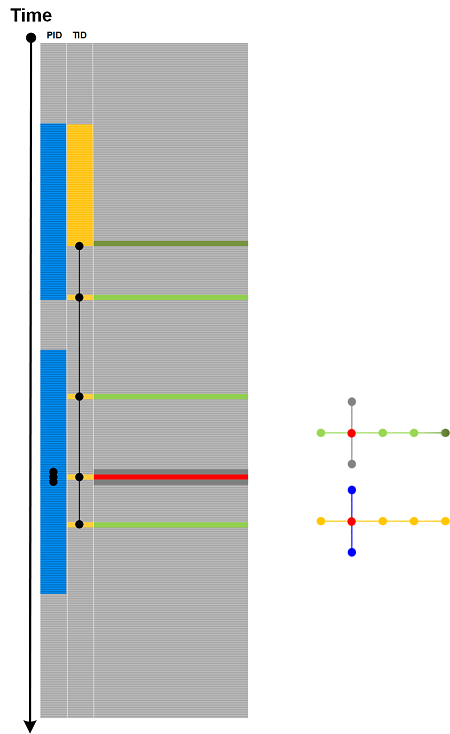
For any Message Complex, we can choose the corresponding Tracemes and assign them to points. If we keep ourselves only to line segments, we call these arrangements Trace Molecules. One example is illustrated in the following diagram:

This molecular approach was inspired by semic molecules in semic analysis. On the other hand, ultimately, the whole trace is one giant molecule similar to the traces and logs as proteins metaphor. This approach differs from the earlier artificial chemistry approach to trace and log analysis where molecules are patterns.

- Dmitry Vostokov @ DumpAnalysis.org + TraceAnalysis.org -
Trace Analysis Patterns (Part 219)

Monday, February 6th, 2023

Consider the following trace message:

object: 0x77F468AB100 ref: 2

It contains several Tracemes, the smallest units of tracing (trace meaning, by analogy with semes), corresponding to Message Invariants and their data: //object memory address//, and //reference count//. However, they are structurally higher in the semantic hierarchy when compared with sememesTraceme is pronounced /tɹeɪˈsiːm/ and can also be interpreted as trace me.

- Dmitry Vostokov @ DumpAnalysis.org + TraceAnalysis.org -
General Abnormal Patterns of Structure and Behavior (Part 0)

Tuesday, January 29th, 2013

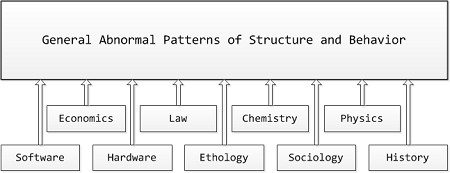
Memory Analysis Patterns (MAPs) including memory dump, malware, software trace (TAPs), and other patterns and pattern catalogs from Software Diagnostics Institute form the very rich semantic network. Now it is possible (by using a metaphorical bijection) to create a catalog of General Patterns of Abnormal Structure and Behaviour including software, hardware, biological behavior including animal (ethology) and human behavior, sociological and historical behavior including economics, business and finance, ethics and law, and even behavior of chemical and physical systems. Such “GAPs of Structure and Behavior” may include wait chains, spikes, deadlocks, etc. We provide more specific examples in the forthcoming parts. So we are a few steps closer to realization of my old dangerous idea of a parameterized science of universal memory dumps by the so called science files or might event a general diagnostics discipline.

- Dmitry Vostokov @ DumpAnalysis.org + TraceAnalysis.org -

Semiotics: The Basics

Thursday, March 29th, 2012

In 2008 when writing the first version of this review I admitted that Semiotics was a big gap in my education which mostly lied in natural and computer sciences. I knew less about social sciences and tried to fill various gaps. The reason why I came upon this discipline is that I’m interested in signs and their interpretations, especially their relation to various structures. I started reading this book in September, 2008.

Semiotics: The Basics

Buy from Amazon

As a by-product of reading I was able to provide the kind of a theoretical explanation for the phenomenon of bugtations:

Bugtations: a semiotic approach

Now after more than 3 years of intermittent reading I finally finished this book. In the mean time I was able to apply Semiotics to memory dump and software trace analysis (Memiotics) and now I also use it in connection with Software Narratology (an application of literary narratology to software narratives such as traces and event logs). What is also good about this book in addition to clearly explained concepts is a very good closing chapter summarising the whole book and the field, extensive reading guide, summary of leading schools, and a very good glossary. There is also an online book with extra materials:

http://users.aber.ac.uk/dgc/Documents/S4B/

- Dmitry Vostokov @ LiterateScientist.com -