Archive for the ‘Humanities’ Category
Tuesday, January 29th, 2013
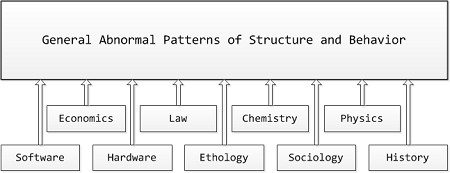
Memory Analysis Patterns (MAPs) including memory dump, malware, software trace (TAPs), and other patterns and pattern catalogs from Software Diagnostics Institute form the very rich semantic network. Now it is possible (by using a metaphorical bijection) to create a catalog of General Patterns of Abnormal Structure and Behaviour including software, hardware, biological behavior including animal (ethology) and human behavior, sociological and historical behavior including economics, business and finance, ethics and law, and even behavior of chemical and physical systems. Such “GAPs of Structure and Behavior” may include wait chains, spikes, deadlocks, etc. We provide more specific examples in the forthcoming parts. So we are a few steps closer to realization of my old dangerous idea of a parameterized science of universal memory dumps by the so called science files or might event a general diagnostics discipline.
- Dmitry Vostokov @ DumpAnalysis.org + TraceAnalysis.org -
Posted in Announcements, Anthropology, Biology, Business, Catastrophe Theory, Causality, Chaos, Chemistry, Complexity, Computation, Economics, Ethics, General Abnormal Patterns, General Memory Analysis, General Science, Hardware, History, Humanities, Ideas, Language, Life, Medicine, Physics, Political Economy, Politics, Psychoanalysis, Psychology, Religion, Semantics, Semiotics, Social Media, Social Sciences, Software Generalist Worldview, Software and Business, Software and Economics, Software and History, Software and Industrial Production, Software and Politics, Software and Religion, Software and Science, Software and Sociology, Structural Memory Analysis and Social Sciences, Systems Theory, Systems Thinking | No Comments »
Thursday, January 19th, 2012
This book I bought in a local Costa bookshop and found it was written by an Irish sociologist Kieran Allen. Shortly before my interest in Marxism was inspired by seeing a link to Irish communist party website and socialist bookshop in a booklet for Dublin Culture nights festival. It was a bit funny to see communists as part of Irish culture festival especially for me from former Soviet Union. Anyway, later I saw on streets that Marxist festivals are popular in Ireland nowadays. So let’s go back to the book. I found it very good and even lucid in explaining various Marxist ideas and vocabulary. A good start for more advance reading such as “Capital” (I have all 3 hardcover volumes from an Indian publisher and plan to have leather bound edition from Russia if I have enough surplus and MEW German edition) or specialized books such as “A Dictionary of Marxist Thought”. What I also tend to agree with the author is that Stalinism is a mirror of Capitalism (there is also a book “Magnetic Mountain: Stalinism as a Civilization” that I’m reading). I leave an application of a dialectical method of double negation to a reader here. Now the weak points of the book: 1) it doesn’t cover post-Stalinist era; 2) subsequent analysis of alternatives sounds a bit naive for me who really lived in socialism and can compare it to capitalism both in post-socialist country and now living in real capitalist country. The book also has a good reading suggestion list and I even thinking now on reading Voloshinov book “Marxism and the Philosophy of Language” (in Russian, although there is an English edition). Anyway, I would recommend Kieran’s book with reservations (about alternatives) as a first introduction to Marxist thought.
Marx and the Alternative to Capitalism

- Dmitry Vostokov @ LiterateScientist.com -
Posted in Economics, From Cover To Cover, History, Humanities, Ideas, Marxism, Philosophy, Political Economy, Politics, Reading List 2012, Reviewed on Amazon, Social Sciences | No Comments »
Friday, December 17th, 2010
As the new decade is approaching (2011-2020) we would like to make a few previews and predictions:
- Increased complexity of software will bring more methods from biological, social sciences and humanities in addition to existing methods of automated debugging and computer science techniques
- Focus on first fault software problem solving (when aspect)
- Focus on pattern-driven software problem solving (how aspect)
- Fusion of debugging and malware analysis into a unified structural and behavioral pattern framework
- Visual debugging, memory and software trace visualization techniques
- Software maintenance certification
- Focus on domain-driven troubleshooting and debugging tools as a service (debugware TaaS)
- Focus on security issues related to memory dumps and software traces
- New scripting languages and programming language extensions for debugging
- The maturation of the science of memory snapshots and software traces (memoretics)
Imagining is not not limited to the above and more to come and explain in the forthcoming parts.
- Dmitry Vostokov @ DumpAnalysis.org + TraceAnalysis.org -
Posted in Announcements, Anthropology, Archaeology of Computer Memory, Biology, Certification, Computer Science, Countefactual Debugging, Crash Analysis Report Environment (CARE), Crash Dump Analysis, Crash Dump Patterns, DebugWare Patterns, Debugging, Debugging Industry, Debugging Methodology, Debugging Trends, Dublin School of Security, EasyDbg, Economics, Escalation Engineering, Evolution, First Fault Problem Solving, Futuristic Memory Dump Analysis, General Memory Analysis, General Science, Geography, Hardware, Hermeneutics of Memory Dumps and Traces, History, Humanities, Language, Laws of Troubleshooting and Debugging, Logic, Malware Analysis, Malware Patterns, Mathematics of Debugging, Memiotics (Memory Semiotics), Memoretics, Memory Analysis Forensics and Intelligence, Memory Analysis Report System, Memory Dump Analysis and History, Memory Systems Language, Memory Visualization, Paleo-debugging, Pattern Models, Pattern Prediction, Physics, Psychology, Publishing, Science of Memory Dump Analysis, Science of Software Tracing, Security, Social Media, Social Sciences, Software Architecture, Software Behavior Patterns, Software Chorography, Software Chorology, Software Defect Construction, Software Engineering, Software Generalist, Software Maintenance Institute, Software Narrative Fiction, Software Narratology, Software Technical Support, Software Trace Analysis, Software Trace Analysis and History, Software Trace Deconstruction, Software Trace Linguistics, Software Trace Visualization, Software Troubleshooting Patterns, Software Victimology, Statistics, Structural Memory Analysis and Social Sciences, Structural Memory Patterns, Structural Trace Patterns, Systems Thinking, Testing, Tools, Trace Analysis Patterns, Troubleshooting Methodology, Unified Debugging Patterns, Uses of UML, Victimware, Virtualization, Visual Dump Analysis, Windows System Administration, Workaround Patterns | No Comments »
Friday, August 7th, 2009
This is an encyclopedic work I bought in a local book shop and finally finished reading today. It took me a year to read from cover to cover and pages were falling out of the glue but I continued to read. Highly recommended for education and another view on human history. The review of Freud was enlightening to me because I didn’t know about the recent scholarship criticizing his work. In fact, I so liked this book that just bought it again in a hardcover version from Folio Society and start rereading it again soon.
Ideas: A History of Thought and Invention, from Fire to Freud

The second encyclopedic book seems was written before the previous one but looks like the logical sequel to it. I’m starting reading it next week.
The Modern Mind: An Intellectual History of the 20th Century

- Dmitry Vostokov @ LiterateScientist.com -
Posted in Anthropology, Art, Biology, Chemistry, Economics, Ethics, Evolution, From Cover To Cover, General Science, Geography, History, Humanities, Ideas, Language, Medicine, Philosophy, Physics, Politics, Psychology, Reading List 2009, Religion, Reviewed on Amazon, Social Sciences, Statistics, Theology | No Comments »