Archive for the ‘Software Narratology and Literary Theory’ Category

Trace Analysis Patterns (Part 258)

Sunday, June 7th, 2026

Usually, software traces and logs are sorted by time.
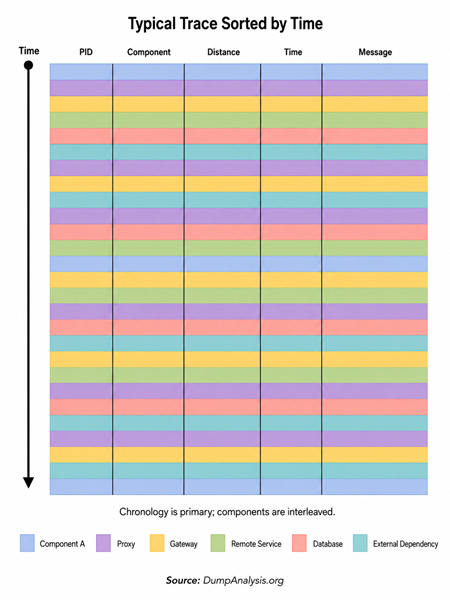
Spatial Form is a specialized Sorted Trace in which trace or log messages are sorted by spatial, topological, or diagnostic proximity to a chosen origin component, device, process, service, or subsystem. Instead of reading the trace solely as a chronological sequence, we choose a diagnostic origin and arrange messages by their distance from that origin. Within each distance layer, the original local time order may still be preserved.
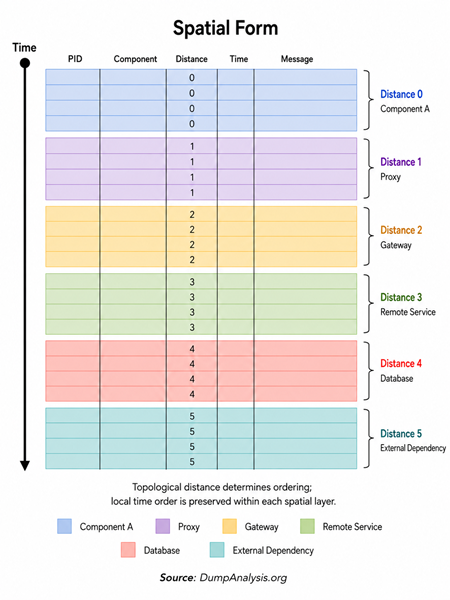
The pattern name comes from Joseph Frank’s The Idea of Spatial Form that is associated with reading narrative structure through juxtaposition and relational arrangement rather than only through linear chronological progression; the concept was introduced into literary discussion through his 1945 essay and later collected with reconsiderations in his book.

Sorted Trace is the more general pattern: messages are sorted according to some attribute value, for example, by TID, ATID, message type, message invariants, or message data.

For Spatial Trace, the distance may come from network topology, service dependency graph, component containment, process/thread ownership, device hierarchy, pipeline stage distance, proxy/gateway chain, address-space relation, storage or shard topology, causal adjacency, and many others. The resulting trace is not anti-temporal. It is spatially primary and temporally secondary.

Spatial Trace analysis pattern may help answer these questions: What happened around this proxy? Which nearby component first showed abnormal behavior? How did the request propagate outward? Was the fault local, adjacent, or remote? It may help distinguish local symptoms, adjacent symptoms, downstream effects, remote dependencies, and external causes. It gives the trace a layered diagnostic structure and spatial Layered Periodization. The pattern is therefore both a sorting technique and a reading strategy.

This pattern is especially useful for distributed systems, microservices, network devices, storage stacks, cloud control planes, request pipelines, proxies, gateways, and agentic AI workflows where activity is spread across many components.

- Dmitry Vostokov @ DumpAnalysis.org + TraceAnalysis.org -
Trace Analysis Patterns (Part 230)

Monday, March 6th, 2023

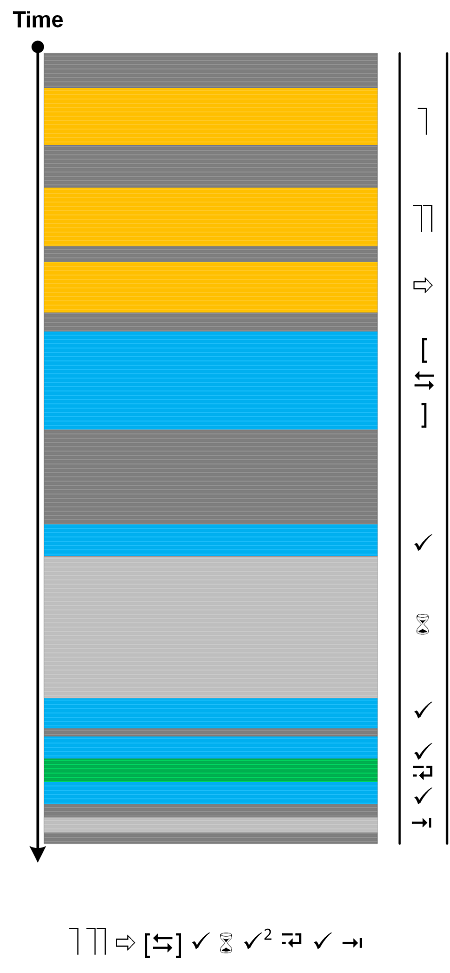
Inspired by Laws of Form and works inspired by it including Story and Structure we introduce Iconic Trace symbolic mapping for individual messages, Activity Regions, Motives, and Activity Theatre. A typical example is illustrated in the following diagram:

It is also possible to construct Iconic CoTraces. We will provide different symbolic profiles (with the meaning of various symbols) and examples later in the forthcoming revision of Software Narratology.

- Dmitry Vostokov @ DumpAnalysis.org + TraceAnalysis.org -

Software Narratology (Literary Theory Terms, Part 2): abstract, accent, act, action, adaptation, address

Sunday, November 8th, 2020

Abstract is usually the summary of an artifact (see Trace Summary analysis pattern) or not concrete description (see Analysis Pattern Square diagram).

Accent as stress in a line of verse has its correspondence to data in Message Pattern, which can be seen as a sequence of variables and Message Invariants.

Act as a play division corresponds to Activity Regions (see also trace partitioning and Activity Theatre analysis patterns).

Action as the main story of a narrative artifact may involve a sequence of selected Significant Events, Macrofunctions, Activity Regions with Motives. In a software narratological framework for presenting software storiesaction is a sequence of selected messages that constitutes a software plot (an acquired software artifact that may not be complete/full due to abridgment like restricting tracing/logging to selected components).

Adaptation as interpreting an artifact as a different one (from one media to another, or a different structure) is similar to treating memory dumps as traces/logs or vice versa as Projective Debugging.

Address as a story written for a specific group of people could be a software execution artifact explicitly acquired and adapted to some external users or Declarative Trace messages crafted for a specific team in mind (see also Embedded Comment analysis pattern).

- Dmitry Vostokov @ DumpAnalysis.org + TraceAnalysis.org -

Software Narratology (Literary Theory Terms, Part 1): ab ovo, in medias res, flashback, abridged edition

Thursday, November 5th, 2020

Ab ovo is a software story (for example, a trace or log, a problem description, see software narratology square) that starts from the beginning of the use case events it narrates (see also Use Case Trail analysis patterns) or the start of software execution (see also Visibility Limit analysis pattern). Logging may start from some middle event of a use case, source code (see also Declarative Trace analysis pattern), or a log may be a part of a larger full trace (see also a software narratological framework for presenting software stories): in medias res. Such software stories may also have flashbacks, for example, stack traces, especially in software problem descriptions. Often, flashbacks are the only available software stories. Some tracing and logging sessions may be deliberately shortened to save space, communication throughput, or other reasons like security, similar to abridged editions of literary works (see also Abridged Dump and Missing Component analysis patterns). Such editions of software execution artifacts often hinder analysis (see Lateral Damage analysis pattern).

- Dmitry Vostokov @ DumpAnalysis.org + TraceAnalysis.org -