Archive for the ‘Systems Theory’ Category
Tuesday, January 29th, 2013
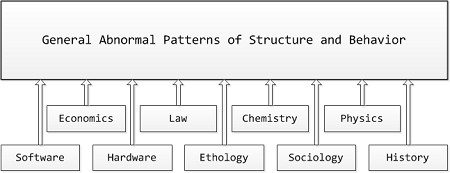
Memory Analysis Patterns (MAPs) including memory dump, malware, software trace (TAPs), and other patterns and pattern catalogs from Software Diagnostics Institute form the very rich semantic network. Now it is possible (by using a metaphorical bijection) to create a catalog of General Patterns of Abnormal Structure and Behaviour including software, hardware, biological behavior including animal (ethology) and human behavior, sociological and historical behavior including economics, business and finance, ethics and law, and even behavior of chemical and physical systems. Such “GAPs of Structure and Behavior” may include wait chains, spikes, deadlocks, etc. We provide more specific examples in the forthcoming parts. So we are a few steps closer to realization of my old dangerous idea of a parameterized science of universal memory dumps by the so called science files or might event a general diagnostics discipline.
- Dmitry Vostokov @ DumpAnalysis.org + TraceAnalysis.org -
Posted in Announcements, Anthropology, Biology, Business, Catastrophe Theory, Causality, Chaos, Chemistry, Complexity, Computation, Economics, Ethics, General Abnormal Patterns, General Memory Analysis, General Science, Hardware, History, Humanities, Ideas, Language, Life, Medicine, Physics, Political Economy, Politics, Psychoanalysis, Psychology, Religion, Semantics, Semiotics, Social Media, Social Sciences, Software Generalist Worldview, Software and Business, Software and Economics, Software and History, Software and Industrial Production, Software and Politics, Software and Religion, Software and Science, Software and Sociology, Structural Memory Analysis and Social Sciences, Systems Theory, Systems Thinking | No Comments »
Friday, September 28th, 2012
The previous mathematical definition of memory dump is for raw memory dumps. They are not really useful because they require symbol files. Each symbol file entry conceptually is a correspondence between a memory address and a direct sum or product of letters from some alphabet:
00000000`76e82c40: kernel32!WaitForMultipleObjectsExImplementation
So we propose an analytical definition of a memory dump as a direct sum of disjoint memory areas Mt taken during some time interval (t0, …, tn) where we replace stk having values from Z2 with Stq having values from Zp and cardinality of Zp depending on a platform (32, 64, etc) plus a symbolic description ∏Di for each Stq with cardinality of ”i” set sufficient enough to accommodate the largest symbolic name:
M = ∑Mt where Mt = ∑(Stq+∏Di)
or simply
M = ∑∑(Stq+∏Di)
This can be visualized as a linear memory space such as a virtual memory space when symbol files are applied to modules one after another. However, all this is not necessary, as a symbol from a virtual address can also be mapped to a physical address if necessary. ∏Di, in fact, refers to any symbolic description.
- Dmitry Vostokov @ DumpAnalysis.org + TraceAnalysis.org -
Posted in Computer Science, Crash Dump Analysis, Crash Dump Patterns, General Memory Analysis, Mathematics, Mathematics of Debugging, Science of Memory Dump Analysis, Systems Theory | No Comments »
Sunday, September 23rd, 2012
Learn from this Webinar about phenomenological, hermeneutical and analytical approaches to software diagnostics and its knowledge, foundations, norms, theories, logic, methodology, language, ontology, nature and truth. This seminar is hosted by Software Diagnostics Services.

Title: Introduction to Philosophy of Software Diagnostics
Date: 17th of December, 2012
Time: 19:00 GMT
Duration: 60 minutes
Space is limited.
Reserve your Webinar seat now at:
https://www3.gotomeeting.com/register/872846486
- Dmitry Vostokov @ DumpAnalysis.org + TraceAnalysis.org -
Posted in Announcements, Computer Science, Core Dump Analysis, Crash Dump Analysis, Crash Dump Patterns, Debugging, Debugging Methodology, Education and Research, Escalation Engineering, First Fault Software Diagnostics, Hermeneutics of Memory Dumps and Traces, Logic, Memiotics (Memory Semiotics), Memoretics, Memory Dump Analysis Methodology, Performance Monitoring, Phenomenology of Software Diagnostics, Philosophy, Philosophy of Software Diagnostics, Root Cause Analysis, Science of Memory Dump Analysis, Science of Software Tracing, Semiotics, Software Behavior Patterns, Software Diagnostics, Software Diagnostics Institute, Software Diagnostics Pattern Language, Software Diagnostics Patterns, Software Diagnostics Services, Software and Philosophy, Systems Theory, Systems Thinking, Testing, The Way of Philip Marlowe, Trace Analysis Patterns, Unified Software Diagnostics, Webinars | No Comments »
Monday, September 17th, 2012
If you liked An Introduction to General Systems Thinking book then you really need this comprehensive introduction which is more formal. Don’t be overwhelmed by the number of pages, you only need to read part 1, the first 218 pages as the rest is a collection of articles you can read selectively later on. For me one of the great features was the coverage of systems literature including some mathematical treatment books (including category theory in addition to famous Rosen’s books such as Anticipatory Systems). I also liked the discussion of critics of general systems theory that points to the fact that it should be called general systems-theory not general-systems theory. Highly recommended.
Facets of Systems Science (IFSR International Series on Systems Science and Engineering)

- Dmitry Vostokov @ LiterateScientist.com -
Posted in Applied Mathematics, Biology, Catastrophe Theory, Causality, Chaos, Complexity, Computer Science, General Science, Ideas, Life, Mathematical Modeling, Mathematics, Nonlinear Science, Philosophy, Reading List 2012, Social Sciences, Systems Theory | No Comments »
Tuesday, August 28th, 2012
This book I bought more than 5 years ago after I recognized that systems approach was needed for memory dump analysis. However, I read it only recently while preparing to talk on systemic software diagnostics. While reading I realized that I already applied some systems theory ideas, for example, about isomorphism of disciplines as systems (which I named as metaphorical bijection): from literary narratology to software narratology and from that to network trace analysis. So if you are interested in systems either computer software ones or human organizational then I would greatly recommend this book as an introduction. The recommended literature in exercises is also useful.
An Introduction to General Systems Thinking (Silver Anniversary Edition)

- Dmitry Vostokov @ LiterateScientist.com -
Posted in Complexity, From Cover To Cover, General Science, Ideas, Mathematical Modeling, Reading List 2012, Reviewed on Amazon, Systems Theory | No Comments »