Archive for the ‘Quantum Software Diagnostics’ Category

Trace Analysis Patterns (Part 245)

Saturday, April 20th, 2024

Feynman Trace borrows ideas from the path integral formulation of quantum mechanics. Such a trace includes all possible traces from all possible traces generated from all possible executions including Trace Amplitudes, Empty Traces, Use Case Trails, and traces with Error Messages, but excluding Impossible Traces:
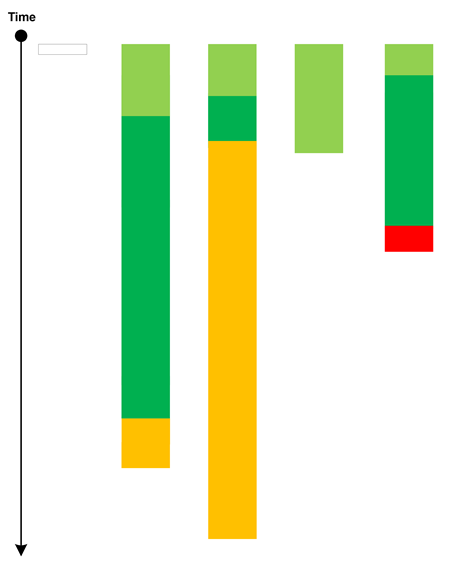
Code flow Declarative Trace analysis can be used to assess the relative contributions of trace and log variants. To reduce infinities arising from loops, Renormalization can be used.

- Dmitry Vostokov @ DumpAnalysis.org + TraceAnalysis.org -
Trace Analysis Patterns (Part 244)

Friday, March 1st, 2024

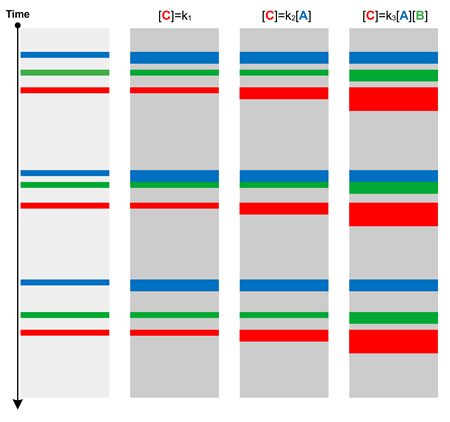
When comparing different traces from the same system we may see different correlations of Statement Densities. For example, when A message density is increased, then C message density is also increased regardless of any changes to B message density. We can borrow concentration notation from chemical kinetics and use [A], [B], and [C] for corresponding Statement Densities, either local in Activity Regions or globally for the whole trace. Observed correlations may point to existing causal mechanisms (like when kinetics points to reaction mechanisms):

This Message Kinetics pattern is more general than Relative Density where a semantic relationship is already known and the comparison is made between working and non-working scenarios. Variations of message densities may occur in normal scenarios, for example, with different amount of input data. There can be several types of Message Kinetics in one trace or log.

- Dmitry Vostokov @ DumpAnalysis.org + TraceAnalysis.org -