Archive for the ‘Chemistry’ Category
Sunday, February 19th, 2023
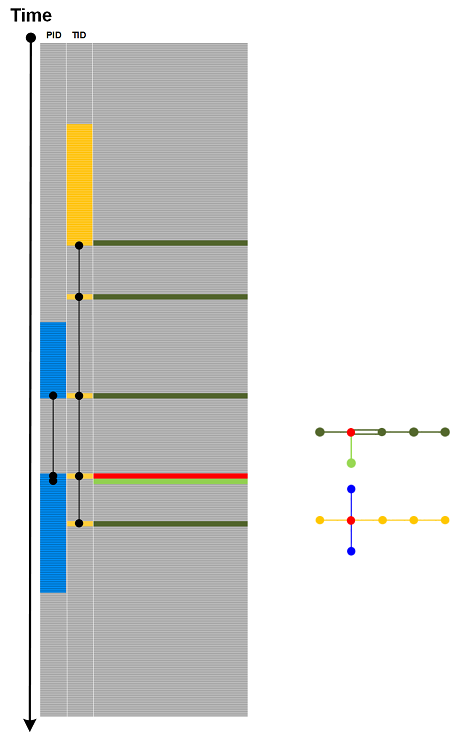
When we construct Trace Molecule, we may find that some Message Complex links from different ATIDs point to the same message and Tracemes. In such a case we have Message Bond by analogy with covalent bonds. One such example is illustrated in the following diagram:
- Dmitry Vostokov @ DumpAnalysis.org + TraceAnalysis.org -
Posted in Chemistry, Log Analysis, Software Trace Analysis, Trace Analysis Patterns | Comments Off
Tuesday, February 7th, 2023
For any Message Complex, we can choose the corresponding Tracemes and assign them to points. If we keep ourselves only to line segments, we call these arrangements Trace Molecules. One example is illustrated in the following diagram:
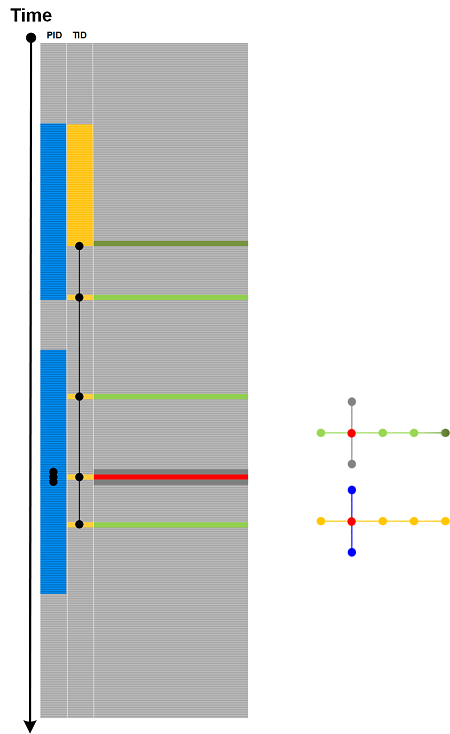
This molecular approach was inspired by semic molecules in semic analysis. On the other hand, ultimately, the whole trace is one giant molecule similar to the traces and logs as proteins metaphor. This approach differs from the earlier artificial chemistry approach to trace and log analysis where molecules are patterns.
- Dmitry Vostokov @ DumpAnalysis.org + TraceAnalysis.org -
Posted in Chemistry, Log Analysis, Semantics, Semiotics, Software Trace Analysis, Software Trace Linguistics, Trace Analysis Patterns | Comments Off
Tuesday, January 29th, 2013
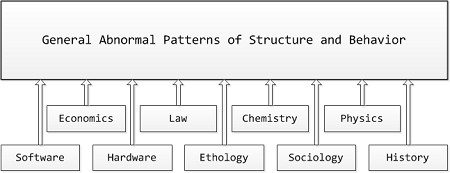
Memory Analysis Patterns (MAPs) including memory dump, malware, software trace (TAPs), and other patterns and pattern catalogs from Software Diagnostics Institute form the very rich semantic network. Now it is possible (by using a metaphorical bijection) to create a catalog of General Patterns of Abnormal Structure and Behaviour including software, hardware, biological behavior including animal (ethology) and human behavior, sociological and historical behavior including economics, business and finance, ethics and law, and even behavior of chemical and physical systems. Such “GAPs of Structure and Behavior” may include wait chains, spikes, deadlocks, etc. We provide more specific examples in the forthcoming parts. So we are a few steps closer to realization of my old dangerous idea of a parameterized science of universal memory dumps by the so called science files or might event a general diagnostics discipline.
- Dmitry Vostokov @ DumpAnalysis.org + TraceAnalysis.org -
Posted in Announcements, Anthropology, Biology, Business, Catastrophe Theory, Causality, Chaos, Chemistry, Complexity, Computation, Economics, Ethics, General Abnormal Patterns, General Memory Analysis, General Science, Hardware, History, Humanities, Ideas, Language, Life, Medicine, Physics, Political Economy, Politics, Psychoanalysis, Psychology, Religion, Semantics, Semiotics, Social Media, Social Sciences, Software Generalist Worldview, Software and Business, Software and Economics, Software and History, Software and Industrial Production, Software and Politics, Software and Religion, Software and Science, Software and Sociology, Structural Memory Analysis and Social Sciences, Systems Theory, Systems Thinking | No Comments »
Monday, January 23rd, 2012
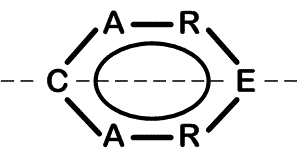
As always, if I’m asked to do something, I don’t stop there and apply all my accumulated knowledge to go beyond. Here is an example: after designing 2CARE2 trademark I imagined an organic creature that catches bugs:
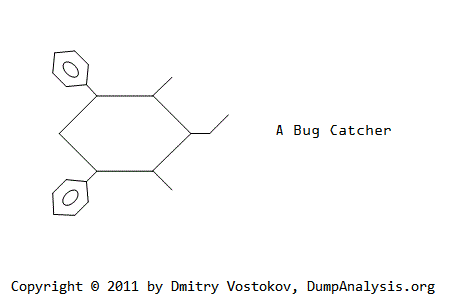
If you compare it with a trademark you would recognize A, R and E as Phenyl, Methyl, and Ethyl groups.
- Dmitry Vostokov @ DumpAnalysis.org + TraceAnalysis.org -
Posted in Art, Chemistry, Computicart (Computical Art), Debugging, Fun with Debugging | No Comments »
Monday, January 23rd, 2012
Memory Dump Analysis Services started working on 2CARE2 system (Crash Analysis Report Environment, 2nd generation) and asked me to design a trademark. My Chemistry background (I like Organic Chemistry most) and imagination led me to represent client and server parts holistically as an aromatic-like compound:
- Dmitry Vostokov @ DumpAnalysis.org + TraceAnalysis.org -
Posted in Announcements, Chemistry, Crash Analysis Report Environment (CARE), Crash Dump Analysis, Memory Dump Analysis Services, Trademarks | No Comments »
Wednesday, November 3rd, 2010
I have discovered rules that make it possible to devise a memory dump and software trace analysis equivalent of the Periodic Table of Elements in Chemistry. It allows prediction of abnormal software behaviour and structural defects and what patterns to look for after deploying software and collecting its artifacts. More on this is in the next part of these series.
- Dmitry Vostokov @ DumpAnalysis.org + TraceAnalysis.org -
Posted in Announcements, Chemistry, Crash Dump Analysis, Crash Dump Patterns, Debugging, Pattern Prediction, Software Behavior Patterns, Software Trace Analysis, Structural Memory Patterns, Structural Trace Patterns, Trace Analysis Patterns | No Comments »
Friday, August 7th, 2009
This is an encyclopedic work I bought in a local book shop and finally finished reading today. It took me a year to read from cover to cover and pages were falling out of the glue but I continued to read. Highly recommended for education and another view on human history. The review of Freud was enlightening to me because I didn’t know about the recent scholarship criticizing his work. In fact, I so liked this book that just bought it again in a hardcover version from Folio Society and start rereading it again soon.
Ideas: A History of Thought and Invention, from Fire to Freud

The second encyclopedic book seems was written before the previous one but looks like the logical sequel to it. I’m starting reading it next week.
The Modern Mind: An Intellectual History of the 20th Century

- Dmitry Vostokov @ LiterateScientist.com -
Posted in Anthropology, Art, Biology, Chemistry, Economics, Ethics, Evolution, From Cover To Cover, General Science, Geography, History, Humanities, Ideas, Language, Medicine, Philosophy, Physics, Politics, Psychology, Reading List 2009, Religion, Reviewed on Amazon, Social Sciences, Statistics, Theology | No Comments »
Tuesday, June 9th, 2009
I was reading General Chemistry book on the way to my office today and found a nice basic chemical formula representation for processes in memory. In this nomenclature, the class of modules developed by a particular vendor constitutes an ”element”. For example, M is for Microsoft modules, C is for Citrix modules, etc. Individual modules of particular elements are similar to “atoms” and denoted as numbers in subscript. For example, net.exe command running in a typical Citrix terminal services environment has the following loaded modules where I highlighted Citrix modules in blue and Microsoft modules in red:
0:000> lm1m

net

wdmaudhook

tzhook

twnhook

scardhook

mmhook

mfaphook

cxinjime

CtxSbxHook

MPR

NETAPI32

Secur32

USER32

msvcrt

GDI32

RPCRT4

kernel32

ADVAPI32

MSVCR71

ntdll
Therefore the formula is this:
M12C8.
I put the element of the main process module first in such formulae.
The formula for IE process from the following case study:
M126A5U
where A is for Adobe modules and U is for an unknown module that needs identification, see Unknown Component pattern.
These formulas can useful to highlight various hooksware components and distinguish memory dumps generated after eliminating modules for troubleshooting and debugging purposes. It also forms the basis for one of many classificatory schemes for the purposes of micro- and macro-taxonomy of software discussed in the forthcoming book:
The Variety of Software: The Richness of Computation (ISBN: 978-1906717544)
In the forthcoming parts I’m also going to discuss the structural formulas as well, similar to the ones used in organic chemistry.
- Dmitry Vostokov @ DumpAnalysis.org -
Posted in Announcements, Chemistry, Crash Dump Analysis, Fun with Crash Dumps, Science of Memory Dump Analysis | No Comments »
Friday, January 23rd, 2009
I’ve been fascinated by Chemistry since the age of 13-14. At that time I noticed organic formulae on the blackboard of a higher school class and was curious about what they meant. So I asked my mother to bring me a book about Chemistry from a library and she brought a school textbook about Inorganic Chemistry. I read it in a few weeks and proceeded to reading a textbook about Organic Chemistry. At the same time I found in a local library 10 volumes of The Feynman Lectures on Physics (in Russian translation) and started reading the first volumes on classical mechanics and learnt about calculus. Another popular book about Quantum Chemistry raised my curiosity in Quantum Mechanics and Morris Kline’s The Loss of Certainty book (in Russian translation) made me interested in abstract mathematics and its logical and set-theoretical foundations including Gödel’s theorems and intuitionistic mathematics. All this happened before the age of 16 and in one evening when I was reading a Linear Algebra textbook an idea struck me to represent certain aspects of Inorganic Chemistry formalisms like Periodic Table and empirical formulas of chemical compounds as linear vector spaces of element vectors over the field of numbers.
Now OpenTask is going to publish its first popular science book called:
Vector Space Chemistry (ISBN: 978-1906717551)
with a preface written after 25 years since the discovery of this mathematical model and formalization of Chemistry.
A note for cautious readers: I’m aware about over-excessive application of mathematics in sciences, especially after reading these books:
Fashionable Nonsense and Social Sciences as Sorcery
My book is just a popular science book that explains some chemical and abstract mathematical concepts and provides an example of using Mathematics as a modeling and formalization tool for Chemistry.
- Dmitry Vostokov @ DumpAnalysis.org -
Posted in Announcements, Books, Chemistry, History, Publishing | 2 Comments »