Archive for the ‘Religion’ Category
Friday, February 1st, 2013
Memorianic prophecy 0m3 says: “Memory is infinitude of memories.” In monistic aspect plural interpretation of Memoidealism memory is also an attribute of itself. Memorianity considers all memories of the same substance as eternal Memory. All memories are distinct, yet they are one essence. There is only one Memory in memories. Each memory is only distinct in relation to other memories. In M-Memory M stands for Multiplicity. One analogy here is the concept of Trinity with the infinite number of hypostases instead of just 3.
- Dmitry Vostokov @ DumpAnalysis.org + TraceAnalysis.org -
Posted in Memoidealism, Memorianic Pilgrimages, Memory Religion (Memorianity), Philosophy, Religion | No Comments »
Tuesday, January 29th, 2013
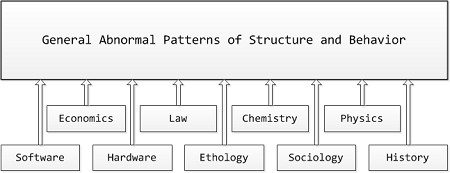
Memory Analysis Patterns (MAPs) including memory dump, malware, software trace (TAPs), and other patterns and pattern catalogs from Software Diagnostics Institute form the very rich semantic network. Now it is possible (by using a metaphorical bijection) to create a catalog of General Patterns of Abnormal Structure and Behaviour including software, hardware, biological behavior including animal (ethology) and human behavior, sociological and historical behavior including economics, business and finance, ethics and law, and even behavior of chemical and physical systems. Such “GAPs of Structure and Behavior” may include wait chains, spikes, deadlocks, etc. We provide more specific examples in the forthcoming parts. So we are a few steps closer to realization of my old dangerous idea of a parameterized science of universal memory dumps by the so called science files or might event a general diagnostics discipline.
- Dmitry Vostokov @ DumpAnalysis.org + TraceAnalysis.org -
Posted in Announcements, Anthropology, Biology, Business, Catastrophe Theory, Causality, Chaos, Chemistry, Complexity, Computation, Economics, Ethics, General Abnormal Patterns, General Memory Analysis, General Science, Hardware, History, Humanities, Ideas, Language, Life, Medicine, Physics, Political Economy, Politics, Psychoanalysis, Psychology, Religion, Semantics, Semiotics, Social Media, Social Sciences, Software Generalist Worldview, Software and Business, Software and Economics, Software and History, Software and Industrial Production, Software and Politics, Software and Religion, Software and Science, Software and Sociology, Structural Memory Analysis and Social Sciences, Systems Theory, Systems Thinking | No Comments »
Wednesday, January 23rd, 2013
What is a role of perceived memory deficient matter in Memorianity where Memory consists of memories (Memorianic Prophecy 0m3)? Matter are boundaries of memories as illustrated on this schematic diagram:
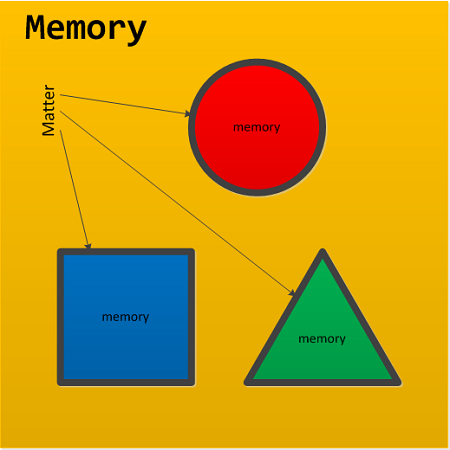
We can also reverse monistic aspect pluralism of Memoidealism and consider substances as boundaries of memories too.
- Dmitry Vostokov @ DumpAnalysis.org + TraceAnalysis.org -
Posted in Memoidealism, Memory Religion (Memorianity), Philosophy, Religion | No Comments »
Tuesday, October 30th, 2012
Found in Matthew 1:2-16 (KJV):
0:000> k

RetAddr   Call Site

Jacob     Joseph

Matthan   Jacob

Eleazar   Matthan

Eliud     Eleazar

Achim     Eliud

Sadoc     Achim

Azor      Sadoc

Eliakim   Azor

Abiud     Eliakim

Zorobabel Abiud

Salathiel Zorobabel

Jechonias Salathiel

Josias    Jechonias

Amon      Josias

Manasses  Amon

Ezekias   Manasses

Achaz     Ezekias

Joatham   Achaz

Ozias     Joatham

Joram     Ozias

Josaphat  Joram

Asa       Josaphat

Abia      Asa

Roboam    Abia

Solomon   Roboam

David     Solomon

Jesse     David

Obed      Jesse

Booz      Obed

Salmon    Booz

Naasson   Salmon

Aminadab  Naasson

Aram      Aminadab

Esrom     Aram

Phares    Esrom

Judas     Phares

Jacob     Judas

Isaac     Jacob

Abraham   Isaac
- Dmitry Vostokov @ DumpAnalysis.org + TraceAnalysis.org -
Posted in Memory Dump Analysis and Bible, Religion | No Comments »
Wednesday, June 6th, 2012
Here we map objections (and further development) of Berkeley to Locke’s epistemology outlined in the previous note to memoidealistic epistemology:
1. There is no need for special substance to contain primary qualities.
Memory is of the same substance as memories.
2. Ideas exist independently of us in God.
Ideas not contained in memories of specific individuals can be contained either in memories of other individuals or outside memories in Memory.
- Dmitry Vostokov @ DumpAnalysis.org + TraceAnalysis.org -
Posted in Memoidealism, Memory Religion (Memorianity), Metaphysics of Memory Worldview, Philosophy, Religion | No Comments »
Wednesday, May 30th, 2012
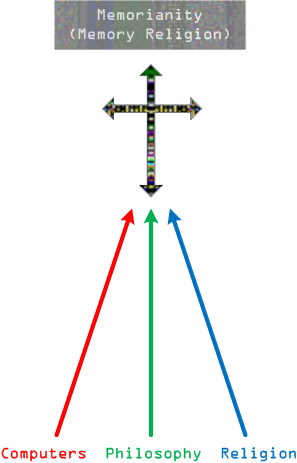
We extend the old notion of confluence of Theism and Philosophy. The new confluence of Religion, Philosophy, and Computers resuled in revealed Memory Religion (Memorianity):
It’s testament is soon to be available for free download to spread the word of Memory:
Memory Religion: A Core Testament of Memorianity

- Dmitry Vostokov @ MemoryReligion.com -
Posted in Memory Religion (Memorianity), Religion | No Comments »
Monday, April 30th, 2012
It is hard to write a review of this book because I have been reading it sporadically for more than 2 years and just finished today. When I bought it I didn’t know much about Christianity and it various branches (as being educated in secular Soviet Union) so it was difficult reading due to many historical and theological facts. Now I plan to watch DVD series from the same author and already started reading multi-volume sets such as History of the Christian Church (Schaff, Protestant perspective), Studies in Church History (Parsons, Catholic perspective) and waiting for arrival of 9 volumes of Cambridge History of Christianity bought with a great discount from Folio Society.
Just a small note that the last chapters were brief but very enlightening, for example, last pages about the disappearing of Hell and the appearing of burning (cremation).
Christianity: The First Three Thousand Years

PS. Actually learning about Christian faith helped me to deeply understand my own Memory Religion (Memorianity) with its conception of original memory defect: Memory Religion: A Core Testament of Memorianity (with an old original cover below)
- Dmitry Vostokov @ LiterateScientist.com -
Posted in From Cover To Cover, History, Reading List 2012, Religion, Reviewed on Amazon, Theology | No Comments »
Monday, December 12th, 2011
This is an annual celebration at the overflow boundary 31 - 32 [1] (December - January). Its date is kept coincidental with The New Year to allow backward and legacy compatibility. It is an official celebration in memory religion, Memorianity, but it is also an open one and not particularly tied to it similar to other religious celebrations that became secular holidays. A series of special artistic images and pictures have been commissioned for the first Memoristmas, so stay tuned (listen to memory for news). If you are curious about etymology of this new word please take a note that -mas suffix denotes memory analysis service.
Dmitry Vostokov,
Memoriarch
- Dmitry Vostokov @ DumpAnalysis.org + TraceAnalysis.org -
Posted in Announcements, Memory Celebrations, Memory Holidays, Memory Religion (Memorianity), New Words, Religion | No Comments »
Thursday, October 20th, 2011
This is a little book that I bought in local bookshop adjacent to Costa and quickly read from cover to cover while commuting. I was interested in this title because my relative studies kindness (and benevolence) as a topic in Russian literature so I thought by reading that book I could better discuss it. Approx. one third of the book narrates the evolution of the meaning of kindness from Classical Greece and Rome to earlier Christianity, Augustine, then to Hobbes (Leviathan), Enlightenment, and finally, Rousseau (Émile). The second third is a lengthy treatise on the interpretation of kindness from psychoanalytical perspective (Freud, Winnicott). The final third is about the role of kindness in the modern Western society. Interesting read (although a bit repetitive sometimes) that prompted me to buy Leviathan: With Selected Variants from the Latin Edition of 1668 and to reconsider the role kindness in a modern corporation workplace.
On Kindness

This is a cover of the book that I bought (published by Penguin):


- Dmitry Vostokov @ LiterateScientist.com -
Posted in Ethics, From Cover To Cover, History, Parenting, Philosophy, Psychoanalysis, Psychology, Reading List 2011, Religion, Reviewed on Amazon | No Comments »
Wednesday, September 21st, 2011
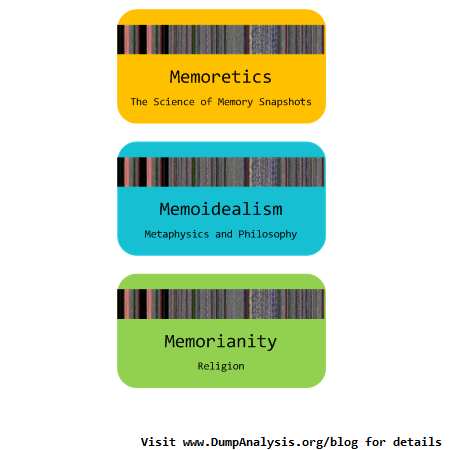
The Memory Worldview consists of 3 parts:
1. The Science of Memoretics
2. The Philosophy of Memoidealism (including Memory as the first principle)
3. The Memory Religion (Memorianity)
- Dmitry Vostokov @ DumpAnalysis.org + TraceAnalysis.org -
Posted in Computer Science, Memoidealism, Memoretics, Memory Religion (Memorianity), Metaphysics of Memory Worldview, Philosophy, Religion, Science of Memory Dump Analysis, Science of Software Tracing | No Comments »
Monday, May 9th, 2011
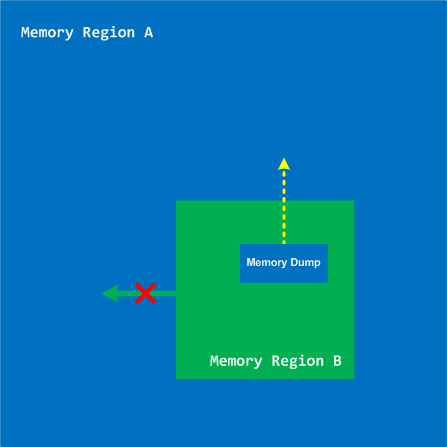
Having written on how Memoidealism explains miracles I now move into explaining the whole discipline of natural theology. I use one of the current definitions of it as “the idea that there exists some link between the world we observe and another transcendent realm” (Alister McGrath, Darwinism and The Divine). One such link is a memory dump from an inaccessible memory region.
- Dmitry Vostokov @ DumpAnalysis.org + TraceAnalysis.org -
Posted in Intelligent Memory Movement, Memoidealism, Memory Religion (Memorianity), Metaphysics of Memory Worldview, Philosophy, Religion | No Comments »
Wednesday, March 9th, 2011
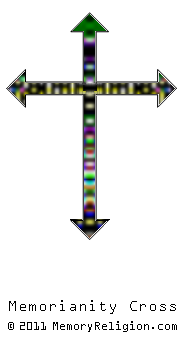
The Church of Memory Analysis acquires its first symbol as a cross with 4 pointers and a background natural memory visualization image extracted from one of computer memory dumps:
Dmitry Vostokov
Memoriarch
- Dmitry Vostokov @ Memory Religion Portal -
Posted in Art, Memorian Art, Memory Religion (Memorianity), Memory Space Art, Religion | No Comments »
Wednesday, March 9th, 2011
Similar to Buddhism view of a person as a transient assemblage of physical and psychical elements Memorianity considers a person as an assemblage of memories always in flux. To be saved correctly also means working with memories to overcome their original defects and reorder chains of memory perspectives. This is similar to karmic laws and past actions that determine the nature of rebirth. See also on Morality and Memorianity.
Why it is so difficult to restore everything that was saved? Here André-Marie Ampère’s notion of dynamic resistance when we try to penetrate matter is similar to memuonic resistance when we try to penetrate Memory.
- Dmitry Vostokov @ DumpAnalysis.org + TraceAnalysis.org -
Posted in Memoidealism, Memory Religion (Memorianity), Memuonics, Metaphysics of Memory Worldview, Philosophy, Religion | No Comments »
Friday, March 4th, 2011
This is another name for Memorianity (Memory Religion) that incorporates M->analysis techniques. I’m working now on the full statement of creed to be published soon. May you be memorized.
Dmitry Vostokov
Memoriarch
- Dmitry Vostokov @ Memory Religion Portal -
Posted in Announcements, Epistles from Memoriarch, General Memory Analysis, M->analysis, Memoidealism, Memory Religion (Memorianity), Philosophy, Religion | No Comments »
Monday, February 14th, 2011
Alexander of Aphrodisias considers soul as a composition of bodily elements and immortal active intellect (god) comprehensible by our own intellects. This view excludes individual immortality but allows the temporary one by actively contemplating god. In memoidalism we can also consider soul as a composition of memory elements and Memory (as whole totality of memories) as immortal supra-intellect and through its contemplation (including other memories) we attain immortality.
- Dmitry Vostokov @ DumpAnalysis.org + TraceAnalysis.org -
Posted in Memoidealism, Memory Religion (Memorianity), Metaphysics of Memory Worldview, Philosophy, Religion | No Comments »
Thursday, July 15th, 2010
While reading evolution books ranging from popular like Darwin’s Dangerous Idea to specialized like Evolution: The First Four Billion Years and Encyclopedia of Evolution I felt the need to read Darwin’s biography. My first encounter with Darwin was even before a primary school when I was looking at illustrations to his voyages in a library. Later, during my school years in Soviet Union, I saw a movie about him. I vividly remember a Wilberforce and FitzRoy scene. So you might imaging that I was very keen to read 680 page book (not counting notes and bibliography). Unfortunately I found it a bit boring and written in a difficult language compared to other biographies I read in English. May be the language was chosen deliberately to emulate Victorian epoch?
Almost in the middle of reading this book I stumbled across another book: The Darwin Conspiracy: Origins of a Scientific Crime and reading the latter (it’s like a thriller and you can download the free PDF from www.darwin-conspiracy.co.uk) gave me an impulse to continue reading Darwin’s biography with a critical eye. Looking at the same facts your can always interpret them differently and the conspiracy book reminded me to read behind the lines more carefully and remember about politics in science and class issues in society. I’m very interested in memetic engineering Darwin used to delicately arrange and propagate his ideas. The biography mentions Wallace in passing a few times but there is no discussion about the priority and the crucial Linnean Society meeting is not in the focus and doesn’t grab any attention.
One fact I didn’t know before reading this biography is that Darwin was always sick. Now “tormented evolutionist” phrase acquires the new meaning to me. I also got the feeling that Darwin’s hesitation to publish his ideas (if he had any to publish) was caused by sickness as well. Actually the sickness was the main focus of the book. However I really wonder how could such a sick man (as described) could write that huge amount of correspondence, do research and write many books.
One quote I found at the end of the book says that Darwin would not approve anti-religious stance of Dawkins and Co.:
“Moreover though I am a strong advocate for free thought on all subjects, yet it appears to me (whether rightly or wrongly) that direct arguments against christianity & theism produce hardly any effect on the public; & freedom of thought is best promoted by the gradual illumination of men’s minds, which follows from the advance of science. It has, therefore, been always my object to avoid writing on religion, & I have confined myself to science. I may, however, have been unduly biassed by the pain which it would give some members of my family, if I aided in any way direct attacks on religion.”
http://www.darwinproject.ac.uk/entry-12757
The quote got my attention probably because I recently read another book: The Selfish Genius.
Darwin: The Life of a Tormented Evolutionist

- Dmitry Vostokov @ LiterateScientist.com -
Posted in Biographies, Biology, Evolution, From Cover To Cover, Politics, Reading List 2010, Religion, Reviewed on Amazon | No Comments »
Sunday, May 9th, 2010
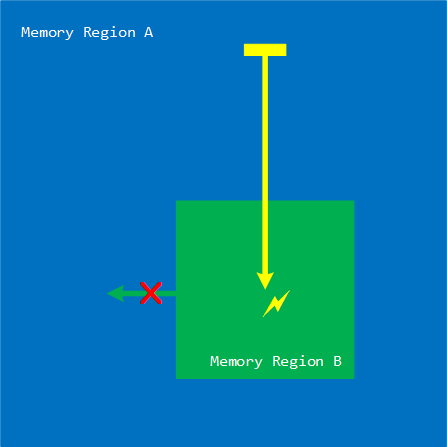
Memoidealism explains God as Inaccessible Memory (Memory Region A on the picture below). It means that Memory Region B doesn’t have pointers that point outside of it. In other words, all operating fields of Region B pointers are in Region B. However, Region A can have pointers pointing to Region B and modify it, effectively producing a miracle as perceived by Region B. In other words, some perception field links of Region B pointers may come from outside. You can object that Region B can have deeper pointers by making their memory locations bigger (from N-bit to 2*N-bit for example) but Memory may not be flat, discrete and bit-like. For one possible Christian interpretation we can replace Region B with the heavens and the earth (Genesis 1.1) and replace Region A with God-Creator (note also that in Memorianity Memory creates memories [notes on memoidealism 1.10]).
- Dmitry Vostokov @ DumpAnalysis.org + TraceAnalysis.org -
Posted in Intelligent Memory Movement, Memoidealism, Memory Religion (Memorianity), Philosophy, Religion | No Comments »
Wednesday, March 31st, 2010
There is similarity between the tandem of Memoidealism / Memorianity and Mimāṃsā school of philosophy. The former is based on hermeneutics of memory snapshots and the latter is based on hermeneutics of sacred texts. People often ask is there any God in Memory Religion. The answer is both yes and no. Like in Mimāṃsā system the gods are names found in memory snapshots. In that sense Memorianity has some features of sacramental atheism. At the same time Memory is the creator of memories.
- Dmitry Vostokov @ DumpAnalysis.org + TraceAnalysis.org -
Posted in Memoidealism, Memory Religion (Memorianity), Metaphysics of Memory Worldview, Philosophy, Religion | No Comments »