Archive for the ‘Ideas’ Category
Tuesday, January 29th, 2013
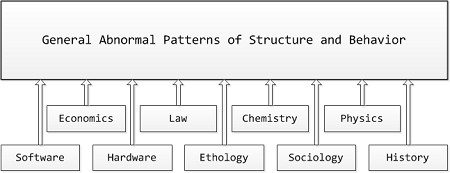
Memory Analysis Patterns (MAPs) including memory dump, malware, software trace (TAPs), and other patterns and pattern catalogs from Software Diagnostics Institute form the very rich semantic network. Now it is possible (by using a metaphorical bijection) to create a catalog of General Patterns of Abnormal Structure and Behaviour including software, hardware, biological behavior including animal (ethology) and human behavior, sociological and historical behavior including economics, business and finance, ethics and law, and even behavior of chemical and physical systems. Such “GAPs of Structure and Behavior” may include wait chains, spikes, deadlocks, etc. We provide more specific examples in the forthcoming parts. So we are a few steps closer to realization of my old dangerous idea of a parameterized science of universal memory dumps by the so called science files or might event a general diagnostics discipline.
- Dmitry Vostokov @ DumpAnalysis.org + TraceAnalysis.org -
Posted in Announcements, Anthropology, Biology, Business, Catastrophe Theory, Causality, Chaos, Chemistry, Complexity, Computation, Economics, Ethics, General Abnormal Patterns, General Memory Analysis, General Science, Hardware, History, Humanities, Ideas, Language, Life, Medicine, Physics, Political Economy, Politics, Psychoanalysis, Psychology, Religion, Semantics, Semiotics, Social Media, Social Sciences, Software Generalist Worldview, Software and Business, Software and Economics, Software and History, Software and Industrial Production, Software and Politics, Software and Religion, Software and Science, Software and Sociology, Structural Memory Analysis and Social Sciences, Systems Theory, Systems Thinking | No Comments »
Monday, September 17th, 2012
If you liked An Introduction to General Systems Thinking book then you really need this comprehensive introduction which is more formal. Don’t be overwhelmed by the number of pages, you only need to read part 1, the first 218 pages as the rest is a collection of articles you can read selectively later on. For me one of the great features was the coverage of systems literature including some mathematical treatment books (including category theory in addition to famous Rosen’s books such as Anticipatory Systems). I also liked the discussion of critics of general systems theory that points to the fact that it should be called general systems-theory not general-systems theory. Highly recommended.
Facets of Systems Science (IFSR International Series on Systems Science and Engineering)

- Dmitry Vostokov @ LiterateScientist.com -
Posted in Applied Mathematics, Biology, Catastrophe Theory, Causality, Chaos, Complexity, Computer Science, General Science, Ideas, Life, Mathematical Modeling, Mathematics, Nonlinear Science, Philosophy, Reading List 2012, Social Sciences, Systems Theory | No Comments »
Tuesday, August 28th, 2012
This book I bought more than 5 years ago after I recognized that systems approach was needed for memory dump analysis. However, I read it only recently while preparing to talk on systemic software diagnostics. While reading I realized that I already applied some systems theory ideas, for example, about isomorphism of disciplines as systems (which I named as metaphorical bijection): from literary narratology to software narratology and from that to network trace analysis. So if you are interested in systems either computer software ones or human organizational then I would greatly recommend this book as an introduction. The recommended literature in exercises is also useful.
An Introduction to General Systems Thinking (Silver Anniversary Edition)

- Dmitry Vostokov @ LiterateScientist.com -
Posted in Complexity, From Cover To Cover, General Science, Ideas, Mathematical Modeling, Reading List 2012, Reviewed on Amazon, Systems Theory | No Comments »
Sunday, April 15th, 2012
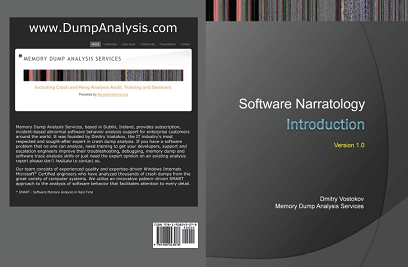
In a week this short full color book should appear in online bookstores:
- Title: Software Narratology: An Introduction to the Applied Science of Software Stories
- Authors: Dmitry Vostokov, Memory Dump Analysis Services
- Description: This is a transcript of Memory Dump Analysis Services Webinar about Software Narratology: an exciting new discipline and a field of research founded by DumpAnalysis.org. When software executes it gives us its stories in the form of UI events, software traces and logs. Such stories can be analyzed for their structure and patterns for troubleshooting, debugging and problem resolution purposes. Topics also include software narremes and their types, anticipatory software construction and software diagnostics.
- Publisher: OpenTask (April 2012)
- Language: English
- Product Dimensions: 28.0 x 21.6
- Paperback: 26 pages
- ISBN-13: 978-1908043078
- Dmitry Vostokov @ DumpAnalysis.org + TraceAnalysis.org -
Posted in Announcements, Books, CDF Analysis Tips and Tricks, Code Reading, Computer Science, Debugging, Debugging Methodology, Debugging Trends, Education and Research, Escalation Engineering, Event Tracing for Windows (ETW), Hermeneutics of Memory Dumps and Traces, Ideas, Narralog Programming Language, New Debugging School, Pattern-Driven Debugging, Pattern-Driven Software Support, Presentations, Publishing, Root Cause Analysis, SPDL, Science of Software Tracing, Software Behavior DNA, Software Behavior Patterns, Software Behavioral Genome, Software Diagnostics, Software Engineering, Software Narrative Fiction, Software Narrative Science, Software Narratology, Software Narremes, Software Problem Description Patterns, Software Problem Solving, Software Technical Support, Software Trace Analysis, Software Trace Analysis and History, Software Trace Deconstruction, Software Trace Linguistics, Software Trace Modeling, Software Trace Reading, Software Trace Visualization, Software Tracing Implementation Patterns, Software Troubleshooting Patterns, Structural Trace Patterns, Systems Thinking, Testing, Tools, Trace Analysis Patterns, Training and Seminars, Troubleshooting Methodology, UI Problem Analysis Patterns, Unified Debugging Patterns, Unified Software Diagnostics, Webinars | No Comments »
Thursday, January 19th, 2012
This book I bought in a local Costa bookshop and found it was written by an Irish sociologist Kieran Allen. Shortly before my interest in Marxism was inspired by seeing a link to Irish communist party website and socialist bookshop in a booklet for Dublin Culture nights festival. It was a bit funny to see communists as part of Irish culture festival especially for me from former Soviet Union. Anyway, later I saw on streets that Marxist festivals are popular in Ireland nowadays. So let’s go back to the book. I found it very good and even lucid in explaining various Marxist ideas and vocabulary. A good start for more advance reading such as “Capital” (I have all 3 hardcover volumes from an Indian publisher and plan to have leather bound edition from Russia if I have enough surplus and MEW German edition) or specialized books such as “A Dictionary of Marxist Thought”. What I also tend to agree with the author is that Stalinism is a mirror of Capitalism (there is also a book “Magnetic Mountain: Stalinism as a Civilization” that I’m reading). I leave an application of a dialectical method of double negation to a reader here. Now the weak points of the book: 1) it doesn’t cover post-Stalinist era; 2) subsequent analysis of alternatives sounds a bit naive for me who really lived in socialism and can compare it to capitalism both in post-socialist country and now living in real capitalist country. The book also has a good reading suggestion list and I even thinking now on reading Voloshinov book “Marxism and the Philosophy of Language” (in Russian, although there is an English edition). Anyway, I would recommend Kieran’s book with reservations (about alternatives) as a first introduction to Marxist thought.
Marx and the Alternative to Capitalism

- Dmitry Vostokov @ LiterateScientist.com -
Posted in Economics, From Cover To Cover, History, Humanities, Ideas, Marxism, Philosophy, Political Economy, Politics, Reading List 2012, Reviewed on Amazon, Social Sciences | No Comments »
Thursday, November 12th, 2009
The CRC Encyclopedia of Mathematics, Third Edition - 3 Volume Set

I spotted this book on Amazon US and was thrilled to have the new edition in 3 volumes for easy handling when reading. I also have the previous edition that is even featured on my own book cover (the picture of my previous library book arrangement, the book is highlighted in white rectangle in the lower right corner):

This is a unique volume that sits between The Princeton Companion to Mathematics (that I’m also reading now) and Encyclopedic Dictionary of Mathematics: The Mathematical Society of Japan (that I also own). In fact after reading 3 volumes from cover to cover I can start with 2 volumes of EDM. There is also Springer Encyclopaedia of Mathematics in 11 volumes with various additional supplement volumes that I plan to own as well and it looks to me on the same level as EDM.
After searching for the best price I ordered a copy from Amazon DE and after my purchase in just a few days the price was up by 50%! I can only explain this that more people tried to purchase after I used twitter to announce this encyclopedia (there were 5 copies available on Amazon DE and in just 2 days only 1 left) or there was a mistake in price.
3 volumes arrived and I immediately started reading them, a few pages from each volume every day using mod 3 reading technique, for example, Wed - Vol I, Thu - Vol II, Fri - Vol III, Mon - Vol I, an so on. I prefer paper books for bulk reading instead of electronic version (in this case corresponding website) although if I’m interested in a specific article or a keyword I go to Wolfram MathWorld website to get the latest update and citations. These paperback volumes are just for day-to-day scheduled reading to get ideas and general mathematical education. This is why I don’t need an Index. For example, just after reading the first pages I got the idea of cubic (qubic) memory representation.
I usually put reviews on Amazon after I finish a book from cover to cover but in this case the review would be waiting for at least a year so I write it now based on my first impressions. After some time I plan to update it.
- Dmitry Vostokov @ LiterateScientist.com -
Posted in Applied Mathematics, Computer Science, Encyclopedias, Ideas, Mathematical Modeling, Mathematics, Physics, Reading List 2009, Reviewed on Amazon | No Comments »
Friday, August 7th, 2009
This is an encyclopedic work I bought in a local book shop and finally finished reading today. It took me a year to read from cover to cover and pages were falling out of the glue but I continued to read. Highly recommended for education and another view on human history. The review of Freud was enlightening to me because I didn’t know about the recent scholarship criticizing his work. In fact, I so liked this book that just bought it again in a hardcover version from Folio Society and start rereading it again soon.
Ideas: A History of Thought and Invention, from Fire to Freud

The second encyclopedic book seems was written before the previous one but looks like the logical sequel to it. I’m starting reading it next week.
The Modern Mind: An Intellectual History of the 20th Century

- Dmitry Vostokov @ LiterateScientist.com -
Posted in Anthropology, Art, Biology, Chemistry, Economics, Ethics, Evolution, From Cover To Cover, General Science, Geography, History, Humanities, Ideas, Language, Medicine, Philosophy, Physics, Politics, Psychology, Reading List 2009, Religion, Reviewed on Amazon, Social Sciences, Statistics, Theology | No Comments »
Friday, July 3rd, 2009
I read this book from cover to cover while flying on a plane from Dublin to St. Petersburg and back. That was so wonderful reading experience - I couldn’t put the book down during those flights. I recall that I visited the Department of Mathematics a few times when I studied Chemistry in Moscow State University although at that time I knew next to nothing about Russian mathematicians. The book touched me so deeply that I bought the main work of Florensky: The Pillar and Ground of the Truth, the history of Russian philosophy and several books explaining Orthodox Church. This is the best mathematics history book I have ever read, my feelings perhaps comparable to those that I experienced when I finished reading Mathematics: The Loss of Certainty by Morris Kline but that was more than 20 years ago.
Naming Infinity: A True Story of Religious Mysticism and Mathematical Creativity

- Dmitry Vostokov @ LiterateScientist.com -
Posted in Biographies, From Cover To Cover, History, Ideas, Logic, Mathematics, Philosophy, Politics, Psychology, Reading List 2009, Religion, Reviewed on Amazon, Theology | No Comments »