May 10th, 2010
This pattern is similar to No Component Symbols memory analysis pattern and is called No Trace Metafile:
#     Module    PID  TID  Time        Message

21372 \src\dllA 2968 5476 3:55:10.004 Calling foo()

21373 Unknown   2968 5476 3:55:10.004 ????? Unknown( 27): GUID=1EF56EBD-A7FC-4892-8DBA-00AD813F8A24 (No Format Information found).

21374 Unknown   2968 5476 3:55:10.004 ????? Unknown( 27): GUID=1EF56EBD-A7FC-4892-8DBA-00AD813F8A24 (No Format Information found).

21375 Unknown   2968 5476 3:55:10.004 ????? Unknown( 27): GUID=1EF56EBD-A7FC-4892-8DBA-00AD813F8A24 (No Format Information found).

21376 Unknown   2968 5476 3:55:10.004 ????? Unknown( 28): GUID=1EF56EBD-A7FC-4892-8DBA-00AD813F8A24 (No Format Information found).

21377 Unknown   2968 5476 3:55:10.004 ????? Unknown( 23): GUID=1EF56EBD-A7FC-4892-8DBA-00AD813F8A24 (No Format Information found).

21378 \src\dllA 2968 5476 3:55:10.004 Calling bar()
In some case when we don’t have TMF files it is possible to detect broad behavioral patterns such as:
By looking at Thread of Activity we can also sometimes infer the possible component name based on surrounding trace messages with present TMF files, escpecially when we have source code access. For example, in the trace above it can be dllA or any other module that foo function calls.
- Dmitry Vostokov @ DumpAnalysis.org + TraceAnalysis.org -
Posted in CDF Analysis Tips and Tricks, Debugging, Software Trace Analysis, Trace Analysis Patterns | No Comments »
May 10th, 2010
My drive to generalization led me to place an adornment on the portal to highlight the fact that memory and software trace analysis patterns are under an umbrella of general software behaviour patterns:
http://www.dumpanalysis.org/Software-Behavior-Patterns-Headline
In the forthcoming post series I plan to write about similarities between these two branches and also provide pattern examples from non-Windows platforms. All this material will provide the foundation for the forthcoming book Software Behavior: A Guide to Systematic Analysis (ISBN: 978-1906717162).
- Dmitry Vostokov @ DumpAnalysis.org + TraceAnalysis.org -
Posted in Announcements, Computer Science, Crash Dump Analysis, Crash Dump Patterns, Debugging, Escalation Engineering, Memiotics (Memory Semiotics), Memoretics, Science of Memory Dump Analysis, Science of Software Tracing, Software Behavior Patterns, Software Engineering, Software Maintenance Institute, Software Technical Support, Software Trace Analysis, Software Troubleshooting Patterns, Trace Analysis Patterns | No Comments »
May 9th, 2010
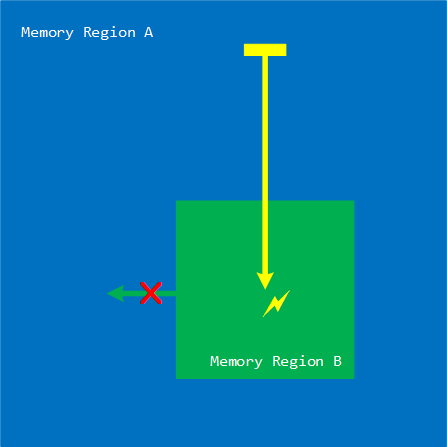
Memoidealism explains God as Inaccessible Memory (Memory Region A on the picture below). It means that Memory Region B doesn’t have pointers that point outside of it. In other words, all operating fields of Region B pointers are in Region B. However, Region A can have pointers pointing to Region B and modify it, effectively producing a miracle as perceived by Region B. In other words, some perception field links of Region B pointers may come from outside. You can object that Region B can have deeper pointers by making their memory locations bigger (from N-bit to 2*N-bit for example) but Memory may not be flat, discrete and bit-like. For one possible Christian interpretation we can replace Region B with the heavens and the earth (Genesis 1.1) and replace Region A with God-Creator (note also that in Memorianity Memory creates memories [notes on memoidealism 1.10]).
- Dmitry Vostokov @ DumpAnalysis.org + TraceAnalysis.org -
Posted in Intelligent Memory Movement, Memoidealism, Memory Religion (Memorianity), Philosophy, Religion | No Comments »
May 8th, 2010
Sometimes when a high number of interrupts is reported but there are no signs of an interrupt storm or pending DPCs in a memory dump file it is useful to search for Hardware Activity in running and / or suspected threads. This can be done by examining execution residue left on a thread raw stack. Although found driver activity might not be related to reported problems it can be a useful start for driver elimination procedure for the general recommendation to check drivers for any updates. Here is an example of a thread raw stack with a network card doing “Scatter-Gather” DMA (more extensive example is coming in a separate pattern cooperation case study):
1: kd> !thread

THREAD f7732090 Cid 0000.0000 Teb: 00000000 Win32Thread: 00000000 RUNNING on processor 1

Not impersonating

Owning Process 8089db40 Image: Idle

Attached Process N/A Image: N/A

Wait Start TickCount 0 Ticks: 24437545 (4:10:03:56.640)

Context Switch Count 75624870

UserTime 00:00:00.000

KernelTime 4 Days 08:56:05.125

Stack Init f78b3000 Current f78b2d4c Base f78b3000 Limit f78b0000 Call 0

Priority 0 BasePriority 0 PriorityDecrement 0

ChildEBP RetAddr Args to Child

f3b30c5c 00000000 00000000 00000000 00000000 LiveKdD+0x1c07
1: kd> dds f78b0000 f78b3000

f78b0000 00000000

f78b0004 00000000

f78b0008 00000000

f78b000c 00000000

f78b0010 00000000

[...]

f78b2870 8b3de0d0

f78b2874 80887b75 nt!KiFlushTargetSingleTb+0xd

f78b2878 8b49032c

f78b287c 00000000

f78b2880 2d003202

f78b2884 00000000

f78b2888 00000000

f78b288c 2d003202

f78b2890 8b490302

f78b2894 f78b28a4

f78b2898 80a61456 hal!KfLowerIrql+0x62

f78b289c 2d00320a

f78b28a0 00000000

f78b28a4 8b3de0d0

f78b28a8 8b3e3730

f78b28ac 00341eb0

f78b28b0 f78b2918

f78b28b4 f63fbf78 NetworkAdapterA!SendWithScatterGather+0×318

f78b28b8 8b3de0d0

f78b28bc 8b341eb0

f78b28c0 f78b28d4

f78b28c4 00000000

f78b28c8 80a5f3c0 hal!KfAcquireSpinLock

f78b28cc 00000000

f78b28d0 8b3de0d0

f78b28d4 00000000

f78b28d8 8b3de0d0

f78b28dc 8b3eb730

f78b28e0 005a7340

f78b28e4 f78b294c

f78b28e8 f63fbf78 NetworkAdapterA!SendWithScatterGather+0×318

f78b28ec 8b3de0d0

f78b28f0 8a5a7340

f78b28f4 f78b2908

f78b28f8 00000000

f78b28fc 8b3de0d0

f78b2900 8b0f5158

f78b2904 001e2340

f78b2908 f78b2970

f78b290c f63fbf78 NetworkAdapterA!SendWithScatterGather+0×318

f78b2910 8b3de0d0

f78b2914 8b1e2340

f78b2918 f78b292c

f78b291c 00000000

f78b2920 80a5f3c0 hal!KfAcquireSpinLock

f78b2924 00000000

f78b2928 8b3de0d0

f78b292c 00000000

f78b2930 8b3eb700

f78b2934 00000000

f78b2938 00000000

f78b293c 00000000

f78b2940 00000000

f78b2944 00000000

f78b2948 00000000

f78b294c 0a446aa2

f78b2950 f78b29b8

f78b2954 8b0f5158

f78b2958 8b01ce10

f78b295c 00000001

f78b2960 8b3de0d0

f78b2964 80a5f302 hal!HalpPerfInterrupt+0×32

f78b2968 00000001

f78b296c 8b3de0d0

f78b2970 80a5f302 hal!HalpPerfInterrupt+0×32

f78b2974 8b3de302

f78b2978 f78b2988

f78b297c 80a61456 hal!KfLowerIrql+0×62

f78b2980 80a5f3c0 hal!KfAcquireSpinLock

f78b2984 8b3de302

f78b2988 f78b29a4

f78b298c 80a5f44b hal!KfReleaseSpinLock+0xb

f78b2990 f63fbbbf NetworkAdapterA!SendPackets+0×1b3

f78b2994 8a446a90

f78b2998 8b0e8ab0

f78b299c 00000000

f78b29a0 008b29d0

f78b29a4 f78b29bc

f78b29a8 f7163790 NDIS!ndisMProcessSGList+0×90

f78b29ac 8b3de388

f78b29b0 f78b29d0

f78b29b4 00000001

f78b29b8 00000000

f78b29bc f78b29e8

f78b29c0 80a60147 hal!HalBuildScatterGatherList+0×1c7

f78b29c4 8b0e89b0

f78b29c8 00000000

f78b29cc 8a44cde8

f78b29d0 8b1e2340

f78b29d4 8a446aa2

f78b29d8 8b026ca0

f78b29dc 8b1e2340

f78b29e0 8b0e8ab0

f78b29e4 8b0e8ab0

f78b29e8 f78b2a44

f78b29ec f716369f NDIS!ndisMAllocSGList+0xda

f78b29f0 8a44cde8

f78b29f4 8b0e89b0

f78b29f8 8a446a70

f78b29fc 00000000

f78b2a00 00000036

f78b2a04 f7163730 NDIS!ndisMProcessSGList

f78b2a08 8b1e2340

f78b2a0c 00000000

f78b2a10 8a44cde8

f78b2a14 00000218

f78b2a18 8b1e2308

f78b2a1c 00000103

f78b2a20 8b0e8ab0

f78b2a24 8a446a70

f78b2a28 8a44cde8

f78b2a2c 00000036

f78b2a30 8b0e8ab0

f78b2a34 00000036

f78b2a38 00000000

f78b2a3c 00000000

f78b2a40 029a9e02

f78b2a44 f78b2a60

f78b2a48 f71402ff NDIS!ndisMSendX+0×1dd

f78b2a4c 8b490310

f78b2a50 8b1e2340

f78b2a54 8a446a70

f78b2a58 8a9a9e02

f78b2a5c 8a9a9e02

f78b2a60 f78b2a88

f78b2a64 f546c923 tcpip!ARPSendData+0×1a9

f78b2a68 8b3e76c8

f78b2a6c 8b1e2340

f78b2a70 8a9a9ea8

f78b2a74 8b490310

f78b2a78 80888b00 nt!RtlBackoff+0×68

f78b2a7c 8a446a70

f78b2a80 8a446aa2

f78b2a84 8a446a70

f78b2a88 f78b2ab4

f78b2a8c f546ba5d tcpip!ARPTransmit+0×112

f78b2a90 8b490310

f78b2a94 8b1e2340

f78b2a98 8a9a9ea8

f78b2a9c 00000103

f78b2aa0 8a446a70

f78b2aa4 00000000

f78b2aa8 8b342398

f78b2aac 8a47e1f8

f78b2ab0 8b1e2340

f78b2ab4 f78b2bf0

f78b2ab8 f546c4fc tcpip!_IPTransmit+0×866

f78b2abc 8a9a9ebc

f78b2ac0 f78b2b02

f78b2ac4 00000001

[…]
We also do a sanity check for coincidental symbols:
1: kd> ub f63fbf78

NetworkAdapterA!SendWithScatterGather+0x304:

f63fbf64 push    eax

f63fbf65 push    edi

f63fbf66 push    esi

f63fbf67 mov     dword ptr [ebp-44h],ecx

f63fbf6a mov     dword ptr [ebp-3Ch],ecx

f63fbf6d mov     dword ptr [ebp-34h],ecx

f63fbf70 mov     dword ptr [ebp-2Ch],ecx

f63fbf73 call    NetworkAdapterA!PacketRetrieveNicActions (f63facd2)
1: kd> ub f63fbbbf

NetworkAdapterA!SendPackets+0x190:

f63fbb9c cmp     dword ptr [esi+0Ch],2

f63fbba0 jl      NetworkAdapterA!SendPackets+0x19e (f63fbbaa)

f63fbba2 mov     dword ptr [ecx+3818h],eax

f63fbba8 jmp     NetworkAdapterA!SendPackets+0x1a4 (f63fbbb0)

f63fbbaa mov     dword ptr [ecx+438h],eax

f63fbbb0 mov     dl,byte ptr [esi+2BCh]

f63fbbb6 mov     ecx,dword ptr [ebp+8]

f63fbbb9 call    dword ptr [NetworkAdapterA!_imp_KfReleaseSpinLock (f640ca18)]
1: kd> ub 80a60147

hal!HalBuildScatterGatherList+0x1b0:

80a60130 je      hal!HalBuildScatterGatherList+0x1b9 (80a60139)

80a60132 mov     dword ptr [eax+4],1

80a60139 push    dword ptr [ebp+20h]

80a6013c push    eax

80a6013d mov     eax,dword ptr [ebp+0Ch]

80a60140 push    dword ptr [eax+14h]

80a60143 push    eax

80a60144 call    dword ptr [ebp+1Ch]
- Dmitry Vostokov @ DumpAnalysis.org + TraceAnalysis.org -
Posted in Crash Dump Analysis, Crash Dump Patterns, Debugging, Hardware | 2 Comments »
May 7th, 2010
This is a variation of Hooked Functions pattern for kernel space. In addition to trampoline patching we also see a modified service table:
0: kd> !chkimg -lo 50 -d !nt -v

Searching for module with expression: !nt

Will apply relocation fixups to file used for comparison

Will ignore NOP/LOCK errors

Will ignore patched instructions

Image specific ignores will be applied

Comparison image path: c:\mss\ntkrnlmp.exe\4B7A8E62280000\ntkrnlmp.exe

No range specified
Scanning section:    .text

Size: 625257

Range to scan: 80801000-80899a69

    808373e3-808373e9  7 bytes - nt!KeAcquireQueuedSpinLockAtDpcLevel+1b

 [ f7 41 04 01 00 00 00:e9 00 0d b2 76 cc cc ]

    8083e6c8-8083e6cb  4 bytes - nt!KiServiceTable+440 (+0×72e5)

 [ 98 4e 98 80:d0 66 e9 f4 ]

    80840605-8084060a  6 bytes - nt!KxFlushEntireTb+9 (+0×1f3d)

 [ ff 15 1c 10 80 80:e9 a5 7a b1 76 cc ]

Total bytes compared: 625257(100%)

Number of errors: 17
Scanning section: MISYSPTE

Size: 1906

Range to scan: 8089a000-8089a772

Total bytes compared: 1906(100%)

Number of errors: 0
Scanning section:   POOLMI

Size: 7868

Range to scan: 8089b000-8089cebc

Total bytes compared: 7868(100%)

Number of errors: 0
Scanning section: POOLCODE

Size: 7754

Range to scan: 8089d000-8089ee4a

Total bytes compared: 7754(100%)

Number of errors: 0
Scanning section:     PAGE

Size: 1097281

Range to scan: 808bc000-809c7e41

Total bytes compared: 1097281(100%)

Number of errors: 0
Scanning section:   PAGELK

Size: 63633

Range to scan: 809c8000-809d7891

Total bytes compared: 63633(100%)

Number of errors: 0
Scanning section:  PAGEWMI

Size: 7095

Range to scan: 809ef000-809f0bb7

Total bytes compared: 7095(100%)

Number of errors: 0
Scanning section:   PAGEKD

Size: 16760

Range to scan: 809f1000-809f5178

Total bytes compared: 16760(100%)

Number of errors: 0
Scanning section: PAGEHDLS

Size: 7508

Range to scan: 809f7000-809f8d54

Total bytes compared: 7508(100%)

Number of errors: 0

17 errors : !nt (808373e3-8084060a)
0: kd> dds 8083e6c8

8083e6c8  f4e966d0 DriverA+0×20d8

8083e6cc  80983436 nt!NtUnloadKey2

8083e6d0  809837b5 nt!NtUnloadKeyEx

8083e6d4  8091cec8 nt!NtUnlockFile

8083e6d8  80805d80 nt!NtUnlockVirtualMemory

8083e6dc  80937630 nt!NtUnmapViewOfSection

8083e6e0  808e7154 nt!NtVdmControl

8083e6e4  809c6ba3 nt!NtWaitForDebugEvent

8083e6e8  8092dc24 nt!NtWaitForMultipleObjects

8083e6ec  8092ccf4 nt!NtWaitForSingleObject

8083e6f0  809c132f nt!NtWaitHighEventPair

8083e6f4  809c12c3 nt!NtWaitLowEventPair

8083e6f8  80925c8d nt!NtWriteFile

8083e6fc  80901790 nt!NtWriteFileGather

8083e700  8091214c nt!NtWriteRequestData

8083e704  8093e63b nt!NtWriteVirtualMemory

8083e708  80822751 nt!NtYieldExecution

8083e70c  808c7c46 nt!NtCreateKeyedEvent

8083e710  8093eee3 nt!NtOpenKeyedEvent

8083e714  809c1ee8 nt!NtReleaseKeyedEvent

8083e718  809c2183 nt!NtWaitForKeyedEvent

8083e71c  809a610b nt!NtQueryPortInformationProcess

8083e720  809a6123 nt!NtGetCurrentProcessorNumber

8083e724  809a1849 nt!NtWaitForMultipleObjects32

8083e728  90909090

8083e72c  1c0d3b90

8083e730  0f8089f1

8083e734  037aaa85

8083e738  00c1f700

8083e73c  0fffff00

8083e740  037a9e85

8083e744  9090c300
0: kd> u 808373e3

nt!KeAcquireQueuedSpinLockAtDpcLevel+0×1b:

808373e3 jmp     DriverB+0×10e8 (f73580e8)

808373e8 int     3

808373e9 int     3

808373ea je      nt!KeAcquireQueuedSpinLockAtDpcLevel+0×12 (808373da)

808373ec pause

808373ee jmp     nt!KeAcquireQueuedSpinLockAtDpcLevel+0×1b (808373e3)

nt!KeReleaseInStackQueuedSpinLockFromDpcLevel:

808373f0 lea     ecx,[ecx]

nt!KeReleaseQueuedSpinLockFromDpcLevel:

808373f2 mov     eax,ecx
0: kd> u 80840605

nt!KxFlushEntireTb+0×9:

80840605 jmp     DriverB+0×10af (f73580af)

8084060a int     3

8084060b mov     byte ptr [ebp-1],al

8084060e mov     ebx,offset nt!KiTbFlushTimeStamp (808a7100)

80840613 mov     ecx,dword ptr [nt!KiTbFlushTimeStamp (808a7100)]

80840619 test    cl,1

8084061c jne     nt!KxFlushEntireTb+0×19 (8082cd8d)

80840622 mov     eax,ecx
- Dmitry Vostokov @ DumpAnalysis.org + TraceAnalysis.org -
Posted in Crash Dump Analysis, Crash Dump Patterns, Debugging, Memory Analysis Forensics and Intelligence, Security | 3 Comments »
May 6th, 2010
Some recent news about StressPrinters tool designed according to Tool Façade DebugWare pattern:
“HP tests its print drivers with the StressPrinters tool provided by Citrix to simulate a user logon where multiple printers are autocreated concurrently.”
Source
- Dmitry Vostokov @ DumpAnalysis.org + TraceAnalysis.org -
Posted in Citrix, DebugWare Patterns, Debugging, Testing, Tools | No Comments »
May 6th, 2010
Befind every trace and its messages is source code:
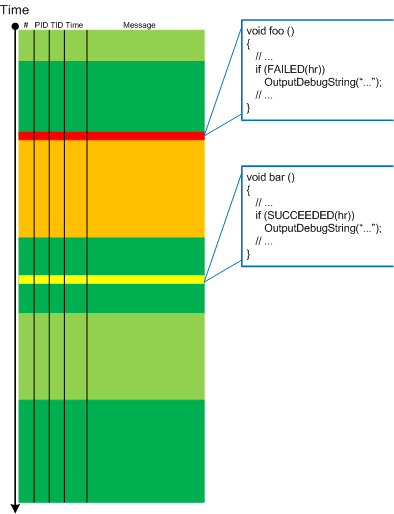
Borrowing the acronym PLOT (Program Lines of Trace) we now try to discern basic source code patterns that give rise to simple message patterns in software traces. There are only a few distinct PLOTs and the ability to mentally map trace statements to source code is crucial to software trace reading and comprehension. More about that in subsequent parts. More complex message patterns (for example, specific message blocks or correlated messages) arise from supportable and maintainable realizations of architectural, design and implementation patterns and will be covered in another post series.
I was thinking about acronym SLOT (Source Lines of Trace) but decided to use PLOT because it metaphorically bijects into literary theory and narrative plots.
Forthcoming CDF and ETW Software Trace Analysis: Practical Foundations
- Dmitry Vostokov @ DumpAnalysis.org + TraceAnalysis.org
Posted in C and C++, CDF Analysis Tips and Tricks, Code Reading, Debugging, Science of Software Tracing, Software Architecture, Software Engineering, Software Narratology, Software Trace Analysis, Software Trace Reading | 2 Comments »
May 5th, 2010
PLOT - Program Lines of Trace - the source code lines behind trace messages
Examples: What a plot do we have here! The struggle against the monster database component and endless voyages across space boundaries.
- Dmitry Vostokov @ DumpAnalysis.org + TraceAnalysis.org
Posted in Debugging, Debugging Slang, Escalation Engineering, New Acronyms, Software Engineering, Software Narratology, Software Technical Support, Software Trace Analysis, Trace Analysis Patterns | 1 Comment »
May 3rd, 2010
Modern pattern-driven software trace analysis on Microsoft and Citrix platforms urgently requires a practical guide and OpenTask plans to publish this summer the following book in both Practical Foundations and Systematic Software Fault Analysis series:
- Title: Citrix Common Diagnostic Facility (CDF) and Microsoft Event Tracing for Windows (ETW) Software Trace Analysis: Practical Foundations
- Author: Dmitry Vostokov
- Publisher: Opentask (August 2010)
- Language: English
- Product Dimensions: 22.86 x 15.24
- ISBN: 1906717176
- ISBN-13: 978-1906717179
- Paperback: 200 pages
- Dmitry Vostokov @ DumpAnalysis.org + TraceAnalysis.org -
Posted in Announcements, Books, Citrix, Escalation Engineering, Publishing, Software Engineering, Software Technical Support, Software Trace Analysis, Software Tracing for Dummies, Testing, Tools, Trace Analysis Patterns, Training and Seminars, Windows System Administration | No Comments »
May 2nd, 2010
c’t – Magazin für Computertechnik has published a review of First Fault Software Problem Solving book:
http://www.heise.de/ct/inhalt/2010/08/192/ (in German)
Fabian Röken kindly translated it into English:
No single large software package comes without errors. It seems that customers simply accept this, patiently waiting and hoping for patches or updates. Skwire sticks up for a more target-aimed approach: one will never get a faultless software, but it would already be a great improvement if flaws were already solved on their first occurrence (”first fault”) and not only after a long analysis (”second fault”).
The advantages are actually obvious. However, a corresponding stringent system architecture, as common on mainframes such as IBM’s z/OS, did not become prevalent in the PC market.
Skwire outlines the types of errors and strategies to resolve them in all details. His 40 years of experience, such as at IBM, shimmers through again and again. He puts emphasis on making sure that the reader understands the terminology he is using: “What is a problem in the first place?”, “What is a service point?” - in some cases he also explains specific metrics such as the “serviceability rating”.
His tool classification includes teaching tips, e.g. regarding the structure of a protocol in case of errors; or for tracking the important information how often an error must occur before a solution has to be approached. His suggestions equally address developers, designers, testers, managers - and the end user. In his last chapter he presents and reviews commercial tools in the first fault and second fault environment.
Skwire addresses a topic which is unfortunately very much neglected, and this alone already makes it worth enough to take a look at his book (***). Short quotations and humorous drawings relax the technical topic. If you are looking for an overview then you will be fine with this book. However, if you are a software developer looking for source code samples then you will search in vain. Skwire has released the book under the print-on-demand process. You will find it on Amazon, for example.
(Tobias Engler/fm)
- Dmitry Vostokov @ DumpAnalysis.org + TraceAnalysis.org -
Posted in Books, Escalation Engineering, First Fault Problem Solving, Software Engineering, Software Technical Support, Troubleshooting Methodology, Windows System Administration | No Comments »
May 2nd, 2010
It is time to start being systematic. In addition to all-encompassing multi-volume Memory Dump Analysis Anthology OpenTask starts Systematic Software Fault Analysis series with Crash Dump Analysis: Practical Foundations as the first book. It introduces basic definitions, tools, memory dump collection and preliminary analysis methods for Windows platforms including legacy versions. This practical reference guide is a must have for system administrators of Windows server platforms and client workstations, technical support engineers and general Windows users. It builds foundation for the second book Crash Dump Analysis for System Administrators and Support Engineers and the remaining tetralogy books Windows Crash Dump Analysis and Advanced Windows Crash Dump Analysis.
Product information:
- Title: Crash Dump Analysis: Practical Foundations (Windows Edition, Systematic Software Fault Analysis Series)
- Authors: Dmitry Vostokov
- Publisher: Opentask (May 2010)
- Language: English
- Product Dimensions: 22.86 x 15.24
- ISBN-13: 978-1-906717-98-8
- Paperback: 100 pages
Fromt cover:

Table of Contents to be published soon.
- Dmitry Vostokov @ DumpAnalysis.org + TraceAnalysis.org -
Posted in Announcements, Books, Crash Dump Analysis, Crash Dumps for Dummies, Escalation Engineering, Publishing, Software Technical Support, Tools, Windows System Administration | No Comments »
May 1st, 2010
The book is about to be submitted for publication. It has 68 full color illustrations. Here is TOC:
Table of Contents
- Dmitry Vostokov @ DumpAnalysis.org + TraceAnalysis.org -
Posted in Announcements, Books, Crash Dump Analysis, Publishing | No Comments »
April 30th, 2010
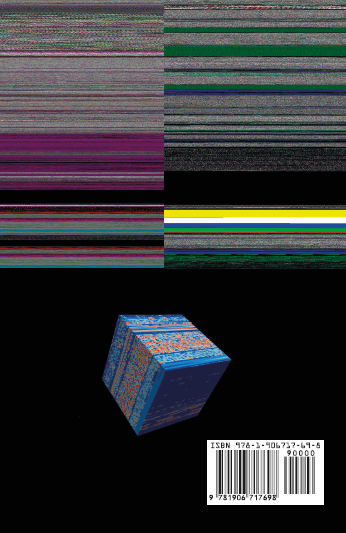
Memory Dump Analysis Anthology lacks full color inserts. This is rather a current limitation of POD technology that OpenTask publisher uses at the present time. The solution previously announced a year ago is to print a separate full color title with selected articles and illustrations. Finally, it is about to be published next month. The book front and back covers are collages from covers of individual memory dump analysis volumes:

TOC will be available soon. Here is the book data:
- Title: Memory Dump Analysis Anthology: Color Supplement for Volumes 1-3
- Author: Dmitry Vostokov
- Publisher: OpenTask (May 2010)
- Language: English
- Product Dimensions: 21.6 x 14.0
- Paperback: 110 pages
- ISBN-13: 978-1906717698
OpenTask also plans a separate color supplement for volumes 4 and 5 once they are published.
- Dmitry Vostokov @ DumpAnalysis.org + TraceAnalysis.org -
Posted in Announcements, Books, Crash Dump Analysis, Debugging, Fun with Crash Dumps, Memory Space Art, Memory Visualization, Publishing, Software Trace Visualization | 2 Comments »


