Metaphorical Bijectionism: A Method of Inquiry
Consider this example mapping (taken metaphorically from the mathematical notion of an injection) of one domain of knowledge to another:
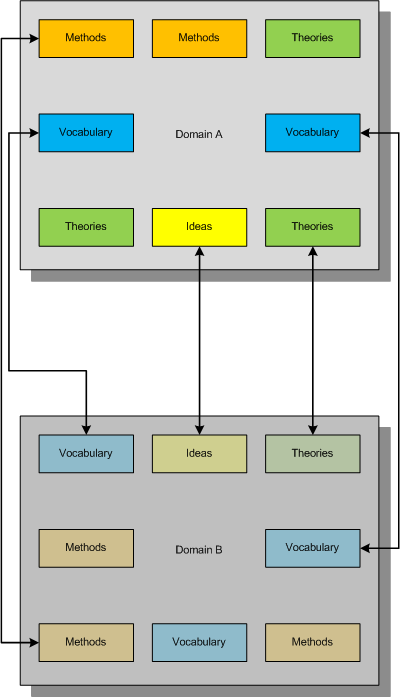
This mapping between concepts and ideas was once called “bijectivism” but was trivially described either as one to one mapping between two domains (like physical vs. mathematical) or fusing different concepts together to get another emerging concept. I myself proposed the similar mapping and called it a metaphorical bijection.
Now consider another mapping metaphorically equivalent to a mathematical notion of a surjection where all constituents of the second domain are covered metaphorically by the first domain:
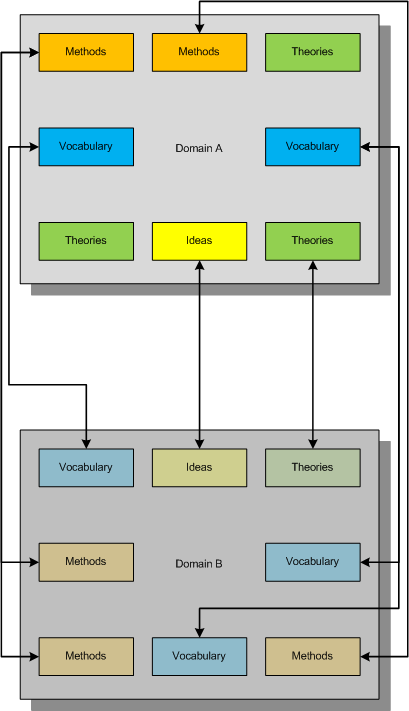
What we strive for is to establish the complete bijective mapping and reorganize our knowledge of both domains to achieve that:
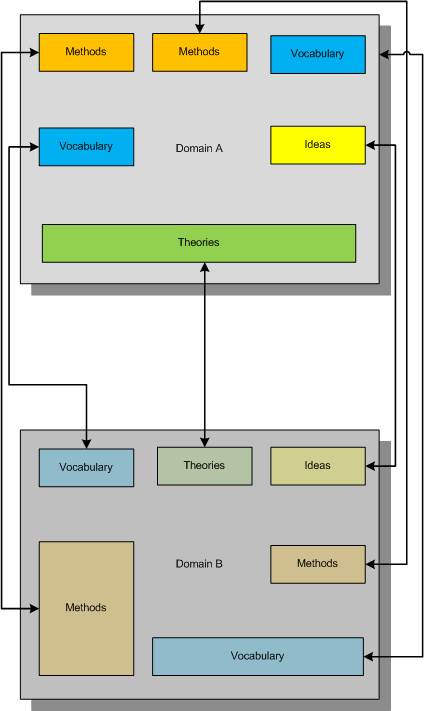
In diagrams above small boxes can represent sets of ideas, methods, etc. or individual ideas, methods, etc. The established metaphorical bijection can divide sets or combine them if needed. There can be several such bijections, of course, and we can use other methods of inquiry (for example, the scientific method) to choose between competing metaphorical bijections.
Useful mnemonic:
BEIS (B=I+S or to BE IS …)
Bijectionism Equals Injection + Surjection
Another mnemonic:
BET (B=T or to BE Transformation…)
Bijectionism Equals Transformation
Note also the second letter of Alef-Beis or Alef-Bet, the letter of Light that has interpretation of Creation in Biblical Hebrew.
More on this later as I need to come back to DebugWare patterns.
- Dmitry Vostokov @ DumpAnalysis.org -
September 16th, 2009 at 4:44 pm
[…] - the view from memory dump analysis engineer: study crash dump analysis patterns (by applying bijectionism) and learn from them. Software artifacts are memory dumps. Software development is memory […]
April 8th, 2010 at 1:31 pm
[…] Metaphorical bijection from literary narratology to software narratology provides a pattern of Backgound and Foreground Components. This can be easily illustrated on pseudo-trace color diagrams. Suppose we troubleshoot a graphical issue using an ETW trace containing the output from all components of the problem system. Graphic components and their messages are foreground for a trace viewer (a person) against numerous background components (for example, database, file and registry access, shown in shades of green): […]
April 22nd, 2010 at 4:15 pm
[…] decided to adapt archaeological classificatory framework (using my favorite method of inquiry: metaphorical bijectionism) to lay out foundations for yet another attempt to classify DA+TA […]
May 6th, 2010 at 1:20 am
[…] was thinking about acronym SLOT (Source Lines of Trace) but decided to use PLOT because it metaphorically bijects into literary theory and narrative […]
October 4th, 2010 at 11:12 am
[…] more recently structural memory patterns) to History (one of my favourite study subjects) using metaphorical bijectionism as I tried before to applying them to the analysis of project failures. Yesterday I found this book […]