Archive for the ‘Software Trace Analysis’ Category
Sunday, August 6th, 2017
We can associate a function with a domain of trace messages (M) to some other range either continuous (T) or discreet (D). We call this analysis pattern Trace Field by analogy with fields in physics:
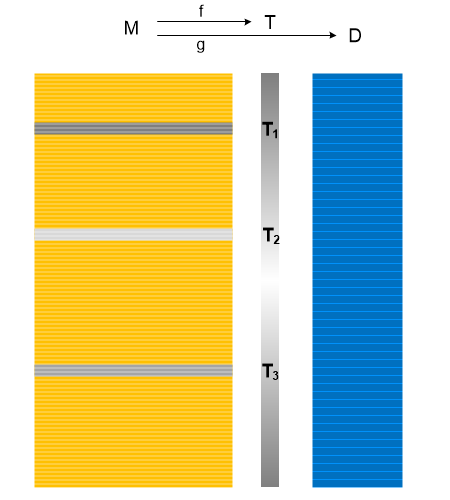
Or, in general, Trace Field, is a functor between the domain of the category of trace messages (M) and a codomain of some other category, not necessarily numerical. Typical examples include Trace Presheaves and Fiber Bundles. Another example, for generalized logs, is Memory Fibration taken to extreme.
- Dmitry Vostokov @ DumpAnalysis.org + TraceAnalysis.org -
Posted in Log Analysis, Software Trace Analysis, Trace Analysis Patterns | No Comments »
Wednesday, August 2nd, 2017
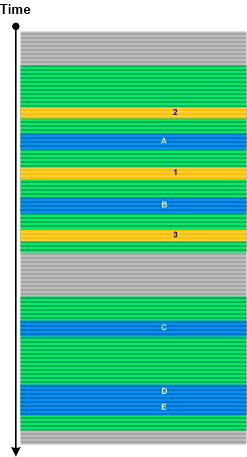
Sometimes we have variable sequences of Significant Events when we expect the certain constant number of such events in repeated normal and problem cases. For example, in repeated normal cases we expect more than 10 of events but in repeated abnormal cases - just 2 events. The latter cases would indicate that something happened inside the processing of the second event. But if one or more such cases contain 3 or 4 events that would point to some external influence that aborted the sequence of events. We call such variable event sequences Hedges by analogy with hedge variables or variadic variables. One of the recent example that we encountered involved multiple abnormal cases with just 2 events. We were about to investigate the internals of the second event but noticed that one of the cases contained 3 events. Further analysis indicated that the whole sequence was aborted by some external process after reaching the certain timeout. In the case of 3 events the first 2 happened too earlier and that allowed for the 3rd event to happen before the timeout was triggered:
- Dmitry Vostokov @ DumpAnalysis.org + TraceAnalysis.org -
Posted in Log Analysis, Software Trace Analysis, Trace Analysis Patterns | No Comments »
Thursday, July 20th, 2017
Certain types of blind SQL injection attacks may leave log messages with just one byte difference. We call with analysis pattern Ultrasimilar Messages by analogy with an ultrametric space in mathematics and the interpretation of messages as p-adic numbers. Since, such messages may be scattered in a log we can choose Message Pattern based on some Message Invariant (for example, parts of SQL request) and then analyze its Fiber of Activity (for example, Data Flow of its variable part). A log with two different types of Ultrasimilar Messages is shown in the following diagram:
- Dmitry Vostokov @ DumpAnalysis.org + TraceAnalysis.org -
Posted in Log Analysis, Mathematics of Debugging, Security, Software Trace Analysis, Trace Analysis Patterns | No Comments »
Monday, May 22nd, 2017
Sometimes we are interested in Message Set that has the same time attribute value (or rounded to some digit). We call this analysis pattern Activity Packet by analogy with wave packets. It may allow identification of related threads and activities.
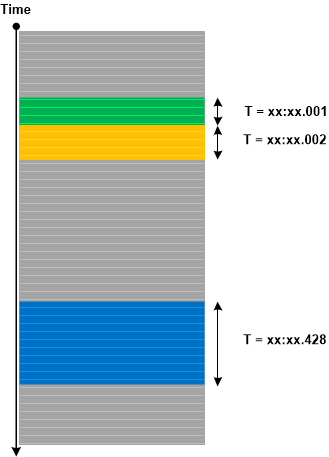
It is different from Activity Quantum analysis pattern where time attribute value may change for continuous Message Set with the same thread id.
- Dmitry Vostokov @ DumpAnalysis.org + TraceAnalysis.org -
Posted in Log Analysis, Software Trace Analysis, Trace Analysis Patterns | No Comments »
Sunday, May 21st, 2017
Some Stack Traces reveal a functional purpose, for example, painting, querying a database, doing HTML or JavaScript processing, loading a file, printing, or something else. Such traces from various Stack Trace Collections (unmanaged, managed, predicate, CPUs) may be compared for similarity and help with analysis patterns, such as examples in Wait Chain (C++11 condition variable, SRW lock), finding semantically Coupled Processes, and many others where we look at the meaning of stack trace frame sequences to relate them to each other. We call this analysis pattern Stack Trace Motif by analogy with Motif trace and log analysis pattern. Longer stack traces may contain several Motives and also Technology-Specific Subtraces (for example, COM interface invocation frames).
- Dmitry Vostokov @ DumpAnalysis.org + TraceAnalysis.org -
Posted in Core Dump Analysis, Crash Dump Analysis, Crash Dump Patterns, Software Trace Analysis, Software Trace Analysis Tips and Tricks, Trace Analysis Patterns | No Comments »
Thursday, May 18th, 2017
A typical software trace or log (for example, from Process Monitor) lists messages from several processes and threads sequentially. However, such columns may be split into individual process ID or thread ID columns. The same can be done for any Adjoint Thread and illustrated in the following diagram:
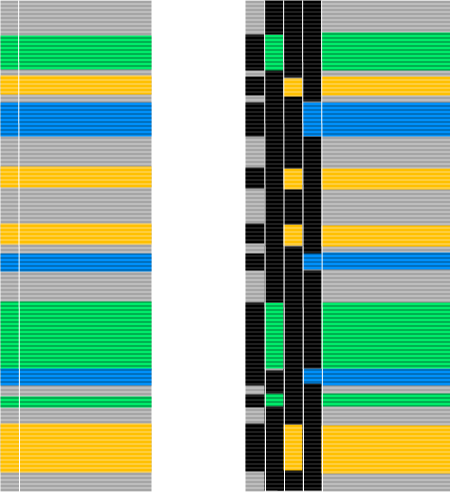
We call this analysis pattern Combed Trace by analogy with multibraiding.
- Dmitry Vostokov @ DumpAnalysis.org + TraceAnalysis.org -
Posted in Log Analysis, Software Trace Analysis, Software Trace Visualization, Trace Analysis Patterns | No Comments »
Wednesday, May 3rd, 2017
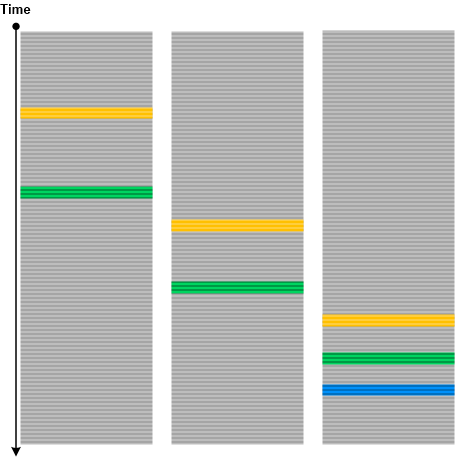
Often, for Inter-Correlational trace and log analysis, we need to make sure that we have synchronized traces. The one version of Unsynchronized Traces analysis pattern is depicted in the following diagram where one trace ends (possibly Truncated Trace) before the start of another trace and both were traced within one hour:
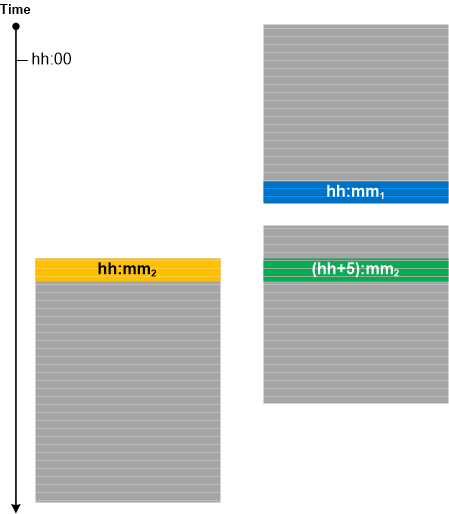
If tracing was done in different time zones with different local times specified in logs we can determine whether the traces are synchronized (when time zone information is not available in Basic Facts) by looking at minutes as shown for the third trace in the diagram above. This technique can also be used in trace calibration (see Calibrating Trace).
There is a similar analysis pattern for memory analysis called Unsynchronized Dumps.
- Dmitry Vostokov @ DumpAnalysis.org + TraceAnalysis.org -
Posted in CDF Analysis Tips and Tricks, Core Dump Analysis, Crash Dump Analysis, Crash Dump Patterns, Log Analysis, Software Trace Analysis, Software Trace Analysis Tips and Tricks, Software Trace Reading, Trace Analysis Patterns | No Comments »
Saturday, April 29th, 2017
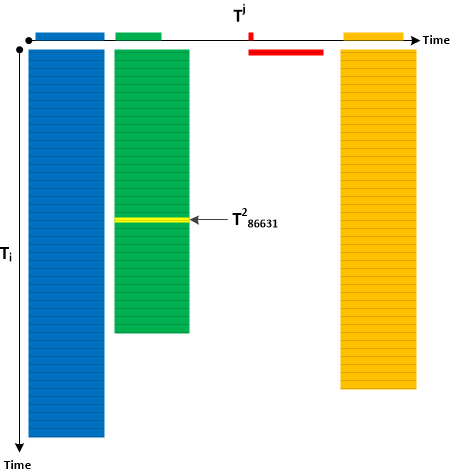
The idea of Tensor Trace analysis pattern initially appeared in the context of memory dumps as general traces with several special traces inside but then developed further when working on Singleton Trace analysis pattern when we realized that several Singleton Traces may form a new separate log:

Therefore, we may combine several traces and logs into one global trace where each message references separate local traces and logs:

Typical example is a repeated tracing. Each trace has an i-th index spanning the number of trace messages. We say it is has Ti components. Each individual logging has an j-th index and overall global log has Tj components. Together the form the second rank tensor:
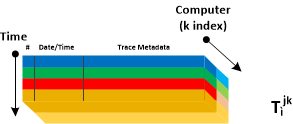
There can be Tensor Traces of the higher rank, for example, the 3rd component spanning computers:
This analysis pattern is different from Meta Trace where the latter is about trace evolution during software development. It is also different from Trace Dimension which is about one trace (Tensor Trace of rank 1).
- Dmitry Vostokov @ DumpAnalysis.org + TraceAnalysis.org -
Posted in Global Trace Analysis, Log Analysis, Software Trace Analysis, Trace Analysis Patterns | No Comments »
Saturday, April 29th, 2017
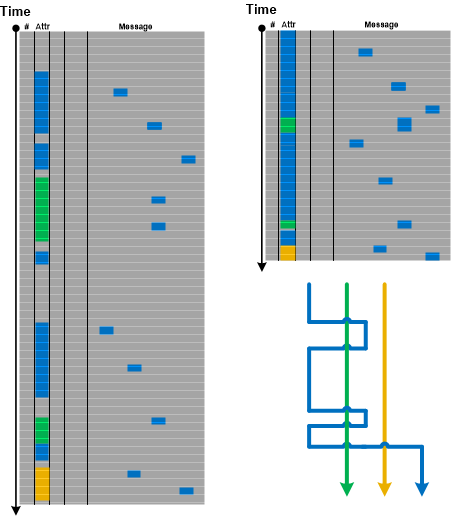
If we consider a log as a text, ignore its column structure, and do search for the particular attribute value (for example, PID) we get Message Set consisting of messages having that attribute value as column (Adjoint Thread of Activity) and messages having that attribute value referenced in their message text. We call this pattern Braid of Activity because metaphorically it looks like Adjoint Threads of Activity cross each other (like multibraiding):
- Dmitry Vostokov @ DumpAnalysis.org + TraceAnalysis.org -
Posted in Log Analysis, Software Trace Analysis, Software Trace Reading, Trace Analysis Patterns | No Comments »
Wednesday, April 19th, 2017
Status updates, error message boxes, and even abort errors can all be considered as examples of software traces and logs. We call such a log with one message only Singleton Trace. Please don’t confuse it with Singleton Event analysis pattern which is trivial for Singleton Traces. We illustrate this pattern with this picture of error message (in Russian it means “The machine doesn’t work. Code: SB”) from a lemonade-dispensing machine:
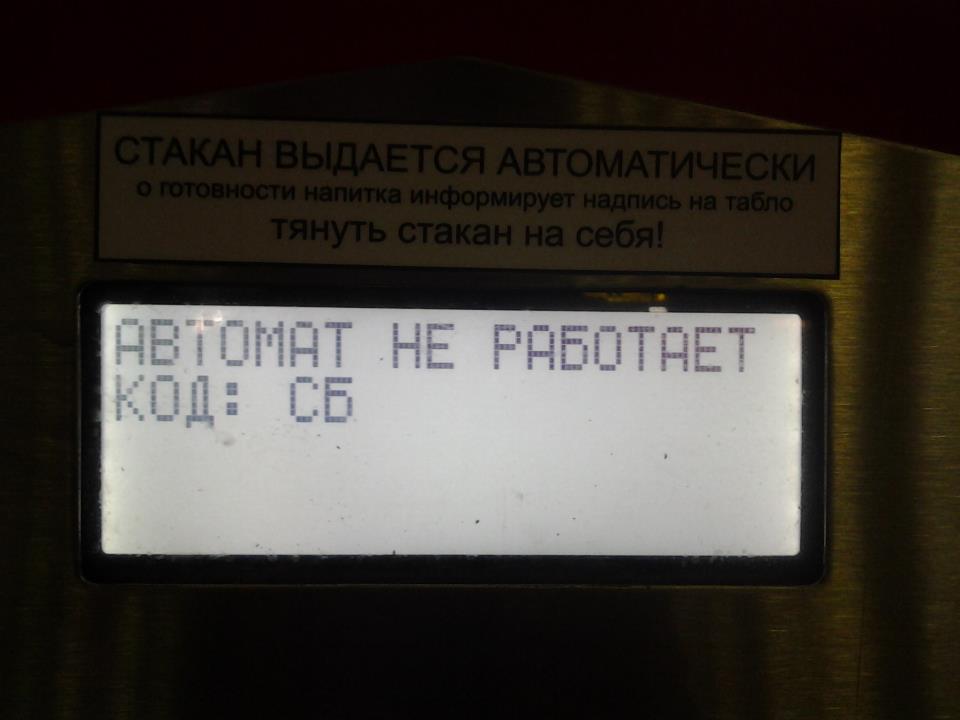
The message in such a trace may contain the associated stack trace as a trivial example of Fiber Bundle.
- Dmitry Vostokov @ DumpAnalysis.org + TraceAnalysis.org -
Posted in Log Analysis, Software Trace Analysis, Trace Analysis Patterns | No Comments »
Tuesday, April 18th, 2017
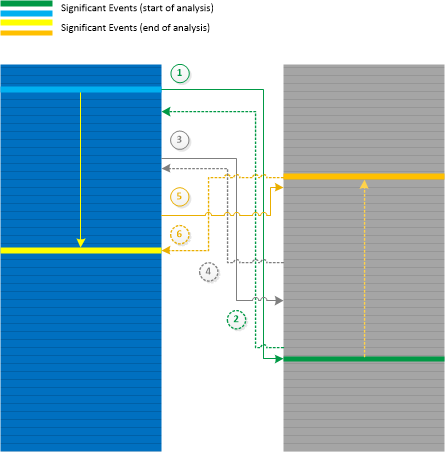
When doing Inter-Correlational analysis between different traces and logs we can move simultaneously along time direction or backwards (Back Tracing). In some cases we may start our analysis with the identification of Significant Events in both logs and then move in opposite directions finding another pair of messages that can be useful for diagnostic identification. We call this analysis pattern Galois Trace by analogy with Galois connection in mathematics. In our case moving from trace A to trace B and back corresponds to F and G functions with a and b as individual trace messages or their Message Contexts (as per monotone definition). The analysis pattern is illustrated in the following diagram:
- Dmitry Vostokov @ DumpAnalysis.org + TraceAnalysis.org -
Posted in Log Analysis, Software Trace Analysis, Trace Analysis Patterns | No Comments »
Monday, April 3rd, 2017
For completeness, we add Aggregated Frames analysis pattern implemented as “aggregated stack trace” in various software performance profiling tools. Such tools periodically record CPU Stack Trace Collection. Other tools profile memory allocations and their stack traces. By aggregation we mean summing up occurrences of modules and functions from all collected stack traces similar to this table:
ModuleA         88%
   +0x234          42%
   +0x123           8%
   !foo            38%
      +0xd            30%
      +0x56            2%
   !bar             6%
      +0x18            6%
ModuleB         12%
   !export         12%
      +0x2380          1%
      +0x1224          6%
      +0x3812          5%
Related to memory dump analysis we can either use Stack Trace Collection to detect Ubiquitous Component in user and kernel spaces, or database Stack Traces, for example, used in detection of process heap, handle, and reference Memory Leaks.
We do not include “stack” in the name of this pattern because frames are not sorted by the execution direction compared to Unified Stack Trace analysis pattern where we have some notion of aggregation depicted as multiplicities.
We can also name it as Frame Usage Signature similar to Stack Trace Signature.
- Dmitry Vostokov @ DumpAnalysis.org + TraceAnalysis.org -
Posted in Crash Dump Analysis, Crash Dump Patterns, Performance Monitoring, Software Trace Analysis | No Comments »
Sunday, April 2nd, 2017
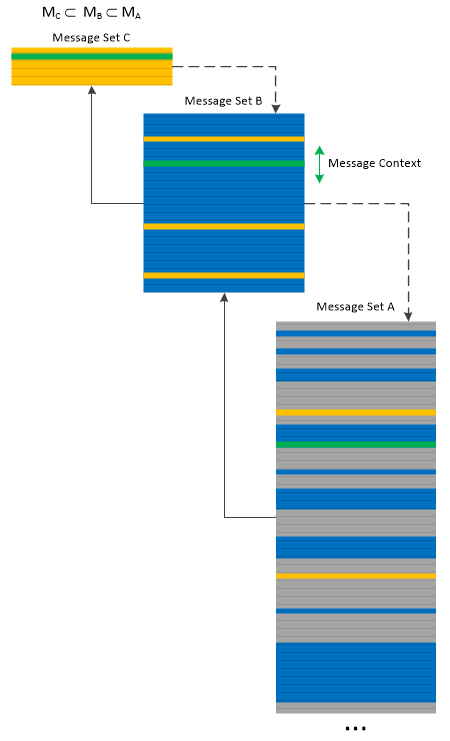
We can apply Message Set trace and log analysis pattern to itself and build multilevel Message Directory. The pattern name come from the analogy with memory management page tables, where we can select every 10th message to build a smaller Message Set, and then select every 10th message from it to build another Message Set, and so on. When looking at a higher level Message Set we can select a trace message and then look at its Message Context in the lower level Message Sets:
Message Directory is similar to Trace Frames analysis pattern but is fine-grained, and more individual message oriented than the latter analysis pattern. However, the former pattern can be used to implement the latter one.
- Dmitry Vostokov @ DumpAnalysis.org + TraceAnalysis.org -
Posted in Log Analysis, Software Trace Analysis, Software Trace Reading, Trace Analysis Patterns | No Comments »
Friday, March 24th, 2017
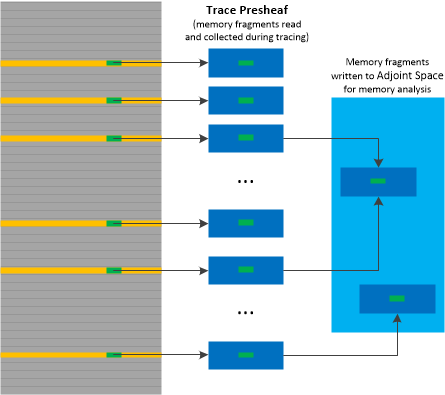
Adjoint Space and Trace Fibration analysis patterns may be useful in cases where complementing traces with memory dumps and vice versa provides better insight into software behavior. Ideally, every trace statement should have Adjoint Space but this is not feasible practically. The solution is to save memory regions surrounding trace message data, for example, structures referenced by pointers. This can be done either for each message or for selected Message Sets. Such memory data can be embedded inside logs as State Dump, Trace Extension or Inter-Correlation with a binary log of such memory fragments. This looks like a mapping between trace messages and memory objects. We call this analysis pattern Trace Presheaf by analogy with presheaves in mathematics. In case Adjoint Spaces are available (for example, memory dumps) such memory buffers can be written to memory by a debugger (in Windows by .readmem WinDbg command) and examined in association with the rest of Adjoint Space. This is illustrated in the following diagram:
- Dmitry Vostokov @ DumpAnalysis.org + TraceAnalysis.org -
Posted in Core Dump Analysis, Crash Dump Analysis, Crash Dump Patterns, Debugging, Log Analysis, Software Trace Analysis, Trace Analysis Patterns | No Comments »
Wednesday, March 22nd, 2017
The dual analysis technique to Adjoint Spaces trace and log analysis pattern is called Memory Fibration (by analogy with fibrations in mathematics). Certain process spaces may have associated external logs so the dynamics of memory can be examined backwards. Such traces and logs may be the parts of just one bigger log as Adjoint Threads of Activity with their PIDs as ATIDs.

- Dmitry Vostokov @ DumpAnalysis.org + TraceAnalysis.org -
Posted in Crash Dump Analysis, Crash Dump Patterns, Log Analysis, Software Trace Analysis, Trace Analysis Patterns | No Comments »
Tuesday, February 21st, 2017
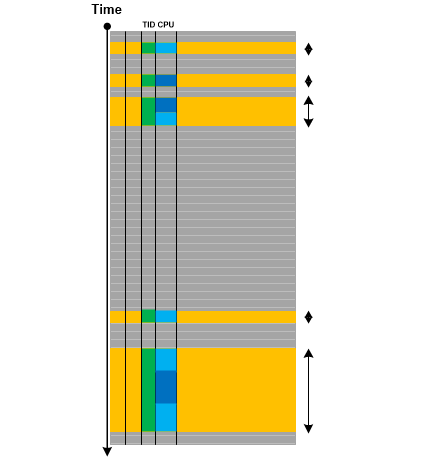
Having chosen a trace message, we are interested in its Message Context which can span all “continuous” messages before and after from the same Thread of Activity. We it Activity Quantum which is variable and independent from the so-called CPU quantums. Different messages from Activity Quantum may be executed on different CPUs. The following diagram depicts this analysis pattern:
- Dmitry Vostokov @ DumpAnalysis.org + TraceAnalysis.org -
Posted in Log Analysis, Software Trace Analysis, Trace Analysis Patterns | No Comments »
Wednesday, February 15th, 2017
Here we introduce Delay Dynamics analysis pattern. It is not an oxymoron and dynamics is referred to by what actually happens during the delay (Discontinuity with Time Delta) in other Threads of Activity as depicted in the following diagram:
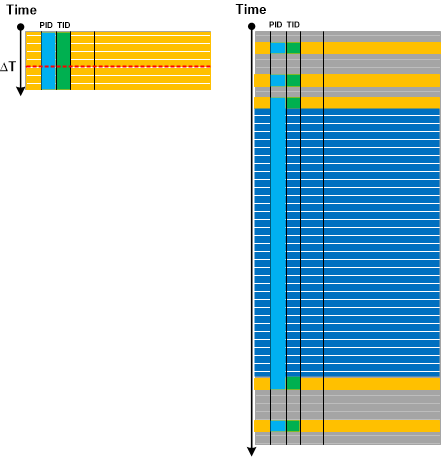
Instead of threads various Adjoint Threads of Activity may also be inspected.
- Dmitry Vostokov @ DumpAnalysis.org + TraceAnalysis.org -
Posted in Log Analysis, Software Trace Analysis, Trace Analysis Patterns | No Comments »
Tuesday, February 7th, 2017
One of the trace attributes we didn’t pay much attention to in the past is CPU. This column is present in some ETW-based trace implementations such as Citrix CDF traces. As any trace attribute, it can be used to form Adjoint Thread of Activity (as all messages from code executed on that particular CPU). As we already considered threads as braids, we use braid groups as a further metaphor. In our case we combine CPUs and threads into one group which uses permutation for CPU scheduling. Instead of permutations, twists may be modeled as changes of threads. The Braid Group analysis pattern is illustrated in the following diagram:
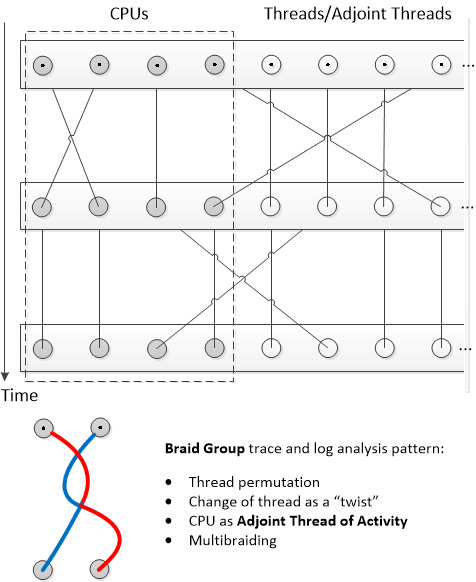
This is a preliminary description of the analysis pattern. We plan to elaborate on it in further case studies. For example, instead of multithreading we can use multibraiding.
- Dmitry Vostokov @ DumpAnalysis.org + TraceAnalysis.org -
Posted in CDF Analysis Tips and Tricks, Log Analysis, Software Trace Analysis, Trace Analysis Patterns | No Comments »
Monday, December 12th, 2016
Recently we found a correlation between software trace with high Statement Density and Current of Periodic Error with uniform Error Distribution and process heap Memory Leak suspected from memory dump analysis. If we metaphorically view periodic errors as “frequency” and the size of a heap as “mass” we may see that the growth of “frequency” correlates with the growth of “mass” and vice versa. Since frequency is inversely proportional to wave length we see a metaphorical analog to Louis de Broglie’s wave-particle duality. In general, as we already pointed in the discussion of narrativity and spatiality of software execution artifacts (see also Software Trace and Memory Dump Analysis seminar), software traces / logs and memory dumps can be seen as “dual” to each other according (metaphorically again) to de Broglie’s “duality of the laws of nature”. So we name this analysis pattern De Broglie Trace Duality since some memory dump regions can be considered of a general trace nature. Our correlation can be depicted in this diagram:
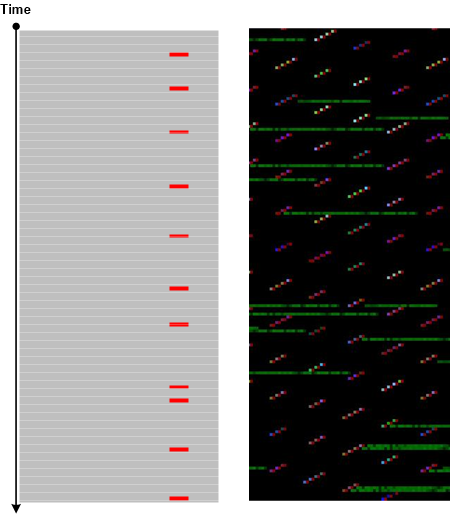
Practically, when we see Memory Consumption Patterns (but don’t know their source / root cause yet) we can ask for traces and logs, and in the case of frequent Periodic Errors found there we can suggest troubleshooting steps that may serve as a resolution or workaround.
- Dmitry Vostokov @ DumpAnalysis.org + TraceAnalysis.org -
Posted in Core Dump Analysis, Crash Dump Analysis, Crash Dump Patterns, Log Analysis, Root Cause Analysis, Software Trace Analysis, Trace Analysis Patterns, Trace Analysis and Physics | No Comments »
Wednesday, November 23rd, 2016
Considering and extending Trace Dimension to TID, ATID, and Time we use Poincaré section and Poincaré map analogies to introduce Poincaré Trace analysis pattern. We choose a value of one “coordinate”, for example, Time, and then form the new trace that consists of messages from different (A)TIDs that have the same timestamp as Time value or the last message(s) from other different ATIDs if they happened before section Time:
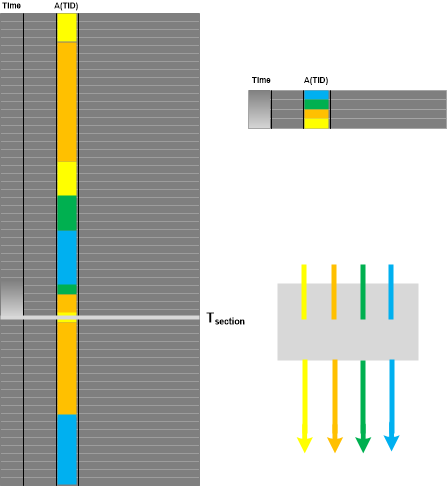
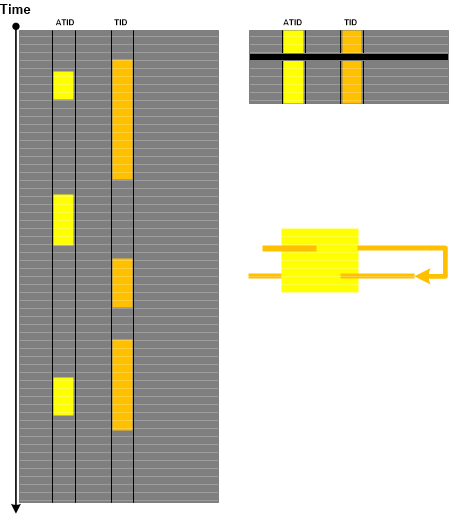
If we choose a different ATID than Time and TID, then Poincare Trace is equivalent to Adjoint Thread of Activity. If ATID is TID we have Thread of Activity as a trivial case. If we have Thread of Activity, we can choose some ATID and get Poincaré Trace as illustrated in the following diagram where the thick black line in the right Poincaré Trace represents Discontinuity and its Time Delta:
- Dmitry Vostokov @ DumpAnalysis.org + TraceAnalysis.org -
Posted in Log Analysis, Software Trace Analysis, Trace Analysis Patterns, Trace Analysis and Physics | No Comments »