Bugtation No.11
Tuesday, September 2nd, 2008The crash dump “is the message”.
- Dmitry Vostokov @ DumpAnalysis.org -
The crash dump “is the message”.
- Dmitry Vostokov @ DumpAnalysis.org -
“The great tragedy of” Software: “the slaying of a beautiful” program “by an ugly” bug.
Thomas Henry Huxley, Collected Essays
- Dmitry Vostokov @ DumpAnalysis.org -
Suppose we set up breakpoints to catch a random issue or at the end of a lengthy loop and we don’t want to sit tight, stare at the screen and wait for a debugger notification event. We just want to sit relaxed and read our favourite book or do something else. I discovered this meta-command where we can specify a wave file to be played every time a debugger breaks into a command prompt:
The .sound_notify command causes a sound to be played when WinDbg enters the wait-for-command state (from WinDbg help).
For example:
(15dc.dd0): Break instruction exception - code 80000003 (first chance)
eax=7ffde000 ebx=00000000 ecx=00000000 edx=77b3d094 esi=00000000 edi=00000000
eip=77af7dfe esp=01c6fbf4 ebp=01c6fc20 iopl=0 nv up ei pl zr na pe nc
cs=001b ss=0023 ds=0023 es=0023 fs=003b gs=0000 efl=00000246
ntdll!DbgBreakPoint:
77af7dfe cc int 3
windbg> .sound_notify /ef c:\Windows\Media\tada.wav
Sound notification: file 'c:\Windows\Media\tada.wav'
0:001> g
(15dc.175c): Break instruction exception - code 80000003 (first chance)
eax=7ffde000 ebx=00000000 ecx=00000000 edx=77b3d094 esi=00000000 edi=00000000
eip=77af7dfe esp=01cafc08 ebp=01cafc34 iopl=0 nv up ei pl zr na pe nc
cs=001b ss=0023 ds=0023 es=0023 fs=003b gs=0000 efl=00000246
ntdll!DbgBreakPoint:
77af7dfe cc int 3
[tada.wav is played when we break into]
- Dmitry Vostokov @ DumpAnalysis.org -
“If you find the” crash dump, “perhaps others may find the explanation.”
Sherlock Holmes, The Problem of Thor Bridge
- Dmitry Vostokov @ DumpAnalysis.org -
In the previous post about resolving security issues with crash dumps I mentioned the solution to use logs generated from memory dump files. In the case of process dumps the obvious step is to save logs by a postmortem debugger at the moment of the crash. Here WinDbg scripts come to the rescue. Suppose that CDB is set as a postmortem debugger (see Custom postmortem debuggers on Vista) and AeDebug \ Debugger registry key value is set to:
"C:\Program Files\Debugging Tools for Windows\cdb.exe" -p %ld -e %ld -g -y SRV*c:\mss*http://msdl.microsoft.com/download/symbols -c "$$><c:\WinDbgScripts\LogsAndDumps.txt;q"
Here we specify MS symbols server and the script file. The symbol path is absolutely necessary to have correct stack traces. The script file has the following contents:
.logopen /t c:\UserDumps\process.log
.kframes 100
!analyze -v
~*kv
lmv
.logclose
.dump /m /u c:\UserDumps\mini_process
.dump /ma /u c:\UserDumps\full_process
.dump /mrR /u c:\UserDumps\secure_mini_process
.dump /marR /u c:\UserDumps\secure_full_process
.kframes WinDbg meta-command is necessary to avoid the common pitfall of looking at cut off stack traces (see Mistake #1). In addition to logging the output of any command we want, the script writes 4 memory dumps of the same process:
- mini dump
- full dump
- secure mini dump
- secure full dump
My previous post WinDbg is privacy-aware explains secure dumps in detail. If you need to tailor dump file names and logs to include real process name might need to try the following or similar technique explained here:
Generating file name for .dump command
- Dmitry Vostokov @ DumpAnalysis.org -
“It requires a very unusual mind to undertake the analysis of the obvious” crash.
Alfred North Whitehead, Science and the Modern World
- Dmitry Vostokov @ DumpAnalysis.org -

.dump WinDbg command doesn’t have an option to include the process name although we can specify PID, date and time using /u option. This question came to me ages ago but only yesterday one of the visitors (Thomas B.) provided a hint to use aliases:
as /c CrashApp [get a module name here]
.dump /ma /u c:\UserDumps\${CrashApp}.dmp
Unfortunately an attempt to use lm command fails due to a line break in the output:
0:001> lmM *.exe 1m
notepad
0:001> as /c CrashApp lmM *.exe 1m
0:001> .dump /ma /u c:\UserDumps\${CrashApp}.dmp
Unable to create file 'c:\UserDumps\notepad
_06ec_2008-08-13_14-39-30-218_06cc.dmp‘ - Win32 error 0n123
“The filename, directory name, or volume label syntax is incorrect.”
After some thinking I recalled that .printf command doesn’t output line breaks. Also the module name can be extracted from _PEB structure if it is accessible. $peb pseudo-register can be used to get PEB address automatically. Therefore I came up with the following alias:
as /c CrashFirstModule .printf "%mu", @@c++((*(ntdll!_LDR_DATA_TABLE_ENTRY**)&@$peb->Ldr->InLoadOrderModuleList.Flink)->BaseDllName.Buffer)
0:001> as /c CrashFirstModule .printf "%mu", @@c++((*(ntdll!_LDR_DATA_TABLE_ENTRY**)&@$peb->Ldr->InLoadOrderModuleList.Flink)->BaseDllName.Buffer)
0:001> .dump /ma /u c:\UserDumps\${CrashFirstModule}.dmp
Creating c:\UserDumps\notepad.exe_06ec_2008-08-13_14-44-51-702_06cc.dmp - mini user dump
Dump successfully written
These commands can be included in a script for a postmortem debugger, for example, CDB.
- Dmitry Vostokov @ DumpAnalysis.org -
Yesterday I sent to print the first draft version with finalized covers for editing in situ. I usually do editing on the real book. Then error corrections and layout improvements can be done in real WYSIWYG hardcopy book mode. What’s new in Volume 2:
- 45 new crash dump analysis patterns
- Pattern interaction and case studies
- Updated checklist
- Fully cross-referenced with Volume 1
- New appendixes
I aim to publish paperback and digital versions on the 3st of October and hardcover version on the 1st of November. Table of Contents will be announced in soon.
Here’s the book cover:

Back cover features visualized virtual process memory generated from a memory dump of colorimetric computer memory dating sample using Dump2Picture.
- Dmitry Vostokov @ DumpAnalysis.org -

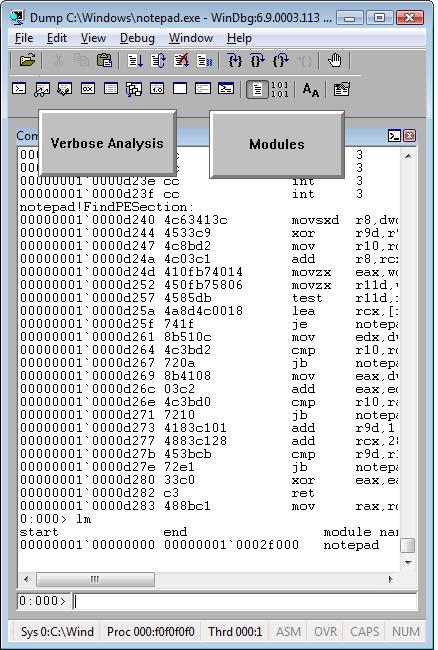
This is already written application (10 years ago by me) that I’m adapting as a high-level interface to WinDbg (can be any GUI debugger actually). The basic idea revolves around floating buttons (listbox and task bar icons, optionally) that dynamically change with every new window or application. The number of buttons can be unlimited, they have tooltips and can be repositioned to any corner of the screen, they can play sounds, show video and pictures. On click they execute elaborated macro commands, including keystrokes and mouse movements, written in a special scripting language. For example, we can create buttons for CDA checklist.
I’ve created 2 buttons for WinDbg window:

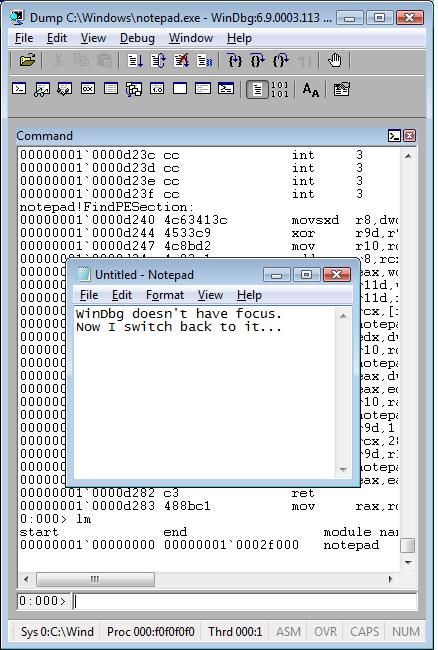
When we switch from WinDbg to another application they disappear:

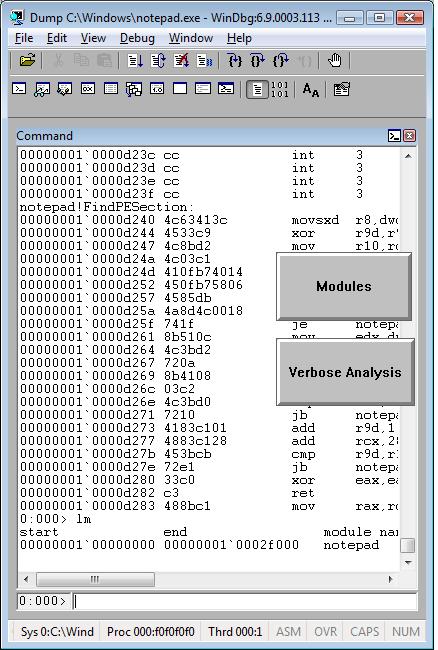
We switch back to WinDbg and they reappear. We can move them around the screen:

We can edit them by right click:

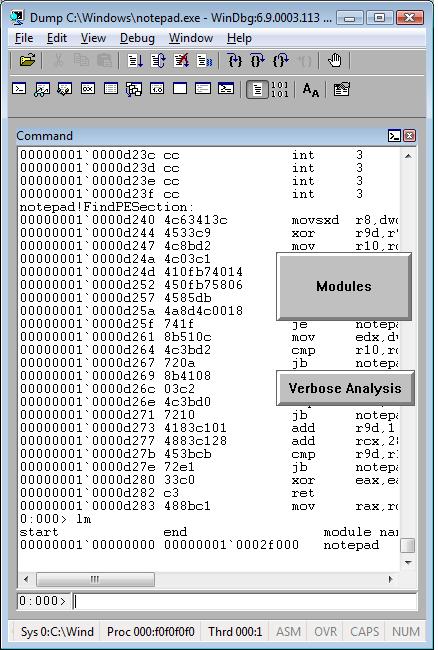
and change their shape:

The set of buttons can be saved as an executable file. When we run it on another PC it recreates all buttons when WinDbg window appears.
Written in C and using only Win32 API EasyDbg process consumes minimum resources. It sits on task bar for easy access:

- Dmitry Vostokov @ DumpAnalysis.org -
This is a new word I’ve just coined to describe applications heavily dependent on various hooks that are either injected by normal Windows hooking mechanism, registry or via more elaborate tricks like remote threads or patching code. Originally I thought of hookware but found that this term is already in use for completely different purpose.
Now I list various patterns in memory dumps that help in detection, troubleshooting and debugging of hooksware:
- Hooked Functions (user space)
- Hooked Functions (kernel space)
This is the primary detection mechanism for hooks that patch code.
See also Raw Pointer and Out-of-Module Pointer patterns.
The WinDbg script to run when you don’t know which module was patched.
Loaded hooks shift other DLLs by changing their load address and therefore might expose dormant bugs.
- Insufficient Memory (module fragmentation)
Hooks loaded in the middle of address space limit the maximum amount of memory that can be allocated at once. For example, various virtual machines, like Java, reserve the big chunk of memory at the start up.
We can get an approximate picture of what a 3rd-party hook module does by looking at its import table or in the case of patching by looking at the list of deviations returned by .chkimg command.
Might give an idea about the author of the hook.
- Coincidental Symbolic Information
Sometimes hooks are loaded at round addresses like 0×10000000 and these values are very frequently used as flags or constants too.
When hooking goes wrong the execution path goes into the wild territory.
Here we can find various hooks that use normal Windows hooking mechanism. Sometimes the search for “hook” word in symbolic raw stack output of dds command reveals them but beware of Coincidental Symbolic Information. See also Raw Stack Analysis Scripts page.
- Message Hooks - Modeling Example
Windows message hooking pattern example.
Some hooks may hide themselves.
- Dmitry Vostokov @ DumpAnalysis.org + TraceAnalysis.org -
Consider an application randomly crashing at different addresses or hanging sometimes. One day we are lucky to get this process postmortem memory dump:
This dump file has an exception of interest stored in it.
The stored exception information can be accessed via .ecxr.
(f34.c6c): Access violation - code c0000005 (first/second chance not available)
eax=73726946 ebx=00403378 ecx=656c2070 edx=656c2074 esi=00403374 edi=00000004
eip=7d64d233 esp=0012ff24 ebp=0012ff4c iopl=0 nv up ei pl nz ac pe cy
cs=0023 ss=002b ds=002b es=002b fs=0053 gs=002b efl=00010217
ntdll!RtlpWaitOnCriticalSection+0xdf:
7d64d233 ff4014 inc dword ptr [eax+14h] ds:002b:7372695a=????????
Aha! It involves critical sections! Let’s see whether we have an instance of Critical Section Corruption pattern. The first disappointment comes when !locks command takes ages to finish so we break it:
0:000> !locks
Stopped scanning because of control-C
Scanned 154686373 critical sections
Next we try to list all of them but without any success:
0:000> !locks -v
CritSec at 00000000 could not be read
Perhaps the critical section was a global variable in a dll that was unloaded?
CritSec at 00000000 could not be read
Perhaps the critical section was a global variable in a dll that was unloaded?
CritSec at 00000000 could not be read
Perhaps the critical section was a global variable in a dll that was unloaded?
CritSec at 00000000 could not be read
Perhaps the critical section was a global variable in a dll that was unloaded?
[...]
Next we look at stack trace to find critical section address:
0:000> kv
ChildEBP RetAddr Args to Child
0012ff4c 7d628576 64726f77 00000004 00000000 ntdll!RtlpWaitOnCriticalSection+0xdf
0012ff6c 00401074 00403374 00403394 00000001 ntdll!RtlEnterCriticalSection+0xa8
0012ff7c 004011e9 00000001 004d2fc0 004d3030 application!wmain+0×74
0012ffc0 7d4e7d2a 00000000 00000000 7efde000 application!__tmainCRTStartup+0×10f
0012fff0 00000000 00401332 00000000 00000000 kernel32!BaseProcessStart+0×28
0:000> dt CRITICAL_SECTION 00403374
application!CRITICAL_SECTION
+0×000 DebugInfo : 0×73726946 _RTL_CRITICAL_SECTION_DEBUG
+0×004 LockCount : 1701585008
+0×008 RecursionCount : 1919251571
+0×00c OwningThread : 0×20666f20
+0×010 LockSemaphore : 0×64726f77
+0×014 SpinCount : 0×73
It looks corrupt indeed so let’s see if it has ASCII fragments:
0:000> db 00403374
00403374 46 69 72 73 70 20 6c 65-73 74 65 72 20 6f 66 20 Firsp lester of
00403384 77 6f 72 64 73 00 00 00-00 00 00 00 02 00 00 00 words………..
[…]
0:000> da 00403374
00403374 “Firsp lester of words”
Looks like garbled sentence “First letter of words”. Who wrote this? Sherlock would say: “Elementary, my dear Watson”, take the first letters, literally: “First letter of words”. Flow component or a component with similar name causes corruption at random addresses! We can’t believe this, run lm WinDbg command and to our astonishment we see Flows module:
0:000> lm
start end module name
00400000 00405000 application
00410000 004ab000 advapi32
71c20000 71c32000 tsappcmp
75490000 754f5000 usp10
77ba0000 77bfa000 msvcrt
78130000 781cb000 msvcr80
7d4c0000 7d5f0000 kernel32
7d600000 7d6f0000 ntdll
7d800000 7d890000 gdi32
7d8d0000 7d920000 secur32
7d930000 7da00000 user32
7da20000 7db00000 rpcrt4
7dbc0000 7dbc9000 Flows
7dee0000 7df40000 imm32
Unloaded modules:
77b90000 77b98000 VERSION.dll
76920000 769e2000 USERENV.dll
71c40000 71c97000 NETAPI32.dll
771f0000 77201000 WINSTA.dll
770e0000 771e8000 SETUPAPI.dll
004e0000 00532000 SHLWAPI.dll
69500000 69517000 faultrep.dll
Checking the module information we see that it is the part of some unstable 3rd-party hookware and removing it solves the problem of elusive crashes. The problem solving power of Mind! The example is a bit contrived but my point here is that there are problems computers would never debug and troubleshoot. Answering the question of Dreyfus’ book “What computers still can’t do”: they still can’t debug…
- Dmitry Vostokov @ DumpAnalysis.org -
Sometimes the question arises about which postmortem debugger saved a crash dump resulted from an unhandled exception. For example, for pre-Vista systems the customer may believe that they used NTSD and but we know that properly configured NTSD as a default debugger never saves mini-dumps. However the WinDbg shows this:
Loading Dump File [application.mdmp]
User Mini Dump File: Only registers, stack and portions of memory are available
In the post Who calls the postmortem debugger? I showed that the default unhandled exception filter launches a default postmortem debugger. Because CreateProcess call needs a path and it is taken from AeDebug registry key the value is stored on a stack. So it is easy to dump the stack data, find UNICODE pattern and dump the string, This can be done using raw stack data or from the full exception processing stack trace where unhandled exception filter is present:
STACK_TEXT:
0dadc884 7c827cfb ntdll!KiFastSystemCallRet
0dadc888 77e76792 ntdll!NtWaitForMultipleObjects+0xc
0dadcb78 77e792a3 kernel32!UnhandledExceptionFilter+0×7c0
0dadcb80 77e61ac1 kernel32!BaseThreadStart+0×4a
0dadcba8 7c828752 kernel32!_except_handler3+0×61
0dadcbcc 7c828723 ntdll!ExecuteHandler2+0×26
0dadcc74 7c82855e ntdll!ExecuteHandler+0×24
0dadcc74 7c35042b ntdll!KiUserExceptionDispatcher+0xe
0dadcf70 0964a32a msvcr71!wcscpy+0xb
[…]
0:086> dds 0dadc884
0dadc884 7c828270 ntdll!_except_handler3
0dadc888 7c827cfb ntdll!NtWaitForMultipleObjects+0xc
0dadc88c 77e76792 kernel32!UnhandledExceptionFilter+0×7c0
0dadc890 00000002
0dadc894 0dadc9e8
0dadc898 00000001
0dadc89c 00000001
0dadc8a0 00000000
0dadc8a4 003a0043
0dadc8a8 0057005c
0dadc8ac 004e0049
0dadc8b0 004f0044
0dadc8b4 00530057
0dadc8b8 0073005c
0dadc8bc 00730079
0dadc8c0 00650074
0dadc8c4 0033006d
0dadc8c8 005c0032
0dadc8cc 00720064
0dadc8d0 00740077
0dadc8d4 006e0073
0dadc8d8 00320033
0dadc8dc 002d0020
0dadc8e0 00200070
0dadc8e4 00390032
0dadc8e8 00320035
0dadc8ec 002d0020
0dadc8f0 00200065
0dadc8f4 00300031
0dadc8f8 00380038
0dadc8fc 002d0020
0dadc900 00000067
0:086> du 0dadc8a4
0dadc8a4 "C:\WINDOWS\system32\drwtsn32 -p ”
0dadc8e4 “2952 -e 1088 -g”
- Dmitry Vostokov @ DumpAnalysis.org -
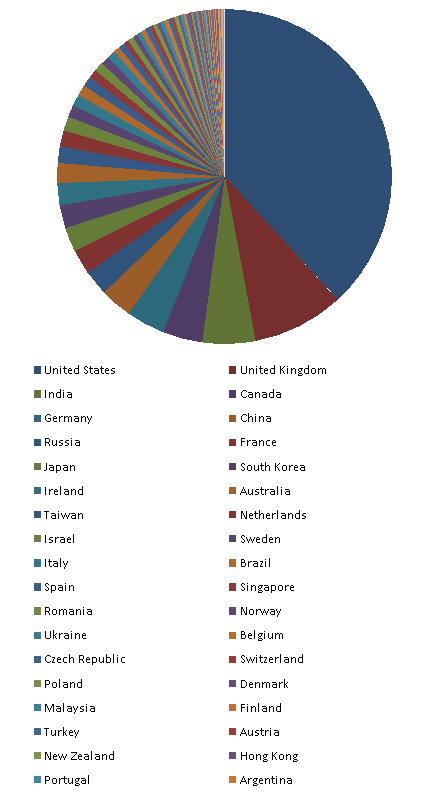
Hmm, I was looking at Google Analytics stats for dumpanalysis.org and here is the list of 154 visitor countries sorted by the decreasing number of visits (data for March - August, 2008):
United States
United Kingdom
India
Canada
Germany
China
Russia
France
Japan
South Korea
Ireland
Australia
Taiwan
Netherlands
Israel
Sweden
Italy
Brazil
Spain
Singapore
Romania
Norway
Ukraine
Belgium
Czech Republic
Switzerland
Poland
Denmark
Malaysia
Finland
Turkey
Austria
New Zealand
Hong Kong
Portugal
Argentina
South Africa
Belarus
Greece
(not set)
Philippines
Hungary
Bulgaria
Mexico
Slovakia
Malta
Serbia
Thailand
Croatia
Estonia
Vietnam
Lithuania
Slovenia
Bolivia
United Arab Emirates
Iran
Latvia
Indonesia
Pakistan
Iceland
Saudi Arabia
Egypt
Serbia and Montenegro
Chile
Colombia
Uruguay
Luxembourg
Peru
Morocco
Kazakhstan
Costa Rica
Jordan
Venezuela
Moldova
Cyprus
Jamaica
Algeria
Ecuador
Panama
Bangladesh
Puerto Rico
Sri Lanka
Bosnia and Herzegovina
Lebanon
Guatemala
Qatar
Kuwait
Tunisia
Mongolia
Syria
Guinea
Dominican Republic
Macedonia
Uzbekistan
Nepal
Bahrain
El Salvador
Palestinian Territory
Mauritius
Armenia
Barbados
Trinidad and Tobago
Georgia
Oman
Brunei
Nigeria
Kenya
Bermuda
Yemen
Cuba
Uganda
Bahamas
Netherlands Antilles
Iraq
Reunion
Maldives
Ghana
Ivory Coast
U.S. Virgin Islands
Guyana
Ethiopia
Andorra
Liechtenstein
Sudan
Namibia
Dominica
Saint Lucia
Seychelles
Angola
Guadeloupe
Libya
Paraguay
Cayman Islands
Gibraltar
Aruba
Laos
Somalia
New Caledonia
Zambia
Saint Vincent and the Grenadines
Montenegro
Congo - Kinshasa
Tanzania
Fiji
Azerbaijan
Faroe Islands
Botswana
Antigua and Barbuda
French Guiana
Myanmar
Grenada
Cambodia
Kyrgyzstan
Greenland
Here is the relative graph:

Another possible reason why North Korea is not on the list could be the total absence of Internet even in government and military institutions. Also note the presence of (not set) territory on the list. I suspect these are spies and other security and forensics professionals hiding their true location.
Other countries where people don’t know about memory dumps are:
Nicaragua
Honduras
Senegal
Western Sahara
Guinea-Bissau
Mauritania
Sierra Leone
Liberia
Mali
Burkina Faso
Benin
Niger
Chad
Cameroon
Gabon
Congo - Brazzaville
Central African Republic
Zimbabwe
Mozambique
Malawi
Madagascar
Afghanistan
Turkmenistan
Tajikistan
Papua New Guinea
They are depicted in red:

I’m thinking now about Memory Dump Awareness Index (MDAI) to assign to each country :-)
- Dmitry Vostokov @ DumpAnalysis.org -
Sometimes we look for modules that were loaded and unloaded at some time. lm command lists unloaded modules but some of them could be mapped to address space without using runtime loader. The latter case is common for drm-type protection tools, rootkits, malware or crimeware which can influence a process execution. In such cases we can hope that they still remain in virtual memory and search for them. WinDbg .imgscan command greatly helps in identifying MZ/PE module headers. The following example just illustrates this command without implying that the found module did any harm:
0:000> .imgscan
MZ at 000d0000, prot 00000002, type 01000000 - size 6000
Name: usrxcptn.dll
MZ at 00350000, prot 00000002, type 01000000 - size 9b000
Name: ADVAPI32.dll
MZ at 00400000, prot 00000002, type 01000000 - size 23000
Name: javaw.exe
MZ at 01df0000, prot 00000002, type 01000000 - size 8b000
Name: OLEAUT32.dll
MZ at 01e80000, prot 00000002, type 01000000 - size 52000
Name: SHLWAPI.dll
[…]
We don’t see usrxcptn in either loaded or unloaded module lists:
0:002> lm
start end module name
00350000 003eb000 advapi32
00400000 00423000 javaw
01df0000 01e7b000 oleaut32
01e80000 01ed2000 shlwapi
[...]
Unloaded modules:
This is why I call this pattern Hidden Module. We can use Unknown Component pattern to see the module resources if present in memory:
0:002> !dh 000d0000
[...]
SECTION HEADER #4
.rsrc name
418 virtual size
4000 virtual address
600 size of raw data
1600 file pointer to raw data
0 file pointer to relocation table
0 file pointer to line numbers
0 number of relocations
0 number of line numbers
40000040 flags
Initialized Data
(no align specified)
Read Only
[...]
0:002> dc 000d0000+4000 L418
[…]
000d4140 […] n…z.)…F.i.l.
000d4150 […] e.D.e.s.c.r.i.p.
000d4160 […] t.i.o.n…..U.s.
000d4170 […] e.r. .D.u.m.p. .
000d4180 […] U.s.e.r. .M.o.d.
000d4190 […] e. .E.x.c.e.p.t.
000d41a0 […] i.o.n. .D.i.s.p.
000d41b0 […] a.t.c.h.e.r…..
0:002> du 000d416C
000d416c "User Dump User Mode Exception Di"
000d41ac "spatcher"
This component seems to be loaded or mapped only if userdump package was fully installed where usrxcptn.dll is a part of its redistribution. Although from the memory dump comment we also see that the dump was taken manually using command line userdump.exe we see that the full userdump package was additionally installed which was probably not necessary (see Correcting Microsoft article about userdump.exe):
Loading Dump File [javaw.dmp]
User Mini Dump File with Full Memory: Only application data is available
Comment: 'Userdump generated complete user-mode minidump with Standalone function on COMPUTER-NAME'
- Dmitry Vostokov @ DumpAnalysis.org -
One of the users got these errors when opening a few crash dumps:
[...]
Ignored in-page I/O error
Exception 0xc0000006 while accessing file mapping
Unable to read KLDR_DATA_TABLE_ENTRY at 8a3dd228 - NTSTATUS 0xC0000006
Ignored in-page I/O error
[...]
He was wondering whether something was wrong with his disk or network drive mapping where they were stored or this was another sign of Corrupt Dump pattern. I also noticed these errors when I keep dump files open for weeks and then come back to them. So my conclusion was to advise him to close and open new drive mappings and/or reopen dump files.
- Dmitry Vostokov @ DumpAnalysis.org -
Sometimes a dump file looks normal inside and at least we don’t see any suspicious past activity. However, as it often happens, the dump was saved manually as a response to some failure. Here Last Error Collection might help in finding further troubleshooting suggestions. If we have a process memory dump we can get all errors and NTSTATUS values at once using !gle command with -all parameter:
0:000> !gle -all
Last error for thread 0:
LastErrorValue: (Win32) 0x3e5 (997) - Overlapped I/O operation is in progress.
LastStatusValue: (NTSTATUS) 0x103 - The operation that was requested is pending completion.
Last error for thread 1:
LastErrorValue: (Win32) 0 (0) - The operation completed successfully.
LastStatusValue: (NTSTATUS) 0 - STATUS_WAIT_0
Last error for thread 2:
LastErrorValue: (Win32) 0 (0) - The operation completed successfully.
LastStatusValue: (NTSTATUS) 0 - STATUS_WAIT_0
Last error for thread 3:
LastErrorValue: (Win32) 0 (0) - The operation completed successfully.
LastStatusValue: (NTSTATUS) 0 - STATUS_WAIT_0
[...]
Last error for thread 28:
LastErrorValue: (Win32) 0 (0) - The operation completed successfully.
LastStatusValue: (NTSTATUS) 0 - STATUS_WAIT_0
Last error for thread 29:
LastErrorValue: (Win32) 0×6ba (1722) - The RPC server is unavailable.
LastStatusValue: (NTSTATUS) 0 - STATUS_WAIT_0
Last error for thread 2a:
LastErrorValue: (Win32) 0 (0) - The operation completed successfully.
LastStatusValue: (NTSTATUS) 0 - STATUS_WAIT_0
Last error for thread 2b:
LastErrorValue: (Win32) 0 (0) - The operation completed successfully.
LastStatusValue: (NTSTATUS) 0 - STATUS_WAIT_0
[...]
For complete memory dumps we can employ the following command or similar to it:
!for_each_thread ".thread /r /p @#Thread; .if (@$teb != 0) { !teb; !gle; }"
0: kd> !for_each_thread ".thread /r /p @#Thread; .if (@$teb != 0) { !teb; !gle; }"
[...]
Implicit thread is now 8941eb40
Implicit process is now 8a4ac498
Loading User Symbols
TEB at 7ff3e000
ExceptionList: 0280ffa8
StackBase: 02810000
StackLimit: 0280b000
SubSystemTib: 00000000
FiberData: 00001e00
ArbitraryUserPointer: 00000000
Self: 7ff3e000
EnvironmentPointer: 00000000
ClientId: 00001034 . 000012b0
RpcHandle: 00000000
Tls Storage: 00000000
PEB Address: 7ffde000
LastErrorValue: 0
LastStatusValue: c00000a3
Count Owned Locks: 0
HardErrorMode: 0
LastErrorValue: (Win32) 0 (0) - The operation completed successfully.
LastStatusValue: (NTSTATUS) 0xc00000a3 - {Drive Not Ready} The drive is not ready for use; its door may be open. Please check drive %hs and make sure that a disk is inserted and that the drive door is closed.
[...]
- Dmitry Vostokov @ DumpAnalysis.org -
More than a year ago I wrote a post about checking computer name in various memory dump types:
Where did the crash dump come from?
Today I found yet another shortcut for process memory dumps using WinDbg command !envvar:
0:003> !envvar COMPUTERNAME
COMPUTERNAME = MYHOMEPC
Of course, we can use it for any other variable. It also works for complete memory dumps but we need to set the appropriate process context first:
3: kd> !envvar PATH
PATH = C:\WINDOWS\system32;C:\WINDOWS;[...]
- Dmitry Vostokov @ DumpAnalysis.org -
I always have 10-20 or more simultaneously opened debugging sessions (mostly crash dump files) and sometimes I quit the wrong one accidentally or by mistake. After that I have to repeat some commands if I forgot to open a log file. I was very pleased to find today that there is a special WinDbg meta-command that prevents you from such accidents:
.quit_lock command sets a password to prevent you from accidentally ending the debugging session (from WinDbg help).
Here is an example:
0:001> .quit_lock
No quit lock
0:001> .quit_lock /s "password"
Quit lock string is 'password'
0:001> q
.quit_lock -q required to unlock 'q'
0:001> .quit_lock -q "password"
Quit lock removed
- Dmitry Vostokov @ DumpAnalysis.org -
This model was inspired by Large Hadron Collider (LHC) and NV’s Debugon. It is a simply-symmetrical model consisting of Bugluon - Debugluon pair of particles where one is a particle and the other is the corresponding antiparticle. The interaction between them is completely of non-gravitational nature. When they annihilate we get the light at the end of a long debugging tunnel, called Large Hard-debugging Collider (LHC). A bugluon particle moving in memory space usually leaves traces and various defects. A photographic picture of tracks left by bugluons is called a memory space dump. The analysis of various track patterns is called memory dump analysis
- Dmitry Vostokov @ DumpAnalysis.org -
This is a proposal for Debug Awards from Narasimha Vedala:
OSCAR parallel in debugging world - Pointer Award

- Dmitry Vostokov @ DumpAnalysis.org -