Archive for the ‘Software Trace Analysis’ Category
Sunday, March 11th, 2012
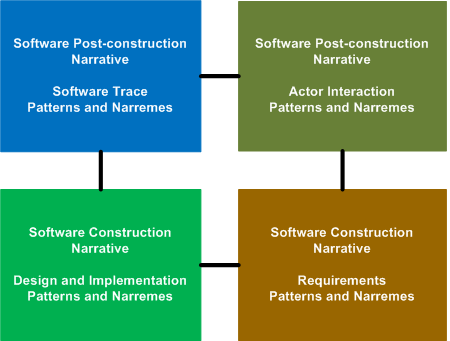
After introducing software narrative planes it is logical to expand the field of software narratology to cover the whole domain of software construction and post-construction. We therefore combine both pairs of planes to create a narratological square:
Please also register for the forthcoming free Webinar: Introduction to Software Narratology where I plan to provide a coherent overview of the recent developments in this new field.
- Dmitry Vostokov @ DumpAnalysis.org + TraceAnalysis.org -
Posted in Computer Science, Debugging, Science of Software Tracing, Software Engineering, Software Narrative Science, Software Narratology, Software Narremes, Software Problem Description Patterns, Software Problem Solving, Software Trace Analysis | No Comments »
Sunday, March 11th, 2012
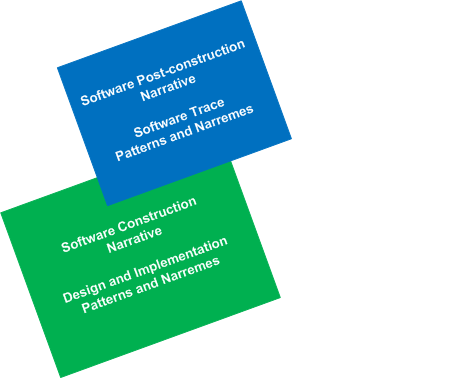
Based on an idea of expression and content planes from glossematics with a basic unit of glosseme we can organize software traces with corresponding patterns and software trace narremes (basic units of software narrative such as traces and event logs) into 2 planes: software trace narrative plane (expression) with narremes and the corresponding program lines of traces (PLOTs) source code and design plane (content) with their own set of construction narremes such as collaboration of software constructs. All this corresponds to the following diagram:
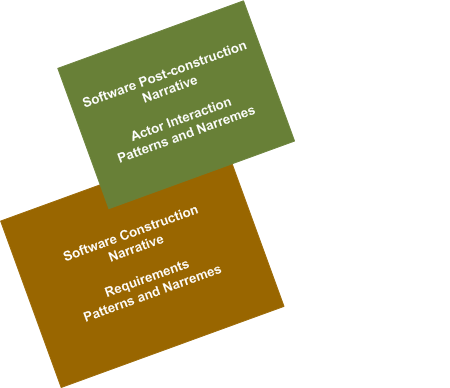
The same can be said about actor interaction level of software construction (what ought to be) and post-construction (what is) phases having their own construction and post-construction narratives, patterns and narremes such as in requirements (use cases) and in problem and software incident descriptions:
In the forthcoming articles I provide more examples and explanations including specific software narremes useful from the practical post-construction software problem solving perspective. Please also register for the forthcoming free Webinar: Introduction to Software Narratology where I plan to provide a coherent overview of this new field.
- Dmitry Vostokov @ DumpAnalysis.org + TraceAnalysis.org -
Posted in Computer Science, Science of Software Tracing, Software Narratology, Software Narremes, Software Problem Solving, Software Trace Analysis, Software Trace Linguistics | No Comments »
Monday, February 20th, 2012
I was recently asked by a group of trainees to outline a simple approach to proceed after opening a memory dump. So I came up with these 7 steps:
1. !analyze -v [-hang]
2. Exception (Bugcheck): stack trace analysis with d* and lmv
3. !locks
4. !runaway f (!running)
5. Dump all (processes and) thread stack traces [with 32-bit] ~*kv (!process 0 ff)
6. Search for signs/patterns of abnormal behavior (exceptions, wait chains, message boxes [, from your custom checklist])
7. Narrow analysis down to a specific thread and dump raw stack data if needed [repeat*]
(commands/options in brackets denote kernel/complete dump variation)
[notes in square brackets denote additional options, such as x64 specifics, your product details, etc.]
What are your steps? I would be interested to hear about alternative analysis steps, techniques, etc.
- Dmitry Vostokov @ DumpAnalysis.org + TraceAnalysis.org -
Posted in Announcements, Best Practices, Complete Memory Dump Analysis, Crash Dump Analysis, Crash Dump Patterns, Debugging, Debugging Methodology, Memory Dump Analysis Methodology, Root Cause Analysis, Software Trace Analysis, WinDbg Tips and Tricks, x64 Windows | 1 Comment »
Sunday, February 19th, 2012
Memory Dump Analysis Services (DumpAnalysis.com) organizes a free Webinar about software narratology: an application of ideas from narratology to software narrative stories.

Learn about this exciting new discipline and a field of research. When software executes it gives us its stories in the form of UI events, software traces and logs. Such stories can be analyzed for their structure and patterns for troubleshooting, debugging and problem resolution purposes.
Prerequisites: basic software troubleshooting and ability to read software generated logs.
Audience: anyone can benefit from this new perspective: from software users to software engineers and managers.
Space is limited.
Reserve your Webinar seat now at:
https://www3.gotomeeting.com/register/603136294
- Dmitry Vostokov @ DumpAnalysis.org + TraceAnalysis.org -
Posted in Announcements, Computer Science, Debugging, Escalation Engineering, Intelligence Analysis Patterns, Memory Dump Analysis Services, SPDL, Science of Software Tracing, Security, Software Behavior DNA, Software Behavior Patterns, Software Behavioral Genome, Software Engineering, Software Narrative Fiction, Software Narratology, Software Problem Description Patterns, Software Problem Solving, Software Technical Support, Software Trace Analysis, Software Trace Deconstruction, Software Trace Linguistics, Software Trace Modeling, Software Trace Reading, Software Trace Visualization, Software Tracing Implementation Patterns, Software Tracing for Dummies, Software Troubleshooting Patterns, Software Victimology, Structural Trace Patterns, Testing, Tools, Trace Analysis Patterns, Troubleshooting Methodology, UI Problem Analysis Patterns, Unified Debugging Patterns, Unit Testing, Victimware, Webinars, Windows System Administration | No Comments »
Friday, February 17th, 2012
In narratology anti-narrative denotes a narrative having sequences of events impossible in reality. In software traces such sequences usually depict abnormal software behaviour. Here are some parallels with corresponding trace analysis patterns:
Fiction                             | Software Trace

================================================

Repeated unrepeatable       | Periodic Error (?)

Denarration (erasure)            | No Activity / Incomplete History

Chronological contradiction | Impossible Trace
Question mark means that possibly another pattern is needed there.
- Dmitry Vostokov @ DumpAnalysis.org + TraceAnalysis.org -
Posted in Crash Dump Analysis, Crash Dump Patterns, Debugging, Software Behavior Patterns, Software Narrative Fiction, Software Narratology, Software Trace Analysis, Trace Analysis Patterns | No Comments »
Thursday, February 2nd, 2012
Forthcoming Accelerated Software Trace Analysis training requires extensive real life like software logs with multiple software behaviour patterns. The similar accelerated memory dump analysis trainings (unmanaged / native Windows and .NET) also required good memory dumps but this problem was solved by modeling patterns of abnormal software behaviour in an appropriate implementation language such as C++ and C#. Modeling software traces with hundreds of software components, processes and threads would require enormous programming efforts. Therefore, the natural approach is to describe a desired software trace in some declarative language (or minimally imperative) and get a million line software log that models a specific combination of trace analysis patterns. So, welcome to such a language called Narralog: Software Narrative Log or Narrative Logic. Please note that this language is different from Riemann programming language which is a language to describe software problems and generate software problem solving tools. Language details and whether a kind of a Metadefect Template Library will be used to implement Narralog or simple macroprogramming is suffice will be decided and announced when we further develop our training.
- Dmitry Vostokov @ DumpAnalysis.org + TraceAnalysis.org -
Posted in Metadefect Template Library, Narralog Programming Language, Riemann Programming Language, SPDL, Software Behavior DNA, Software Behavior Patterns, Software Behavioral Genome, Software Defect Construction, Software Engineering, Software Narrative Fiction, Software Narratology, Software Problem Solving, Software Trace Analysis, Software Trace Modeling, Software and Modeling, Trace Analysis Patterns | No Comments »
Thursday, February 2nd, 2012
John Randall’s blog about narratology and narremes suggested me to elaborate on a basic software trace (log) unit. One candidate is a trace message invariant, a skeleton trace message similar to a format string. There is also a corresponding software trace analysis pattern called Message Invariant. Although, this might be too an elementary unit akin to a sentence level and another candidate is a macromessage, a combination of several messages serving some semantic function. There is a corresponding general pattern Macrofunction and an example concrete analysis pattern called Exception Stack Trace. The actual software narreme might be situated between these two extremes: invariants and macrofunctions.
If you are new to a software narratology field please look at these posts placed in chronological order (except a pattern catalog):
- Dmitry Vostokov @ DumpAnalysis.org + TraceAnalysis.org -
Posted in Software Narratology, Software Trace Analysis, Trace Analysis Patterns | No Comments »
Tuesday, January 31st, 2012
Memory Dump Analysis Services starts providing debugging training and assistance in addition to (based on) memory dump and software trace analysis. It has recently registered www.debugging.pro domain and is working on extending its courses to cover live debugging and additional OS platforms this year.
- Dmitry Vostokov @ DumpAnalysis.org + TraceAnalysis.org -
Posted in .NET Debugging, Android Crash Corner, Announcements, Crash Dump Analysis, Debugging, Debugging Bureau, Debugging Methodology, Debugging Today, Debugging Trends, Linux Crash Corner, Live Debugging, Mac Crash Corner, Memory Dump Analysis Services, Software Debugging Services, Software Trace Analysis, Training and Seminars | No Comments »
Sunday, January 22nd, 2012
I have discovered that Romantic era music is good for debugging, memory dump and software trace analysis sessions. Previously I included Beethoven and now suggest to listen to Schumann. For a starter you can try this album: Schumann: Symphonies Nos. 1-4

- Dmitry Vostokov @ DumpAnalysis.org + TraceAnalysis.org -
Posted in Debugging, Music for Debugging, Software Trace Analysis | No Comments »
Saturday, January 21st, 2012
According to Google Analytics the number of visits / year increased by 4% since 2010 with almost 160,000 unique visitors (2% increase) from 180 countries and 34% of them are coming back. 2,725 visits were via 12 mobile operating systems (106% increase). Here are the top 100 network locations out of 28,932:
| Service Provider |
Visits
|
| microsoft corp |
5,292
|
| comcast cable communications inc. |
3,596
|
| internet service provider |
3,509
|
| road runner holdco llc |
3,314
|
| verizon online llc |
2,597
|
| comite gestor da internet no brasil |
2,557
|
| hewlett-packard company |
2,546
|
| ip pools |
2,222
|
| deutsche telekom ag |
2,160
|
| japan network information center |
2,109
|
| chunghwa telecom data communication business group |
1,632
|
| intel corporation |
1,518
|
| uunet non-portable customer assignment |
1,312
|
| qwest communications company llc |
1,202
|
| symantec corporation |
1,170
|
| charter communications |
1,110
|
| at&t internet services |
1,108
|
| emc corporation |
1,099
|
| network of citrix systems inc |
1,093
|
| broadband multiplay project o/o dgm bb noc bsnl bangalore |
1,063
|
| abts (karnataka) |
1,043
|
| comcast cable communications holdings inc |
986
|
| eircom |
919
|
| this space is statically assigned. |
918
|
| chinanet guangdong province network |
900
|
| cox communications |
896
|
| korea telecom |
895
|
| proxad / free sas |
886
|
| comcast business communications llc |
845
|
| tw telecom holdings inc. |
825
|
| china unicom beijing province network |
816
|
| psinet inc. |
811
|
| kaspersky lab internet |
734
|
| telstra internet |
716
|
| chinanet shanghai province network |
664
|
| comcast cable communications |
652
|
| honeywell international inc. |
641
|
| cisco systems inc. |
637
|
| shaw communications inc. |
629
|
| cox communications inc. |
627
|
| xo communications |
618
|
| ntt communications corporation |
604
|
| optimum online (cablevision systems) |
597
|
| microsoft |
595
|
| symantec |
590
|
| krnic |
589
|
| citrix systems inc. |
571
|
| chtd chunghwa telecom co. ltd. |
557
|
| telefonica de espana sau |
547
|
| this space is statically assigned |
543
|
| dynamic ip pool for broadband customers |
538
|
| frontier communications of america inc. |
523
|
| computer associates international |
501
|
| appense |
479
|
| telus communications inc. |
473
|
| unknown |
473
|
| research in motion limited |
469
|
| singnet pte ltd |
458
|
| customers ie |
457
|
| arcor ag |
454
|
| chinanet jiangsu province network |
448
|
| sympatico hse |
445
|
| suddenlink communications |
435
|
| nib (national internet backbone) |
429
|
| comcast cable communications ip services |
426
|
| rcs & rds s.a. |
425
|
| dynamic pools |
421
|
| siemens ag |
419
|
| mcafee inc. |
410
|
| iinet limited |
409
|
| smart comp. a.s. |
406
|
| eset s.r.o. |
400
|
| tpg internet pty ltd. |
393
|
| ziggo consumers |
390
|
| ncc#2011011865 approved ip assignment |
383
|
| ibm india private limited |
373
|
| abts tamilnadu |
355
|
| pt telkom indonesia |
340
|
| tata teleservices ltd - tata indicom - cdma division |
336
|
| pacnet services (japan) corp. |
334
|
| opera software asa |
333
|
| core ip development |
332
|
| easynet ltd |
327
|
| mcafee |
313
|
| global crossing |
312
|
| uecomm |
311
|
| wipro technologies |
310
|
| mtnl cat b isp |
306
|
| upc polska sp. z o.o. |
305
|
| integra telecom inc. |
304
|
| videotron ltee |
299
|
| network of ign arch. and design gb |
297
|
| rcom-wireless-hsd-mumbai |
292
|
| scansafe inc. |
292
|
| hutchison global communications |
285
|
| upc slovakia |
279
|
| gesti n de direccionamiento uninet |
278
|
| bellsouth.net inc. |
277
|
| starhub cable vision ltd |
271
|
| las colinas microsoft |
268
|
Top 25 visiting countries:
| Country/Territory |
Visits
|
| United States |
67,799
|
| India |
22,266
|
| United Kingdom |
17,258
|
| Russia |
11,094
|
| Germany |
10,244
|
| China |
8,928
|
| Canada |
7,569
|
| France |
5,551
|
| Japan |
4,944
|
| Australia |
4,792
|
| South Korea |
4,279
|
| Taiwan |
3,845
|
| Ukraine |
3,315
|
| Netherlands |
3,176
|
| Israel |
2,791
|
| Poland |
2,781
|
| Brazil |
2,773
|
| Italy |
2,701
|
| Spain |
2,623
|
| Ireland |
2,592
|
| Romania |
2,391
|
| Czech Republic |
2,359
|
| Singapore |
2,307
|
| Sweden |
2,255
|
| Finland |
1,800
|
More than 8,000 portal and blog pages were viewed a total of more than 392,000 times with top 100 content pages:
| Page |
Pageviews
|
| / |
39,456
|
| /blog/ |
30,649
|
| /blog/index.php/2007/06/20/crash-dump-analysis-checklist/ |
7,596
|
| /blog/index.php/category/windbg-tips-and-tricks/ |
7,406
|
| /blog/index.php/2008/01/10/what-is-kifastsystemcallret/ |
5,553
|
| /blog/index.php/2008/09/12/adplus-in-21-seconds-and-13-steps/ |
4,179
|
| /blog/index.php/2007/07/20/crash-dump-analysis-patterns-part-17/ |
3,712
|
| /blog/index.php/category/minidump-analysis/ |
3,393
|
| /blog/index.php/category/windows-7/ |
3,012
|
| /blog/index.php/2007/09/17/resolving-symbol-file-could-not-be-found/ |
2,932
|
| /blog/index.php/2007/09/06/minidump-analysis-part-2/ |
2,859
|
| /Tools |
2,632
|
| /Memory+Dump+Analysis+Anthology+Volume+5 |
2,507
|
| /blog/index.php/category/windbg-scripts/ |
2,444
|
| /ru/blog/ |
2,337
|
| /blog/index.php/category/windows-server-2008/ |
2,262
|
| /blog/index.php/2008/03/13/crash-dump-analysis-patterns-part-2b/ |
2,196
|
| /blog/index.php/2006/10/31/crash-dump-analysis-patterns-part-2/ |
2,182
|
| /blog/index.php/2008/04/22/bugchecks-system_service_exception/ |
2,073
|
| /blog/index.php/2007/09/11/crash-dump-analysis-patterns-part-26/ |
1,998
|
| /blog/index.php/2008/01/24/crash-dump-analysis-patterns-part-43/ |
1,986
|
| /blog/index.php/2007/04/03/crash-dump-analysis-patterns-part-11/ |
1,960
|
| /blog/index.php/2007/10/11/minidump-analysis-part-4/ |
1,938
|
| /blog/index.php/category/gdb-for-windbg-users/ |
1,928
|
| /blog/index.php/2006/12/09/clipboard-issues-explained/ |
1,922
|
| /blog/index.php/about/ |
1,863
|
| /blog/index.php/2006/10/30/crash-dump-analysis-patterns-part-1/ |
1,803
|
| /FCMDA-book |
1,800
|
| /mda-learning-speed |
1,793
|
| /blog/index.php/2007/02/02/crash-dump-analysis-patterns-part-8/ |
1,753
|
| /Memory+Dump+Analysis+Anthology+Volume+1 |
1,746
|
| /blog/index.php/2007/04/25/bugchecks-system_thread_exception_not_handled/ |
1,712
|
| /blog/index.php/2007/02/09/crash-dump-analysis-patterns-part-9a/ |
1,705
|
| /blog/index.php/2007/08/06/crash-dump-analysis-patterns-part-20a/ |
1,661
|
| /blog/index.php/category/windbg-tips-and-tricks/page/2/ |
1,661
|
| /blog/index.php/2008/03/12/bug-check-frequencies/ |
1,646
|
| /blog/index.php/2007/10/17/crash-dump-analysis-patterns-part-31/ |
1,615
|
| /blog/index.php/2007/03/04/windbg-tips-and-tricks-analyzing-hangs-faster/ |
1,605
|
| /blog/index.php/basic-windows-crash-dump-analysis/ |
1,600
|
| /blog/index.php/2007/07/15/interrupts-and-exceptions-explained-part-4/ |
1,591
|
| /blog/index.php/category/bugchecks-depicted/ |
1,584
|
| /blog/index.php/2007/08/29/minidump-analysis-part-1/ |
1,508
|
| /blog/index.php/2008/06/12/crash-dump-analysis-patterns-part-59b/ |
1,479
|
| /blog/index.php/crash-dump-analysis-patterns/ |
1,456
|
| /blog/index.php/2008/03/08/time-travel-debugging/ |
1,453
|
| /ru/blog/index.php/category/komandy-otladchika-windbg/ |
1,420
|
| /WinDbg+reference |
1,396
|
| /blog/index.php/crash-dump-examples/ |
1,358
|
| /advanced-software-debugging-reference |
1,347
|
| /blog/index.php/category/windbg-tips-and-tricks/page/6/ |
1,317
|
| /ru/blog/index.php/page/2/ |
1,314
|
| /blog/index.php/2010/01/08/live-kernel-debugging-of-a-system-freeze-case-study/ |
1,298
|
| /Forthcoming+Windows+Debugging+Notebook |
1,285
|
| /Crash+Dump+Analysis+for+System+Administrators |
1,278
|
| /blog/index.php/2007/03/03/windbg-tips-and-tricks-hypertext-commands/ |
1,240
|
| /accelerated-windows-memory-dump-analysis |
1,191
|
| /blog/index.php/2007/06/21/crash-dump-analysis-patterns-part-16a/ |
1,178
|
| /blog/index.php/category/cartoons/ |
1,157
|
| /blog/index.php/category/windbg-tips-and-tricks/page/7/ |
1,128
|
| /blog/index.php/2008/06/26/heuristic-stack-trace-in-windbg-693113/ |
1,114
|
| /blog/index.php/2007/12/17/crash-dump-analysis-patterns-part-41b/ |
1,106
|
| /blog/index.php/category/mac-crash-corner/ |
1,082
|
| /blog/index.php/2007/05/19/resurrecting-dr-watson-on-vista/ |
1,036
|
| /blog/index.php/category/bugchecks-depicted/page/2/ |
976
|
| /blog/index.php/2007/02/10/crash-dump-analysis-in-visual-studio-2005/ |
947
|
| /blog/index.php/category/dump-analysis/ |
937
|
| /blog/index.php/2008/05/09/windbg-cheat-sheet-for-crash-dump-analysis/ |
931
|
| /arts-photography-links |
917
|
| /blog/index.php/2008/04/03/crash-dump-analysis-patterns-part-57/ |
915
|
| /blog/index.php/2007/06/21/repair-clipboard-chain-201/ |
880
|
| /blog/index.php/automated-analysis/ |
848
|
| /blog/index.php/2007/07/25/reconstructing-stack-trace-manually/ |
844
|
| /Forthcoming+Windows+Debugging:+Practical+Foundations |
841
|
| /Memory+Dump+Analysis+Anthology+Volume+4 |
831
|
| /blog/index.php/2007/09/ |
828
|
| /blog/index.php/2007/09/14/crash-dump-analysis-patterns-part-27/ |
819
|
| /museum-debugging |
813
|
| /blog/index.php/dumps-for-dummies/ |
810
|
| /blog/index.php/2007/08/19/crash-dump-analysis-patterns-part-23a/ |
807
|
| /blog/index.php/2007/08/04/visualizing-memory-dumps/ |
797
|
| /blog/index.php/2007/11/02/crash-dump-analysis-patterns-part-13c/ |
785
|
| /blog/index.php/2008/01/02/how-to-distinguish-between-1st-and-2nd-chances/ |
784
|
| /blog/index.php/2008/05/08/stl-and-windbg/ |
780
|
| /blog/index.php/2007/05/20/custom-postmortem-debuggers-on-vista/ |
764
|
| /blog/index.php/2007/10/01/windows-service-crash-dumps-on-vista/ |
760
|
| /blog/index.php/category/linux-crash-corner/ |
748
|
| /blog/index.php/memory-dump-analysis-interview-questions/ |
746
|
| /blog/index.php/2007/12/19/crash-dump-analysis-patterns-part-42b/ |
723
|
| /blog/index.php/2007/10/30/object-names-and-waiting-threads/ |
720
|
| /blog/index.php/2006/10/09/dumps-for-dummies-part-1/ |
700
|
| /blog/index.php/category/windbg-scripts/page/2/ |
693
|
| /node?page=1 |
687
|
| /Forthcoming+Memory+Dump+Analysis+Anthology+Volume+2 |
686
|
| /blog/index.php/2006/10/ |
680
|
| /blog/index.php/2008/10/15/crash-dump-analysis-patterns-part-1b/ |
680
|
| /blog/index.php/2006/11/01/crash-dump-analysis-patterns-part-3/ |
677
|
| /blog/index.php/2007/12/12/crash-dump-analysis-patterns-part-41a/ |
676
|
| /blog/index.php/category/net-debugging/ |
675
|
| /blog/index.php/2007/07/15/crash-dump-analysis-patterns-part-13b/ |
674
|
| /blog/index.php/category/windbg-scripts/page/3/ |
667
|
More than 70,000 Google search keywords pointed to the portal and this blog with 100 most frequent (some are in Russian):
| Keyword |
Visits
|
| crash dump |
2,485
|
| crash dump analysis |
2,042
|
| kifastsystemcallret |
1,881
|
| nt!_gshandlercheck_seh |
1,111
|
| adplus |
1,099
|
| dump analysis |
894
|
| ntdll!kifastsystemcallret |
640
|
| windbg |
595
|
| bugcheck 3b |
570
|
| win32 error 0n2 |
551
|
| memory dump analysis |
526
|
| symbol file could not be found |
405
|
| windbg commands |
393
|
| dmitry vostokov |
385
|
| dumpanalysis.org |
361
|
| fnodobfm |
361
|
| system_thread_exception_not_handled |
338
|
| adplus download |
336
|
| crash dump analyzer |
328
|
| crash dump windows 7 |
326
|
| windbg crash dump analysis |
320
|
| kisystemservicecopyend |
317
|
| idna trace |
306
|
| dumpanalysis |
301
|
| minidump analysis |
288
|
| warning: frame ip not in any known module. following frames may be wrong. |
264
|
| crash dumps |
253
|
| windows 7 crash dump |
250
|
| crashdump |
244
|
| frame ip not in any known module |
239
|
| adplus tutorial |
237
|
| memory dump analysis anthology |
235
|
| core dump analysis |
224
|
| windbg script |
217
|
| kiuserexceptiondispatcher |
213
|
| application_fault_status_breakpoint |
211
|
| pool corruption |
192
|
| exception_double_fault |
189
|
| basethreadinitthunk |
188
|
| анализ дампа памяти |
187
|
| getcontextstate failed, 0xd0000147 |
184
|
| ntdll kifastsystemcallret |
184
|
| nngakegl |
180
|
| memory dump analysis tool |
179
|
| analyze minidump |
177
|
| error: symbol file could not be found |
176
|
| dump analyzer |
175
|
| kernel_mode_exception_not_handled |
174
|
| rtlpwaitoncriticalsection |
174
|
| trap frame |
174
|
| дамп памяти |
173
|
| getcontextstate failed, 0×80070026 |
171
|
| windows crash dump analysis |
170
|
| windbg analyze |
168
|
| system_service_exception |
167
|
| frame pointer omission |
161
|
| minidump analyzer |
156
|
| obfreferenceobject |
155
|
| “this book fills the gap in children’s literature and introduces binary arithmetic to babies” |
154
|
| life cycle of a beetle |
152
|
| string theory |
148
|
| отладка windows dump |
143
|
| application_hang_blockedon_fileio |
142
|
| bugcheck 7e |
139
|
| image dump analysis visual studio |
139
|
| ntdll.dll!kifastsystemcallret |
138
|
| windbg cheat sheet |
138
|
| msmapi32.dll!fopenthreadimpersonationtoken |
130
|
| windbg debugging using vmware mac osx |
128
|
| download adplus |
127
|
| memory worldview |
127
|
| waitformultiple windbg???? |
127
|
| rtlplowfragheapfree |
125
|
| application_hang_busyhang |
124
|
| symbol file could not be found. defaulted to export symbols for fltmgr.sys |
121
|
| error: symbol file could not be found. defaulted to export symbols for ntkrnlmp.exe |
120
|
| unwindandcontinuerethrowhelperaftercatch |
120
|
| анализ дампа памяти ядра |
120
|
| bugcheck analysis |
118
|
| ntdll dbgbreakpoint |
117
|
| error: symbol file could not be found. |
116
|
| windows debugging: practical foundations |
116
|
| !cs windbg |
113
|
| bios disassembly ninjutsu uncovered |
112
|
| kipagefault |
110
|
| pool_corruption |
110
|
| windbg symbol file could not be found |
109
|
| crash dump analysis windbg |
108
|
| linux crash dump analysis |
105
|
| warning: stack unwind information not available. following frames may be wrong. |
104
|
| zwwaitforworkviaworkerfactory |
104
|
| failure_bucket_id |
103
|
| system_thread_exception_not_handled (7e) |
103
|
| the stored exception information can be accessed via .ecxr. |
103
|
| анализ дампов памяти |
103
|
| dump crash |
101
|
| ldrpsnapthunk |
101
|
| the stored exception information can be accessed via .ecxr |
101
|
| windbg !locks |
100
|
| windbg gs:[58h] |
100
|
Special thanks to more 1,000 web sites that mention the portal and this blog with the first top 100:
| Source/Medium |
Visits
|
| google |
152,133
|
| (direct) / (none) |
34,419
|
| bing |
6,847
|
| windbg.org |
5,106
|
| google.com |
4,904
|
| google.co.in |
2,576
|
| stackoverflow.com |
1,713
|
| yandex |
1,614
|
| dumpanalysis.com |
1,577
|
| twitter.com |
1,229
|
| baike.baidu.com |
1,165
|
| yahoo |
1,157
|
| t.co |
709
|
| blogs.msdn.com |
665
|
| google.co.uk |
609
|
| dumpanalysis.org |
574
|
| baidu |
560
|
| facebook.com |
558
|
| google.de |
502
|
| winvistaclub.com |
442
|
| naver |
419
|
| google.ca |
394
|
| search |
373
|
| linkedin.com |
356
|
| google.ru |
311
|
| google.com.au |
296
|
| citrixblogger.org |
277
|
| en.wikipedia.org |
257
|
| reconstructer.org |
256
|
| analyze-v.com |
252
|
| debuggingexperts.com |
250
|
| itdatabase.com |
250
|
| windbg.dumpanalysis.org |
230
|
| advancedwindowsdebugging.com |
226
|
| nynaeve.net |
225
|
| google.com.br |
209
|
| blog.miniasp.com |
208
|
| google.fr |
200
|
| google.it |
181
|
| google.com.hk |
180
|
| advanceddotnetdebugging.com |
172
|
| blogs.microsoft.co.il |
171
|
| community.citrix.com |
166
|
| google.co.kr |
165
|
| google.es |
152
|
| social.technet.microsoft.com |
149
|
| google.pl |
142
|
| google.nl |
140
|
| google.com.ua |
136
|
| serverfault.com |
125
|
| google.com.tw |
123
|
| google.com.tr |
118
|
| bytetalk.net |
114
|
| google.co.jp |
107
|
| forum.sysinternals.com |
105
|
| blog.naver.com |
104
|
| google.be |
98
|
| reddit.com |
97
|
| google.com.sg |
95
|
| google.co.il |
93
|
| google.ch |
91
|
| jasonhaley.com |
87
|
| netfxharmonics.com |
87
|
| google.ie |
83
|
| support.citrix.com |
83
|
| advdbg.org |
81
|
| google.se |
80
|
| google.com.pk |
77
|
| saygoodnight.com |
76
|
| google.ro |
75
|
| blogs.technet.com |
74
|
| news.ycombinator.com |
74
|
| google.co.za |
73
|
| driverentry.com.br |
72
|
| google.co.nz |
69
|
| google.cz |
68
|
| admin.itdatabase.com |
66
|
| codemachine.com |
66
|
| rambler |
66
|
| ask |
63
|
| dotnettips.info |
63
|
| google.at |
63
|
| pchelpforum.com |
63
|
| techspot.com |
62
|
| google.com.my |
61
|
| images.google |
61
|
| my.safaribooksonline.com |
60
|
| opentask.com |
60
|
| voneinem-windbg.blogspot.com |
60
|
| google.com.ph |
58
|
| google.no |
55
|
| google.gr |
54
|
| ja.iphone.luna.tv |
53
|
| kaixin001.com |
53
|
| aol |
52
|
| google.co.id |
52
|
| networksteve.com |
52
|
| caloni.com.br |
51
|
| google.com.ar |
51
|
- Dmitry Vostokov @ DumpAnalysis.org + TraceAnalysis.org -
Posted in Announcements, Crash Dump Analysis, Debugging, DumpAnalysis.org Statistics, History, Software Trace Analysis | No Comments »
Saturday, January 7th, 2012
This is another tracing example of unified debugging patterns introduced previously.
- Analysis Patterns
Focus of Tracing
- Architectural Patterns
Debug Event Subscription / Notification
- Design Patterns
Shared Debug Event State
- Implementation Patterns
Shared Variable
- Usage Patterns
Saving a memory address obtained at a breakpoint event in a debugger pseudo-register for use at later breakpoint events
Debugging.tv published a case study for tracing window messages in WinDbg. There a pseudo-register is used to save a buffer address before GetMessage call and then to reuse it after the call. Please look at Event State Management slide on Frames episode 0×06 presentation. The full WinDbg log and the recording are available there too.
- Dmitry Vostokov @ DumpAnalysis.org + TraceAnalysis.org -
Posted in Debugging, Debugging TV, Software Architecture, Software Behavior Patterns, Software Engineering, Software Trace Analysis, Trace Analysis Patterns, Unified Debugging Patterns, WinDbg Scripts, WinDbg Tips and Tricks | No Comments »
Monday, January 2nd, 2012
Based on ideas of Roman Jakobson about “marked” and “unmarked” categories we propose another pattern called Marked Message that groups trace messages based on having some feature or property. For example, marked messages may point to some domain of software activity such related to functional requirements and therefore may help in troubleshooting and debugging. Unmarked messages include all other messages that don’t say anything about such activities (although may include messages pointing to such activities indirectly we unaware of) or messages that say explicitly that no such activity has occurred. We can even borrow a notation of distinctive features from phonology and annotate any trace or log after analysis to compare it with a master trace, for example, compose the following list of software trace distinctive features:
session database queries [+]
session initialization [-]
socket activity [+]
process A launched [+]
process B launched [-]
process A exited [-]
[…]
Here [+] means the activity is present in the trace and [-] means the activity is either undetected or definitely not present. Sometime a non-present activity can be a marked activity corresponding to all inclusive unmarked present activity (see, for example, No Activity pattern).
- Dmitry Vostokov @ DumpAnalysis.org + TraceAnalysis.org -
Posted in Debugging, Science of Software Tracing, Software Narratology, Software Trace Analysis, Software Trace Linguistics, Software Trace Reading, Trace Analysis Patterns | No Comments »
Saturday, December 24th, 2011
I created a special picture based on CPU and memory timing diagram (an optimistic version of the original computicart):

- Dmitry Vostokov @ DumpAnalysis.org + TraceAnalysis.org -
Posted in Announcements, Art, Computicart (Computical Art), Debugging, Fun with Software Traces, Software Trace Analysis | No Comments »
Monday, December 19th, 2011
150 bugtations so far…
Program history has two sides, a computational and a human.
Philip Schaff
- Dmitry Vostokov @ DumpAnalysis.org + TraceAnalysis.org -
Posted in Announcements, Bugtations, Crash Dump Analysis, Debugging, Fun with Crash Dumps, Fun with Debugging, Fun with Software Traces, History, Memory Dump Analysis and History, Software Trace Analysis, Software Trace Analysis and History | No Comments »
Sunday, December 18th, 2011
This is the first initiative for the year of software trace analysis: the first and unique software trace and log analysis training based entirely on patterns of software behavior. No longer you will be frustrated when opening a software trace with millions of messages from hundreds of software components, threads and processes.
Memory Dump Analysis Services (DumpAnalysis.com) organizes a training course:
Learn how to efficiently and effectively analyze software traces and logs from complex software environments. Covered popular software logs and trace formats from Microsoft and Citrix products and tools including Event Tracing for Windows (ETW) and Citrix Common Diagnostics Format (CDF). Learn how to use pioneering and innovative pattern-driven software problem behavior analysis to troubleshoot and debug software incidents.
If your are registered you are allowed to optionally submit your software traces and logs before the training. This will allow us in addition to the carefully constructed problems tailor additional examples to the needs of the attendees.
The training consists of 2 two-hour sessions and additional homework exercises. When you finish the training you additionally get:
- A full transcript in PDF format (retail price $200)
- 6 volumes of Memory Dump Analysis Anthology in PDF format (retail price $120)
- A personalized attendance certificate with unique CID (PDF format)
- Free Dump Analysis World Network membership including updates to full PDF transcript Q&A section
Prerequisites: Basic Windows troubleshooting.
Audience: Software technical support and escalation engineers, software maintenance engineers, system administrators.
Session 1: October 12, 2012 4:00 PM - 6:00 PM BST
Session 2: October 15, 2012 4:00 PM - 6:00 PM BST
Price: 210 USD
Space is limited.
Reserve your remote training seat now at:
https://student.gototraining.com/r/5287623225237732608

- Dmitry Vostokov @ DumpAnalysis.org + TraceAnalysis.org -
Posted in Announcements, CDF Analysis Tips and Tricks, Debugging, Software Technical Support, Software Trace Analysis, Software Trace Reading, Tools, Trace Analysis Patterns, Training and Seminars, Troubleshooting Methodology, Windows System Administration | No Comments »
Saturday, December 17th, 2011
The number of software trace analysis patterns approaches the critical mass of 50 and we have decided to focus on software tracing and logging in the forthcoming year. Some books on tracing including Volume 7 of Memory Dump Analysis Anthology will be published by OpenTask during that year and our efforts will be to further advance software narratology, software trace linguistics, and software trace analysis in the context of memory dump analysis, generative debugging and modeling software behavior.
- Dmitry Vostokov @ DumpAnalysis.org + TraceAnalysis.org -
Posted in Announcements, CDF Analysis Tips and Tricks, Debugging, Generative Debugging, Memoretics, Science of Software Tracing, Software Behavior DNA, Software Behavior Patterns, Software Behavioral Genome, Software Narratology, Software Trace Analysis, Software Trace Analysis and History, Software Trace Deconstruction, Software Trace Linguistics, Software Trace Reading, Software Trace Visualization, Software Tracing Implementation Patterns, Software Tracing for Dummies, Trace Analysis Patterns | No Comments »
Monday, December 12th, 2011
More than 4 years passed since I provided a longer structuralist definition. Recently I came to recognize a pattern-driven iterative and incremental nature of memory and software trace analysis and post-construction software problem solving in general and therefore a one sentence definition became necessary:
“Recognition and interpretation of patterns of software behavior”
- Dmitry Vostokov @ DumpAnalysis.org + TraceAnalysis.org -
Posted in Announcements, Crash Dump Analysis, Crash Dump Patterns, Malware Analysis, Malware Patterns, Memiotics (Memory Semiotics), Memoretics, Memory Analysis Forensics and Intelligence, Science of Memory Dump Analysis, Science of Software Tracing, Software Behavior Patterns, Software Narratology, Software Problem Solving, Software Trace Analysis, Structural Memory Patterns, Structural Trace Patterns, Trace Analysis Patterns, Victimware | No Comments »
Tuesday, November 22nd, 2011
Frequently we observe that several trace messages form a single semantic unit we call Macrofunction where individual trace messages serve the role of microfunctions. We borrowed this idea and distinction from functionalist linguistics. An example would be a software trace fragment where messages log an attempt to update a database:
#     Module   PID  TID   Time         Message

[...]

42582 DBClient 5492 9476  11:04:33.398 Opening connection

[...]

42585 DBClient 5492 9476  11:04:33.398 Sending SQL command

[...]

42589 DBServer 6480 10288 11:04:33.399 Executing SQL command

[...]

42592 DBClient 5492 9476  11:04:33.400 Closing connection

[...]
Please note that these macrofunctions need not be from the same ATID in the traditional sense like in the example above unless we form adjoint threads from certain fragments like “DB”.
- Dmitry Vostokov @ DumpAnalysis.org + TraceAnalysis.org -
Posted in Debugging, Software Narratology, Software Trace Analysis, Software Trace Linguistics, Trace Analysis Patterns | No Comments »
Friday, November 11th, 2011
One of the new initiatives for 2012 is the development of SPDL (Software Problem Description Language). Its purpose is automatic generation of a software troubleshooting tool(s) based on the description of a problem. Here software problem means a post-construction problem as outlined in Introduction to Pattern-Driven Software Problem Solving. The tool construction will utilize an expanded set of DebugWare and Workaround patterns together with the refind version of RADII software development process. This will also provide necessary effectiveness, efficiency and enhanced problem solving capabilities to existing TaaS (Tools as a Service) implementations that are limited in the number of tools they offer.
- Dmitry Vostokov @ DumpAnalysis.org + TraceAnalysis.org -
Posted in Announcements, Computer Science, Crash Dump Analysis, DebugWare Patterns, Debugging, Generative Debugging, New Acronyms, New Debugging School, SPDL, Software Behavior DNA, Software Behavior Patterns, Software Behavioral Genome, Software Engineering, Software Problem Solving, Software Technical Support, Software Trace Analysis, Software Troubleshooting Patterns, Software and Modeling, TaaS, Testing, Tool Objects, Tools, Troubleshooting Methodology, Unified Debugging Patterns, Windows System Administration | No Comments »