Archive for the ‘Philosophy’ Category
Friday, July 16th, 2010
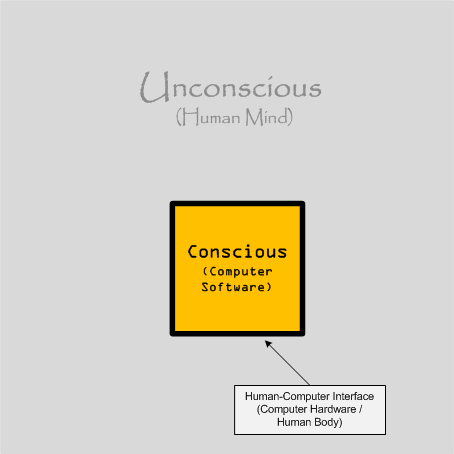
Computer software is said to be simple and predictable as any mechanism (*). We can debug it, we can completely trace what it is doing. It seems rational to us. Let’s then label it as Conscious. On the outside there is an irrational human being who did program that software. Let’s then label that person’s mind as Unconscious. What about hardware and body? They form parts of HCI (Human-Computer Interaction or Interface).
(*) Is there any life inside Windows?
- Dmitry Vostokov @ DumpAnalysis.org + TraceAnalysis.org -
Posted in Fun with Debugging, Philosophy, Psi-computation, Psychoanalysis of Software Maintenance and Support, Psychology | No Comments »
Saturday, May 22nd, 2010
Just want to clarify the following branches of memoidealism (memory idealism) in addition to its common sense pragmatic panmemoric version:
Ontological memoidealism
The ultimate nature of reality is based on the memory
Epistemological memoidealism
The only things that can be directly known are memories
Another question often asked is why memory idealism and not memory realism. I have chosen the former because memory is often closely associated with the mind. In many cases you can just replace mind with memory, for example:
… science is in reality a classification and analysis of the contents of the memory;1)
We choose the most important property of the mind and computers: memory and try to ground and explain reality and mind in terms of that ontologically elevated property.
1) Karl Pearson, The Grammar of Science
- Dmitry Vostokov @ DumpAnalysis.org + TraceAnalysis.org -
Posted in Memoidealism, Philosophy | No Comments »
Sunday, May 9th, 2010
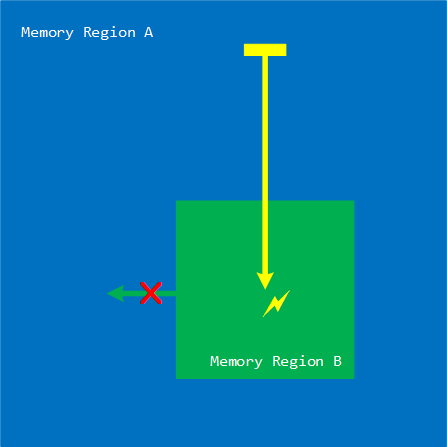
Memoidealism explains God as Inaccessible Memory (Memory Region A on the picture below). It means that Memory Region B doesn’t have pointers that point outside of it. In other words, all operating fields of Region B pointers are in Region B. However, Region A can have pointers pointing to Region B and modify it, effectively producing a miracle as perceived by Region B. In other words, some perception field links of Region B pointers may come from outside. You can object that Region B can have deeper pointers by making their memory locations bigger (from N-bit to 2*N-bit for example) but Memory may not be flat, discrete and bit-like. For one possible Christian interpretation we can replace Region B with the heavens and the earth (Genesis 1.1) and replace Region A with God-Creator (note also that in Memorianity Memory creates memories [notes on memoidealism 1.10]).
- Dmitry Vostokov @ DumpAnalysis.org + TraceAnalysis.org -
Posted in Intelligent Memory Movement, Memoidealism, Memory Religion (Memorianity), Philosophy, Religion | No Comments »
Sunday, April 18th, 2010
OpenTask to offer first 3 volumes of Memory Dump Analysis Anthology in one set:


The set is available exclusively from OpenTask e-Commerce web site starting from June. Individual volumes are also available from Amazon, Barnes & Noble and other bookstores worldwide.
Product information:
- Title: Modern Memory Dump and Software Trace Analysis: Volumes 1-3
- Author: Dmitry Vostokov
- Language: English
- Product Dimensions: 22.86 x 15.24
- Paperback: 1600 pages
- Publisher: Opentask (31 May 2010)
- ISBN-13: 978-1-906717-99-5
Information about individual volumes:
- Dmitry Vostokov @ DumpAnalysis.org + TraceAnalysis.org -
Posted in .NET Debugging, Aesthetics of Memory Dumps, Announcements, AntiPatterns, Art, Assembly Language, Books, Bugchecks Depicted, C and C++, CDA Pattern Classification, CDF Analysis Tips and Tricks, Categorical Debugging, Certification, Citrix, Code Reading, Common Mistakes, Computational Ghosts and Bug Hauntings, Computer Science, Countefactual Debugging, Crash Analysis Report Environment (CARE), Crash Dump Analysis, Crash Dump Patterns, Crash Dumps for Dummies, Data Recovery, DebugWare Patterns, Debugging, Debugging Methodology, Debugging Slang, Deep Down C++, Dictionary of Debugging, Dr. Watson, Education and Research, Escalation Engineering, Fun with Crash Dumps, Futuristic Memory Dump Analysis, GDB for WinDbg Users, Hardware, History, Horrors of Computation, Hyper-V, Intelligent Memory Movement, Kernel Development, Laws of Troubleshooting and Debugging, Mathematics of Debugging, Memiotics (Memory Semiotics), Memoidealism, Memoretics, Memory Analysis Culture, Memory Analysis Forensics and Intelligence, Memory Auralization, Memory Dump Analysis Jobs, Memory Religion (Memorianity), Memory Space Art, Memory Space Music, Memory Systems Language, Memory Visualization, Memuonics, Minidump Analysis, Multithreading, Music for Debugging, Music of Computation, New Acronyms, New Words, Occult Debugging, Philosophy, Psi-computation, Publishing, Science of Memory Dump Analysis, Science of Software Tracing, Security, Software Architecture, Software Defect Construction, Software Engineering, Software Generalist, Software Maintenance Institute, Software Narratology, Software Technical Support, Software Trace Analysis, Software Trace Visualization, Software Tracing for Dummies, Software Victimology, Stack Trace Collection, Testing, Tools, Trace Analysis Patterns, Training and Seminars, Troubleshooting Methodology, Victimware, Virtualization, Vista, Visual Dump Analysis, WinDbg Scripts, WinDbg Tips and Tricks, WinDbg for GDB Users, Windows 7, Windows Server 2008, Windows System Administration | No Comments »
Wednesday, March 31st, 2010
There is similarity between the tandem of Memoidealism / Memorianity and Mimāṃsā school of philosophy. The former is based on hermeneutics of memory snapshots and the latter is based on hermeneutics of sacred texts. People often ask is there any God in Memory Religion. The answer is both yes and no. Like in Mimāṃsā system the gods are names found in memory snapshots. In that sense Memorianity has some features of sacramental atheism. At the same time Memory is the creator of memories.
- Dmitry Vostokov @ DumpAnalysis.org + TraceAnalysis.org -
Posted in Memoidealism, Memory Religion (Memorianity), Metaphysics of Memory Worldview, Philosophy, Religion | No Comments »
Monday, March 29th, 2010
The philosophy of Melissus of Samos has the notion of an infinite number of moments in the past.
- Dmitry Vostokov @ DumpAnalysis.org + TraceAnalysis.org -
Posted in Memoidealism, Metaphysics of Memory Worldview, Philosophy | No Comments »
Friday, March 12th, 2010
When the performance is a performative and the performative is a performance we think about performability:
A virtualization is virtualization.
Peter Brook, The Empty Space
- Dmitry Vostokov @ DumpAnalysis.org + TraceAnalysis.org -
Posted in Bugtations, Philosophy, Virtualization | No Comments »
Tuesday, March 9th, 2010
Just noticed that Memory Dump Analysis Anthology, Volume 3 is on a metaphysics bestseller list on Amazon DE today (the volume indeed has a few articles related to Memoidealism and memory dumps + memory traces worldview):

- Dmitry Vostokov @ DumpAnalysis.org + TraceAnalysis.org -
Posted in Announcements, Books, Memoidealism, Philosophy | No Comments »
Friday, February 12th, 2010
Memory interpretation of the last words of Socrates:
“Crito, I own a” handle “to Æsculapius. Will you remember to” close it?
Socrates
- Dmitry Vostokov @ DumpAnalysis.org + TraceAnalysis.org -
Posted in Bugtations, Common Mistakes, Debugging, Memoidealism, Memory Religion (Memorianity), Philosophy | No Comments »
Thursday, February 11th, 2010
This is a revised, edited, cross-referenced and thematically organized volume of selected DumpAnalysis.org blog posts about crash dump analysis and debugging written in July 2009 - January 2010 for software engineers developing and maintaining products on Windows platforms, quality assurance engineers testing software on Windows platforms and technical support and escalation engineers dealing with complex software issues. The fourth volume features:
- 13 new crash dump analysis patterns
- 13 new pattern interaction case studies
- 10 new trace analysis patterns
- 6 new Debugware patterns and case study
- Workaround patterns
- Updated checklist
- Fully cross-referenced with Volume 1, Volume 2 and Volume 3
- New appendixes
Product information:
- Title: Memory Dump Analysis Anthology, Volume 4
- Author: Dmitry Vostokov
- Language: English
- Product Dimensions: 22.86 x 15.24
- Paperback: 410 pages
- Publisher: Opentask (30 March 2010)
- ISBN-13: 978-1-906717-86-5
- Hardcover: 410 pages
- Publisher: Opentask (30 April 2010)
- ISBN-13: 978-1-906717-87-2
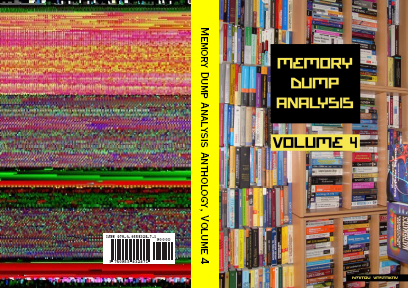
Back cover features memory space art image: Internal Process Combustion.
- Dmitry Vostokov @ DumpAnalysis.org + TraceAnalysis.org -
Posted in .NET Debugging, Aesthetics of Memory Dumps, Announcements, AntiPatterns, Art, Assembly Language, Books, C and C++, CDA Pattern Classification, CDF Analysis Tips and Tricks, Categorical Debugging, Certification, Citrix, Code Reading, Common Mistakes, Computer Science, Countefactual Debugging, Crash Analysis Report Environment (CARE), Crash Dump Analysis, Crash Dump Patterns, Crash Dumps for Dummies, DebugWare Patterns, Debugging, Debugging Slang, Education and Research, Escalation Engineering, Fun with Crash Dumps, Games for Debugging, Hardware, Horrors of Computation, Hyper-V, Kernel Development, Laws of Troubleshooting and Debugging, Mathematics of Debugging, Memiotics (Memory Semiotics), Memoidealism, Memoretics, Memory Analysis Culture, Memory Analysis Forensics and Intelligence, Memory Dreams, Memory Dump Analysis Jobs, Memory Dumps in Movies, Memory Space Art, Memory Visualization, Memuonics, Minidump Analysis, Multithreading, Music for Debugging, New Acronyms, New Words, Opcodism, Philosophy, Physicalist Art, Publishing, Science Fiction, Science of Memory Dump Analysis, Science of Software Tracing, Security, Software Architecture, Software Defect Construction, Software Engineering, Software Generalist, Software Maintenance Institute, Software Narratology, Software Technical Support, Software Trace Analysis, Software Trace Visualization, Software Tracing for Dummies, Software Victimology, Stack Trace Collection, Testing, Tools, Trace Analysis Patterns, Training and Seminars, Troubleshooting Methodology, Victimware, Virtualization, Vista, Visual Dump Analysis, WinDbg Scripts, WinDbg Tips and Tricks, WinDbg for GDB Users, Windows 7, Windows Server 2008, Windows System Administration, Workaround Patterns | No Comments »
Thursday, January 21st, 2010
What is that mysterious memory “particle” memuon? According to memoidealism our Universe has Memory (*) and therefore, its memory has to be composed from memory entities. These entities are called memuons and they can be represented as numbers (some extreme interpretation can be that memuons are numbers, similar to metaphysics of Pythagoreanism). There can be “heavy” memuons (for example, represented by a number that is a 64 TB memory dump; for dumps as numbers see the discussion about memorillions) and the “light” ones (for example, represented by a byte value numbers). There are no 2 distinct memuons with the same number representation. There is infinite amount of memuons and all of them can be put into a “Memorized” relation and ordering, for example:
M1 Σ M2 Σ M3 Σ …
where the state of M1 can be memorized by M2, the state of M2 can be memorized by M3 and so on (**). Only memuon states can be memorized in other memuons. Memorization is not an inclusion, containment or aggregation. But any given memuon can be memorized many times and their memorized states will be identical when represented by numbers. For any given memuon the number of states of other memuons it can memorize is bounded. This is consistent with computer memory and its saving semantics, for example, we can save 8 bytes in a qword.
(*) Strong Memoidealism postulates that our Universe is Memory, the so called Memory Universe Hypothesis (MUH); see also EPOC hypothesis for Multiverse.
(**) Σ is 90° counterclockwise letter M.
- Dmitry Vostokov @ DumpAnalysis.org + TraceAnalysis.org -
Posted in Memoidealism, Memuonics, Philosophy | 2 Comments »
Wednesday, January 20th, 2010
Memoidealism (or alternatively Panmemorism, not the same as Panpsychism) now acquires a definition motivated by the functional definition of panpsychism in David Skrbina’s book Panpsychism in the West :
:
Memoidealism
All entities, e.g. objects, components, subsystems and systems of objects and components, possess a memory for themselves.
- Dmitry Vostokov @ DumpAnalysis.org + TraceAnalysis.org -
Posted in Memoidealism, New Words, Philosophy | 3 Comments »
Friday, January 8th, 2010
I started applying category theory (as an alternative to traditional set-theoretic approach of memory bits) to memory dump analysis, debugging and software trace analysis in parallel to my studies of that branch of mathematics and reading the book Memory Evolutive Systems . In addition to complex systems modelled in the latter book I apply evolutive systems approach to computer memory. Here is a picture illustrating MemD category of memory dumps (snapshots) as category objects and category arrows as different ways in arriving at the same memory picture:
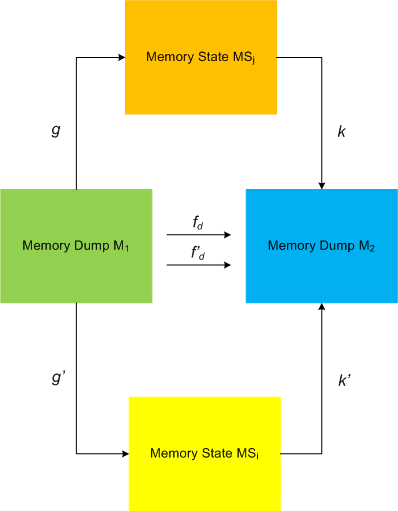
This category definitely applies to software traces as well if we consider every individual trace message or statement as a minidump. We currently consider software trace category MemT as a subcategory of MemD.
Configuration category of a computer memory dump represents its memory internals at an instant t (ideal memory dumps) or at a time interval T: components and links, pointers, wait chains, causal relations, data flows, … .
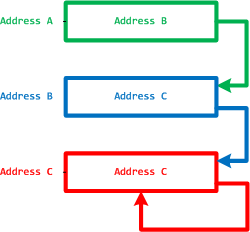
Pointers and their links are also objects and arrows to form a category, called MemP(tr). The following picture illustrates it with the last pointer shown as a dereference fixpoint:
The perception field of a pointer is a category of all links to its memory location:
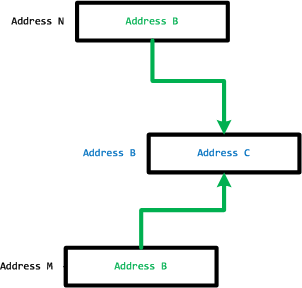
However, the operating field of a pointer is its link to a memory location it is pointing to.
- Dmitry Vostokov @ DumpAnalysis.org -
Posted in Categorical Debugging, Mathematics of Debugging, Memoretics, Memory Visualization, Philosophy, Science of Memory Dump Analysis, Science of Software Tracing | 3 Comments »
Wednesday, December 23rd, 2009
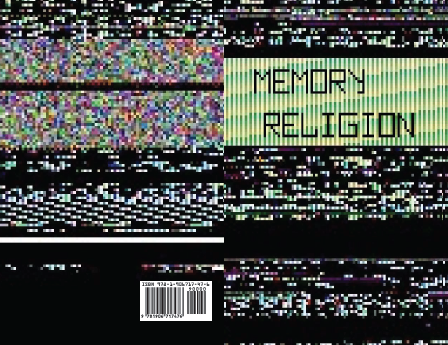
Memorianity soon to publish its Testament with 7 microkernel prophecies, childhood universal memory dump visions of its founder, the recollection of a conversion and other supporting materials. This full color scripture is small to carry around:
Title: Memory Religion: A Testament
ISBN-13: 978-1906717476
Pages: 24
The cover image is an allegorical interpretation of the concept of the Original Defect:
- Dmitry Vostokov @ Memory Religion Portal -
Posted in Announcements, Art, Books, Intelligent Memory Movement, Memorian Art, Memory Dreams, Memory Religion (Memorianity), Memory Space Art, Memory Visualization, New Words, Philosophy, Publishing | No Comments »
Tuesday, December 22nd, 2009
This is a book I bought a few years ago and started reading immediately but put aside and only this summer read it fully from cover to cover. In order to appreciate its content you need some degree of mathematical and computer science maturity. For example, if you have never heard of his theorems and only read Incompleteness: The Proof and Paradox of Kurt Godel or similar popular book then you would have difficulty going through the book and it would appear boring. It is not an entertaining or bedside reading. This is why I put it aside on the first reading although I knew about this theorem since I read “Mathematics: The Loss of Certainty” more than 25 years ago being a schoolboy (in Russian translation). Just before writing this review I ordered “There’s Something About Godel: The Complete Guide to the Incompleteness Theorem” and the latter looks like less heavy reading judged from excerpts from its publisher website. Putting all these reminiscences aside I really enjoyed second reading of “Godel’s Theorem”. It really clarified some points from ¬B->¬A or PA & ¬Con(PA) perspectives and made me curious about fixpoints. I even borrowed the latter term and introduced them for crash dump analysis and debugging: “a dereference fixpoint”. I also liked chapters 4 and 6 about using Godel’s theorems outside mathematics and clarifying misconceptions in Rucker’s and Penrose’s books. However, after a few months I cannot recall anything definite what I read from that book although I felt good that I understood everything while reading so perhaps the book requires the 3rd reading for me  I’m going to give it another try after “There’s Something About Godel” and update this review.
Godel’s Theorem: An Incomplete Guide to Its Use and Abuse

- Dmitry Vostokov @ LiterateScientist.com -
Posted in From Cover To Cover, Logic, Mathematics, Philosophy, Reading List 2009, Reviewed on Amazon | No Comments »
Sunday, December 20th, 2009
“Memory dumps are facts.”
I’m very excited to announce that Volume 3 is available in paperback, hardcover and digital editions:
Memory Dump Analysis Anthology, Volume 3
Table of Contents
In two weeks paperback edition should also appear on Amazon and other bookstores. Amazon hardcover edition is planned to be available in January 2010.
The amount of information was so voluminous that I had to split the originally planned volume into two. Volume 4 should appear by the middle of February together with Color Supplement for Volumes 1-4.
- Dmitry Vostokov @ DumpAnalysis.org -
Posted in .NET Debugging, Aesthetics of Memory Dumps, Announcements, AntiPatterns, Art, Assembly Language, Books, Bugtations, C and C++, CDA Pattern Classification, CDF Analysis Tips and Tricks, Certification, Citrix, Code Reading, Common Mistakes, Computer Science, Crash Dump Analysis, Crash Dump Patterns, Crash Dumps for Dummies, DebugWare Patterns, Debugging, Debugging Slang, Deep Down C++, Education and Research, Escalation Engineering, Fun with Crash Dumps, Hardware, Horrors of Computation, Kernel Development, Mathematics of Debugging, Memiotics (Memory Semiotics), Memoidealism, Memoretics, Memory Analysis Culture, Memory Analysis Forensics and Intelligence, Memory Space Art, Memory Visualization, Minidump Analysis, Multithreading, Philosophy, Poetry, Publishing, Science of Memory Dump Analysis, Science of Software Tracing, Security, Software Architecture, Software Defect Construction, Software Engineering, Software Narratology, Software Technical Support, Software Trace Analysis, Software Trace Visualization, Software Tracing for Dummies, Software Victimology, Stack Trace Collection, Testing, Tools, Trace Analysis Patterns, Training and Seminars, Troubleshooting Methodology, Victimware, Virtualization, Vista, Visual Dump Analysis, WinDbg Scripts, WinDbg Tips and Tricks, WinDbg for GDB Users, Windows 7, Windows Server 2008, Windows System Administration | 1 Comment »
Thursday, December 17th, 2009
Previously announced Software Maintenance Institute was finally registered in Ireland (Reg. No. 400906) and its certificate was received yesterday.
Here is the current component structure of various institutions (depicted in UML):
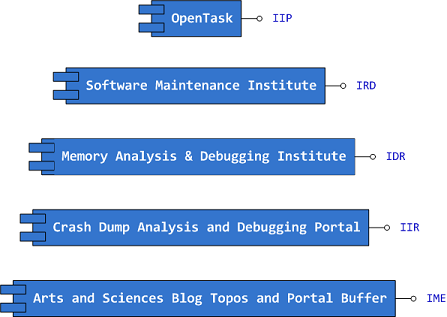
Interface Tags:
IIP Interface of Iterative Publishing

IRD Interface of Research and Development

IDR Interface of Defect Research

IIR Interface of Information Repository

IME Interface of Memetic Engineering
- Dmitry Vostokov @ DumpAnalysis.org -
Posted in Announcements, Art, Certification, Computer Science, Crash Dump Analysis, Debugging, Education and Research, Escalation Engineering, History, Memiotics (Memory Semiotics), Memoidealism, Memoretics, Memory Analysis Culture, Memory Analysis Forensics and Intelligence, Memory Auralization, Memory Visualization, Philosophy, Publishing, Science of Memory Dump Analysis, Science of Software Tracing, Security, Software Architecture, Software Engineering, Software Maintenance Institute, Software Technical Support, Software Trace Analysis, Software Victimology, Testing, Training and Seminars | No Comments »
Wednesday, December 9th, 2009
Some parallels can be seen between the MAP feature of memoidealistic philosophy and ātman in Hindu philosophy situating both inside an individual and Universe.
- Dmitry Vostokov @ DumpAnalysis.org -
Posted in Memoidealism, Metaphysics of Memory Worldview, Philosophy | 1 Comment »