Archive for the ‘Philosophy’ Category
Tuesday, December 8th, 2009
This is another description of a memoidealistic philosophical worldview that memory exists in everything, living and nonliving. In its even stronger form, panmemorism is also a theory that memory is a part of itself, thus adding an infinite element (see Memoidealism as Monistic Aspect Pluralism for some illustrations) and providing a foundation for perceived processes.
- Dmitry Vostokov @ DumpAnalysis.org -
Posted in Memoidealism, Memory Religion (Memorianity), New Words, Philosophy | 1 Comment »
Monday, November 9th, 2009
- Dmitry Vostokov @ DumpAnalysis.org -
Posted in Art, Books, Crash Dump Analysis, Debugging, Fun with Crash Dumps, History, Memory Analysis Culture, Philosophy, Physicalist Art | 1 Comment »
Monday, November 9th, 2009
Some differences with Anaxagoras philosophy where Mind is a partial substance to distinguish animate and inanimate and is a source of Motion. In memoidealism Memory is a substance that is always present in things including itself and is a source of Process.
- Dmitry Vostokov @ DumpAnalysis.org -
Posted in Memoidealism, Metaphysics of Memory Worldview, Philosophy | No Comments »
Tuesday, October 20th, 2009
Although everything changes in the philosophy of Heraclitus, its Urstoff, fire, is eternal, indestructable. The same can be said about Memory and its memory fragments. Memoidealism has also some proximity with the notion of everlasting existence of thought of or spoken named objects in the philosophy of Parmenides. Once we think of or speak of something we immediately recall a memory fragment from and, at the same time, commit it to Memory again, perhaps as a different memory fragment, an assembled new memory trace.
- Dmitry Vostokov @ DumpAnalysis.org -
Posted in Memoidealism, Metaphysics of Memory Worldview, Philosophy, Science of Memory Dump Analysis, Science of Software Tracing | No Comments »
Wednesday, September 30th, 2009
Welcome to Physicalist Art that has its foundation in Physicalism. The first physicalist composition was on display today and I took a picture of it (weather condition was not good):

Material: blue agate
It was originally called “Blue in a gate: memory dump and minidumps”. I plan to reinstall it again with more elaborate surroundings.
- Dmitry Vostokov @ DumpAnalysis.org -
Posted in Announcements, Art, Fun with Crash Dumps, Memiotics (Memory Semiotics), Memory Visualization, Minidump Analysis, Philosophy, Physicalist Art | No Comments »
Saturday, September 26th, 2009
This is a revised, edited, cross-referenced and thematically organized volume of selected DumpAnalysis.org blog posts about crash dump analysis and debugging written in October 2008 - June 2009 for software engineers developing and maintaining products on Windows platforms, quality assurance engineers testing software on Windows platforms and technical support and escalation engineers dealing with complex software issues. The third volume features:
- 15 new crash dump analysis patterns
- 29 new pattern interaction case studies
- Trace analysis patterns
- Updated checklist
- Fully cross-referenced with Volume 1 and Volume 2
- New appendixes
Product information:
- Title: Memory Dump Analysis Anthology, Volume 3
- Author: Dmitry Vostokov
- Language: English
- Product Dimensions: 22.86 x 15.24
- Paperback: 404 pages
- Publisher: Opentask (20 December 2009)
- ISBN-13: 978-1-906717-43-8
- Hardcover: 404 pages
- Publisher: Opentask (30 January 2010)
- ISBN-13: 978-1-906717-44-5
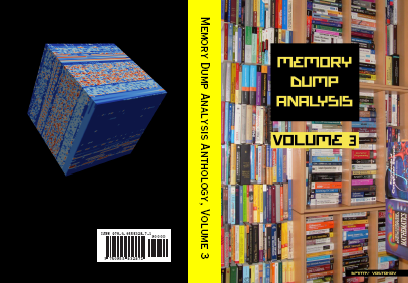
Back cover features 3D computer memory visualization image.
- Dmitry Vostokov @ DumpAnalysis.org -
Posted in Announcements, AntiPatterns, Art, Assembly Language, Books, C and C++, CDF Analysis Tips and Tricks, Certification, Citrix, Code Reading, Common Mistakes, Computational Ghosts and Bug Hauntings, Computer Science, Countefactual Debugging, Crash Dump Analysis, Crash Dump Patterns, Crash Dumps for Dummies, DebugWare Patterns, Debugging, Debugging Slang, Deep Down C++, Education and Research, Escalation Engineering, Fun with Crash Dumps, Futuristic Memory Dump Analysis, Games for Debugging, Hardware, Horrors of Computation, Hyper-V, Intelligent Memory Movement, Kernel Development, Mathematics of Debugging, Memiotics (Memory Semiotics), Memoidealism, Memoretics, Memory Analysis Culture, Memory Analysis Forensics and Intelligence, Memory Dreams, Memory Dump Analysis Jobs, Memory Space Music, Memory Visualization, Memuonics, Minidump Analysis, Multithreading, Music for Debugging, New Acronyms, New Words, Occult Debugging, Philosophy, Poetry, Psi-computation, Publishing, Science of Memory Dump Analysis, Science of Software Tracing, Security, Software Architecture, Software Defect Construction, Software Engineering, Software Generalist, Software Narratology, Software Technical Support, Software Trace Analysis, Software Tracing for Dummies, Testing, Tools, Trace Analysis Patterns, Training and Seminars, Troubleshooting Methodology, Virtualization, Vista, Visual Dump Analysis, WinDbg Scripts, WinDbg Tips and Tricks, WinDbg for GDB Users, Windows 7, Windows Server 2008, Windows System Administration | No Comments »
Friday, September 18th, 2009
The notion of transmigration of memories in Memoidealism has its similarity with Orphicism. The notions of limited (memories) and unlimited memory (Memory), and “things are memories” similar to Pythagoreanism view on Limited and Unlimited, and “things are numbers”.
- Dmitry Vostokov @ DumpAnalysis.org -
Posted in Memoidealism, Memory Religion (Memorianity), Metaphysics of Memory Worldview, Philosophy, Science of Memory Dump Analysis | No Comments »
Monday, September 7th, 2009
Consider this example mapping (taken metaphorically from the mathematical notion of an injection) of one domain of knowledge to another:
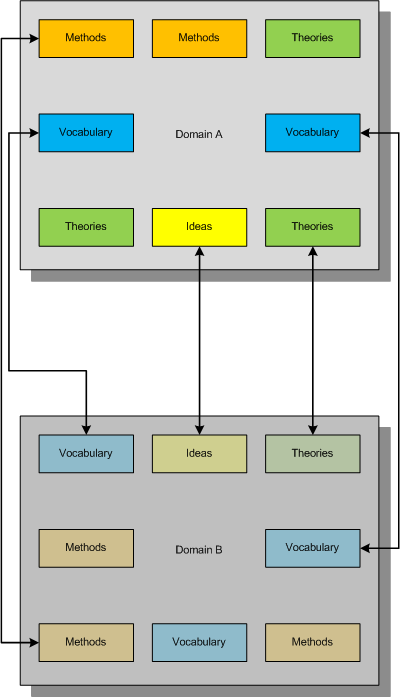
This mapping between concepts and ideas was once called “bijectivism” but was trivially described either as one to one mapping between two domains (like physical vs. mathematical) or fusing different concepts together to get another emerging concept. I myself proposed the similar mapping and called it a metaphorical bijection.
Now consider another mapping metaphorically equivalent to a mathematical notion of a surjection where all constituents of the second domain are covered metaphorically by the first domain:
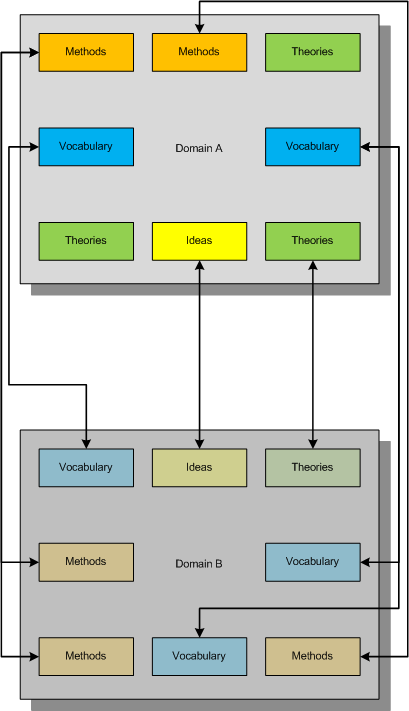
What we strive for is to establish the complete bijective mapping and reorganize our knowledge of both domains to achieve that:
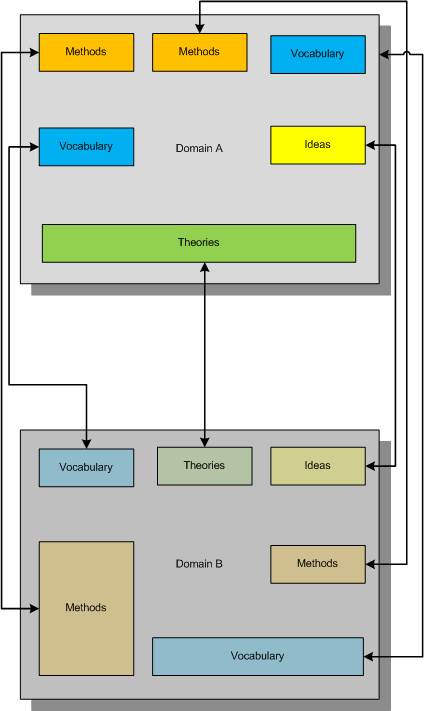
In diagrams above small boxes can represent sets of ideas, methods, etc. or individual ideas, methods, etc. The established metaphorical bijection can divide sets or combine them if needed. There can be several such bijections, of course, and we can use other methods of inquiry (for example, the scientific method) to choose between competing metaphorical bijections.
Useful mnemonic:
BEIS (B=I+S or to BE IS …)
Bijectionism Equals Injection + Surjection
Another mnemonic:
BET (B=T or to BE Transformation…)
Bijectionism Equals Transformation
Note also the second letter of Alef-Beis or Alef-Bet, the letter of Light that has interpretation of Creation in Biblical Hebrew.
More on this later as I need to come back to DebugWare patterns.
- Dmitry Vostokov @ DumpAnalysis.org -
Posted in Announcements, Memiotics (Memory Semiotics), Memoidealism, Memoretics, New Acronyms, New Words, Philosophy, Science of Memory Dump Analysis, Science of Software Tracing, Troubleshooting Methodology | 5 Comments »
Friday, September 4th, 2009
I don’t read mere books. I analyze memory dumps. Books are memory dumps. Memory dumps are books.
Dmitry Vostokov, Variation on a theme “A book is a memory dump”
- Dmitry Vostokov @ DumpAnalysis.org -
Posted in Books, Bugtations, Fun with Crash Dumps, Memory Religion (Memorianity), Philosophy | No Comments »
Wednesday, September 2nd, 2009
Our Universe is Unhandled Exception Processing saving one huge Memory Dump from a runaway HUC (Big Bang of Hyper-Universal Computation, or simply HUge Computation). The idea came to me some months ago but I decided to publish it after learning today about a “Mathematical Universe Hypothesis” (MUH) from Max Tegmark stating that our Universe is Mathematics.
EPOCH
Exception Processing Of Crash Hypothesis (or Memory Dump Universe Hypothesis)
Note: what a sad feeling I had while simultaneously listening to the Light track from Thin Red Line soundtrack while writing this post…
- Dmitry Vostokov @ DumpAnalysis.org -
Posted in Announcements, Fun with Crash Dumps, Memoidealism, Memory Religion (Memorianity), New Acronyms, Philosophy | 3 Comments »
Friday, August 7th, 2009
This is an encyclopedic work I bought in a local book shop and finally finished reading today. It took me a year to read from cover to cover and pages were falling out of the glue but I continued to read. Highly recommended for education and another view on human history. The review of Freud was enlightening to me because I didn’t know about the recent scholarship criticizing his work. In fact, I so liked this book that just bought it again in a hardcover version from Folio Society and start rereading it again soon.
Ideas: A History of Thought and Invention, from Fire to Freud

The second encyclopedic book seems was written before the previous one but looks like the logical sequel to it. I’m starting reading it next week.
The Modern Mind: An Intellectual History of the 20th Century

- Dmitry Vostokov @ LiterateScientist.com -
Posted in Anthropology, Art, Biology, Chemistry, Economics, Ethics, Evolution, From Cover To Cover, General Science, Geography, History, Humanities, Ideas, Language, Medicine, Philosophy, Physics, Politics, Psychology, Reading List 2009, Religion, Reviewed on Amazon, Social Sciences, Statistics, Theology | No Comments »
Monday, July 27th, 2009
If memory is the basis of everything we might think that memoidealism is a kind of dual aspect monism or plural aspect monism, where mind, body and perhaps many other aspects are manifestations of one single memory substance. Or perhaps, memory is the same as matter or the realm of ideas (materialism or some sort of idealism), and memoidealism is the kind of monism. Or memory is the same or not the same as mind or matter and can be associated with one side of dualism. Not at all, memory is the aspect or attribute of mind, body and other substances, possibly itself. This can be illustrated on the following picture:
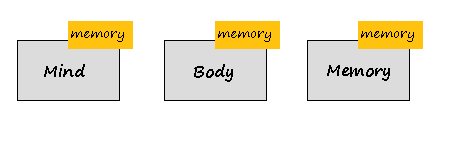
If there are only 2 substances then we have monistic aspect dualism as an extension of monism, for example, the extension of idealism:

or the extension of materialism (memuonic theory, memuonics):

Therefore, Memory is a substance and an aspect (attribute) at the same time. This is the essence of MAP (Monistic Aspect Pluralism).
- Dmitry Vostokov @ DumpAnalysis.org -
Posted in Memoidealism, Memuonics, New Acronyms, Philosophy, Science of Memory Dump Analysis | 3 Comments »
Tuesday, July 21st, 2009
The idea to have a reading notebook online came to me after I recalled that at school I heard that Lenin had Philosophical Notebooks. You can find them in Lenin Internet Library, volume 38 of his Collected Works. As a schoolboy, I was curious about Lenin’s notebooks and even borrowed them from the school library to see how they looked like inside. I wasn’t impressed though due to the lack of philosophical knowledge on my side but the idea stuck to my mind. At my school age I read his biography several times and my favourite episode was an assassination attempt by socialist revolutionary Fanny Kaplan.
- Dmitry Vostokov @ DumpAnalysis.org -
Posted in Books, History, Philosophy, Publishing, Reading Notebook | No Comments »
Wednesday, July 15th, 2009
“Life is too short not to believe in Memory.”
Founding Farther of Memorianity
Imagine someone wrote an AI program and fit it into 4Gb. Imagine that it becomes intelligent indeed after some execution time (learning?). At some point when we admit its true intelligence we save a complete memory dump. Conclusion: we successfully reduced AI to a memory dump (out of memorillion of them). If AI requires a distributed network we still have the more complex dump (but still the dump). If AI program requires storage for its learning database we just concatenate it to the complete memory dump and we have the dump file again. Would advocates of AI or even Artificial General Intelligence agree with me?
- Dmitry Vostokov @ DumpAnalysis.org -
Posted in Fun with Crash Dumps, Intelligent Memory Movement, Philosophy, Science of Software Tracing | No Comments »
Tuesday, July 14th, 2009
IMM, The Intelligent Memory Movement borrows the following Intel meta-opcode for its slogan:
NoIndirection: MOV OPERAND, IMM ; Memory first, Being second
Please assemble and join me in the direction of this movement!
- Dmitry Vostokov @ DumpAnalysis.org -
Posted in Announcements, Assembly Language, Fun with Crash Dumps, Intelligent Memory Movement, Memoidealism, Memory Religion (Memorianity), Philosophy | No Comments »
Thursday, July 9th, 2009
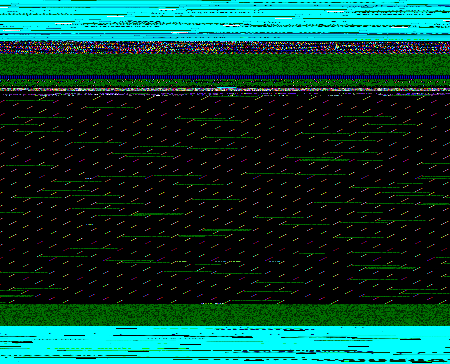
There are many books and articles titled “Large-scale Structure of X”, where X can be Space-Time, Cosmos or Universe. Here is the large-scale structure of 12Gb complete memory dump:

The image was generated with the help of ImageMagick. The dump file was interpreted as a raw RGBA image with 8-bits per color:
C:\MemoryDumps>convert -size 56751x56751 -depth 8

-resize 450x450 rgba:complete.dmp dump_12Gb_rgba_8_sq.jpg
The width and height were calculated as sqrt(filesize/4).
Complete memory dumps are physical memory dumps where modularized structure of virtual space of kernel and process memory is not expected but we see some structure nevertheless.
I’ve also created two pages with dump slices. Some viewers do not handle files with more that 32767 pixels in one dimension so I split 450×56751 slice into two:
Complete Memory Dump Slice Part 1 (11Mb JPEG)
Complete Memory Dump Slice Part 2 (10Mb JPEG)
- Dmitry Vostokov @ DumpAnalysis.org -
Posted in Art, Fun with Crash Dumps, Memory Visualization, Philosophy, Science of Memory Dump Analysis | No Comments »
Friday, July 3rd, 2009
I read this book from cover to cover while flying on a plane from Dublin to St. Petersburg and back. That was so wonderful reading experience - I couldn’t put the book down during those flights. I recall that I visited the Department of Mathematics a few times when I studied Chemistry in Moscow State University although at that time I knew next to nothing about Russian mathematicians. The book touched me so deeply that I bought the main work of Florensky: The Pillar and Ground of the Truth, the history of Russian philosophy and several books explaining Orthodox Church. This is the best mathematics history book I have ever read, my feelings perhaps comparable to those that I experienced when I finished reading Mathematics: The Loss of Certainty by Morris Kline but that was more than 20 years ago.
Naming Infinity: A True Story of Religious Mysticism and Mathematical Creativity

- Dmitry Vostokov @ LiterateScientist.com -
Posted in Biographies, From Cover To Cover, History, Ideas, Logic, Mathematics, Philosophy, Politics, Psychology, Reading List 2009, Religion, Reviewed on Amazon, Theology | No Comments »