Archive for the ‘Crash Dump Analysis’ Category

WinDbg.Org: WinDbg Quick Links

Monday, February 11th, 2008

Sometimes I need a quick link to install Debugging Tools for Windows and for other related information such as standard symbol server path, common commands, etc. For this purpose I’ve setup windbg.org domain and hope it will be handy. Currently its main page has the following links:

  • Download links to 32-bit and 64-bit versions
  • My favourite standard symbol path
  • Link to HTML version of Crash Dump Analysis Poster
  • Link to Crash Dump Analysis Checklist

Help menu on dumpanalysis.org used to point to CDA Poster now points to this page too.

I’ll add more useful information there soon. Any suggestions are welcome!

- Dmitry Vostokov @ DumpAnalysis.org -

WinDbg

Friday, February 8th, 2008

Google shows different cheat sheets for WinDbg and I want to remind about my own version that is geared towards postmortem dump analysis of native code:

Memory Dump Analysis Checklist

This post was motivated by WinDbg blog post written by Volker von Einem :-)

- Dmitry Vostokov @ DumpAnalysis.org -
Memory Dump Analysis Anthology, Volume 1

Thursday, February 7th, 2008

It is very easy to become a publisher nowadays. Much easier than I thought. I registered myself as a publisher under the name of OpenTask which is my registered business name in Ireland. I also got the list of ISBN numbers and therefore can announce product details for the first volume of Memory Dump Analysis Anthology series:

Memory Dump Analysis Anthology, Volume 1

  • Paperback: 720 pages (*)
  • ISBN-13: 978-0-9558328-0-2
  • Hardcover: 720 pages (*)
  • ISBN-13: 978-0-9558328-1-9
  • Author: Dmitry Vostokov
  • Publisher: Opentask (15 Apr 2008)
  • Language: English
  • Product Dimensions: 22.86 x 15.24

(*) subject to change 

PDF file will be available for download too.

- Dmitry Vostokov @ DumpAnalysis.org -

Crash Dump Analysis Patterns (Part 47)

Wednesday, February 6th, 2008

Most of the time threads are not suspended explicitly. If you look at active and waiting threads in kernel and complete memory dumps their SuspendCount member is 0:

THREAD 88951bc8  Cid 03a4.0d24  Teb: 7ffaa000 Win32Thread: 00000000 WAIT: (Unknown) UserMode Non-Alertable
    889d6a78  Semaphore Limit 0x7fffffff
    88951c40  NotificationTimer
Not impersonating
DeviceMap                 e1b80b98
Owning Process            888a9d88       Image:         svchost.exe
Wait Start TickCount      12669          Ticks: 5442 (0:00:01:25.031)
Context Switch Count      3            
UserTime                  00:00:00.000
KernelTime                00:00:00.000
Win32 Start Address RPCRT4!ThreadStartRoutine (0x77c4b0f5)
Start Address kernel32!BaseThreadStartThunk (0x7c8217ec)
Stack Init f482f000 Current f482ec0c Base f482f000 Limit f482c000 Call 0
Priority 10 BasePriority 10 PriorityDecrement 0
ChildEBP RetAddr 
f482ec24 80833465 nt!KiSwapContext+0x26
f482ec50 80829a62 nt!KiSwapThread+0x2e5
f482ec98 809226bd nt!KeWaitForSingleObject+0x346
f482ed48 8088978c nt!NtReplyWaitReceivePortEx+0x521
f482ed48 7c9485ec nt!KiFastCallEntry+0xfc (TrapFrame @ f482ed64)
00efff84 77c58792 ntdll!KiFastSystemCallRet
00efff8c 77c5872d RPCRT4!RecvLotsaCallsWrapper+0xd
00efffac 77c4b110 RPCRT4!BaseCachedThreadRoutine+0x9d
00efffb8 7c824829 RPCRT4!ThreadStartRoutine+0x1b
00efffec 00000000 kernel32!BaseThreadStart+0x34

5: kd> dt _KTHREAD 88951bc8
ntdll!_KTHREAD
   +0x000 Header           : _DISPATCHER_HEADER
   +0x010 MutantListHead   : _LIST_ENTRY [ 0x88951bd8 - 0x88951bd8 ]
   +0x018 InitialStack     : 0xf482f000
   +0x01c StackLimit       : 0xf482c000
   +0x020 KernelStack      : 0xf482ec0c
   +0x024 ThreadLock       : 0
   +0x028 ApcState         : _KAPC_STATE
...
...
...
   +0x14f FreezeCount      : 0 ''
   +0×150 SuspendCount     : 0 ”


You won’t find SuspendCount in reference stack traces. Only when some other thread explicitly suspends another thread the latter has non-zero suspend count. Suspended threads are excluded from thread scheduling and therefore can be considered as blocked. This might be the sign of a debugger present, for example, all threads in a process are suspended when a user debugger is processing a debugger event like a breakpoint or access violation exception. In this case !process 0 ff command output shows SuspendCount value:

THREAD 888b8668  Cid 0ca8.1448  Teb: 00000000 Win32Thread: 00000000 WAIT: (Unknown) KernelMode Non-Alertable
SuspendCount 2
    888b87f8  Semaphore Limit 0×2
Not impersonating
DeviceMap                 e10028e8
Owning Process            898285b0       Image:         processA.exe
Wait Start TickCount      13456          Ticks: 4655 (0:00:01:12.734)
Context Switch Count      408            
UserTime                  00:00:00.000
KernelTime                00:00:00.000
Start Address driver!DriverThread (0xf6fb8218)
Stack Init f455b000 Current f455a3ac Base f455b000 Limit f4558000 Call 0
Priority 6 BasePriority 6 PriorityDecrement 0
ChildEBP RetAddr 
f455a3c4 80833465 nt!KiSwapContext+0×26
f455a3f0 80829a62 nt!KiSwapThread+0×2e5
f455a438 80833178 nt!KeWaitForSingleObject+0×346
f455a450 8082e01f nt!KiSuspendThread+0×18
f455a498 80833480 nt!KiDeliverApc+0×117
f455a4d0 80829a62 nt!KiSwapThread+0×300
f455a518 f6fb7f13 nt!KeWaitForSingleObject+0×346
f455a548 f4edd457 driver!WaitForSingleObject+0×75
f455a55c f4edcdd8 driver!DeviceWaitForRead+0×19
f455ad90 f6fb8265 driver!InputThread+0×17e
f455adac 80949b7c driver!DriverThread+0×4d
f455addc 8088e062 nt!PspSystemThreadStartup+0×2e
00000000 00000000 nt!KiThreadStartup+0×16

5: kd> dt _KTHREAD 888b8668
ntdll!_KTHREAD
   +0x000 Header           : _DISPATCHER_HEADER
   +0x010 MutantListHead   : _LIST_ENTRY [ 0x888b8678 - 0x888b8678 ]
   +0x018 InitialStack     : 0xf455b000
   +0x01c StackLimit       : 0xf4558000
   +0x020 KernelStack      : 0xf455a3ac
   +0x024 ThreadLock       : 0
...
...
...
   +0x14f FreezeCount      : 0 ''
   +0×150 SuspendCount     : 2 ”


I call this pattern Suspended Thread. It should rise suspicion bar and in some cases coupled with Special Process pattern can lead to immediate problem identification.

- Dmitry Vostokov @ DumpAnalysis.org -
Memoretics

Monday, February 4th, 2008

I’ve been trying to put memory dump analysis on relevant scientific grounds for some time and now this branch of science needs its own name. After considering different alternative names I finally chose the word Memoretics. Here is the brief definition:

Computer Memoretics studies computer memory snapshots and their evolution in time.

Obviously this domain of research has many links with application and system debugging. However its scope is wider than debugging because it doesn’t necessarily study memory snapshots from systems and applications experiencing faulty behaviour.

Initially I was thinking about Memogenics word but its suffix is heavily associated with genes metaphor which I’m currently trying to avoid although I personally re-discovered software genes approach to software disorders when thinking about Memoretics vs. Memogenics. Later I found some research efforts going on but seems they are based on constructing software genes artificially. On the contrary I would try to discover genes in computer memories first.

genic

Also Memoretics has longer prefix almost resembling Memory word. This had the final influence on my decision.

PS. I was also thinking about Memorology word but it has negative connotations with Astrology or Numerology and was coined already by someone like Memology and Memorics

- Dmitry Vostokov @ DumpAnalysis.org -

Crash Dump Analysis Patterns (Part 13d)

Monday, February 4th, 2008

In order to maintain virtual to physical address translation OS needs page tables. These tables occupy memory too. If there is not enough memory for new tables the system will fail to create processes, allocate I/O buffers and memory from pools. You might see the following diagnostic message from WinDbg:

4: kd> !vm

*** Virtual Memory Usage ***
 Physical Memory:      851422 (   3405688 Kb)
 Page File: \??\C:\pagefile.sys
   Current:   2095104 Kb  Free Space:   2081452 Kb
   Minimum:   2095104 Kb  Maximum:      4190208 Kb
 Available Pages:      683464 (   2733856 Kb)
 ResAvail Pages:       800927 (   3203708 Kb)
 Locked IO Pages:         145 (       580 Kb)
 Free System PTEs:      23980 (     95920 Kb)

 ******* 356363 system PTE allocations have failed ******

 Free NP PTEs:           6238 (     24952 Kb)
 Free Special NP:           0 (         0 Kb)
 Modified Pages:          482 (      1928 Kb)
 Modified PF Pages:       482 (      1928 Kb)
 NonPagedPool Usage:    18509 (     74036 Kb)
 NonPagedPool Max:      31970 (    127880 Kb)
 PagedPool 0 Usage:      8091 (     32364 Kb)
 PagedPool 1 Usage:      2495 (      9980 Kb)
 PagedPool 2 Usage:      2580 (     10320 Kb)
 PagedPool 3 Usage:      2552 (     10208 Kb)
 PagedPool 4 Usage:      2584 (     10336 Kb)
 PagedPool Usage:       18302 (     73208 Kb)
 PagedPool Maximum:     39936 (    159744 Kb)

 ********** 48530 pool allocations have failed **********

 Shared Commit:          5422 (     21688 Kb)
 Special Pool:              0 (         0 Kb)
 Shared Process:         5762 (     23048 Kb)
 PagedPool Commit:      18365 (     73460 Kb)
 Driver Commit:          2347 (      9388 Kb)
 Committed pages:      129014 (    516056 Kb)
 Commit limit:        1342979 (   5371916 Kb)

We also see another diagnostic message about pool allocation failures which could be the consequence of PTE allocation failures.

The cause of system PTE allocation failures might be incorrect value of SystemPages registry key that needs to be adjusted as explained in the following TechNet article:

The number of free page table entries is low, which can cause system instability

Another cause would be /3GB boot option on x86 systems especially used for hosting terminal sessions. This case is explained in Brad Rutkowski’s blog post which also shows how to detect /3GB kernel and complete memory dumps:

Consequences of running 3GB and PAE together  

In our case the system was booted with /3GB:

4: kd> vertarget
Windows Server 2003 Kernel Version 3790 (Service Pack 2) MP (8 procs) Free x86 compatible
Product: Server, suite: Enterprise TerminalServer
Built by: 3790.srv03_sp2_gdr.070304-2240
Kernel base = 0xe0800000 PsLoadedModuleList = 0xe08af9c8
Debug session time: Fri Feb  1 09:10:17.703 2008 (GMT+0)
System Uptime: 6 days 17:14:45.528

Normal Windows 2003 systems have different kernel base address which can be checked from Reference Stack Traces for Windows Server 2003 (Virtual Memory section): 

kd> vertarget
Windows Server 2003 Kernel Version 3790 (Service Pack 2) UP Free x86 compatible
Product: Server, suite: Enterprise TerminalServer SingleUserTS
Built by: 3790.srv03_sp2_rtm.070216-1710
Kernel base = 0×80800000 PsLoadedModuleList = 0×8089ffa8
Debug session time: Wed Jan 30 17:54:13.390 2008 (GMT+0)
System Uptime: 0 days 0:30:12.000

- Dmitry Vostokov @ DumpAnalysis.org -

2007 in Retrospection (Part 3)

Friday, February 1st, 2008

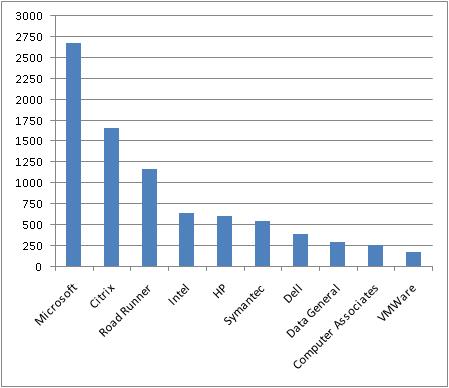
Out of more than 13,000 organizations including more than 450 universities and colleges I selected top 10 visited my blog. Here is the graph showing the number of visits vs. company name:

- Dmitry Vostokov @ DumpAnalysis.org -

Reference Stack Traces (Volume 3)

Thursday, January 31st, 2008

Now the third volume is ready. Here is PDF file for free download:

Windows Server 2003™ x86 Complete Memory Dump

Surprisingly it is almost twice less in the number of pages than the first volume for Vista x86.  

Printed versions are available for purchase at the nominal price to cover manufacturing costs:

The second edition will contain annotations and comments.

Large print (paperback)

Buy

Small print (paperback)

Buy

Small print (hardcover)

Buy

- Dmitry Vostokov @ DumpAnalysis.org -

Crash Dump Analysis Patterns (Part 46)

Thursday, January 31st, 2008

Similar to No Process Dumps pattern there is corresponding No System Dumps pattern where the system bluescreens either on demand or because of a bug check condition but no kernel or complete dumps are saved. In such cases I would advise to check free space on a drive where memory dumps are supposed to be saved. This is because crash dumps are saved to a page file first and then copied to a separate file during boot time, by default to memory.dmp file. Please see related Microsoft links in my old post. In case you have enough free space but not enough page file space you might get an instance of Truncated Dump or Corrupt Dump pattern.   

Yesterday I experienced No System Dump pattern on Windows Server 2003 SP2 running on VMWare workstation when I was trying to get a complete memory dump using SystemDump. I set up page file correctly as sizeof(PhysicalMemory) + 100Mb but I didn’t check free space on drive C: and no dump was saved, not even kernel minidump. System event log entry was blank too. 

- Dmitry Vostokov @ DumpAnalysis.org -

Component-Based Debugging and Troubleshooting

Thursday, January 31st, 2008

Component identification is one of the main goals of post-mortem memory dump analysis and troubleshooting process in general. Using the definition of components as units of deployment and 3rd-party composition taken from Clemens Szyperski’s seminal book discussing component software in general and COM, CORBA, Java and .NET in particular (highly recommended book)

Component Software: Beyond Object-Oriented Programming (2nd Edition)

Buy from Amazon

I would say that CBDT is centered around component isolation and replacement.

- Dmitry Vostokov @ DumpAnalysis.org -

Crash Dump Analysis Patterns (Part 45)

Wednesday, January 30th, 2008

The absence of crash dumps when we expect them can be considered as a pattern on its own and I call it No Process Dumps. This can happen due to variety of reasons and troubleshooting should be based on the distinction between crashes and hangs. We have 3 combinations here:

  1. A process is visible in Task Manager and is functioning normally

  2. A process is visible in Task Manager and has stopped functioning normally

  3. A process is not visible in Task Manager

If a process is visible in task list and is functioning normally then the following reasons should be considered:

  • - Exceptions haven’t happened yet due to different code execution paths or the time has not come yet and we need to wait more

  • - Exceptions haven’t happened yet due to a different memory layout. This can be the instance of Changed Environment pattern.

If a process is visible in Task Manager and has stopped functioning normally then it might be hanging and waiting for some input. In such cases it is better to get  process dumps proactively

If a process is not visible in Task Manager then the following reasons should be considered:

  • - Debugger value for AeDebug key is invalid, missing or points to a wrong path or a command line has wrong arguments. For examples see Custom Postmortem Debuggers on Vista or NTSD on x64 Windows 2003.

  • - Something is wrong with exception handling mechanism or WER settings. Use Process Monitor to see what processes are launched and modules are loaded when an exception happens. Check WER settings in Control panel.

  • - Try LocalDumps registry key for Vista SP1 and Windows Server 2008 (this one I haven’t tried yet)

  • - Use live debugging techniques like attaching to a process or running a process under a debugger to monitor exceptions and saving first chance exception crash dumps.

This is very important pattern for technical support environments that rely on post-mortem analysis and I’m going to revisit it later to add more information and recommendations if necessary. 

- Dmitry Vostokov @ DumpAnalysis.org -

Reference Stack Traces (Volume 2)

Tuesday, January 29th, 2008

Based on success with Reference Stack Traces for 32-bit Vista I created the similar reference volume for Vista x64. Here is PDF file for free download:

Windows Vista™ x64 Complete Memory Dump

Printed version is available for purchase at the nominal price to cover manufacturing costs:

Large print (paperback)

The second edition will contain annotations and comments.

More volumes to come for other OS versions. I created the separate page to list all current and forthcoming volumes:

Reference Stack Traces

- Dmitry Vostokov @ DumpAnalysis.org -

Reference Stack Traces (Volume 1)

Monday, January 28th, 2008

We need to know normal thread stacks when looking at Stack Trace Collection from kernel and complete memory dumps and trying to spot anomalies. In order to fill this gap I just published the reference stack traces and other information form my Vista x86 running on Mac Mini with Apple Boot Camp. Some additional processes like explorer.exe and iexplore.exe were launched in order to include their user space stack traces commonly found in crash dumps. Here is PDF file for free download:

Windows Vista™ x86 Complete Memory Dump

The second edition will contain more information and comments. Soon I’m planning to release additional volumes for Vista x64 and other OS versions.

Printed version is available for purchase at the nominal price to cover manufacturing costs:

Large print (paperback)

This is actually my first complete book :-)

- Dmitry Vostokov @ DumpAnalysis.org -

I/O and Memory Priority in Vista

Sunday, January 27th, 2008

You might have noticed additional IoPriority and PagePriority values when using !thread command in kernel and complete memory dumps coming from Vista:

THREAD 8362a390  Cid 0b90.0b94  Teb: 7ffdf000 Win32Thread: ff34c848 WAIT: (WrUserRequest) UserMode Non-Alertable
    83656de0  SynchronizationEvent
Not impersonating
DeviceMap                 a7766db8
Owning Process            8362a638       Image:         explorer.exe
Wait Start TickCount      43496          Ticks: 3 (0:00:00:00.046)
Context Switch Count      14502            
UserTime                  00:00:00.436
KernelTime                00:00:00.608
Win32 Start Address Explorer!wWinMainCRTStartup (0x0052d070)
Stack Init 9e8b3000 Current 9e8b2c10 Base 9e8b3000 Limit 9e8b0000 Call 0
Priority 12 BasePriority 8 PriorityDecrement 2 IoPriority 2 PagePriority 5
ChildEBP RetAddr 
9e8b2c28 81cac9cf nt!KiSwapContext+0×26
9e8b2c64 81c293a7 nt!KiSwapThread+0×389
9e8b2cc0 8cedb8ed nt!KeWaitForSingleObject+0×414
9e8b2d1c 8cedb724 win32k!xxxRealSleepThread+0×1ad
9e8b2d38 8ced573c win32k!xxxSleepThread+0×2d
9e8b2d4c 8ced5759 win32k!xxxRealWaitMessageEx+0×12
9e8b2d5c 81c8caaa win32k!NtUserWaitMessage+0×14
9e8b2d5c 77490f34 nt!KiFastCallEntry+0×12a
000ffb94 761db5bc ntdll!KiFastSystemCallRet
000ffb98 765e07f6 USER32!NtUserWaitMessage+0xc
000ffbb0 76566f4e SHELL32!CDesktopBrowser::_MessageLoop+0×4c
000ffbbc 00529039 SHELL32!SHDesktopMessageLoop+0×24
000ffea8 0052d1e0 Explorer!wWinMain+0×447
000fff3c 75f33833 Explorer!_initterm_e+0×1b1
000fff48 7746a9bd kernel32!BaseThreadInitThunk+0xe
000fff88 00000000 ntdll!_RtlUserThreadStart+0×23

These are new thread priorities added to Vista kernel and explained in the following articles:

Inside the Windows Vista Kernel: Part 1 (I/O Priority section)
Inside the Windows Vista Kernel: Part 2 (Memory Priorities section)

You can change it for any process according to blogs.technet.com/vitalipro/archive/2007/02/16/645675.aspx

I changed values for notepad.exe and it works: 

[HKEY_LOCAL_MACHINE\SOFTWARE\Microsoft\Windows NT\CurrentVersion\Image File Execution Options\notepad.exe\PerfOptions]
"IoPriority"=dword:00000001
"PagePriority"=dword:00000001

THREAD 838edd78  Cid 0378.0d3c  Teb: 7ffdf000 Win32Thread: fed7e848 WAIT: (WrUserRequest) UserMode Non-Alertable
    838c84a0  SynchronizationEvent
Not impersonating
DeviceMap                 a7766db8
Owning Process            838e25a0       Image:         notepad.exe
Wait Start TickCount      12967          Ticks: 30532 (0:00:07:56.302)
Context Switch Count      490            
UserTime                  00:00:00.000
KernelTime                00:00:00.109
Win32 Start Address notepad!WinMainCRTStartup (0x003631f8)
Stack Init a691b000 Current a691ab68 Base a691b000 Limit a6918000 Call 0
Priority 12 BasePriority 8 PriorityDecrement 2 IoPriority 1 PagePriority 1
Kernel stack not resident.
ChildEBP RetAddr 
a691ab80 81cac9cf nt!KiSwapContext+0×26
a691abbc 81c293a7 nt!KiSwapThread+0×389
a691ac18 8cedb8ed nt!KeWaitForSingleObject+0×414
a691ac74 8cedb724 win32k!xxxRealSleepThread+0×1ad
a691ac90 8ced9976 win32k!xxxSleepThread+0×2d
a691ace8 8cedd983 win32k!xxxRealInternalGetMessage+0×4a4
a691ad4c 81c8caaa win32k!NtUserGetMessage+0×3f
a691ad4c 77490f34 nt!KiFastCallEntry+0×12a
0006f6d0 761e199a ntdll!KiFastSystemCallRet
0006f6d4 761e19cd USER32!NtUserGetMessage+0xc
0006f6f0 0036149c USER32!GetMessageW+0×33
0006f730 00361971 notepad!WinMain+0xec
0006f7c0 75f33833 notepad!_initterm_e+0×1a1
0006f7cc 7746a9bd kernel32!BaseThreadInitThunk+0xe
0006f80c 00000000 ntdll!_RtlUserThreadStart+0×23

- Dmitry Vostokov @ DumpAnalysis.org -

Crash Dump Analysis Patterns (Part 44)

Friday, January 25th, 2008

Spiking Thread pattern includes normal threads running at PASSIVE_LEVEL or APC_LEVEL IRQL that can be preempted by any other higher priority thread. Therefore, spiking threads are not necessarily ones that were in RUNNING state when the memory dump was saved. They consumed much CPU and this is reflected in their User and Kernel time values. The pattern also includes threads running at DISPATCH_LEVEL and higher IRQL. These threads cannot be preempted by another thread so they usually remain in RUNNING state all the time unless they lower their IRQL. Some of them I’ve seen were trying to acquire a spinlock and I decided to create another more specialized pattern and call it Dispatch Level Spin. We would see it when a spinlock for some data structure wasn’t released or was corrupt and some thread tries to acquire it and enters endless spinning loop unless interrupted by higher IRQL interrupt. These infinite loops can also happen due to software defects in code running at dispatch level or higher IRQL.

Let’s look at one example. The following running thread was interrupted by keyboard interrupt apparently to save Manual Dump. We see that it spent almost 11 minutes in kernel:

0: kd> !thread
THREAD 830c07c0  Cid 0588.0528  Teb: 7ffa3000 Win32Thread: e29546a8 RUNNING on processor 0
IRP List:
    86163008: (0006,01d8) Flags: 00000900  Mdl: 84f156c0
Not impersonating
DeviceMap                 e257b7c8
Owning Process            831ec608       Image:         MyApp.EXE
Wait Start TickCount      122850         Ticks: 40796 (0:00:10:37.437)
Context Switch Count      191                 LargeStack
UserTime                  00:00:00.000
KernelTime                00:10:37.406
Win32 Start Address MyApp!ThreadImpersonation (0×35f76821)
Start Address kernel32!BaseThreadStartThunk (0×7c810659)
Stack Init a07bf000 Current a07beca0 Base a07bf000 Limit a07bb000 Call 0
Priority 11 BasePriority 8 PriorityDecrement 2 DecrementCount 16
ChildEBP RetAddr
a07be0f8 f77777fa nt!KeBugCheckEx+0×1b
a07be114 f7777032 i8042prt!I8xProcessCrashDump+0×237
a07be15c 805448e5 i8042prt!I8042KeyboardInterruptService+0×21c
a07be15c 806e4a37 nt!KiInterruptDispatch+0×45 (FPO: [0,2] TrapFrame @ a07be180)

a07be220 a1342755 hal!KeAcquireInStackQueuedSpinLock+0×47
a07be220 a1342755 MyDriver!RcvData+0×98


To see the code and context we switch to the trap frame and disassemble the interrupted function:

1: kd> .trap a07be180
ErrCode = 00000000
eax=a07be200 ebx=a07be228 ecx=831dabf5 edx=a07beb94 esi=831d02a8 edi=831dabd8
eip=806e4a37 esp=a07be1f4 ebp=a07be220 iopl=0 nv up ei pl nz na po nc
cs=0008 ss=0010 ds=0000 es=0000 fs=0000 gs=0000 efl=00000202
hal!KeAcquireInStackQueuedSpinLock+0x47:
806e4a37 ebf3            jmp     hal!KeAcquireInStackQueuedSpinLock+0×3c (806e4a2c)

1: kd> uf hal!KeAcquireInStackQueuedSpinLock
hal!KeAcquireInStackQueuedSpinLock:
806e49f0 mov     eax,dword ptr ds:[FFFE0080h]
806e49f5 shr     eax,4
806e49f8 mov     al,byte ptr hal!HalpVectorToIRQL (806ef218)[eax]
806e49fe mov     dword ptr ds:[0FFFE0080h],41h
806e4a08 mov     byte ptr [edx+8],al
806e4a0b mov     dword ptr [edx+4],ecx
806e4a0e mov     dword ptr [edx],0
806e4a14 mov     eax,edx
806e4a16 xchg    edx,dword ptr [ecx]
806e4a18 cmp     edx,0
806e4a1b jne     hal!KeAcquireInStackQueuedSpinLock+0x34 (806e4a24)

hal!KeAcquireInStackQueuedSpinLock+0x2d:
806e4a1d or      ecx,2
806e4a20 mov     dword ptr [eax+4],ecx

hal!KeAcquireInStackQueuedSpinLock+0x33:
806e4a23 ret

hal!KeAcquireInStackQueuedSpinLock+0x34:
806e4a24 or      ecx,1
806e4a27 mov     dword ptr [eax+4],ecx
806e4a2a mov     dword ptr [edx],eax

hal!KeAcquireInStackQueuedSpinLock+0x3c:
806e4a2c test    dword ptr [eax+4],1
806e4a33 je      hal!KeAcquireInStackQueuedSpinLock+0×33 (806e4a23)

hal!KeAcquireInStackQueuedSpinLock+0x45:
806e4a35 pause
806e4a37 jmp     hal!KeAcquireInStackQueuedSpinLock+0×3c (806e4a2c)

JMP instruction transfers execution to the code that tests the first bit at [EAX+4] address. If it isn’t set it falls through to the same JMP instruction. We know the value of EAX from the trap frame so we can dereference that address:

1: kd> dyd eax+4 l1
           3          2          1          0
          10987654 32109876 54321098 76543210
          -------- -------- -------- --------
a07be204  10000011 00011101 10101011 11110101  831dabf5

The value is odd: the first leftmost bit is set. Therefore the code will loop indefinitely unless a different thread running on another processor clears that bit. However the second processor is idle:

0: kd> ~0s

0: kd> k
ChildEBP RetAddr
f794cd54 00000000 nt!KiIdleLoop+0x14

Seems we have a problem. We need to examine MyDriver.sys code to understand how it uses queued spinlocks.

Note: In addition to user-defined there are internal system queued spinlocks you can check by using !qlocks WinDbg command. 

- Dmitry Vostokov @ DumpAnalysis.org -

Crash Dump Analysis Patterns (Part 43)

Thursday, January 24th, 2008

Corrupt Dump pattern was on my writing list for a long time. It is quite frequent and usually the consequence of Truncated Dump pattern. When we open such crash dumps we usually notice immediate errors in WinDbg output. I distinguish between 2 classes of corrupt memory dumps: totally corrupt and partially corrupt. Total corruption is less frequent, results from invalid file header and manifests itself in an error message box with the following Win32 error:

Loading Dump File [C:\Documents and Settings\All Users\Application Data\Microsoft\Dr Watson\user_corrupted.dmp]
ERROR: Directory not present in dump (RVA 0x20202020)
Could not open dump file [C:\Documents and Settings\All Users\Application Data\Microsoft\Dr Watson\user_corrupted.dmp], Win32 error 1392
    “The file or directory is corrupted and unreadable.”

Partially corrupt files can be loaded but some critical information is missing like the list of loaded modules and context for all or some processors. We can see lots of messages in WinDbg output like:

GetContextState failed, 0x80070026
Unable to get current machine context, Win32 error 0n38

or

GetContextState failed, 0x80004005

or

GetContextState failed, 0xD0000147

which mean:

?: kd> !error 0x80070026
Error code: (HRESULT) 0x80070026 (2147942438) - Reached the end of the file.

?: kd> !error 0x80004005
Error code: (HRESULT) 0x80004005 (2147500037) - Unspecified error

?: kd> !error 0xD0000147
Error code: (NTSTATUS) 0xd0000147 (3489661255) - {No Paging File Specified}  No paging file was specified in the system configuration.

However, in many such cases we can still see system information and bugcheck parameters:

************************************
THIS DUMP FILE IS PARTIALLY CORRUPT.
KdDebuggerDataBlock is not present or unreadable.
************************************
Unable to read PsLoadedModuleList
KdDebuggerData.KernBase < SystemRangeStart
Windows Server 2003 Kernel Version 3790 MP (4 procs) Free x86 compatible
Product: Server, suite: TerminalServer

Kernel base = 0×00000000 PsLoadedModuleList = 0×808af9c8
Debug session time: Wed Nov 21 20:29:31.373 2007 (GMT+0)
System Uptime: 0 days 0:45:02.312

Unable to read PsLoadedModuleList
KdDebuggerData.KernBase < SystemRangeStart
Loading Kernel Symbols
Unable to read PsLoadedModuleList
GetContextState failed, 0×80070026
CS descriptor lookup failed
GetContextState failed, 0×80070026
Unable to get program counter
GetContextState failed, 0×80070026
Unable to get current machine context, Win32 error 0n38
GetContextState failed, 0×80070026

Use !analyze -v to get detailed debugging information.

BugCheck 20, {0, ffff, 0, 1}

***** Debugger could not find nt in module list, module list might be corrupt, error 0x80070057.

GetContextState failed, 0x80070026
Unable to read selector for PCR for processor 0
GetContextState failed, 0x80070026
Unable to read selector for PCR for processor 0
GetContextState failed, 0x80070026
Unable to read selector for PCR for processor 0
GetContextState failed, 0x80070026
Unable to get current machine context, Win32 error 0n38
GetContextState failed, 0x80070026
Unable to get current machine context, Win32 error 0n38
GetContextState failed, 0x80070026

Looking at bugcheck number and parameters we can form some signature and check in our crash database (if it exists). We can also request a kernel minidump corresponding to debug session time. 

- Dmitry Vostokov @ DumpAnalysis.org -

Crash Dump Analysis Patterns (Part 42c)

Tuesday, January 22nd, 2008

The most common and easily detectable example of Wait Chain pattern in kernel and complete memory dumps is when objects are executive resources. In some complex cases we can even have multiple wait chains. For example, in the output of !locks WinDbg command below we can find at least 3 wait chains marked in red, blue and magenta:

883db310 -> 8967d020 -> 889fa230
89a74228 -> 883ad4e0 -> 88d7a3e0
88e13990 -> 899da538 -> 8805fac8

Try to figure other chains there. The manual procedure is simple. Pick up a thread marked with <*>. This is one that currently holds the resource. See what threads are waiting on exclusive access to that resource. Then search for other occurrences of <*> thread to see whether it is waiting exclusively for another resource blocked by some other thread and so on.

1: kd> !locks
**** DUMP OF ALL RESOURCE OBJECTS ****

Resource @ 0x8b4425c8    Shared 1 owning threads
    Contention Count = 45
    NumberOfSharedWaiters = 43
    NumberOfExclusiveWaiters = 2
     Threads: 8967d020-01<*> 88748b10-01    88b8b020-01    8b779ca0-01   
              88673248-01    8b7797c0-01    889c8358-01    8b777b40-01   
              8b7763f0-01    8b776b40-01    8b778b40-01    8841b020-01   
              8b7788d0-01    88cc7b00-01    8b776020-01    8b775020-01   
              87f6d6c8-01    8816b020-01    8b7773f0-01    89125db0-01   
              8b775db0-01    8846a020-01    87af2238-01    8b7792e0-01   
              8b777020-01    87f803b8-01    8b7783f0-01    8b7768d0-01   
              8b778020-01    8b779a30-01    8b778660-01    8943a020-01   
              88758020-01    8b777db0-01    88ee3590-01    896f3020-01   
              89fc4b98-01    89317938-01    8867f1e0-01    89414118-01   
              88e989a8-01    88de5b70-01    88c4b588-01    8907dd48-01   
     Threads Waiting On Exclusive Access:
              883db310       8907d280

Resource @ 0x899e27ac    Exclusively owned
    Contention Count = 1
    NumberOfExclusiveWaiters = 1
     Threads: 889fa230-01<*>
     Threads Waiting On Exclusive Access:
              8967d020

Resource @ 0x881a38f8    Exclusively owned
    Contention Count = 915554
    NumberOfExclusiveWaiters = 18
     Threads: 883ad4e0-01<*>
     Threads Waiting On Exclusive Access:
              89a74228       8844c630       8955e020       891aa440      
              8946a270       898b7ab0       89470d20       881e5760      
              8b594af8       88dce020       899df328       8aa86900      
              897ff020       8920adb0       8972b1c0       89657c70      
              88bcc868       88cb0cb0

Resource @ 0x88a8d5b0    Exclusively owned
    Contention Count = 39614
    NumberOfExclusiveWaiters = 3
     Threads: 88d7a3e0-01<*>
     Threads Waiting On Exclusive Access:
              883ad4e0       89a5f020       87d00020

Resource @ 0x89523658    Exclusively owned
    Contention Count = 799193
    NumberOfExclusiveWaiters = 18
     Threads: 899da538-01<*>
     Threads Waiting On Exclusive Access:
              88e13990       89a11cc0       88f4b2f8       898faab8      
              8b3200c0       88758468       88b289f0       89fa4a58      
              88bf2510       8911a020       87feb548       8b030db0      
              887ad2c8       8872e758       89665020       89129810      
              886be480       898a6020

Resource @ 0x897274b0    Exclusively owned
    Contention Count = 37652
    NumberOfExclusiveWaiters = 2
     Threads: 8805fac8-01<*>
     Threads Waiting On Exclusive Access:
              899da538       88210db0

Resource @ 0x8903db88    Exclusively owned
    Contention Count = 1127998
    NumberOfExclusiveWaiters = 17
     Threads: 882c9b68-01<*>
     Threads Waiting On Exclusive Access:
              8926fdb0       8918fd18       88036430       89bc2c18      
              88fca478       8856d710       882778f0       887c3240      
              88ee15e0       889d3640       89324c68       8887b020      
              88d826a0       8912ca08       894edb10       87e518f0      
              89896688

Resource @ 0x89351430    Exclusively owned
    Contention Count = 51202
    NumberOfExclusiveWaiters = 1
     Threads: 882c9b68-01<*>
     Threads Waiting On Exclusive Access:
              88d01378

Resource @ 0x87d6b220    Exclusively owned
    Contention Count = 303813
    NumberOfExclusiveWaiters = 14
     Threads: 8835d020-01<*>
     Threads Waiting On Exclusive Access:
              8b4c52a0       891e2ae0       89416888       897968e0      
              886e58a0       89b327d8       894ba4c0       8868d648      
              88a10968       89a1da88       8985a1d0       88f58a30      
              89499020       89661220

Resource @ 0x88332cc8    Exclusively owned
    Contention Count = 21214
    NumberOfExclusiveWaiters = 3
     Threads: 88d15b50-01<*>
     Threads Waiting On Exclusive Access:
              88648020       8835d020       88a20ab8
    

Resource @ 0x8986ab80    Exclusively owned
    Contention Count = 753246
    NumberOfExclusiveWaiters = 13
     Threads: 88e6ea60-01<*>
     Threads Waiting On Exclusive Access:
              89249020       87e01d50       889fb6c8       89742cd0      
              8803b6a8       888015e0       88a89ba0       88c09020      
              8874d470       88d97db0       8919a2d0       882732c0      
              89a9eb28

Resource @ 0x88c331c0    Exclusively owned
    Contention Count = 16940
    NumberOfExclusiveWaiters = 2
     Threads: 8b31c748-01<*>
     Threads Waiting On Exclusive Access:
              896b3390       88e6ea60

33816 total locks, 20 locks currently held

Now we can dump the top thread from selected wait chain to see its call stack and why it is stuck holding other threads. For example,

883db310 -> 8967d020 -> 889fa230

1: kd> !thread 889fa230
THREAD 889fa230  Cid 01e8.4054  Teb: 7ffac000 Win32Thread: 00000000 RUNNING on processor 3
IRP List:
    889fc008: (0006,0094) Flags: 00000a00  Mdl: 00000000
Impersonation token:  e29c1630 (Level Impersonation)
DeviceMap                 d7030620
Owning Process            89bcb480       Image:         MyService.exe
Wait Start TickCount      113612852      Ticks: 6 (0:00:00:00.093)
Context Switch Count      19326191            
UserTime                  00:00:11.0765
KernelTime                18:52:35.0750
Win32 Start Address 0×0818f190
LPC Server thread working on message Id 818f190
Start Address 0×77e6b5f3
Stack Init 8ca60000 Current 8ca5fb04 Base 8ca60000 Limit 8ca5d000 Call 0
Priority 8 BasePriority 8 PriorityDecrement 0
ChildEBP RetAddr  Args to Child             
8ca5fbb8 b86c1c93 c00a0006 00000003 8ca5fbfc driver!foo5+0×67
8ca5fbdc b86bdb8a 8b4742e0 00000003 8ca5fbfc driver!foo4+0×71
8ca5fc34 b86bf682 8b4742e0 889fc008 889fc078 driver!foo3+0xd8
8ca5fc50 b86bfc74 889fc008 889fc078 889fc008 driver!foo2+0×40
8ca5fc68 8081dcdf 8b45a3c8 889fc008 889fa438 driver!foo+0xd0
8ca5fc7c 808f47b7 889fc078 00000001 889fc008 nt!IofCallDriver+0×45
8ca5fc90 808f24ee 8b45a3c8 889fc008 89507e90 nt!IopSynchronousServiceTail+0×10b
8ca5fd38 80888c7c 0000025c 0000029d 00000000 nt!NtWriteFile+0×65a
8ca5fd38 7c82ed54 0000025c 0000029d 00000000 nt!KiFastCallEntry+0xfc

Because of huge kernel time, contention count and RUNNING status it is most probably the instance of Spiking Thread pattern involving driver.sys called in the context of MyService.exe process.

- Dmitry Vostokov @ DumpAnalysis.org -

Iterative and Incremental Publishing Process

Monday, January 14th, 2008

Being committed to writing several books brings the question about the proper writing and publishing process beyond page-a-day time management. Borrowed from software engineering I decided to use iterative and incremental process to finish previously announced Windows® Crash Dump Analysis book. The first iteration will result in this working title:

Memory Dump Analysis Anthology, Volume I

This is revised, expanded, commented and cross-referenced 500 page volume of selected blog posts and other useful information. Details will be announced soon so stay tuned. Russian translation is also planned.

The abbreviation “MDAA” actually sounds funny in Russian. Similar to “Hmmm”  :-)

- Dmitry Vostokov @ DumpAnalysis.org -

Introduction to WinDbg Scripts for C/C++ Users

Friday, January 11th, 2008

I have published the sample chapter from “Windows® Crash Dump Analysis” book. I have decided that it should be a short introduction to the scripting language from Debugging Tools for Windows package. If you know some C-style language like C, C++, Java or C# then the mapping between it and scripting facilities is pretty straightforward. You can download the chapter from this link:

Sample Chapter

- Dmitry Vostokov @ DumpAnalysis.org -

What is KiFastSystemCallRet?

Thursday, January 10th, 2008

This question was asked hundreds of times in 2007 and here is the short answer. This is a return function address for trap frames created for system calls on x86 post-W2K systems. 

Since Pentium II Microsoft changed OS call dispatching from interrupt driven INT /IRETD mechanism used in Windows NT and Windows 2000 to faster optimized instruction sequence. This is SYSENTER / SYSEXIT pair on x86 32-bit Intel platforms and SYSCALL / SYSRET pair on x64 Intel and AMD platforms.

INT instruction saves a return address but SYSENTER doesn’t. Let’s look at a typical thread call stack from complete memory dump coming from x86 Windows 2003 system:

1: kd> kL
ChildEBP RetAddr 
a5a2ac64 80502d26 nt!KiSwapContext+0x2f
a5a2ac70 804faf20 nt!KiSwapThread+0x8a
a5a2ac98 805a4d6c nt!KeWaitForSingleObject+0x1c2
a5a2ad48 8054086c nt!NtReplyWaitReceivePortEx+0x3dc
a5a2ad48 7c91eb94 nt!KiFastCallEntry+0xfc
00a0fe18 7c91e399 ntdll!KiFastSystemCallRet
00a0fe1c 77e56703 ntdll!NtReplyWaitReceivePortEx+0xc
00a0ff80 77e56c22 RPCRT4!LRPC_ADDRESS::ReceiveLotsaCalls+0xf4
00a0ff88 77e56a3b RPCRT4!RecvLotsaCallsWrapper+0xd
00a0ffa8 77e56c0a RPCRT4!BaseCachedThreadRoutine+0×79
00a0ffb4 7c80b683 RPCRT4!ThreadStartRoutine+0×1a
00a0ffec 00000000 kernel32!BaseThreadStart+0×37

RPC module calls the native function to wait for a reply from an LPC port. Note that we disassemble the return address instead of the symbolic address because of OMAP Code Optimization:

1: kd> ub RPCRT4!LRPC_ADDRESS::ReceiveLotsaCalls+0xf4
                                                    ^ Unable to find valid previous instruction for 'ub RPCRT4!LRPC_ADDRESS::ReceiveLotsaCalls+0xf4'

1: kd> ub 77e56703
RPCRT4!LRPC_ADDRESS::ReceiveLotsaCalls+0xd9:
77e566e8 e8edfeffff      call    RPCRT4!RpcpPurgeEEInfoFromThreadIfNecessary (77e565da)
77e566ed ff75ec          push    dword ptr [ebp-14h]
77e566f0 8d45f0          lea     eax,[ebp-10h]
77e566f3 ff75f4          push    dword ptr [ebp-0Ch]
77e566f6 ff75fc          push    dword ptr [ebp-4]
77e566f9 50              push    eax
77e566fa ff7658          push    dword ptr [esi+58h]
77e566fd ff15b010e577    call    dword ptr [RPCRT4!_imp__NtReplyWaitReceivePortEx (77e510b0)]

1: kd> dps 77e510b0 l1
77e510b0  7c91e38d ntdll!ZwReplyWaitReceivePortEx

NTDLL stub for the native function is small and transitions to level 0 via shared SystemCallSub immediately:

1: kd> uf ntdll!NtReplyWaitReceivePortEx
ntdll!ZwReplyWaitReceivePortEx:
7c91e38d mov     eax,0C4h
7c91e392 mov     edx,offset SharedUserData!SystemCallStub (7ffe0300)
7c91e397 call    dword ptr [edx]

7c91e399 ret     14h

1: kd> dps 7ffe0300 l3
7ffe0300  7c91eb8b ntdll!KiFastSystemCall
7ffe0304  7c91eb94 ntdll!KiFastSystemCallRet
7ffe0308  00000000

1: kd> uf ntdll!KiFastSystemCall
ntdll!KiFastSystemCall:
7c91eb8b mov     edx,esp
7c91eb8d sysenter
7c91eb8f nop
7c91eb90 nop
7c91eb91 nop
7c91eb92 nop
7c91eb93 nop
7c91eb94 ret

Before executing SYSENTER ESP points to the following return address:

1: kd> u 7c91e399
ntdll!NtReplyWaitReceivePortEx+0xc:
7c91e399 ret     14h

SYSENTER instruction changes ESP and EIP to new values contained in machine-specific registers (MSR). As a result EIP points to nt!KiFastCallEntry. After saving a trap frame and checking parameters it calls nt!NtReplyWaitReceivePortEx address from system function table. When the latter function returns KiFastCallEntry proceeds to KiServiceExit and KiSystemCallExit2:

1: kd> ub 8054086c
nt!KiFastCallEntry+0xe2:
80540852 mov     ebx,dword ptr [edi+eax*4]
80540855 sub     esp,ecx
80540857 shr     ecx,2
8054085a mov     edi,esp
8054085c cmp     esi,dword ptr [nt!MmUserProbeAddress (80561114)]
80540862 jae     nt!KiSystemCallExit2+0×9f (80540a10)
80540868 rep movs dword ptr es:[edi],dword ptr [esi]
8054086a call    ebx

1: kd> u
nt!KiFastCallEntry+0x105:
80540875 mov     edx,dword ptr [ebp+3Ch]
80540878 mov     dword ptr [ecx+134h],edx
nt!KiServiceExit:
8054087e cli
8054087f test    dword ptr [ebp+70h],20000h
80540886 jne     nt!KiServiceExit+0x10 (8054088e)
80540888 test    byte ptr [ebp+6Ch],1
8054088c je      nt!KiServiceExit+0x66 (805408e4)
8054088e mov     ebx,dword ptr fs:[124h]

1: kd> u
nt!KiSystemCallExit2+0x12:
80540983 sti
80540984 sysexit

Let’s inspect the trap frame:

1: kd> kv5
ChildEBP RetAddr  Args to Child             
a5a2ac64 80502d26 82ffc090 82ffc020 804faf20 nt!KiSwapContext+0x2f
a5a2ac70 804faf20 e12424b0 8055c0a0 e12424b0 nt!KiSwapThread+0x8a
a5a2ac98 805a4d6c 00000001 00000010 00000001 nt!KeWaitForSingleObject+0x1c2
a5a2ad48 8054086c 000000c8 00a0ff70 00000000 nt!NtReplyWaitReceivePortEx+0x3dc
a5a2ad48 7c91eb94 000000c8 00a0ff70 00000000 nt!KiFastCallEntry+0xfc (TrapFrame @ a5a2ad64)

1: kd> .trap a5a2ad64
ErrCode = 00000000
eax=00000000 ebx=00000000 ecx=00a0fd6c edx=7c91eb94 esi=00159b38 edi=00000100
eip=7c91eb94 esp=00a0fe1c ebp=00a0ff80 iopl=0 nv up ei pl zr na pe nc
cs=001b ss=0023 ds=0023 es=0023 fs=003b gs=0000 efl=00000246
ntdll!KiFastSystemCallRet:
001b:7c91eb94 ret

1: kd> kL
  *** Stack trace for last set context - .thread/.cxr resets it
ChildEBP RetAddr 
00a0fe18 7c91e399 ntdll!KiFastSystemCallRet
00a0fe1c 77e56703 ntdll!NtReplyWaitReceivePortEx+0xc
00a0ff80 77e56c22 RPCRT4!LRPC_ADDRESS::ReceiveLotsaCalls+0xf4
00a0ff88 77e56a3b RPCRT4!RecvLotsaCallsWrapper+0xd
00a0ffa8 77e56c0a RPCRT4!BaseCachedThreadRoutine+0x79
00a0ffb4 7c80b683 RPCRT4!ThreadStartRoutine+0x1a
00a0ffec 00000000 kernel32!BaseThreadStart+0x37

Therefore I believe the dummy ntdll!KiFastSystemCallRet function with one RET instruction is used to create a uniform trap frame across system calls. Otherwise trap frames for different native API calls would contain different return values.

While reading this post I found two related articles. The first one explains old mechanism for Windows NT and the second one explains the new one:

I’ll cover SYSCALL / SYSRET in another blog post.  

- Dmitry Vostokov @ DumpAnalysis.org -