Archive for the ‘Crash Dump Analysis’ Category

Dictionary of Debugging: Memory Space

Tuesday, September 22nd, 2009

Memory Space

The linear range of memory addresses. Usually, addresses are numbers from N0 set. For example, [0, 7FFFFFFF] or [0×80000000, 0xFFFFFFFF]. Memory space is divided into memory regions. The memory contents might not be available for specific memory regions of a memory space.

Synonyms:

Antonyms:

Also: memory dump, memory region, user dump, kernel dump, complete dump, physical memory, virtual memory, user spacekernel space.

- Dmitry Vostokov @ DumpAnalysis.org -

ALPC wait chain, missing threads, message box, zombie and special processes: pattern cooperation

Friday, September 18th, 2009

The purpose of this case study is to show how to choose what to include in a fiber bundle memory dump when x64 complete memory dumps are huge and not an option to deliver:

1: kd> !vm

*** Virtual Memory Usage ***
 Physical Memory:     5880464 (   23521856 Kb)
[…]

The dump we have is a kernel. When we dump all processes and threads and look for “Waiting for ” we find many ALPC wait chains spanning 3 - 4 processes (sometimes semicircular), sometimes originated from processes with missing threads (just one or two present threads when we expect a dozen of them in a normal state):

1: kd> !process fffffa800b834c10
PROCESS fffffa800b834c10
    SessionId: 205  Cid: 13c40    Peb: 7fffffdb000  ParentCid: 133c0
    DirBase: 13b61d000  ObjectTable: fffff8800c2295b0  HandleCount:  58.
    Image: ProcessA.exe
    VadRoot fffffa8007d70c00 Vads 121 Clone 0 Private 497. Modified 0. Locked 0.
    DeviceMap fffff88000007450
    Token                             fffff8800c695560
    ElapsedTime                       00:03:42.083
    UserTime                          00:00:00.000
    KernelTime                        00:00:00.000
    QuotaPoolUsage[PagedPool]         65968
    QuotaPoolUsage[NonPagedPool]      11520
    Working Set Sizes (now,min,max)  (1274, 50, 345) (5096KB, 200KB, 1380KB)
    PeakWorkingSetSize                1278
    VirtualSize                       37 Mb
    PeakVirtualSize                   38 Mb
    PageFaultCount                    1286
    MemoryPriority                    BACKGROUND
    BasePriority                      13
    CommitCharge                      581

THREAD fffffa800b845bb0  Cid 13c40.1332c  Teb: 000007fffffde000 Win32Thread: fffff900c0076010 WAIT: (WrLpcReply) UserMode Non-Alertable
    fffffa800b845f40  Semaphore Limit 0x1
Waiting for reply to ALPC Message fffff88012527770 : queued at port fffffa80055bca60 : owned by process fffffa80054dfc10
Not impersonating
DeviceMap                 fffff88000007450
Owning Process            fffffa800b834c10       Image:         ProcessA.exe
Attached Process          N/A            Image:         N/A
Wait Start TickCount      10912787       Ticks: 14208 (0:00:03:42.000)
Context Switch Count      34                 LargeStack
UserTime                  00:00:00.000
KernelTime                00:00:00.015
Win32 Start Address 0×00000000fff60260
Stack Init fffffa600e8d5db0 Current fffffa600e8d5670
Base fffffa600e8d6000 Limit fffffa600e8ce000 Call 0
Priority 15 BasePriority 15 PriorityDecrement 0 IoPriority 2 PagePriority 5
Child-SP          RetAddr           Call Site
fffffa60`0e8d56b0 fffff800`016a36fa nt!KiSwapContext+0×7f
fffffa60`0e8d57f0 fffff800`0169835b nt!KiSwapThread+0×13a
fffffa60`0e8d5860 fffff800`016cd4e2 nt!KeWaitForSingleObject+0×2cb
fffffa60`0e8d58f0 fffff800`01916d14 nt!AlpcpSignalAndWait+0×92
fffffa60`0e8d5980 fffff800`019137a6 nt!AlpcpReceiveSynchronousReply+0×44
fffffa60`0e8d59e0 fffff800`0190330f nt!AlpcpProcessSynchronousRequest+0×24f
fffffa60`0e8d5b00 fffff800`016a0ef3 nt!NtAlpcSendWaitReceivePort+0×19f
fffffa60`0e8d5bb0 00000000`774d756a nt!KiSystemServiceCopyEnd+0×13 (TrapFrame @ fffffa60`0e8d5c20)
00000000`0026f038 00000000`00000000 0×774d756a

1: kd> !alpc /m fffff88012527770

Message @ fffff88012527770
  MessageID             : 0x10E8 (4328)
  CallbackID            : 0xC3416B (12796267)
  SequenceNumber        : 0x00000002 (2)
  Type                  : LPC_REQUEST
  DataLength            : 0x0040 (64)
  TotalLength           : 0x0068 (104)
  Canceled              : No
  Release               : No
  ReplyWaitReply        : No
  Continuation          : Yes
  OwnerPort             : fffffa80076e9660 [ALPC_CLIENT_COMMUNICATION_PORT]
  WaitingThread         : fffffa800b845bb0
  QueueType             : ALPC_MSGQUEUE_PENDING
  QueuePort             : fffffa80055bca60 [ALPC_CONNECTION_PORT]
  QueuePortOwnerProcess : fffffa80054dfc10 (ProcessB.exe)
  ServerThread          : fffffa800b711060
  QuotaCharged          : No
  CancelQueuePort       : 0000000000000000
  CancelSequencePort    : 0000000000000000
  CancelSequenceNumber  : 0×00000000 (0)
  ClientContext         : 00000000003fcf20
  ServerContext         : 0000000000000000
  PortContext           : 00000000029fda00
  CancelPortContext     : 0000000000000000
  SecurityData          : 0000000000000000
  View                  : 0000000000000000

1: kd> !thread fffffa800b711060
THREAD fffffa800b711060  Cid 032c.146e8  Teb: 000007fffff7c000 Win32Thread: 0000000000000000 WAIT: (WrLpcReply) UserMode Non-Alertable
    fffffa800b7113f0  Semaphore Limit 0x1
Waiting for reply to ALPC Message fffff8800e401200 : queued at port fffffa8005a32730 : owned by process fffffa8004c39040
Not impersonating
DeviceMap                 fffff88000007450
Owning Process            fffffa80054dfc10       Image:         ProcessB.exe
Attached Process          N/A            Image:         N/A
Wait Start TickCount      10916800       Ticks: 10195 (0:00:02:39.296)
Context Switch Count      401            
UserTime                  00:00:00.000
KernelTime                00:00:00.000
Win32 Start Address 0×000007fefe647780
Stack Init fffffa6001d33db0 Current fffffa6001d33670
Base fffffa6001d34000 Limit fffffa6001d2e000 Call 0
Priority 10 BasePriority 8 PriorityDecrement 1 IoPriority 2 PagePriority 5
Child-SP          RetAddr           : Call Site
fffffa60`01d336b0 fffff800`016a36fa : nt!KiSwapContext+0×7f
fffffa60`01d337f0 fffff800`0169835b : nt!KiSwapThread+0×13a
fffffa60`01d33860 fffff800`016cd4e2 : nt!KeWaitForSingleObject+0×2cb
fffffa60`01d338f0 fffff800`01916d14 : nt!AlpcpSignalAndWait+0×92
fffffa60`01d33980 fffff800`019137a6 : nt!AlpcpReceiveSynchronousReply+0×44
fffffa60`01d339e0 fffff800`0190330f : nt!AlpcpProcessSynchronousRequest+0×24f
fffffa60`01d33b00 fffff800`016a0ef3 : nt!NtAlpcSendWaitReceivePort+0×19f
fffffa60`01d33bb0 00000000`774d756a : nt!KiSystemServiceCopyEnd+0×13 (TrapFrame @ fffffa60`01d33c20)
00000000`03d8e458 00000000`00000000 : 0×774d756a

1: kd> !alpc /m fffff8800e401200

Message @ fffff8800e401200
  MessageID             : 0x0BA4 (2980)
  CallbackID            : 0xC3E68A (12838538)
  SequenceNumber        : 0x00021911 (137489)
  Type                  : LPC_REQUEST
  DataLength            : 0x00C0 (192)
  TotalLength           : 0x00E8 (232)
  Canceled              : No
  Release               : No
  ReplyWaitReply        : No
  Continuation          : Yes
  OwnerPort             : fffffa8005b119c0 [ALPC_CLIENT_COMMUNICATION_PORT]
  WaitingThread         : fffffa800b711060
  QueueType             : ALPC_MSGQUEUE_PENDING
  QueuePort             : fffffa8005a32730 [ALPC_CONNECTION_PORT]
  QueuePortOwnerProcess : fffffa8004c39040 (ProcessC.exe)
  ServerThread          : fffffa800a843bb0
  QuotaCharged          : No
  CancelQueuePort       : 0000000000000000
  CancelSequencePort    : 0000000000000000
  CancelSequenceNumber  : 0×00000000 (0)
  ClientContext         : 0000000002e2e810
  ServerContext         : 0000000000000000
  PortContext           : 00000000002f3eb0
  CancelPortContext     : 0000000000000000
  SecurityData          : 0000000000000000
  View                  : 0000000000000000

1: kd> !thread fffffa800a843bb0
THREAD fffffa800a843bb0  Cid 048c.fbec  Teb: 000007ffffdaa000 Win32Thread: 0000000000000000 WAIT: (UserRequest) UserMode Non-Alertable
    fffffa8006027d80  Semaphore Limit 0x7fffffff
    fffffa800a843c68  NotificationTimer
Not impersonating
DeviceMap                 fffff88001800ba0
Owning Process            fffffa8004c39040       Image:         ProcessC.exe
Attached Process          N/A            Image:         N/A
Wait Start TickCount      10916801       Ticks: 10194 (0:00:02:39.281)
Context Switch Count      239            
UserTime                  00:00:00.000
KernelTime                00:00:00.015
Win32 Start Address 0×000007fefe647780
Stack Init fffffa601b280db0 Current fffffa601b280940
Base fffffa601b281000 Limit fffffa601b27b000 Call 0
Priority 9 BasePriority 8 PriorityDecrement 0 IoPriority 2 PagePriority 5
Child-SP          RetAddr           : Call Site
fffffa60`1b280980 fffff800`016a36fa : nt!KiSwapContext+0×7f
fffffa60`1b280ac0 fffff800`0169835b : nt!KiSwapThread+0×13a
fffffa60`1b280b30 fffff800`019013e8 : nt!KeWaitForSingleObject+0×2cb
fffffa60`1b280bc0 fffff800`016a0ef3 : nt!NtWaitForSingleObject+0×98
fffffa60`1b280c20 00000000`774d6d5a : nt!KiSystemServiceCopyEnd+0×13 (TrapFrame @ fffffa60`1b280c20)
00000000`10b7e548 00000000`00000000 : 0×774d6d5a

Some processes designed to be non-interactive have threads that wait for UI messages and therefore could be potential message or dialog box threads waiting for a dismissal and blocking other threads:

THREAD fffffa8005a7aa20  Cid 061c.0778  Teb: 000007fffff9e000 Win32Thread: fffff900c079fd50 WAIT: (WrUserRequest) UserMode Non-Alertable
    fffffa8005a7a5a0  SynchronizationEvent
Not impersonating
DeviceMap                 fffff88000007450
Owning Process            fffffa80058f01b0       Image:         ProcessD.exe
Attached Process          N/A            Image:         N/A
Wait Start TickCount      10911798       Ticks: 15197 (0:00:03:57.453)
Context Switch Count      88939                 LargeStack
UserTime                  00:00:00.078
KernelTime                00:00:00.609
Win32 Start Address 0×000007fefa8238a0
Stack Init fffffa60046a8db0 Current fffffa60046a8720
Base fffffa60046a9000 Limit fffffa60046a0000 Call 0
Priority 10 BasePriority 8 PriorityDecrement 0 IoPriority 2 PagePriority 5
Child-SP          RetAddr           Call Site
fffffa60`046a8760 fffff800`016a36fa nt!KiSwapContext+0×7f
fffffa60`046a88a0 fffff800`0169835b nt!KiSwapThread+0×13a
fffffa60`046a8910 fffff960`0014c053 nt!KeWaitForSingleObject+0×2cb
fffffa60`046a89a0 fffff960`0014c0ea win32k!xxxRealSleepThread+0×25f
fffffa60`046a8a40 fffff960`0014bb3a win32k!xxxSleepThread+0×56
fffffa60`046a8a70 fffff960`0014bc39 win32k!xxxRealInternalGetMessage+0×72e
fffffa60`046a8b50 fffff960`0014d0d9 win32k!xxxInternalGetMessage+0×35
fffffa60`046a8b90 fffff800`016a0ef3 win32k!NtUserGetMessage+0×79

fffffa60`046a8c20 00000000`773dd58a nt!KiSystemServiceCopyEnd+0×13 (TrapFrame @ fffffa60`046a8c20)
00000000`03d2f7b8 00000000`00000000 0×773dd58a

We also have more than 30,000 zombie processes including some special ones signifying past faults:

1: kd> !vm
[...]
         15714 ProcessE.exe       0 (         0 Kb)
         15650 WerFault.exe       0 (         0 Kb)
         15644 ProcessF.exe       0 (         0 Kb)
         15640 ProcessE.exe       0 (         0 Kb)
         15610 ProcessG.exe       0 (         0 Kb)
         1560c ProcessE.exe       0 (         0 Kb)
         155f8 ProcessH.exe       0 (         0 Kb)
         155e8 ProcessE.exe       0 (         0 Kb)
         155c4 ProcessG.exe       0 (         0 Kb)
         155bc ProcessE.exe       0 (         0 Kb)
         155b8 ProcessH.exe       0 (         0 Kb)
         1559c WerFault.exe       0 (         0 Kb)
         15560 ProcessE.exe       0 (         0 Kb)
[…]

What we recommend here is to save user dumps of processes A, B, C and D and then force a kernel dump next time the problem surfaces. Also to check WER settings for any recorder faults and, because of the fact the the system is W2K8, configure LocalDumps registry keys to capture full user dumps.

- Dmitry Vostokov @ DumpAnalysis.org -

Forthcoming Books in Q4, 2009

Thursday, September 17th, 2009

I plan the following titles to be published in Q4:

- Debugged! MZ/PE: Software Tracing, September, 2009 (ISBN: 978-1906717797)
- Windows Debugging Notebook: Essential Concepts, WinDbg Commands and Tools (ISBN: 978-1906717001)
- Memory Dump Analysis Anthology, Volume 3 (ISBN: 978-1906717438 and 978-1906717445)
- Memory Dump Analysis Anthology: Color Supplement for Volumes 1-3 (ISBN: 978-1906717698)
- First Fault Software Problem Solving: A Guide for Engineers, Managers and Users (ISBN: 978-1906717421) by Dan Skwire
- Crash Dump Analysis for System Administrators and Support Engineers (Windows Edition)  (ISBN: 978-1906717025) 

The title of the latter book was slightly changed. After some time we realized that the same material is appropriate for support engineers as well.

- Dmitry Vostokov @ DumpAnalysis.org -

Debugging and Asm Bestsellers

Thursday, September 17th, 2009

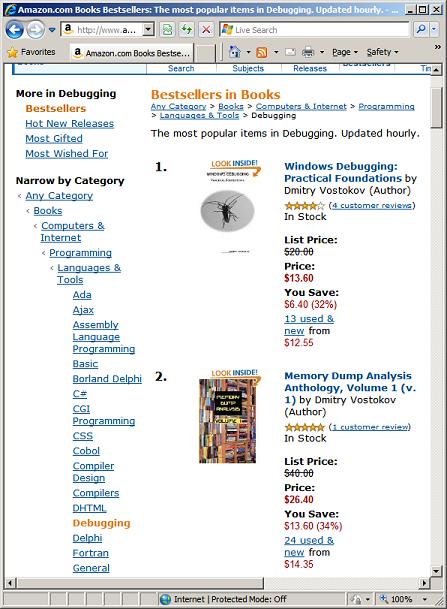
Occasionally I check my books to see how they are positioned on Amazon and noticed that Windows Debugging: Practical Foundations and Memory Dump Analysis Anthology, Volume 1 paperback titles are #1 and #2 bestsellers (at the time of this writing) on Amazon Debugging and Assembly Language Programming bestselling lists:

- Dmitry Vostokov @ DumpAnalysis.org -

Debugging Spy Network

Tuesday, September 15th, 2009

SecretSES (Secret Software Engineering Society) announces Debugging Spy Network of Memory Analysis Forensics and Intelligence Agents (MAFIA).

Motivation: seeing various nomadic and settled debugging teams I finally decided to unfold my own net.

- Dmitry Vostokov @ DumpAnalysis.org -

Counterfactual Debugging: Data Ordering

Tuesday, September 15th, 2009

Having discussed dereference fixpoints we come back to the quiz code and see what happens when we execute it after compilation as default Debug target with Debug Information Format set to Program Database to avoid extra stack space allocation:

int _tmain(int argc, _TCHAR* argv[])
{
   char c;
   char* pc = &c;
   while(1)
   {
     *pc = 0;
     pc++;
   }


   return 0;
}

Expecting crashes I created the following key HKEY_LOCAL_MACHINE \ SOFTWARE \ Microsoft \ Windows \ Windows Error Reporting \ LocalDumps with the following values: DumpFolder (REG_EXPAND_SZ) and DumpType (2, Full).

When running the compiled program I noticed that it crashed according to my expectations. The saved dump StackErasure.exe.2096.dmp confirmed that the crash was due to the stack underflow when it hit the base address:

0:000> r
eax=002c0000 ebx=7efde000 ecx=00000001 edx=002c0000 esi=00000000 edi=00000000
eip=00e11039 esp=002bf7c4 ebp=002bf7d4 iopl=0         nv up ei pl nz na po nc
cs=0023  ss=002b  ds=002b  es=002b  fs=0053  gs=002b             efl=00010202
StackErasure!wmain+0x29:
00e11039 c60200          mov     byte ptr [edx],0           ds:002b:002c0000=??

0:000> !teb
TEB at 7efdd000
    ExceptionList:        002bf810
    StackBase:            002c0000
    StackLimit:           002be000
    SubSystemTib:         00000000
    FiberData:            00001e00
    ArbitraryUserPointer: 00000000
    Self:                 7efdd000
    EnvironmentPointer:   00000000
    ClientId:             00000830 . 00000a78
    RpcHandle:            00000000
    Tls Storage:          7efdd02c
    PEB Address:          7efde000
    LastErrorValue:       0
    LastStatusValue:      0
    Count Owned Locks:    0
    HardErrorMode:        0

The loop from source code is highlighted in blue:

0:000> uf wmain
StackErasure!wmain:
00e11010 push    ebp
00e11011 mov     ebp,esp
00e11013 sub     esp,10h
00e11016 mov     eax,0CCCCCCCCh
00e1101b mov     dword ptr [ebp-10h],eax
00e1101e mov     dword ptr [ebp-0Ch],eax
00e11021 mov     dword ptr [ebp-8],eax
00e11024 mov     dword ptr [ebp-4],eax
00e11027 lea     eax,[ebp-5]
00e1102a mov     dword ptr [ebp-10h],eax

StackErasure!wmain+0x1d:
00e1102d mov     ecx,1
00e11032 test    ecx,ecx
00e11034 je      StackErasure!wmain+0x37 (00e11047)

StackErasure!wmain+0x26:
00e11036 mov     edx,dword ptr [ebp-10h]
00e11039 mov     byte ptr [edx],0
00e1103c mov     eax,dword ptr [ebp-10h]
00e1103f add     eax,1
00e11042 mov     dword ptr [ebp-10h],eax
00e11045 jmp     StackErasure!wmain+0x1d (00e1102d)

StackErasure!wmain+0x37:
00e11047 xor     eax,eax
00e11049 push    edx
00e1104a mov     ecx,ebp
00e1104c push    eax
00e1104d lea     edx,[StackErasure!wmainCRTStartup+0x10 (00e11060)]
00e11053 call    StackErasure!__tmainCRTStartup+0x50 (00e110c0)
00e11058 pop     eax
00e11059 pop     edx
00e1105a mov     esp,ebp
00e1105c pop     ebp
00e1105d ret

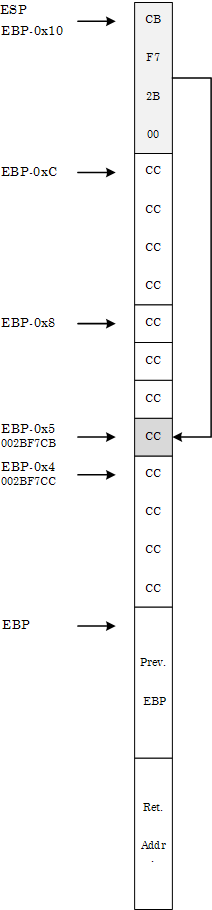
We see that our char variable ‘c’ is located at EBP-5 and the pointer ‘pc’ is located at EBP-10 (in another words ‘c’ follows ‘pc’ in memory):

00e11027 lea     eax,[ebp-5]
00e1102a mov     dword ptr [ebp-10h],eax

Both locations were initialized to 0xCCCCCCCC:

00e11016 mov     eax,0CCCCCCCCh
00e1101b mov     dword ptr [ebp-10h],eax
00e1101e mov     dword ptr [ebp-0Ch],eax
00e11021 mov     dword ptr [ebp-8],eax  ; this ends with EBP-5
00e11024 mov     dword ptr [ebp-4],eax

The memory layout before the start of the loop is depicted on the following diagram in the style of Windows Debugging: Practical Foundations book:
At the crash point we have the following final memory layout:
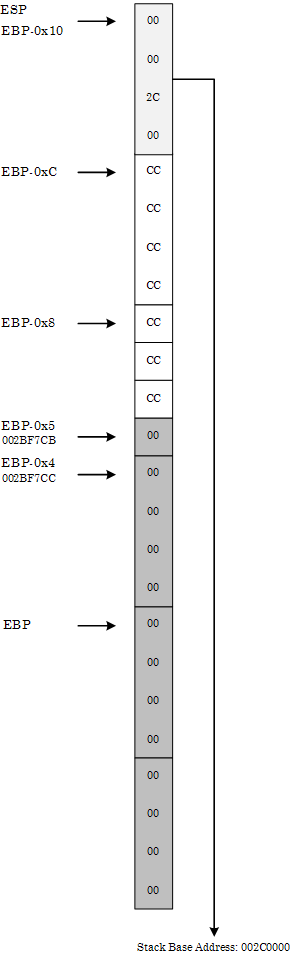
We can see it from the raw stack:

0:000> db esp
002bf7c4  00 00 2c 00 cc cc cc cc-cc cc cc 00 00 00 00 00
002bf7d4  00 00 00 00 00 00 00 00-00 00 00 00 00 00 00 00
002bf7e4  00 00 00 00 00 00 00 00-00 00 00 00 00 00 00 00
002bf7f4  00 00 00 00 00 00 00 00-00 00 00 00 00 00 00 00
002bf804  00 00 00 00 00 00 00 00-00 00 00 00 00 00 00 00
002bf814  00 00 00 00 00 00 00 00-00 00 00 00 00 00 00 00
002bf824  00 00 00 00 00 00 00 00-00 00 00 00 00 00 00 00
002bf834  00 00 00 00 00 00 00 00-00 00 00 00 00 00 00 00

or in pointer-sized (double word) values where we can see little endian effects (compare 00 00 2c 00  with 002c0000):

0:000> dp esp
002bf7c4  002c0000 cccccccc 00cccccc 00000000
002bf7d4  00000000 00000000 00000000 00000000
002bf7e4  00000000 00000000 00000000 00000000
002bf7f4  00000000 00000000 00000000 00000000
002bf804  00000000 00000000 00000000 00000000
002bf814  00000000 00000000 00000000 00000000
002bf824  00000000 00000000 00000000 00000000
002bf834  00000000 00000000 00000000 00000000

The loop code erases stack starting from EBP-5 until it hits the base address. 

Now we change Basic Runtime Checks in Code Generation properties to Default, recompile and launch the project. Suddenly it no longer crashes but loops infinitely (shown in blue):

0:000> bp wmain

0:000> g
[...]

0:000> uf wmain
StackErasure!wmain:
00d01010 push    ebp
00d01011 mov     ebp,esp
00d01013 sub     esp,8
00d01016 lea     eax,[ebp-5]
00d01019 mov     dword ptr [ebp-4],eax

StackErasure!wmain+0xc:
00d0101c mov     ecx,1
00d01021 test    ecx,ecx
00d01023 je      StackErasure!wmain+0x26 (00d01036)

StackErasure!wmain+0x15:
00d01025 mov     edx,dword ptr [ebp-4]
00d01028 mov     byte ptr [edx],0
00d0102b mov     eax,dword ptr [ebp-4]
00d0102e add     eax,1
00d01031 mov     dword ptr [ebp-4],eax
00d01034 jmp     StackErasure!wmain+0xc (00d0101c)

StackErasure!wmain+0x26:
00d01036 xor     eax,eax
00d01038 mov     esp,ebp
00d0103a pop     ebp
00d0103b ret

At first it looks strange but if we look at the stack memory layout we would see that ‘pc’ pointer follows ‘c’ (the opposite to the memory layout discussed above):

00d01016 lea     eax,[ebp-5]
00d01019 mov     dword ptr [ebp-4],eax
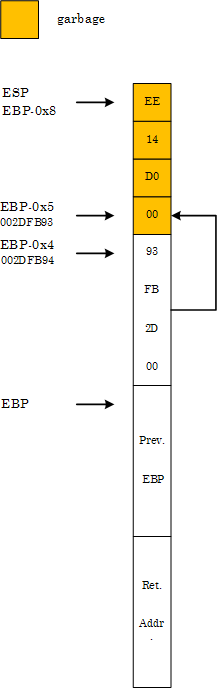
0:000> dp esp
002dfb90 00d014ee 002dfb93 002dfbe4 00d01186
002dfba0 00000001 00081d70 00081df8 5a16a657
002dfbb0 00000000 00000000 7ffdb000 00000000
002dfbc0 00000000 00000000 00000000 002dfbac
002dfbd0 000001bb 002dfc28 00d06e00 5aed06eb
002dfbe0 00000000 002dfbec 00d0105f 002dfbf8
002dfbf0 77844911 7ffdb000 002dfc38 7791e4b6
002dfc00 7ffdb000 705b3701 00000000 00000000

Therefore, when the pointer at EBP-4 is incremented by 1 during the first loop iteration it becomes a dereference fixpoint:

0:000> bp 00d0101c

0:000> g
Breakpoint 1 hit
eax=002dfb93 ebx=7ffdb000 ecx=00000001 edx=00081df8 esi=00000000 edi=00000000
eip=00d0101c esp=002dfb90 ebp=002dfb98 iopl=0         nv up ei pl nz na pe nc
cs=001b  ss=0023  ds=0023  es=0023  fs=003b  gs=0000             efl=00000206
StackErasure!wmain+0xc:
00d0101c b901000000      mov     ecx,1

0:000> t
eax=002dfb93 ebx=7ffdb000 ecx=00000001 edx=00081df8 esi=00000000 edi=00000000
eip=00d01021 esp=002dfb90 ebp=002dfb98 iopl=0         nv up ei pl nz na pe nc
cs=001b  ss=0023  ds=0023  es=0023  fs=003b  gs=0000             efl=00000206
StackErasure!wmain+0x11:
00d01021 85c9            test    ecx,ecx

0:000> t
eax=002dfb93 ebx=7ffdb000 ecx=00000001 edx=00081df8 esi=00000000 edi=00000000
eip=00d01023 esp=002dfb90 ebp=002dfb98 iopl=0         nv up ei pl nz na po nc
cs=001b  ss=0023  ds=0023  es=0023  fs=003b  gs=0000             efl=00000202
StackErasure!wmain+0x13:
00d01023 7411            je      StackErasure!wmain+0x26 (00d01036)      [br=0]

0:000> t
eax=002dfb93 ebx=7ffdb000 ecx=00000001 edx=00081df8 esi=00000000 edi=00000000
eip=00d01025 esp=002dfb90 ebp=002dfb98 iopl=0         nv up ei pl nz na po nc
cs=001b  ss=0023  ds=0023  es=0023  fs=003b  gs=0000             efl=00000202
StackErasure!wmain+0x15:
00d01025 8b55fc          mov     edx,dword ptr [ebp-4] ss:0023:002dfb94=002dfb93

0:000> t
eax=002dfb93 ebx=7ffdb000 ecx=00000001 edx=002dfb93 esi=00000000 edi=00000000
eip=00d01028 esp=002dfb90 ebp=002dfb98 iopl=0         nv up ei pl nz na po nc
cs=001b  ss=0023  ds=0023  es=0023  fs=003b  gs=0000             efl=00000202
StackErasure!wmain+0x18:
00d01028 c60200          mov     byte ptr [edx],0           ds:0023:002dfb93=00

0:000> t
eax=002dfb93 ebx=7ffdb000 ecx=00000001 edx=002dfb93 esi=00000000 edi=00000000
eip=00d0102b esp=002dfb90 ebp=002dfb98 iopl=0         nv up ei pl nz na po nc
cs=001b  ss=0023  ds=0023  es=0023  fs=003b  gs=0000             efl=00000202
StackErasure!wmain+0x1b:
00d0102b 8b45fc          mov     eax,dword ptr [ebp-4] ss:0023:002dfb94=002dfb93

0:000> t
eax=002dfb93 ebx=7ffdb000 ecx=00000001 edx=002dfb93 esi=00000000 edi=00000000
eip=00d0102e esp=002dfb90 ebp=002dfb98 iopl=0         nv up ei pl nz na po nc
cs=001b  ss=0023  ds=0023  es=0023  fs=003b  gs=0000             efl=00000202
StackErasure!wmain+0x1e:
00d0102e 83c001          add     eax,1

0:000> t
eax=002dfb94 ebx=7ffdb000 ecx=00000001 edx=002dfb93 esi=00000000 edi=00000000
eip=00d01031 esp=002dfb90 ebp=002dfb98 iopl=0         nv up ei pl nz na po nc
cs=001b  ss=0023  ds=0023  es=0023  fs=003b  gs=0000             efl=00000202
StackErasure!wmain+0x21:
00d01031 8945fc          mov     dword ptr [ebp-4],eax ss:0023:002dfb94=002dfb93

0:000> t
eax=002dfb94 ebx=7ffdb000 ecx=00000001 edx=002dfb93 esi=00000000 edi=00000000
eip=00d01034 esp=002dfb90 ebp=002dfb98 iopl=0         nv up ei pl nz na po nc
cs=001b  ss=0023  ds=0023  es=0023  fs=003b  gs=0000             efl=00000202
StackErasure!wmain+0x24:
00d01034 ebe6            jmp     StackErasure!wmain+0xc (00d0101c)

0:000> dp ebp-4 l1
002dfb94  002dfb94
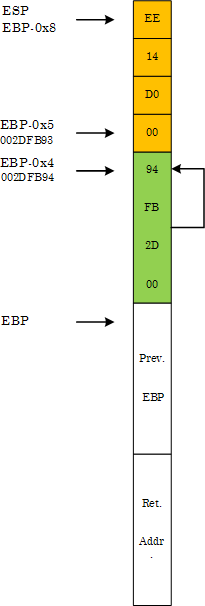
During the second iteration the assignment of zero to ‘*pc’ clears the first byte of ‘pc’:

0:000> t
Breakpoint 1 hit
eax=002dfb94 ebx=7ffdb000 ecx=00000001 edx=002dfb93 esi=00000000 edi=00000000
eip=00d0101c esp=002dfb90 ebp=002dfb98 iopl=0         nv up ei pl nz na po nc
cs=001b  ss=0023  ds=0023  es=0023  fs=003b  gs=0000             efl=00000202
StackErasure!wmain+0xc:
00d0101c b901000000      mov     ecx,1

0:000> t
eax=002dfb94 ebx=7ffdb000 ecx=00000001 edx=002dfb93 esi=00000000 edi=00000000
eip=00d01021 esp=002dfb90 ebp=002dfb98 iopl=0         nv up ei pl nz na po nc
cs=001b  ss=0023  ds=0023  es=0023  fs=003b  gs=0000             efl=00000202
StackErasure!wmain+0x11:
00d01021 85c9            test    ecx,ecx

0:000> t
eax=002dfb94 ebx=7ffdb000 ecx=00000001 edx=002dfb93 esi=00000000 edi=00000000
eip=00d01023 esp=002dfb90 ebp=002dfb98 iopl=0         nv up ei pl nz na po nc
cs=001b  ss=0023  ds=0023  es=0023  fs=003b  gs=0000             efl=00000202
StackErasure!wmain+0x13:
00d01023 7411            je      StackErasure!wmain+0x26 (00d01036)      [br=0]

0:000> t
eax=002dfb94 ebx=7ffdb000 ecx=00000001 edx=002dfb93 esi=00000000 edi=00000000
eip=00d01025 esp=002dfb90 ebp=002dfb98 iopl=0         nv up ei pl nz na po nc
cs=001b  ss=0023  ds=0023  es=0023  fs=003b  gs=0000             efl=00000202
StackErasure!wmain+0x15:
00d01025 8b55fc          mov     edx,dword ptr [ebp-4] ss:0023:002dfb94=002dfb94

0:000> t
eax=002dfb94 ebx=7ffdb000 ecx=00000001 edx=002dfb94 esi=00000000 edi=00000000
eip=00d01028 esp=002dfb90 ebp=002dfb98 iopl=0         nv up ei pl nz na po nc
cs=001b  ss=0023  ds=0023  es=0023  fs=003b  gs=0000             efl=00000202
StackErasure!wmain+0x18:
00d01028 c60200          mov     byte ptr [edx],0           ds:0023:002dfb94=94

0:000> t
eax=002dfb94 ebx=7ffdb000 ecx=00000001 edx=002dfb94 esi=00000000 edi=00000000
eip=00d0102b esp=002dfb90 ebp=002dfb98 iopl=0         nv up ei pl nz na po nc
cs=001b  ss=0023  ds=0023  es=0023  fs=003b  gs=0000             efl=00000202
StackErasure!wmain+0x1b:
00d0102b 8b45fc          mov     eax,dword ptr [ebp-4] ss:0023:002dfb94=002dfb00

0:000> dp esp
002dfb90  00d014ee 002dfb00 002dfbe4 00d01186
002dfba0  00000001 00081d70 00081df8 5a16a657
002dfbb0  00000000 00000000 7ffdb000 00000000
002dfbc0  00000000 00000000 00000000 002dfbac
002dfbd0  000001bb 002dfc28 00d06e00 5aed06eb
002dfbe0  00000000 002dfbec 00d0105f 002dfbf8
002dfbf0  77844911 7ffdb000 002dfc38 7791e4b6
002dfc00  7ffdb000 705b3701 00000000 00000000
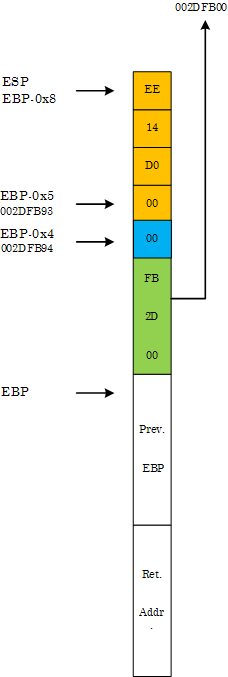
The new ‘pc’ pointer points to the following region of the stack:

0:000> dp 002dfb00 l100/4
002dfb00  002dfb0c 00000004 00000000 5c008ede
002dfb10  002dfb28 00d0634a 0008128c 5aed018b
002dfb20  000807f8 7790fb66 00000000 7ffdb000
002dfb30  00000000 002dfb40 00d089a6 00d68ab8
002dfb40  002dfb4c 00d019bc 00000008 002dfb84
002dfb50  00d07520 00d07519 5a16a637 00000000
002dfb60  00000000 7ffdb000 00d02b10 00000004
002dfb70  00000002 002dfbd4 00d06e00 5aed007b
002dfb80  fffffffe 002dfb90 00d0769e 002dfba0
002dfb90  00d014ee 002dfb00 002dfbe4 00d01186
002dfba0  00000001 00081d70 00081df8 5a16a657
002dfbb0  00000000 00000000 7ffdb000 00000000
002dfbc0  00000000 00000000 00000000 002dfbac
002dfbd0  000001bb 002dfc28 00d06e00 5aed06eb
002dfbe0  00000000 002dfbec 00d0105f 002dfbf8
002dfbf0  77844911 7ffdb000 002dfc38 7791e4b6

The loop code now starts clearing this region until the pointer becomes the fixpoint again after successive increments and therefore continues to loop indefinitely:

0:000> bc 0 1

0:000> g
(1238.c9c): Break instruction exception - code 80000003 (first chance)
eax=7ffde000 ebx=00000000 ecx=00000000 edx=7796d094 esi=00000000 edi=00000000
eip=77927dfe esp=00a4ff30 ebp=00a4ff5c iopl=0         nv up ei pl zr na pe nc
cs=001b  ss=0023  ds=0023  es=0023  fs=003b  gs=0000             efl=00000246
ntdll!DbgBreakPoint:
77927dfe cc              int     3

0:001> dp 002dfb00 l100/4
002dfb00  0000000c 00000000 00000000 00000000
002dfb10  00000000 00000000 00000000 00000000
002dfb20  00000000 00000000 00000000 00000000
002dfb30  00000000 00000000 00000000 00000000
002dfb40  00000000 00000000 00000000 00000000
002dfb50  00000000 00000000 00000000 00000000
002dfb60  00000000 00000000 00000000 00000000
002dfb70  00000000 00000000 00000000 00000000
002dfb80  00000000 00000000 00000000 00000000
002dfb90  00000000
002dfb1f 002dfbe4 00d01186
002dfba0  00000001 00081d70 00081df8 5a16a657
002dfbb0  00000000 00000000 7ffdb000 00000000
002dfbc0  00000000 00000000 00000000 002dfbac
002dfbd0  000001bb 002dfc28 00d06e00 5aed06eb
002dfbe0  00000000 002dfbec 00d0105f 002dfbf8
002dfbf0  77844911 7ffdb000 002dfc38 7791e4b6

StackErasure that loops indefinitely is available for download

- Dmitry Vostokov @ DumpAnalysis.org -
Video from Microsoft GEC

Monday, September 14th, 2009

Ntdebugging blog has put the link to the video online from Microsoft Global Engineering Conference where I presented the pattern-driven memory dump analysis methodology:

Citrix engineers at Microsoft GEC

Note: you need to open a video link URL from the blog post in Windows Media Player if you don’t have an association for WMV files or save the file.

- Dmitry Vostokov @ DumpAnalysis.org -

Counterfactual Debugging: Dereference Fixpoints

Friday, September 11th, 2009

Imagine we have the following arrangements in memory:

address: value

where value == address, so we have effectively:

address: address

So when we dereference the address we get the address value. If we name the dereference function as p(address) we get

p(address) = address

That gave me an idea to name after the mathematical notion of a function fixpoint (fixed point).

In C++ we can write the following code to initialize a fixpoint:

void *pc = &pc;

in assembly language:

lea      eax, [pc]
mov      dword ptr [pc], eax

or using local variables:

lea      eax, [ebp-4]
mov      dword ptr [ebp-4], eax

Dereference of a fixpoint pointer gives us the same value as its address, for example, using old style conversion:

int *pc = (int *)&pc;

if (pc == (int *)*pc) {
 // TRUE

or for C++ purists:

int *pc = reinterpret_cast<int *>(&pc);

if (pc == reinterpret_cast<int *>(*pc)) {
 // TRUE

In x86 assembly language we have this comparison:

mov         eax,dword ptr [pc]
mov         ecx,dword ptr [pc]
cmp         ecx,dword ptr [eax]

or using local variables:

mov         eax,dword ptr [ebp-4]
mov         ecx,dword ptr [ebp-4]
cmp         ecx,dword ptr [eax]

Now, having discussed fixpoints, let me ask the question to ponder over this weekend. What would this code do?

int _tmain(int argc, _TCHAR* argv[])
{
   char c;
   char* pc = &c;

   while(1)
   {
     *pc = 0;
     pc++;
   }
 

   return 0;
}

Would it produce stack overflow with an exception, or stack underflow with an exception or loop indefinitely? The C++ Standard answer of compiler and platform dependence is not acceptable. I plan to elaborate on this topic on Monday.

The notion of counterfactual debugging (”what if” debugging) was inspired by the so called counterfactual history.

- Dmitry Vostokov @ DumpAnalysis.org -

Truncated dump, stack trace collection, waiting thread time and wait chains: pattern cooperation

Thursday, September 10th, 2009

It was reported that functionality of some applications was not available until ServiceA was killed and restarted. Complete memory dump was forced. For that memory dump WinDbg !stacks command shows every thread bugchecking the system, for example:

0: kd> !stacks
Proc.Thread  .Thread  Ticks   ThreadState Blocker
[...]
                            [8ca72020 ApplicationA.exe]
 4bc.0004c4  8bf76af0 0000cc4 Blocked    nt!KeBugCheckEx+0x1b
 4bc.0004d0  8bf53650 000055d Blocked    nt!KeBugCheckEx+0x1b
 4bc.0004e8  8bf33c88 0000094 Blocked    nt!KeBugCheckEx+0x1b
 4bc.001ffc  8ba86020 0000eed Blocked    nt!KeBugCheckEx+0x1b
 4bc.001e30  8b7a0ca8 00003ac Blocked    nt!KeBugCheckEx+0x1b
 4bc.001934  8b664020 0000eed Blocked    nt!KeBugCheckEx+0x1b
 4bc.001af0  8ca6d3b0 0000094 Blocked    nt!KeBugCheckEx+0x1b
 4bc.001cac  8bf41af0 0001412 Blocked    nt!KeBugCheckEx+0x1b
 4bc.00141c  8b6458d0 0000094 Blocked    nt!KeBugCheckEx+0x1b
[...]

Seeing this nonsense I checked that complete dump was truncated by half because page file was 4Gb but the amount of physical memory was 8Gb:

0: kd> !vm
*** Virtual Memory Usage ***
 Physical Memory:     2096553 (   8386212 Kb)
 Paging File Name paged out
   Current:   4195328 Kb  Free Space:   4182336 Kb
   Minimum:   4195328 Kb  Maximum:      4195328 Kb
[…]

However it was possible to get stack trace collection using !process 0 ff command with most data from _ETHREAD structures present but most of kernel and user space stack traces not present in the output. ServiceA has many threads waiting for LPC requests during last 5 minutes (the bugcheck was forced after 3 - 4 minutes the issue manifested itself):

THREAD 8cc9b590  Cid 053c.0668  Teb: 7ffaf000 Win32Thread: b84e5770 WAIT: (Unknown) UserMode Non-Alertable
    8cc9b77c  Semaphore Limit 0x1
Waiting for reply to LPC MessageId 0005bbdf:
Current LPC port e2cee338
IRP List:
    8b6548b8: (0006,0268) Flags: 00000000  Mdl: 00000000
Not impersonating
DeviceMap                 e1003860
Owning Process            8bf81d88       Image:         ServiceA.exe
Attached Process          N/A            Image:         N/A
Wait Start TickCount      193823         Ticks: 13752 (0:00:03:34.875)
Context Switch Count      389                 LargeStack
UserTime                  00:00:00.015
KernelTime                00:00:00.000
Win32 Start Address 0×7d1f5e70
Start Address 0×77e617ec
Stack Init b3a44000 Current b3a43c08 Base b3a44000 Limit b3a41000 Call 0
Priority 9 BasePriority 8 PriorityDecrement 0
Kernel stack not resident.

The similar waits were found for ApplicationB and ApplicationC processes. Therefore it was advised to limit the amount of physical memory to 4Gb and reproduce the issue or if the liveliness of the system needs to be preserved to manually dump the following processes on the next occasion:

ServiceA.exe
ApplicationB.exe
ApplicationC.exe

- Dmitry Vostokov @ DumpAnalysis.org -

Electronic Version of Debugged! Magazine

Tuesday, September 8th, 2009

Responding to numerous requests and suggestions I plan to make magazine interior excluding promotional vouchers available for free download. If someone needs covers including back covers where I put tips and tables to be used as posters or certification vouchers printed inside then they should buy the magazine from Amazon or other bookshops.

This initiative will be accompanied by a smart marketing trick that I plan to unveil in a few days together with the magazine website.

- Dmitry Vostokov @ DumpAnalysis.org -

Manual parameter reconstruction on x64 Windows systems

Friday, September 4th, 2009

Although the first 2 parameters are passed via registers RCX and RDX they are saved on a stack as the part of a function prolog (as can be seen in many examples from my book x64 Windows Debugging: Practical Foundations):

0:000> uf arithmetic
FunctionParameters!arithmetic [c:\dumps\wdpf-x64\functionparameters\arithmetic.cpp @ 2]:
    2 00000001`40001020 mov     dword ptr [rsp+10h],edx
    2 00000001`40001024 mov     dword ptr [rsp+8],ecx

    2 00000001`40001028 push    rdi
    3 00000001`40001029 mov     eax,dword ptr [rsp+10h]
    3 00000001`4000102d mov     ecx,dword ptr [rsp+18h]
    3 00000001`40001031 add     ecx,eax
    3 00000001`40001033 mov     eax,ecx
    3 00000001`40001035 mov     dword ptr [rsp+18h],eax
    4 00000001`40001039 mov     eax,dword ptr [rsp+10h]
    4 00000001`4000103d add     eax,1
    4 00000001`40001040 mov     dword ptr [rsp+10h],eax
    5 00000001`40001044 mov     eax,dword ptr [rsp+10h]
    5 00000001`40001048 imul    eax,dword ptr [rsp+18h]
    5 00000001`4000104d mov     dword ptr [rsp+18h],eax
    7 00000001`40001051 mov     eax,dword ptr [rsp+18h]
    8 00000001`40001055 pop     rdi
    8 00000001`40001056 ret

Notice that RDI is saved too. This helps us later in a more complex case. If we put a breakpoint at arithmetic entry we see that WinDbg is not able to get parameters from RCX and RDX:

0:000> bp 00000001`40001020

0:000> g
ModLoad: 000007fe`ff4d0000 000007fe`ff5d8000   C:\Windows\system32\ADVAPI32.DLL
ModLoad: 000007fe`fef80000 000007fe`ff0c3000   C:\Windows\system32\RPCRT4.dll
Breakpoint 0 hit
FunctionParameters!arithmetic:
00000001`40001020 89542410        mov     dword ptr [rsp+10h],edx ss:00000000`0012fe88=cccccccc

0:000> kv
Child-SP          RetAddr           : Args to Child                                                           : Call Site
00000000`0012fe78 00000001`400010a5 : cccccccc`cccccccc cccccccc`cccccccc cccccccc`cccccccc cccccccc`cccccccc : FunctionParameters!arithmetic
00000000`0012fe80 00000001`4000137c : 00000000`00000001 00000000`00282960 00000000`00000000 00000000`00000000 : FunctionParameters!main+0×35
00000000`0012fec0 00000001`4000114e : 00000000`00000000 00000000`00000000 00000000`00000000 00000000`00000000 : FunctionParameters!__tmainCRTStartup+0×21c
00000000`0012ff30 00000000`7776be3d : 00000000`00000000 00000000`00000000 00000000`00000000 00000000`00000000 : FunctionParameters!mainCRTStartup+0xe
00000000`0012ff60 00000000`778a6a51 : 00000000`00000000 00000000`00000000 00000000`00000000 00000000`00000000 : kernel32!BaseThreadInitThunk+0xd
00000000`0012ff90 00000000`00000000 : 00000000`00000000 00000000`00000000 00000000`00000000 00000000`00000000 : ntdll!RtlUserThreadStart+0×1d

This seems correct approach in general because at the time of any other breakpoint in the middle of the code parameter passing registers could be already overwritten, for example, RCX at 0000000140001031. However, as soon as we execute the first two MOV instruction one by one, parameters appear on kv output one by one too:

0:000> t
ModLoad: 000007fe`fd810000 000007fe`fd845000   C:\Windows\system32\apphelp.dll
FunctionParameters!arithmetic+0x4:
00000001`40001024 894c2408        mov     dword ptr [rsp+8],ecx ss:00000000`0012fe80=cccccccc

0:000> kv
Child-SP          RetAddr           : Args to Child                                                           : Call Site
00000000`0012fe78 00000001`400010a5 : cccccccc`cccccccc cccccccc`00000001 cccccccc`cccccccc cccccccc`cccccccc : FunctionParameters!arithmetic+0×4
00000000`0012fe80 00000001`4000137c : 00000000`00000001 00000000`00282960 00000000`00000000 00000000`00000000 : FunctionParameters!main+0×35
00000000`0012fec0 00000001`4000114e : 00000000`00000000 00000000`00000000 00000000`00000000 00000000`00000000 : FunctionParameters!__tmainCRTStartup+0×21c
00000000`0012ff30 00000000`7776be3d : 00000000`00000000 00000000`00000000 00000000`00000000 00000000`00000000 : FunctionParameters!mainCRTStartup+0xe
00000000`0012ff60 00000000`778a6a51 : 00000000`00000000 00000000`00000000 00000000`00000000 00000000`00000000 : kernel32!BaseThreadInitThunk+0xd
00000000`0012ff90 00000000`00000000 : 00000000`00000000 00000000`00000000 00000000`00000000 00000000`00000000 : ntdll!RtlUserThreadStart+0×1d

0:000> t
FunctionParameters!arithmetic+0x8:
00000001`40001028 57              push    rdi

0:000> kv
Child-SP          RetAddr           : Args to Child                                                           : Call Site
00000000`0012fe78 00000001`400010a5 : cccccccc`00000001 cccccccc`00000001 cccccccc`cccccccc cccccccc`cccccccc : FunctionParameters!arithmetic+0×8
00000000`0012fe80 00000001`4000137c : 00000000`00000001 00000000`00282960 00000000`00000000 00000000`00000000 : FunctionParameters!main+0×35
00000000`0012fec0 00000001`4000114e : 00000000`00000000 00000000`00000000 00000000`00000000 00000000`00000000 : FunctionParameters!__tmainCRTStartup+0×21c
00000000`0012ff30 00000000`7776be3d : 00000000`00000000 00000000`00000000 00000000`00000000 00000000`00000000 : FunctionParameters!mainCRTStartup+0xe
00000000`0012ff60 00000000`778a6a51 : 00000000`00000000 00000000`00000000 00000000`00000000 00000000`00000000 : kernel32!BaseThreadInitThunk+0xd
00000000`0012ff90 00000000`00000000 : 00000000`00000000 00000000`00000000 00000000`00000000 00000000`00000000 : ntdll!RtlUserThreadStart+0×1d

Now we come to the more complex example:

1: kd> kv
  *** Stack trace for last set context - .thread/.cxr resets it
Child-SP          RetAddr           : Args to Child                                                           : Call Site
fffffa60`166a7020 fffffa60`07e9dbf2 : fffffa80`1dbd8820 00000000`00000000 fffffa80`1ec3b7a8 fffffa60`166a7278 : Driver!DeviceWrite+0xae
fffffa60`166a7050 fffffa60`062ae7cb : 00000000`00000000 fffffa80`1dbd8820 fffffa60`166a7340 fffffa80`1df4f520 : Driver!RawWrite+0×8a
[…]

1: kd> r
Last set context:
rax=000000000083a03b rbx=fffffa801ec3b800 rcx=fffffa8018cdc000
rdx=0000000000000004 rsi=fffffa801ec3b9f0 rdi=0000000005040000
rip=fffffa6007ea006e rsp=fffffa60166a7020 rbp=fffffa801ec3b7a8
 r8=fffff6fd400f61e0  r9=000000000083a03b r10=fffffa801ec3b9f8
r11=fffffa801ec3b9f8 r12=fffffa801e7c9000 r13=0000000000000000
r14=000000000038011b r15=fffffa8019891670
iopl=0         nv up ei ng nz na po cy
cs=0010 ss=0018 ds=002b es=002b fs=0053 gs=002b efl=00010287
Driver!DeviceWrite+0xae:
fffffa60`07ea006e mov     rax,qword ptr [rdi+10h] ds:002b:00000000`05040010=????????????????

We know that the first parameter to Write function is a pointer to some structure we want to explore because we see from the disassembly that some member from that structure was used ([rcx+320h]) and it was used as a pointer (assigned to RDI) that was trapping ([rdi+10h]):

1: kd> .asm no_code_bytes
Assembly options: no_code_bytes

1: kd> u Driver!DeviceWrite Driver!DeviceWrite+0xae+10
Driver!DeviceWrite:
fffffa60`07e9ffc0 mov     qword ptr [rsp+8],rbx
fffffa60`07e9ffc5 mov     qword ptr [rsp+10h],rbp
fffffa60`07e9ffca mov     qword ptr [rsp+18h],rsi
fffffa60`07e9ffcf push    rdi
fffffa60`07e9ffd0 sub     rsp,20h
fffffa60`07e9ffd4 mov     rdi,qword ptr [rcx+320h]
[…]
fffffa60`07ea006e mov     rax,qword ptr [rdi+10h] ; TRAP
[…]

Unfortunately RCX was not saved on the stack and fffffa80`1dbd8820 from kv was just the value of the saved RBX. This can be double-checked by verifying that parameter+320 doesn’t point to RDI value (05040000) at the time of the trap:

1: kd> dq fffffa80`1dbd8820+320 l1
fffffa80`1dbd8b40  00000000`00020000

Looking at DeviceWrite caller we see that RCX was initialized from RDI:

1: kd> ub fffffa60`07e9dbf2
Driver!RawWrite+0x66:
fffffa60`07e9dbce mov     rax,qword ptr [rdi+258h]
fffffa60`07e9dbd5 mov     qword ptr [rcx-18h],rax
fffffa60`07e9dbd9 mov     rax,qword ptr [rdi+260h]
fffffa60`07e9dbe0 mov     qword ptr [rcx-20h],rax
fffffa60`07e9dbe4 mov     dword ptr [rdx+10h],ebp
fffffa60`07e9dbe7 mov     rdx,rsi
fffffa60`07e9dbea mov     rcx,rdi
fffffa60`07e9dbed call    Driver!DeviceWrite (fffffa60`07e9ffc0)

We also see that RDI was saved at the function prolog so we can get our real first parameter from the raw stack bearing in mind that 0×20 was subtracted from RSP too:

1: kd> dq esp
fffffa60`166a7020  fffffa80`1ec3b800 00000000`05040000 ; SUB RSP, 20H
fffffa60`166a7030  fffffa60`07edc5dd fffffa60`07ee6f8f ;
fffffa60`166a7040  fffffa80`1ec3b520 fffffa60`07e9dbf2 ; Saved RDI - Return Address
fffffa60`166a7050  fffffa80`1dbd8820 00000000`00000000 ; Saved RBX and RBP
fffffa60`166a7060  fffffa80`1ec3b7a8 fffffa60`166a7278 ; Saved RSI 
fffffa60`166a7070  fffffa60`166a7250 fffffa60`01ab5180
fffffa60`166a7080  fffffa80`1e2937c8 fffff800`018a928a
fffffa60`166a7090  00000003`0004000d 00000026`0024000d

We see that saved RDI value +320 points to the right expected address:

1: kd> dq fffffa80`1ec3b520+320 l1
fffffa80`1ec3b840  00000000`05040000

Now we can investigate the structure but this is beyond the scope of this post. 

- Dmitry Vostokov @ DumpAnalysis.org -

Wild code and partial stack reconstruction

Friday, September 4th, 2009

I recently got a chance to see an instance of Wild Code pattern in kernel mode:

ATTEMPTED_EXECUTE_OF_NOEXECUTE_MEMORY (fc)
An attempt was made to execute non-executable memory. The guilty driver is on the stack trace (and is typically the current instruction pointer). When possible, the guilty driver's name (Unicode string) is printed on the bugcheck screen and saved in KiBugCheckDriver.
Arguments:
Arg1: a98ccfc4, Virtual address for the attempted execute.
Arg2: 17b1b963, PTE contents.
Arg3: a98ccf38, (reserved)
Arg4: 00000001, (reserved)

3: kd> .trap 0xffffffffa98ccf38
ErrCode = 00000011
eax=00000000 ebx=bf8c16eb ecx=bf855770 edx=00000026 esi=be4da0e8 edi=0000029e
eip=a98ccfc4 esp=a98ccfac ebp=a98ccfa0 iopl=0 nv up ei ng nz ac pe nc
cs=0008 ss=0010 ds=0023 es=0023 fs=0030 gs=0000 efl=00010296
a98ccfc4 dcda  fcomp3  st(2)

3: kd> !pte a98ccfc4
VA a98ccfc4
PDE at 00000000C0602A60    PTE at 00000000C054C660
contains 000000000B40A863  contains 8000000017B1B963
pfn b40a       ---DA--KWEV    pfn 17b1b      -G-DA--KW-V

3: kd> k
*** Stack trace for last set context - .thread/.cxr resets it
ChildEBP RetAddr
WARNING: Frame IP not in any known module. Following frames may be wrong.
a98ccff0 80889db4 0xa98ccfc4
a98ccff0 00000000 nt!KiCallbackReturn+0×84

We see that the execution address belongs to thread kernel stack range:

3: kd> !thread
THREAD 8959f548  Cid 20c4.0dd8  Teb: 7ffdf000 Win32Thread: bc1a9550 RUNNING on processor 3
Not impersonating
DeviceMap                 e183a628
Owning Process            890af4b0       Image:         ApplicationA.exe
Attached Process          N/A            Image:         N/A
Wait Start TickCount      67969974       Ticks: 0
Context Switch Count      2833569                 LargeStack
UserTime                  00:01:18.171
KernelTime                00:00:50.468
Win32 Start Address 0x00401c94
Start Address 0x7c8217f8
Stack Init a98cd260 Current a98ccc48 Base a98ce000 Limit a98c3000 Call a98cd268
Priority 13 BasePriority 8 PriorityDecrement 0
ChildEBP RetAddr  Args to Child
a98ccea8 8085eced 000000fc a98ccfc4 17b1b963 nt!KeBugCheckEx+0×1b
a98ccf20 8088c798 00000008 a98ccfc4 00000000 nt!MmAccessFault+0xb25
a98ccf20 a98ccfc4 00000008 a98ccfc4 00000000 nt!KiTrap0E+0xdc
WARNING: Frame IP not in any known module. Following frames may be wrong.
a98ccff0 80889db4 0013e3d4 0000000c 00000000 0xa98ccfc4
a98ccff0 00000000 0013e3d4 0000000c 00000000 nt!KiCallbackReturn+0×84

Something must have gone wrong after the return from KiCallbackReturn. On x86 systems this is an IDT entry (2b). See an example output I did while writing down notes on Windows Internals. Windows NT/2000 Native API Reference states that it is the same function as ZwCallBackReturn and it is used to return from win32k.sys user-mode and space callbacks, for example, to send a window message (p. 408). We find the following call on raw stack and use an extended version of k command to get partial stack trace before user-mode callback call:

3: kd> dds a98c3000 a98ce000
[...]
a98cd244 a98cd270
a98cd248 80833485 nt!KiSwapThread+0x305
a98cd24c 8959f548
a98cd250 8959f5f0
a98cd254 00000001
a98cd258 8959f548
a98cd25c 00000000
a98cd260 ffffffff
a98cd264 00000001
a98cd268 a98cd8a0
a98cd26c a98cd604
a98cd270 a98cd8a8
a98cd274 0013f2e4
a98cd278 7ffdf000
a98cd27c 0013e3ac
a98cd280 a98cd2d8
a98cd284 8091d6d1 nt!KeUserModeCallback+0×8f

a98cd288 a98cd388
a98cd28c a98cd384
a98cd290 a98cd370
a98cd294 bc1a9550
a98cd298 006fa0e8
a98cd29c 0013f2e4
a98cd2a0 7ffdf000
a98cd2a4 00000018
a98cd2a8 8948c7f8
[…]

3: kd> k L=a98cd280
ChildEBP RetAddr
WARNING: Frame IP not in any known module. Following frames may be wrong.
a98cd280 8091d6d1 0xa98ccfc4
a98cd2d8 bf858a9a nt!KeUserModeCallback+0×8f
a98cd3b4 bf8a244e win32k!SfnINOUTNCCALCSIZE+0×10b
a98cd3fc bf8a13fa win32k!xxxSendMessageToClient+0×176
a98cd448 bf8a130f win32k!xxxSendMessageTimeout+0×1a6
a98cd46c bf85cd68 win32k!xxxSendMessage+0×1b
a98cd530 bf85daca win32k!xxxCalcValidRects+0×3bc
a98cd58c bf85def4 win32k!xxxEndDeferWindowPosEx+0xf2
a98cd5a8 bf85061c win32k!xxxSetWindowPos+0xb1
a98cd5cc bf8e3df8 win32k!xxxRedrawFrame+0×16
a98cd5d8 bf8a2b69 win32k!xxxDrawMenuBar+0×19
a98cd5f4 8088978c win32k!NtUserCallHwndLock+0×6b
a98cd5f4 7c9485ec nt!KiFastCallEntry+0xfc

0013e438 00000000 0×7c9485ec

- Dmitry Vostokov @ DumpAnalysis.org -

SAD Events (Debugging Slang, Part 3)

Thursday, September 3rd, 2009
SAD event

System or Application Dump event

- Dmitry Vostokov @ DumpAnalysis.org -

Dao of Debugging

Wednesday, September 2nd, 2009

Dao De Jing bugging

Bang the Debugger, explains his extraordinary skill in debugging:

“The Thread is the Way, the flow I follow. When I started I could only use !analyze -v command. After 4 years I could see through memory bits without lenses of a debugger program because Dao is beyond computer understanding and more than technical skills.”

Based on the famous story from Ding the Butcher.

- Dmitry Vostokov @ DumpAnalysis.org -

Music for Debugging: The Duet of Threads

Tuesday, September 1st, 2009

When listening for the first time to all Bach Cantatas from Complete Works, I found Aria Duetto “Wir danken, wir preisen” (”We thank you, we praise”) from BWV 134 (#4) very stimulating to think about multithreading while debugging or analyzing memory dumps and confirmed my feelings during second listening to all Cantatas.

Bach Edition: Complete Works (155 CD Box Set)

Buy from Amazon

Whom do we thank and praise then? Of course, the creator of the correct and maintainable multithreaded code.

- Dmitry Vostokov @ DumpAnalysis.org -

10 Common Mistakes in Memory Analysis (Part 5)

Monday, August 31st, 2009

Sometimes not paying attention to all aspects of default analysis makes it difficult to consider an alternative troubleshooting hypothesis. Here is a sample of !analyze -v output showing massive patching (hooked functions pattern) by DriverA module:

KERNEL_MODE_EXCEPTION_NOT_HANDLED (8e)
This is a very common bugcheck.  Usually the exception address pinpoints the driver/function that caused the problem.  Always note this address as well as the link date of the driver/image that contains this address. Some common problems are exception code 0x80000003.  This means a hard coded breakpoint or assertion was hit, but this system was booted /NODEBUG.  This is not supposed to happen as developers should never have hardcoded breakpoints in retail code, but ... If this happens, make sure a debugger gets connected, and the system is booted /DEBUG.  This will let us see why this breakpoint is happening.
Arguments:
Arg1: c0000005, The exception code that was not handled
Arg2: 8092d47f, The address that the exception occurred at
Arg3: f5205b14, Trap Frame
Arg4: 00000000

[...]

CHKIMG_EXTENSION: !chkimg -lo 50 -d !nt
    80822a49-80822a4d  5 bytes - nt!NtYieldExecution
 [ 8b ff 55 8b ec:e9 14 3a 95 76 ]
    80823c11-80823c14  4 bytes - nt!KeFlushProcessTb+2c (+0x11c8)
 [ 69 76 82 80:88 ff ff ff ]
    80823c17-80823c1a  4 bytes - nt!KeFlushProcessTb+32 (+0x06)
 [ dd 40 01 00:b5 34 b3 76 ]
    8083771f-80837725  7 bytes - nt!KeAcquireQueuedSpinLockAtDpcLevel+1b (+0x13b08)
 [ f7 41 04 01 00 00 00:e9 c4 f9 b1 76 cc cc ]
    80840945-8084094a  6 bytes - nt!KxFlushEntireTb+9 (+0x9226)
 [ ff 15 1c 10 80 80:e9 65 67 b1 76 cc ]
    80845fe0-80845fe3  4 bytes - nt!KeFlushSingleTb+49 (+0x569b)
 [ 14 1d ff ff:dd 10 b1 76 ]
    80845fe5 - nt!KeFlushSingleTb+4e (+0x05)
 [ b9:c3 ]
    8084722d-80847230  4 bytes - nt!KeFlushMultipleTb+45 (+0x1248)
 [ 5e e3 82 80:14 00 00 00 ]
    80847233-80847236  4 bytes - nt!KeFlushMultipleTb+4b (+0x06)
 [ c1 0a ff ff:99 fe b0 76 ]
    808c039c-808c039e  3 bytes - nt!NtSetContextThread
 [ 8b ff 55:e9 31 5f ]
    808c03a0 - nt!NtSetContextThread+4 (+0x04)
 [ ec:76 ]
    808e3184-808e3188  5 bytes - nt!NtCreateProcess (+0x22de4)
 [ 8b ff 55 8b ec:e9 0b 31 89 76 ]
    808f6ad0-808f6ad6  7 bytes - nt!NtLoadKeyEx (+0x1394c)
 [ 6a 70 68 98 4b 81 80:e9 e7 f8 87 76 90 90 ]
    8090c66f-8090c675  7 bytes - nt!NtDeleteValueKey (+0x15b9f)
 [ 6a 44 68 60 f0 81 80:e9 c4 9c 86 76 90 90 ]
    8090e36c-8090e370  5 bytes - nt!NtTerminateProcess (+0x1cfd)
 [ 8b ff 55 8b ec:e9 34 81 86 76 ]
    80915342-80915346  5 bytes - nt!NtDeleteKey (+0x6fd6)
 [ 8b ff 55 8b ec:e9 c7 0f 86 76 ]
    80918114-80918118  5 bytes - nt!NtOpenThread (+0x2dd2)
 [ 68 c4 00 00 00:e9 53 e1 85 76 ]
    80921eac-80921eb2  7 bytes - nt!NtEnumerateKey (+0x9d98)
 [ 6a 48 68 f0 f9 82 80:e9 f5 44 85 76 90 90 ]
    80922578-8092257e  7 bytes - nt!NtEnumerateValueKey (+0x6cc)
 [ 6a 48 68 10 fc 82 80:e9 13 3e 85 76 90 90 ]
    80922efd-80922f01  5 bytes - nt!NtNotifyChangeKey (+0x985)
 [ 8b ff 55 8b ec:e9 e4 34 85 76 ]
    809246fb-809246ff  5 bytes - nt!NtOpenProcess (+0x17fe)
 [ 68 c8 00 00 00:e9 58 1b 85 76 ]
    8092c8a0-8092c8a4  5 bytes - nt!NtCreateKey (+0x81a5)
 [ 68 c0 00 00 00:e9 55 9a 84 76 ]
    8092f3a6-8092f3ac  7 bytes - nt!NtSetValueKey (+0x2b06)
 [ 6a 58 68 a0 f6 82 80:e9 a3 6f 84 76 90 90 ]
    8092fa88-8092fa8c  5 bytes - nt!NtCreateFile (+0x6e2)
 [ 8b ff 55 8b ec:e9 ab 69 84 76 ]
    80931311-80931315  5 bytes - nt!NtOpenKey (+0x1889)
 [ 68 ac 00 00 00:e9 d0 4f 84 76 ]
    809316ed-809316f3  7 bytes - nt!NtQueryValueKey (+0x3dc)
 [ 6a 60 68 80 90 84 80:e9 72 4c 84 76 90 90 ]
    8093470f-80934715  7 bytes - nt!NtQueryKey (+0x3022)
 [ 6a 58 68 c8 97 84 80:e9 0e 1d 84 76 90 90 ]
    809354fa-80935500  7 bytes - nt!NtMapViewOfSection (+0xdeb)
 [ 6a 38 68 80 a2 84 80:e9 77 0f 84 76 90 90 ]
    80935785-80935789  5 bytes - nt!NtUnmapViewOfSection (+0x28b)
 [ 8b ff 55 8b ec:e9 02 0d 84 76 ]
    8093ba96-8093ba9c  7 bytes - nt!NtProtectVirtualMemory (+0x6311)
 [ 6a 44 68 40 03 85 80:e9 b1 a9 83 76 90 90 ]
    8093c86d-8093c871  5 bytes - nt!NtSetInformationProcess (+0xdd7)
 [ 68 08 01 00 00:e9 4c 9a 83 76 ]
    8093ce6b-8093ce71  7 bytes - nt!NtCreateProcessEx (+0x5fe)
 [ 6a 0c 68 58 0e 85 80:e9 38 94 83 76 90 90 ]
    80978fef-80978ff5  7 bytes - nt!NtQueryMultipleValueKey (+0x3c184)
 [ 6a 48 68 f0 f9 86 80:e9 86 d3 7f 76 90 90 ]
    80979775-8097977b  7 bytes - nt!NtRenameKey (+0x786)
 [ 6a 3c 68 38 fa 86 80:e9 a8 cb 7f 76 90 90 ]
    80979caf-80979cb3  5 bytes - nt!NtRestoreKey (+0x53a)
 [ 8b ff 55 8b ec:e9 46 c7 7f 76 ]
    8097a11c-8097a120  5 bytes - nt!NtUnloadKey (+0x46d)
 [ 8b ff 55 8b ec:e9 b1 c2 7f 76 ]
    8097a139-8097a13d  5 bytes - nt!NtReplaceKey (+0x1d)
 [ 8b ff 55 8b ec:e9 d0 c2 7f 76 ]
197 errors : !nt (80822a49-8097a13d)

MODULE_NAME: DriverA

IMAGE_NAME:  DriverA.sys

MEMORY_CORRUPTOR:  PATCH_DriverA

FAILURE_BUCKET_ID:  MEMORY_CORRUPTION_PATCH_DriverA

BUCKET_ID:  MEMORY_CORRUPTION_PATCH_DriverA

However, when we look at the stack trace, we would see that BSOD happened when accessing registry while updating drivers:

FAULTING_IP:
nt!HvpGetCellMapped+97
8092d47f 8b4604          mov     eax,dword ptr [esi+4]

TRAP_FRAME:  f5205b14 -- (.trap 0xfffffffff5205b14)
ErrCode = 00000000
eax=e1021000 ebx=e101a3b8 ecx=00000003 edx=89214988 esi=00000100 edi=00000000
eip=8092d47f esp=f5205b88 ebp=f5205bfc iopl=0         nv up ei pl nz na pe nc
cs=0008  ss=0010  ds=0023  es=0023  fs=0030  gs=0000             efl=00010206
nt!HvpGetCellMapped+0×97:
8092d47f 8b4604          mov     eax,dword ptr [esi+4] ds:0023:00000104=????????
Resetting default scope

PROCESS_NAME:  updatedrivers.exe

STACK_TEXT: 
f52056e0 8085bb9f 0000008e c0000005 8092d47f nt!KeBugCheckEx+0x1b
f5205aa4 808346b4 f5205ac0 00000000 f5205b14 nt!KiDispatchException+0x3a2
f5205b0c 80834668 f5205bfc 8092d47f badb0d00 nt!CommonDispatchException+0x4a
f5205b98 8092d559 e101a3b8 e63a8e40 0010fc18 nt!Kei386EoiHelper+0x186
f5205bfc 80920fcd e101a3b8 00610052 3b9aca07 nt!HvpGetCellMapped+0×36a
f5205c20 8092248b e63a8e40 e22b4794 00000000 nt!CmpGetValueKeyFromCache+0xa4
f5205cc0 80922649 e63a8e40 00000000 00000001 nt!CmEnumerateValueKey+0×45a
f5205d44 80833bdf 00000058 00000000 00000001 nt!NtEnumerateValueKey+0×1c9
f5205d44 7c9485ec 00000058 00000000 00000001 nt!KiFastCallEntry+0xfc
WARNING: Frame IP not in any known module. Following frames may be wrong.
001290fc 00000000 00000000 00000000 00000000 0×7c9485ec

So an alternative hypothesis to pursue would be some sort of registry corruption after driver updates.

- Dmitry Vostokov @ DumpAnalysis.org -

x64 book becomes a debugging bestseller

Wednesday, August 19th, 2009

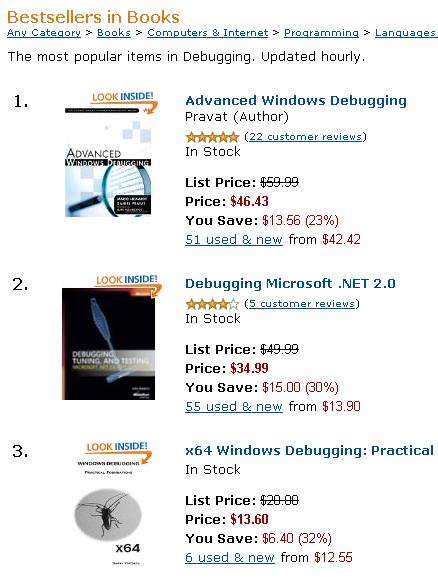
Shortly after being published, x64 Windows Debugging: Practical Foundations book rises to the top of Amazon debugging bestesellers list (on 22:30 19.08.09):

- Dmitry Vostokov @ DumpAnalysis.org -

Free Stack Traces

Tuesday, August 18th, 2009

By analogy with the free verse and the anthropologist John Tedlock’s written narratives of Native American Zuni where different font size was used for different levels I tried today the similar technique with a raw stack data from the previous case study of registry corruption:

[...]
    f690a3dc f7a21a06 BOOTVID!ReadWriteMode+0×42
    f690a3e0 f7a219a7 BOOTVID!__outpw+0×17
    f690a3ec f7a21a76 BOOTVID!SetPixel+0×6a
    f690a404 f7a21c1b BOOTVID!DisplayCharacter+0×47
    f690a420 b42e14db dump_iaStor+0×3a4db
    f690a468 b4364080 dump_iaStor+0xbd080
    f690a480 f6249983 ati2mtag+0×1b6983
    f690a488 804f2ee6 nt!IopWritePageToDisk+0xe4
    f690a4e0 804f2fb6 nt!IopWriteSummaryDump+0×7e
    f690a4e4 b42e12d8 dump_iaStor+0×3a2d8
    f690a50c 804f3c8d nt!IoWriteCrashDump+0×42d
    f690a514 b42e12d8 dump_iaStor+0×3a2d8
    f690a584 804f8fa7 nt!KiDumpParameterImages+0×5f
    f690a594 f74764bb sptd+0×664bb
    f690a598 f74764a0 sptd+0×664a0
    f690a59c b42e162a dump_iaStor+0×3a62a
    f690a5a8 f7a22394 BOOTVID!PreserveRow+0×7c
    f690a5c0 b42e12d8 dump_iaStor+0×3a2d8
    f690a5cc 804f9ecd nt!KeBugCheck2+0xa4d
    f690a6e0 804f9f43 nt!KeBugCheckEx+0×1b
    f690a950 80545d00 nt!KiSwapProcess+0×60
    f690a9a0 80522d45 nt!MiDecrementReferenceCount+0×65
    f690a9ac 805067ea nt!MiDeferredUnlockPages+0×1c8

f690a9c8 804f9f43 nt!KeBugCheckEx+0×1b
f690a9e8 80548c2d nt!MiFreePoolPages+0×8b
    f690aa04 80564d20 nt!NonPagedPoolDescriptor
f690aa28 8054b49a nt!ExFreePoolWithTag+0×1ba
    f690aa3c 8062bc17 nt!CmpPinCmView+0xab
    f690aa5c 80637e13 nt!HvpDelistBinFreeCells+0xad

f690aa68 8063bf19 nt!CmpFree+0×17
f690aa78 8063eb20 nt!HvpRecoverData+0×3ec
f690aad4 8063ef05 nt!HvMapHive+0×133
    f690ab10 80539ac0 nt!_except_handler3
    f690ab14 804e0e38 nt!`string’+0×258

f690ab20 8063087e nt!HvInitializeHive+0×416
f690ab38 806383a9 nt!CmpInitializeHive+0×26d
    f690ab54 8063bf02 nt!CmpFree
    f690ab58 8063b918 nt!CmpFileSetSize
    f690ab5c 8063c466 nt!CmpFileWrite
    f690ab60 8063c33e nt!CmpFileRead
    f690ab64 8063c1fc nt!CmpFileFlush

f690aba4 80625bf9 nt!CmpInitHiveFromFile+0xa3
f690abfc 8062ad8b nt!CmpCmdHiveOpen+0×21
f690ac24 80631f24 nt!CmLoadKey+0×90
    f690ac98 80622053 nt!CmConvertHandleToKernelHandle+0×55
f690acb0 806257b4 nt!NtLoadKey2+0×1fc
    f690acc8 806259ac nt!NtLoadKey
    f690acd8 805bc33f nt!ObpCloseHandleTableEntry+0×14d
    f690ad24 805bc401 nt!ObpCloseHandle+0xab
    f690ad34 80539ac0 nt!_except_handler3
    f690ad38 804e0bd0 nt!`string’+0×364

f690ad44 806259be nt!NtLoadKey+0×12
f690ad58 8054162c nt!KiFastCallEntry+0xfc
    f690ade0 805460ee nt!KiThreadStartup+0×16
    f690ade4 80626dee nt!CmpLoadHiveThread
    f690aec0 bf875fb4 win32k!WatchdogDrvStretchBlt+0×92
    f690aee4 bf988527 win32k!_except_handler3
    f690aee8 bf995f40 win32k!`string’+0×124
    f690aef0 bf875fb4 win32k!WatchdogDrvStretchBlt+0×92
    f690aef4 bf873ec2 win32k!EngStretchBltROP+0×3a9

where the larger font size indicates the stack trace from kv command and the smaller font size indicates symbolic information found between call frames that may or may not correspond to partial stack traces left from intermediate nested function calls of the current call sequence or past stack traces and their frames.

- Dmitry Vostokov @ DumpAnalysis.org -

September Issue of Debugged! MZ/PE

Tuesday, August 18th, 2009

Finally, the front cover has materialized for this issue of Debugged! magazine:

Debugged! MZ/PE: Software Tracing (ISBN: 978-1906717797)

If you have an article idea or if you’d like to write an article for us please use the following contact form:

http://www.dumpanalysis.org/contact

The deadline for this issue is 25th of September.

- Dmitry Vostokov @ DumpAnalysis.org -

Registry Corruption: A Case Study

Monday, August 17th, 2009

A friend of mine couldn’t start Windows XP on his notebook. As soon as he entered his credentials in a logon window the system experienced a BSOD event. He booted from another media and collected mini-dumps. All of them were consistent in resisting to my attempts to load symbols and modules. Even explicit downloading the symbol package from Microsoft didn’t help. All bugcheck info and stack traces were like this pointing to pool corruption:

0: kd> !analyze -v
[...]
BAD_POOL_CALLER (c2)
The current thread is making a bad pool request. Typically this is at a bad IRQL level or double freeing the same allocation, etc.
Arguments:
Arg1: 00000043, Attempt to free a virtual address which was never in any pool
Arg2: c9c00000, Address being freed.
Arg3: 00000000, 0
Arg4: 00000000, 0
[...]

1: kd> kv 100
ChildEBP RetAddr  Args to Child             
WARNING: Stack unwind information not available. Following frames may be wrong.
f6cc09e4 80548c2d 000000c2 00000043 c9c00000 nt+0x22f43
f6cc0a24 8054b49a c9c00000 e2039410 e23fd000 nt+0x71c2d
f6cc0a64 8063bf19 c9c00000 00000000 f6cc0ad0 nt+0x7449a
f6cc0a74 8063eb20 c9c00000 00002000 00000000 nt+0x164f19
f6cc0ad0 8063ef05 e1f6e008 00000000 00000000 nt+0x167b20
f6cc0b1c 8063087e e1f6e008 00000000 00000001 nt+0x167f05
f6cc0b34 806383a9 e1f6e101 00000005 00000000 nt+0x15987e
f6cc0ba0 80625bf9 f6cc0bdc 00000005 00000000 nt+0x1613a9
f6cc0bf8 8062ad8b f6cc0d04 00000000 f6cc0c64 nt+0x14ebf9
f6cc0c20 80631f24 f6cc0ccc f6cc0c6c f6cc0c5c nt+0x153d8b
f6cc0cac 806257b4 f6cc0ce4 f6cc0ccc 00000000 nt+0x15af24
f6cc0d40 806259be 0006dcc4 0006dcac 00000000 nt+0x14e7b4
f6cc0d54 8054162c 0006dcc4 0006dcac 0006dcf0 nt+0x14e9be
f6cc0d64 7c91e514 badb0d00 0006dc98 00000000 nt+0x6a62c
f6cc0d68 badb0d00 0006dc98 00000000 00000000 0x7c91e514
f6cc0d6c 0006dc98 00000000 00000000 00000090 0xbadb0d00
f6cc0d70 00000000 00000000 00000090 000000a4 0x6dc98

Portions of raw stack data available in minidump didn’t have any traces of other modules and drivers except nt:

1: kd> !thread
GetPointerFromAddress: unable to read from 80562134
[...]
86485da8: Unable to get thread contents

1: kd> dps f6cc09cc-3000 f6cc09cc+3000
[...]
f6cc095c  ????????
f6cc0960  ????????
f6cc0964  ????????
f6cc0968  00000000
f6cc096c  00000000
f6cc0970  003d0058
f6cc0974  f6cc09a8
f6cc0978  00000000
f6cc097c  0000c000
f6cc0980  00000000
f6cc0984  00000000
f6cc0988  8648b4d8
f6cc098c  863eb240
f6cc0990  00000000
f6cc0994  01ffffff
f6cc0998  f6cc093c
f6cc099c  00000000
f6cc09a0  f6cc0a14
f6cc09a4  80539ac0 nt+0x62ac0
f6cc09a8  804d8228 nt+0x1228
f6cc09ac  ffffffff
f6cc09b0  00000002
f6cc09b4  80506653 nt+0x2f653
f6cc09b8  f78a9548
f6cc09bc  c9c00000
f6cc09c0  0000bb40
[...]
f6cc0fcc  00000000
f6cc0fd0  00000000
f6cc0fd4  00000000
f6cc0fd8  00000000
f6cc0fdc  00000000
f6cc0fe0  7c91d5aa
f6cc0fe4  7c940574
f6cc0fe8  0015fd80
f6cc0fec  00100020
f6cc0ff0  00000000
f6cc0ff4  00000000
f6cc0ff8  00000000
f6cc0ffc  00000000
f6cc1000  ????????
f6cc1004  ????????
f6cc1008  ????????
[...]

So I advised to give me a kernel dump and fortunately there was one available too. It was more amenable for analysis and showed the involvement of registry:

0: kd> kv 100
ChildEBP RetAddr  Args to Child             
f690a9e4 80548c2d 000000c2 00000043 dcf40000 nt!KeBugCheckEx+0x1b
f690aa24 8054b49a dcf40000 e1294410 e17c6000 nt!MiFreePoolPages+0x8b
f690aa64 8063bf19 dcf40000 00000000 f690aad0 nt!ExFreePoolWithTag+0x1ba
f690aa74 8063eb20 dcf40000 00002000 00000000 nt!CmpFree+0×17
f690aad0 8063ef05 e11c4b60 00000000 00000000 nt!HvpRecoverData+0×3ec
f690ab1c 8063087e e11c4b60 00000000 00000001 nt!HvMapHive+0×133
f690ab34 806383a9 e11c4c01 00000005 00000000 nt!HvInitializeHive+0×416
f690aba0 80625bf9 f690abdc 00000005 00000000 nt!CmpInitializeHive+0×26d
f690abf8 8062ad8b f690ad04 00000000 f690ac64 nt!CmpInitHiveFromFile+0xa3
f690ac20 80631f24 f690accc f690ac6c f690ac5c nt!CmpCmdHiveOpen+0×21
f690acac 806257b4 f690ace4 f690accc 00000000 nt!CmLoadKey+0×90
f690ad40 806259be 0006dcc4 0006dcac 00000000 nt!NtLoadKey2+0×1fc
f690ad54 8054162c 0006dcc4 0006dcac 0006dcf0 nt!NtLoadKey+0×12

f690ad54 7c91e514 0006dcc4 0006dcac 0006dcf0 nt!KiFastCallEntry+0xfc
WARNING: Frame IP not in any known module. Following frames may be wrong.
0006dcf0 00000000 00000000 00000000 00000000 0×7c91e514

Examination of parameters on raw stack pointed to a user hive for MyFriend user:

0: kd> dpu f690ace4
f690ace4  00000018
f690ace8  80000ce0
f690acec  f690ad0c “Z\..(”
f690acf0  00000240
f690acf4  00000000
f690acf8  00000000
f690acfc  00660066
f690ad00  00eddea0
f690ad04  00660066
f690ad08  e10b1e60 “\??\C:\Documents and Settings\MyFriend\ntuser.dat”
f690ad14  00000028
[…]

So the solution was to log as Administrator and recreate the user.

- Dmitry Vostokov @ DumpAnalysis.org -