Archive for the ‘Crash Dump Analysis’ Category

Crash Dump Analysis Patterns (Part 136)

Wednesday, June 1st, 2011

Version-Specific Extension is a pattern similar to Platform-Specific Debugger pattern by suggesting the course of the further debugging actions. Similar instructions are given when a debugger depends on specialized modules differing from platform (or application) version. We consider here a .NET example where opening a dump shows only that it was perhaps saved manually with possible hidden exceptions that need to be dug out:

0:000> !analyze -v

FAULTING_IP:
+0
00000000`00000000 ??              ???

EXCEPTION_RECORD:  ffffffffffffffff -- (.exr 0xffffffffffffffff)
ExceptionAddress: 0000000000000000
   ExceptionCode: 80000003 (Break instruction exception)
  ExceptionFlags: 00000000
NumberParameters: 0

We notice a failed attempt for .NET analysis and the following instructions on how correct it:

MANAGED_STACK: !dumpstack -EE
Failed to load data access DLL, 0×80004005

Verify that 1) you have a recent build of the debugger (6.2.14 or newer)
            2) the file mscordacwks.dll that matches your version of mscorwks.dll is in the version directory
            3) or, if you are debugging a dump file, verify that the file mscordacwks_<arch>_<arch>_<version>.dll is on your symbol path.
            4) you are debugging on the same architecture as the dump file. For example, an IA64 dump file must be debugged on an IA64 machine.

You can also run the debugger command .cordll to control the debugger's load of mscordacwks.dll.  .cordll -ve -u -l will do a verbose reload. If that succeeds, the SOS command should work on retry.

If you are debugging a minidump, you need to make sure that your executable path is pointing to mscorwks.dll as well.

Because we know that we have .NET framework installed on a postmortem debugging machine we check the target module version:

0:000> lmv m mscorwks
start             end                 module name
000007fe`ee380000 000007fe`eed1d000   mscorwks   (pdb symbols)       
    Loaded symbol image file: mscorwks.dll
    Image path: C:\Windows\Microsoft.NET\Framework64\v2.0.50727\mscorwks.dll
    Image name: mscorwks.dll
    Timestamp:        Sun Feb 06 20:53:54 2011 (4D4F0A62)
    CheckSum:         00990593
    ImageSize:        0099D000
    File version:     2.0.50727.5444
    Product version:  2.0.50727.5444
    File flags:       0 (Mask 3F)
    File OS:          4 Unknown Win32
    File type:        2.0 Dll
    File date:        00000000.00000000
    Translations:     0409.04b0
    CompanyName:      Microsoft Corporation
    ProductName:      Microsoft® .NET Framework
    InternalName:     mscorwks.dll
    OriginalFilename: mscorwks.dll
    ProductVersion:   2.0.50727.5444
    FileVersion:      2.0.50727.5444 (Win7SP1GDR.050727-5400)
    FileDescription:  Microsoft .NET Runtime Common Language Runtime - WorkStation
    LegalCopyright:   © Microsoft Corporation.  All rights reserved.
    Comments:         Flavor=Retail

It is slightly newer (.5444) than we have installed (.3619). The customer also sent their framework version together with the memory dump file. So we unload the current SOS extension (for details please see Managed Code Exception pattern): 

0:000> .chain
Extension DLL chain:
    C:\Windows\Microsoft.NET\Framework64\v2.0.50727\sos: image 2.0.50727.3619, API 1.0.0, built Mon Oct 25 06:52:09 2010
        [path: C:\Windows\Microsoft.NET\Framework64\v2.0.50727\sos.dll]
    dbghelp: image 6.11.0001.404, API 6.1.6, built Thu Feb 26 02:10:27 2009
        [path: C:\Program Files\Debugging Tools for Windows (x64)\dbghelp.dll]
    ext: image 6.11.0001.404, API 1.0.0, built Thu Feb 26 02:10:26 2009
        [path: C:\Program Files\Debugging Tools for Windows (x64)\winext\ext.dll]
    exts: image 6.11.0001.404, API 1.0.0, built Thu Feb 26 02:10:17 2009
        [path: C:\Program Files\Debugging Tools for Windows (x64)\WINXP\exts.dll]
    uext: image 6.11.0001.404, API 1.0.0, built Thu Feb 26 02:10:20 2009
        [path: C:\Program Files\Debugging Tools for Windows (x64)\winext\uext.dll]
    ntsdexts: image 6.1.7015.0, API 1.0.0, built Thu Feb 26 02:09:22 2009
        [path: C:\Program Files\Debugging Tools for Windows (x64)\WINXP\ntsdexts.dll]

0:000> .unload C:\Windows\Microsoft.NET\Framework64\v2.0.50727\sos
Unloading C:\Windows\Microsoft.NET\Framework64\v2.0.50727\sos extension DLL

and load the customer version:

0:000> .load \MyData\sos.dll

0:000> .chain
Extension DLL chain:
    \MyDatasos.dll: image 2.0.50727.5444, API 1.0.0, built Sun Feb 06 21:14:12 2011
        [path: \MyData\sos.dll]
    dbghelp: image 6.11.0001.404, API 6.1.6, built Thu Feb 26 02:10:27 2009
        [path: C:\Program Files\Debugging Tools for Windows (x64)\dbghelp.dll]
    ext: image 6.11.0001.404, API 1.0.0, built Thu Feb 26 02:10:26 2009
        [path: C:\Program Files\Debugging Tools for Windows (x64)\winext\ext.dll]
    exts: image 6.11.0001.404, API 1.0.0, built Thu Feb 26 02:10:17 2009
        [path: C:\Program Files\Debugging Tools for Windows (x64)\WINXP\exts.dll]
    uext: image 6.11.0001.404, API 1.0.0, built Thu Feb 26 02:10:20 2009
        [path: C:\Program Files\Debugging Tools for Windows (x64)\winext\uext.dll]
    ntsdexts: image 6.1.7015.0, API 1.0.0, built Thu Feb 26 02:09:22 2009
        [path: C:\Program Files\Debugging Tools for Windows (x64)\WINXP\ntsdexts.dll]

0:000> .cordll -ve -u -l
CLR DLL status: No load attempts

Then we do a load attempt: 

0:000> !CLRStack
CLRDLL: C:\Windows\Microsoft.NET\Framework64\v2.0.50727\mscordacwks.dll:2.0.50727.3619 f:0
doesn't match desired version 2.0.50727.5444 f:0
CLRDLL: Unable to find mscordacwks_AMD64_AMD64_2.0.50727.5444.dll by mscorwks search
CLRDLL: Unable to find ‘mscordacwks_AMD64_AMD64_2.0.50727.5444.dll’ on the path
CLRDLL: Unable to get version info for ‘c:\mss\mscorwks.dll\4D4F0A6299d000\mscordacwks_AMD64_AMD64_2.0.50727.5444.dll’, Win32 error 0n87
CLRDLL: ERROR: Unable to load DLL mscordacwks_AMD64_AMD64_2.0.50727.5444.dll, Win32 error 0n87
Failed to load data access DLL, 0×80004005

Verify that 1) you have a recent build of the debugger (6.2.14 or newer)
            2) the file mscordacwks.dll that matches your version of mscorwks.dll is in the version directory
            3) or, if you are debugging a dump file, verify that the file mscordacwks_<arch>_<arch>_<version>.dll is on your symbol path.
            4) you are debugging on the same architecture as the dump file. For example, an IA64 dump file must be debugged on an IA64 machine.

You can also run the debugger command .cordll to control the debugger's load of mscordacwks.dll.  .cordll -ve -u -l will do a verbose reload. If that succeeds, the SOS command should work on retry.

If you are debugging a minidump, you need to make sure that your executable path is pointing to mscorwks.dll as well.

We rename mscordacwks.dll to mscordacwks_AMD64_AMD64_2.0.50727.5444.dll and retry: 

0:000> .cordll -ve -u -l
CLR DLL status: No load attempts

0:000> !CLRStack
CLRDLL: C:\Windows\Microsoft.NET\Framework64\v2.0.50727\mscordacwks.dll:2.0.50727.3619 f:0
doesn't match desired version 2.0.50727.5444 f:0
CLRDLL: Loaded DLL \MyData\mscordacwks_AMD64_AMD64_2.0.50727.5444.dll
OS Thread Id: 0×16e8 (0)
Child-SP         RetAddr          Call Site
00000000002fe570 000007feeaf8e378 System.Windows.Forms.Application+ComponentManager.System.Windows.Forms. UnsafeNativeMethods.IMsoComponentManager.FPushMessageLoop(Int32, Int32, Int32)
00000000002fe7c0 000007feeaf8dde5 System.Windows.Forms.Application+ThreadContext.RunMessageLoopInner(Int32, System.Windows.Forms.ApplicationContext)
00000000002fe910 000007ff002364b6 System.Windows.Forms.Application+ThreadContext.RunMessageLoop(Int32, System.Windows.Forms.ApplicationContext)
00000000002fe970 000007feee6414c2 MyApplication.Main(System.String[])

0:000> !pe
Exception object: 00000000034a13f8
Exception type: System.IO.FileNotFoundException
Message: Could not load file or assembly 'System.Windows.Forms.XmlSerializers, Version=2.0.0.0, Culture=neutral, PublicKeyToken= ...' or one of its dependencies. The system cannot find the file specified.
InnerException: System.IO.FileNotFoundException, use !PrintException 00000000034a1b28 to see more
StackTrace (generated):
    SP               IP               Function
    00000000002FD0A0 0000000000000001 mscorlib_ni!System.Reflection.Assembly._nLoad(System.Reflection.AssemblyName, System.String, System.Security.Policy.Evidence, System.Reflection.Assembly, System.Threading.StackCrawlMark ByRef, Boolean, Boolean)+0x2
    00000000002FD0A0 000007FEED7ABF61 mscorlib_ni!System.Reflection.Assembly.InternalLoad(System.Reflection.AssemblyName, System.Security.Policy.Evidence, System.Threading.StackCrawlMark ByRef, Boolean)+0x1a1
    00000000002FD130 000007FEED7E4804 mscorlib_ni!System.Reflection.Assembly.Load(System.Reflection.AssemblyName)+0x24
    00000000002FD170 000007FEE7855C0A System_Xml_ni!System.Xml.Serialization.TempAssembly.LoadGeneratedAssembly(System.Type, System.String, System.Xml.Serialization.XmlSerializerImplementation ByRef)+0x11a

StackTraceString: <none>
HResult: 80070002

0:000> !PrintException 00000000034a1b28
Exception object: 00000000034a1b28
Exception type: System.IO.FileNotFoundException
Message: Could not load file or assembly 'System.Windows.Forms.XmlSerializers, Version=2.0.0.0, Culture=neutral, PublicKeyToken=...' or one of its dependencies. The system cannot find the file specified.
InnerException: <none>
StackTrace (generated):
<none>
StackTraceString: <none>
HResult: 80070002

- Dmitry Vostokov @ DumpAnalysis.org + TraceAnalysis.org -

Bugtation No.142

Wednesday, May 25th, 2011

“The people behind your” crashes.

MAFIA

- Dmitry Vostokov @ DumpAnalysis.org + TraceAnalysis.org -

From Bugchecks to Patterns

Tuesday, May 24th, 2011

One of the questions asked during Introduction to Pattern-Driven Software Problem Solving Webinar was how to map bugcheck codes to crash dump analysis patterns. I’m starting this post to provide a few initial mappings and plan to extend it later.

BAD_POOL_CALLER (c2)

BAD_POOL_HEADER (19)

Dynamic Memory Corruption (kernel pool)

Self-Diagnosis (kernel mode)

UNEXPECTED_KERNEL_MODE_TRAP (7f)
Arg1: 00000000, EXCEPTION_DIVIDED_BY_ZERO

Divide by Zero (kernel mode)

NO_MORE_IRP_STACK_LOCATIONS (35)

Stack Overflow (software implementation)

MANUALLY_INITIATED_CRASH (e2)

NMI_HARDWARE_FAILURE (80)

CRITICAL_OBJECT_TERMINATION (f4)

KMODE_EXCEPTION_NOT_HANDLED (1e)
Arg2: 000000000000f001, The address that the exception occurred at

DRIVER_IRQL_NOT_LESS_OR_EQUAL (d1)
Arg4: 0000f001, address which referenced memory

Manual Dump (kernel)

- Dmitry Vostokov @ DumpAnalysis.org + TraceAnalysis.org -

Limited Offer of Summa Memorianica 5 Volume Set

Friday, May 20th, 2011

Memory Dump Analysis Services offers 5 volumes of Memory Dump Analysis Anthology (in PDF format) with a 50% discount until the end of June:

http://www.dumpanalysis.com/ultimate-memory-analysis-reference

- Dmitry Vostokov @ DumpAnalysis.org + TraceAnalysis.org -

Accelerated Windows Memory Dump Analysis Training Course

Sunday, May 8th, 2011

Learn how to analyze application, service and system crashes and freezes, navigate through memory dump space and diagnose heap corruption, memory leaks, CPU spikes, blocked threads, deadlocks, wait chains, and much more. We use a unique and innovative pattern-driven analysis approach to speed up the learning curve.

Accelerated Windows Memory Dump Analysis Logo

Memory Dump Analysis Services organizes a training course.

If you are registered you are allowed to optionally submit your memory dumps before the training. This will allow us in addition to the carefully constructed problems tailor extra examples to the needs of the attendees. All registrants will receive an optional pre-test before the first session and an optional test after each session.

The training consists of 2 four-hour sessions (4 hours on the first day and 4 hours on the next day). When you finish the training you additionally get:

  1. A full transcript in PDF format (retail price $200)
  2. 5 volumes of Memory Dump Analysis Anthology in PDF format (retail price $100)
  3. An attendance certificate (PDF format)

Prerequisites: Basic Windows troubleshooting

Session 1: August 1, 2011 2:00 PM - 6:00 PM BST
Session 2: August 2, 2011 2:00 PM - 6:00 PM BST

Price: 210 USD

Space is limited.
Reserve your remote training seat now.

- Dmitry Vostokov @ DumpAnalysis.org + TraceAnalysis.org -

StopPages 2011 Victimware Analysis Conference

Thursday, May 5th, 2011

This is a forthcoming virtual event to learn analysis of blockages, delays, obstructions, preventions, and stoppages in victimware suffering from software defects and malware. Additional information on how to join will be available soon on the main portal page:

http://www.dumpanalysis.org/stoppages2011

- Dmitry Vostokov @ DumpAnalysis.org + TraceAnalysis.org -
Crash Dump Analysis Patterns (Part 69b)

Tuesday, April 26th, 2011

This pattern is a kernel mode counterpart to Self-Diagnosis in user mode. It is just a collection of bugcheck codes where a problem is usually detected before corruption causes a fault, exception or trap. Typical example would be a detection of a failed assertion or corrupt structures such as:

BAD_POOL_HEADER (19)
The pool is already corrupt at the time of the current request.
This may or may not be due to the caller.
The internal pool links must be walked to figure out a possible cause of the problem, and then special pool applied to the suspect tags or the driver verifier to a suspect driver.
Arguments:
Arg1: 00000020, a pool block header size is corrupt.
Arg2: 8b79d078, The pool entry we were looking for within the page.
Arg3: 8b79d158, The next pool entry.
Arg4: 8a1c0004, (reserved)

More examples would be added in the forthcoming case studies.

- Dmitry Vostokov @ DumpAnalysis.org + TraceAnalysis.org -

Crash Dump Analysis Patterns (Part 127b)

Monday, April 25th, 2011

Here we continue with Technology-Specific Subtrace pattern series started earlier with COM interface invocation example. In this part we consider dynamic memory allocation example in kernel space (kernel pool). Usually pool corruption is detected during pool memory allocation or release with a special bugcheck code, for example:

BAD_POOL_HEADER (19)
The pool is already corrupt at the time of the current request.
This may or may not be due to the caller.
The internal pool links must be walked to figure out a possible cause of the problem, and then special pool applied to the suspect tags or the driver verifier to a suspect driver.
Arguments:
Arg1: 00000020, a pool block header size is corrupt.
Arg2: 8b79d078, The pool entry we were looking for within the page.
Arg3: 8b79d158, The next pool entry.
Arg4: 8a1c0004, (reserved)

However, pool corruption might be deeper enough to trigger an access violation even before self-diagnosis. In such cases stack subtraces with functions like ExFreePoolWithTag might point to troubleshooting and debugging directions:

ATTEMPTED_WRITE_TO_READONLY_MEMORY (be)
An attempt was made to write to readonly memory. The guilty driver is on the stack trace (and is typically the current instruction pointer).
When possible, the guilty driver’s name (Unicode string) is printed on the bugcheck screen and saved in KiBugCheckDriver.
Arguments:
Arg1: 00470044, Virtual address for the attempted write.
Arg2: 06d39025, PTE contents.
Arg3: aec0fb30, (reserved)
Arg4: 0000000a, (reserved)

TRAP_FRAME:  aec0fb30 -- (.trap 0xffffffffaec0fb30)
ErrCode = 00000003
eax=8ac12d38 ebx=8b700040 ecx=000001ff edx=00470040 esi=8ac12db8 edi=808b0b40
eip=808949e7 esp=aec0fba4 ebp=aec0fbf0 iopl=0 nv up ei pl nz na po nc
cs=0008  ss=0010  ds=0023  es=0023  fs=0030  gs=0000  efl=00010202
nt!ExFreePoolWithTag+0x6a3:
808949e7 895a04          mov     dword ptr [edx+4],ebx ds:0023:00470044=????????

STACK_TEXT:
aec0faa0 80860121 000000be 00470044 06d39025 nt!KeBugCheckEx+0x1b
aec0fb18 8088e490 00000001 00470044 00000000 nt!MmAccessFault+0xb25
aec0fb18 808949e7 00000001 00470044 00000000 nt!KiTrap0E+0xdc
aec0fbf0 808d93b5 8ac12dc0 00000000 00000000 nt!ExFreePoolWithTag+0×6a3
aec0fc08 808cd304 e5ae5770 8ac12dc0 8aa77db0 nt!CmpFreePostBlock+0×4d
aec0fc3c 8082ea53 8ac12dc0 aec0fc88 aec0fc7c nt!CmpPostApc+0xde
aec0fc8c 80833eec 00000000 00000000 00000000 nt!KiDeliverApc+0xf9
aec0fcc4 808290bd aec0fd64 8099781c 0160fd44 nt!KiSwapThread+0×300
aec0fd0c 809978a0 00000001 00000000 f77275e0 nt!KeDelayExecutionThread+0×2ab
aec0fd54 8088b45c 00000000 0160fd74 0160fd9c nt!NtDelayExecution+0×84
aec0fd54 7c82847c 00000000 0160fd74 0160fd9c nt!KiFastCallEntry+0xfc
WARNING: Frame IP not in any known module. Following frames may be wrong.
0160fd9c 00000000 00000000 00000000 00000000 0×7c82847c

1: kd> !pool 8ac12dc0
Pool page 8ac12dc0 region is Nonpaged pool
 8ac12000 size:  858 previous size:    0  (Allocated)  TWPG
 8ac12858 size:    8 previous size:  858  (Free)       ….
 8ac12860 size:   20 previous size:    8  (Allocated)  VadS
 8ac12880 size:    8 previous size:   20  (Free)       NtFs
 8ac12888 size:   20 previous size:    8  (Allocated)  VadS
 8ac128a8 size:   28 previous size:   20  (Allocated)  Ntfn
 8ac128d0 size:   30 previous size:   28  (Allocated)  Vad
 8ac12900 size:   40 previous size:   30  (Allocated)  Muta (Protected)
 8ac12940 size:   38 previous size:   40  (Allocated)  Sema (Protected)
 8ac12978 size:   40 previous size:   38  (Allocated)  Muta (Protected)
 8ac129b8 size:  270 previous size:   40  (Allocated)  Thre (Protected)
 8ac12c28 size:   40 previous size:  270  (Allocated)  Ntfr
 8ac12c68 size:   d0 previous size:   40  (Allocated)  DRIV
8ac12d38 is not a valid large pool allocation, checking large session pool…
8ac12d38 is freed (or corrupt) pool
Bad previous allocation size @8ac12d38, last size was 1a

***
*** An error (or corruption) in the pool was detected;
*** Attempting to diagnose the problem.
***
*** Use !poolval 8ac12000 for more details.
***

Pool page [ 8ac12000 ] is __inVALID.

Analyzing linked list...
[ 8ac12c68 --> 8ac12db8 (size = 0x150 bytes)]: Corrupt region
Scanning for single bit errors...

None found

- Dmitry Vostokov @ DumpAnalysis.org + TraceAnalysis.org -

Crash Dump Analysis Patterns (Part 135)

Sunday, April 24th, 2011

Module Hint pattern is frequently observed in dynamic memory corruption incidents. It is similar to Execution Residue or String Parameter patterns were we have ASCII or UNICODE fragments providing troubleshooting and debugging hints. Module Hint is therefore a more specialized pattern where we can link module names to raw data. For example, a kernel memory dump saved after the detected pool corruption shows P12345.DLL module name in a pool entry that can provide a link to the corresponding functionally to be reconfigured or removed:

BAD_POOL_HEADER (19)
The pool is already corrupt at the time of the current request.
This may or may not be due to the caller.
The internal pool links must be walked to figure out a possible cause of the problem, and then special pool applied to the suspect tags or the driver verifier to a suspect driver.
Arguments:
Arg1: 00000020, a pool block header size is corrupt.
Arg2: 8b79d078, The pool entry we were looking for within the page.
Arg3: 8b79d158, The next pool entry.
Arg4: 8a1c0004, (reserved)

STACK_TEXT: 
b3e0aa4c 808947bb 00000019 00000020 8b79d078 nt!KeBugCheckEx+0x1b
b3e0aab4 b368c00f 8b79d080 00000000 00000000 nt!ExFreePoolWithTag+0×477
b3e0aac4 b366c68e 8b79d080 00000000 00000000 DriverA!MemFree+0xf
[…]
b3e0ac44 8081e0c3 808f77c9 b3e0ac64 808f77c9 nt!IovCallDriver+0×112
b3e0ac50 808f77c9 8a8eef60 8b6862a8 8a8eeef0 nt!IofCallDriver+0×13
b3e0ac64 808f856b 8ce456b0 8a8eeef0 8b6862a8 nt!IopSynchronousServiceTail+0×10b
b3e0ad00 808f109a 000009dc 00000000 00000000 nt!IopXxxControlFile+0×5e5
b3e0ad34 8088b45c 000009dc 00000000 00000000 nt!NtDeviceIoControlFile+0×2a
b3e0ad34 7c82847c 000009dc 00000000 00000000 nt!KiFastCallEntry+0xfc
WARNING: Frame IP not in any known module. Following frames may be wrong.
00f5fb18 00000000 00000000 00000000 00000000 0×7c82847c

2: kd> !pool 8b79d080
Pool page 8b79d080 region is Unknown
 8b79d000 size:   30 previous size:    0  (Allocated)  FSfm
 8b79d030 size:   28 previous size:   30  (Allocated)  VadS
 8b79d058 size:   20 previous size:   28  (Allocated)  ReEv
*8b79d078 size:   e0 previous size:   20  (Allocated) *DRIV 
  Owning component : Unknown (update pooltag.txt)
8b79d158 is not a valid large pool allocation, checking large session pool…
8b79d158 is freed (or corrupt) pool
Bad previous allocation size @8b79d158, last size was 1c

***
*** An error (or corruption) in the pool was detected;
*** Pool Region unknown (0xFFFFFFFF8B79D158)
***
*** Use !poolval 8b79d000 for more details.
***

2: kd> dc 8b79d078
8b79d078  [...] ..DRIV  ......AP
8b79d088  [...] P12345.DLL……
8b79d098  […] …..<%n……..
8b79d0a8  […] ….$…:.F…X.
[…]

- Dmitry Vostokov @ DumpAnalysis.org + TraceAnalysis.org -

.NET / CLR / Managed Space Patterns

Friday, April 22nd, 2011

A page to reference all different kinds of .NET related patterns is necessary, so I created this post:

I’ll update it as soon as I add more similar patterns.

- Dmitry Vostokov @ DumpAnalysis.org + TraceAnalysis.org -

Just In Time Crash Analysis Report (JIT CAR)

Thursday, April 21st, 2011

Imagine a pattern-driven crash analysis report (car) when you need it: at the very moment of a crash, just in time! And the car drives you to a problem resolution. Imagine also a periodic pattern-driven just-in-time memory space analysis (JIT MSA) that provides you instant intelligent reports on what’s going on inside memory while your application, service or system is running! This is a forthcoming optional client side part of CARE (Crash Analysis Report Environment) which is being developed by Memory Dump Analysis Services engineering team under the leadership of Alexey Golikov. Combined with generative debugging techniques both client and server parts form a complete unique enterprise crash and hang analysis solution suitable for development and production environments. Stay tuned for further exciting updates.

PS. The car drives on a road to the first fault software problem solving.

- Dmitry Vostokov @ DumpAnalysis.org + TraceAnalysis.org -

Memory Dump Analysis Anthology, Volume 5 is available for download

Sunday, April 17th, 2011

I’m pleased to announce that MDAA, Volume 5 is available in PDF format:

www.dumpanalysis.org/Memory+Dump+Analysis+Anthology+Volume+5

It features:

- 25 new crash dump analysis patterns
- 11 new pattern interaction case studies (including software tracing)
- 16 new trace analysis patterns
- 7 structural memory patterns
- 4 modeling case studies for memory dump analysis patterns
- Discussion of 3 common analysis mistakes
- Malware analysis case study
- Computer independent architecture of crash analysis report service
- Expanded coverage of software narratology
- Metaphysical and theological implications of memory dump worldview
- More pictures of memory space and physicalist art
- Classification of memory visualization tools
- Memory visualization case studies
- Close reading of the stories of Sherlock Holmes: Dr. Watson’s observational patterns
- Fully cross-referenced with Volume 1, Volume 2, Volume 3, and Volume 4

Its table of contents is available here:

www.dumpanalysis.org/MDAA/MDA-Anthology-V5-TOC.pdf

Paperback and hardcover versions should be available in a week or two. I also started working on Volume 6 that should be available in November-December.

- Dmitry Vostokov @ DumpAnalysis.org + TraceAnalysis.org -

Forthcoming Presentation of Software Trace Analysis

Tuesday, April 12th, 2011

I’m to present pattern-driven software trace analysis with examples from application and desktop delivery environments featuring Memory Dump Analysis Services at the forthcoming E2E Virtualization Conference (PubForum) in Dublin on 13th of May, 2011. Topics include a case study covering simultaneous analysis of software traces and memory dumps.

Software Trace and Memory Dump Analysis Logo

- Dmitry Vostokov @ DumpAnalysis.org + TraceAnalysis.org -

Cyber Warfare Memory Dump Analysis

Monday, April 11th, 2011

Memory Dump Analysis Services plans a free Webinar in July to introduce a uniform methodology and tools for analysis of memory in cyber intelligence and counterintelligence activities.

Cyber Warfare Memory Dump Analysis Logo

- Dmitry Vostokov @ DumpAnalysis.org + TraceAnalysis.org -

Forthcoming Webinar The Old New Crash: Cloud Memory Dump Analysis

Sunday, April 10th, 2011

The first Webinar to start an in-depth discussion of a uniform methodology and tools for analysis of crashes, hangs, and other types of abnormal software behaviour in cloud environments.

The Old New Crash: Cloud Memory Dump Analysis Logo

Memory Dump Analysis Services (DumpAnalysis.com) organizes a free Webinar

Date: 13th of June 2011
Time: 18:45 (BST) 13:45 (EST) 10:45 (PST)
Duration: 60 minutes

Topics include:

  • What’s old
  • What’s new
  • Orbifold memory spaces
  • Methodology and best practices
  • Cloud-specific patterns
  • Hands-on exercises

Prerequisites: working knowledge of basic memory dump analysis or live debugging.

Space is limited.
Reserve your Webinar seat now at:
https://www3.gotomeeting.com/register/597101206

- Dmitry Vostokov @ DumpAnalysis.org + TraceAnalysis.org -

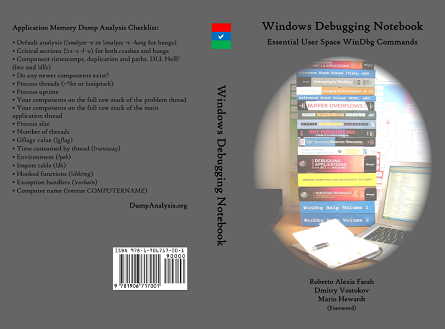
Forthcoming Windows Debugging Notebook: Essential User Space WinDbg Commands

Tuesday, April 5th, 2011

Finally, after the numerous delays, the first Windows Debugging Notebook is almost ready for publication by the end of this month with a new cover and a foreword written by Mario Hewardt, the author of Advanced Windows Debugging and Advanced .NET Debugging books:

It is the first notebook because we have decided to split it into 3 different memory space volumes and one additional overview volume for concepts and tools:

- Windows Debugging Notebook: Essential User Space WinDbg Commands (ISBN: 978-1906717001 and 978-0955832857)
- Windows Debugging Notebook: Essential Kernel Space WinDbg Commands (ISBN: 978-1908043146)
- Windows Debugging Notebook: Essential Managed Space WinDbg .NET Commands (ISBN: 978-1908043153)
- Windows Debugging Notebook: Essential Concepts and Tools (ISBN: 978-1908043160)

On a bookshelf you would be able to distinguish between the first 3 volumes by a 3 color spine stripe with an appropriate check on it: red for kernel, blue for user, and green for managed space.

The Table of Contents has been changed too.

- Dmitry Vostokov @ DumpAnalysis.org + TraceAnalysis.org -

Crash Dump Analysis Patterns (Part 39b)

Tuesday, April 5th, 2011

This is a kernel space counterpart to Custom Exception Handler pattern in user space. In the following stack trace below we see that DriverA code intercepted an access violation exception resulted from dereferencing a NULL pointer and generated a custom bugcheck:

kd> !analyze -v

[...]

EXCEPTION_RECORD: fffff8801c757158 -- (.exr 0xfffff8801c757158)
ExceptionAddress: fffff88003977de1 (DriverA!foo+0x0000000000000381)
ExceptionCode: c0000005 (Access violation)
  ExceptionFlags: 00000000
NumberParameters: 2
  Parameter[0]: 0000000000000000
  Parameter[1]: 0000000000000070
Attempt to read from address 0000000000000070

TRAP_FRAME: fffff8801c757200 -- (.trap 0xfffff8801c757200)
NOTE: The trap frame does not contain all registers.
Some register values may be zeroed or incorrect.
rax=0000000000000000 rbx=0000000000000000 rcx=fffff8a00da3f3c0
rdx=0000000000000000 rsi=0000000000000000 rdi=0000000000000000
rip=fffff88003977de1 rsp=fffff8801c757390 rbp=fffffa8009a853f0
 r8=0000000000000000 r9=0000000000000000 r10=006800740020006e
r11=fffff8a00da3f3c6 r12=0000000000000000 r13=0000000000000000
r14=0000000000000000 r15=0000000000000000
iopl=0 nv up ei pl zr na po nc
DriverA!foo+0×381:
fffff880`03977de1 0fb74070 movzx eax,word ptr [rax+70h] ds:0703:0070=????
Resetting default scope

[...]

kd> kL 100
Child-SP          RetAddr           Call Site
fffff880`1c7560f8 fffff880`039498f7 nt!KeBugCheckEx
fffff880`1c756100 fffff880`039352a0 DriverA!MyBugCheckEx+0×93
fffff880`1c756140 fffff800`016f1d1c DriverA!MyExceptionFilter+0×1d0

fffff880`1c756210 fffff800`016e940d nt!_C_specific_handler+0×8c
fffff880`1c756280 fffff800`016f0a90 nt!RtlpExecuteHandlerForException+0xd

fffff880`1c7562b0 fffff800`016fd9ef nt!RtlDispatchException+0×410
fffff880`1c756990 fffff800`016c2d82 nt!KiDispatchException+0×16f
fffff880`1c757020 fffff800`016c18fa nt!KiExceptionDispatch+0xc2
fffff880`1c757200 fffff880`03977de1 nt!KiPageFault+0×23a

fffff880`1c757390 fffff880`03977754 DriverA!foo+0×381
fffff880`1c757430 fffff880`0396f006 DriverA!bar+0×74
[…]
fffff880`1c7579b0 fffff800`019a6e0a DriverA!QueryInformation+0×30b
fffff880`1c757a70 fffff800`016c2993 nt!NtQueryInformationFile+0×535
fffff880`1c757bb0 00000000`76e5fe6a nt!KiSystemServiceCopyEnd+0×13
00000000`0a08dfe8 00000000`00000000 0×76e5fe6a

kd> !exchain
24 stack frames, scanning for handlers...
Frame 0×05: nt!RtlpExecuteHandlerForException+0xd (fffff800`016e940d)
  ehandler nt!RtlpExceptionHandler (fffff800`016e93d0)

Frame 0×07: nt!KiDispatchException+0×16f (fffff800`016fd9ef)
  ehandler nt!_GSHandlerCheck_SEH (fffff800`0169aec0)
Frame 0×0b: DriverA!bar+0×74 (fffff880`03977754)
  ehandler DriverA!__GSHandlerCheck (fffff880`039a12fc)

[…]
Frame 0×14: DriverA!QueryInformation+0×30b (fffff880`039303ab)
  ehandler DriverA!_C_specific_handler (fffff880`039a1864)
Frame 0×15: nt!NtQueryInformationFile+0×535 (fffff800`019a6e0a)
  ehandler nt!_C_specific_handler (fffff800`016f1c90)
Frame 0×16: nt!KiSystemServiceCopyEnd+0×13 (fffff800`016c2993)
  ehandler nt!KiSystemServiceHandler (fffff800`016c2580)
Frame 0×17: error getting module for 0000000076e5fe6a

- Dmitry Vostokov @ DumpAnalysis.org + TraceAnalysis.org -

Crash Dump Analysis Patterns (Part 134a)

Monday, March 28th, 2011

Data Correlation is a general pattern where values found in different parts of a memory dump correlate between each other according to some rules, for example, in some proportion. Here we show a variant for function parameters.

A process user memory dump showed a C++ exception:

0:000> kL
  *** Stack trace for last set context - .thread/.cxr resets it
ChildEBP RetAddr 
0012e950 78158e89 kernel32!RaiseException+0x53
0012e988 7830770c msvcr80!_CxxThrowException+0×46
0012e99c 783095bc mfc80u!AfxThrowMemoryException+0×19
0012e9b4 02afa8ca mfc80u!operator new+0×27

0012e9c8 02b0992f ModuleA!std::_Allocate<…>+0×1a
0012e9e0 02b09e7c ModuleA!std::vector<double,std::allocator<double> >::vector<double,std::allocator<double> >+0×3f
[…]

We suspected an out-of-memory condition and looked for function parameters:

0:000> kv 5
ChildEBP RetAddr  Args to Child             
0012e950 78158e89 e06d7363 00000001 00000003 kernel32!RaiseException+0x53
0012e988 7830770c 0012e998 783b0110 783c8d68 msvcr80!_CxxThrowException+0x46
0012e99c 783095bc 0000a7c0 0012ea40 000014f8 mfc80u!AfxThrowMemoryException+0x19
0012e9b4 02afa8ca 0000a7c0 089321b0 089321f0 mfc80u!operator new+0×27 (FPO: [Uses EBP] [1,0,0])
0012e9c8 02b0992f 000014f8 00000000 00000008 ModuleA!std::_Allocate<…>+0×1a (FPO: [2,3,0])

Because of FPO optimization we originally thought that stack arguments would be invalid. However, bearing in mind the function prototype and semantics of operator new and std::vector double element type we immediately see the correlation between 0xa7c0 and 0×14f8 which are proportional to sizeof(double) == 8:

0:000> ? 0000a7c0/000014f8
Evaluate expression: 8 = 00000000`00000008

We therefore conclude without looking at disassembly that memory allocation size was 42944 bytes:

0:000> .formats 0000a7c0
Evaluate expression:
  Hex:     00000000`0000a7c0
  Decimal: 42944
  Octal:   0000000000000000123700
  Binary:  00000000 00000000 00000000 00000000 00000000 00000000 10100111 11000000
  Chars:   ……..
  Time:    Thu Jan 01 11:55:44 1970
  Float:   low 6.01774e-041 high 0
  Double:  2.12172e-319

- Dmitry Vostokov @ DumpAnalysis.org + TraceAnalysis.org -

Presentation from Webinar: Introduction to Pattern-Driven Software Problem Solving

Saturday, March 26th, 2011

The presentation materials from the webinar (25th of March, 2011) are available for download:

http://www.dumpanalysis.com/PDSPSI-materials

Thanks to everyone who registered and attended!

- Dmitry Vostokov @ DumpAnalysis.org + TraceAnalysis.org -

Icons for Memory Dump Analysis Patterns (Part 94)

Wednesday, March 23rd, 2011

Today we introduce an icon for Stack Overflow (software implementation) pattern:

B/W

Color

- Dmitry Vostokov @ DumpAnalysis.org + TraceAnalysis.org -