Trace Analysis Patterns (Part 256)
Saturday, February 28th, 2026Sometimes, we want to count the number of (Adjoint) Threads of Activity corresponding to a specified ATID:
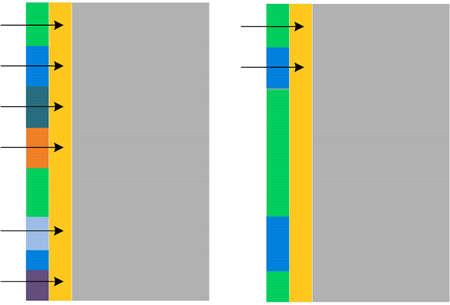
We can view this as (adjoint) threads coming into or out of the specified ATID, similar to divergence, which gives the name Trace Divergence log analysis pattern. This analysis pattern differs from Cord of Activity, which is not a number, and the latter may not have a single, unvarying source or target ATID to which other A(TID)s correspond. It is also different from Trace Flux, where the number of threads is an external variable not related to traces and logs, and from Message Flow, which operates on the individual message level, temporal in nature, and counters are set in advance.
Typical examples include SYN floods in network traces (src and dst ATIDs), the number of threads corresponding to the specific PID, or the number of threads contending for the specified API.
Activity Divergence may look similar, but its surface is temporal, whereas Trace Divergence’s, surface is structural. There can be several Trace Divergencies in the same trace or log since they are per ATID.
Formally, Trace Divergence is a property of a constructed graph, for example, Din(a)=∣{x∈V∣x→a}∣; Activity Divergence is a property of a constructed signal, interpreted as dynamics, for example, Din(a,t).
- Dmitry Vostokov @ DumpAnalysis.org + TraceAnalysis.org -