Trace Analysis Patterns (Part 146)
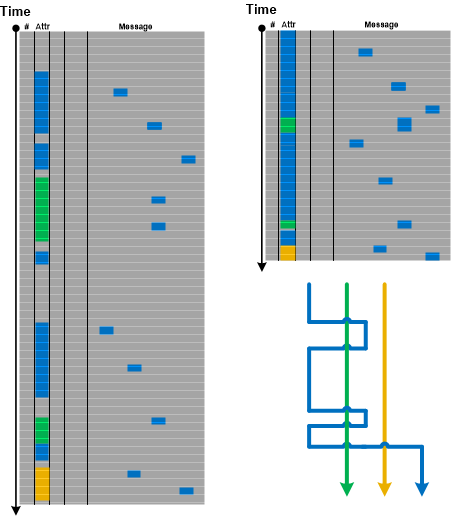
Saturday, April 29th, 2017The idea of Tensor Trace analysis pattern initially appeared in the context of memory dumps as general traces with several special traces inside but then developed further when working on Singleton Trace analysis pattern when we realized that several Singleton Traces may form a new separate log:

Therefore, we may combine several traces and logs into one global trace where each message references separate local traces and logs:

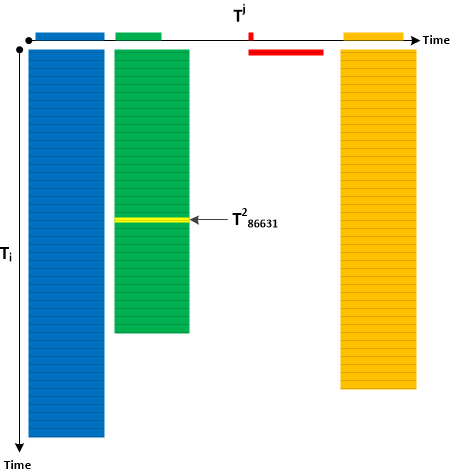
Typical example is a repeated tracing. Each trace has an i-th index spanning the number of trace messages. We say it is has Ti components. Each individual logging has an j-th index and overall global log has Tj components. Together the form the second rank tensor:
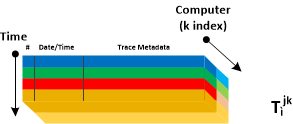
There can be Tensor Traces of the higher rank, for example, the 3rd component spanning computers:
This analysis pattern is different from Meta Trace where the latter is about trace evolution during software development. It is also different from Trace Dimension which is about one trace (Tensor Trace of rank 1).
- Dmitry Vostokov @ DumpAnalysis.org + TraceAnalysis.org -