Archive for the ‘Software Trace Analysis’ Category
Saturday, March 16th, 2013
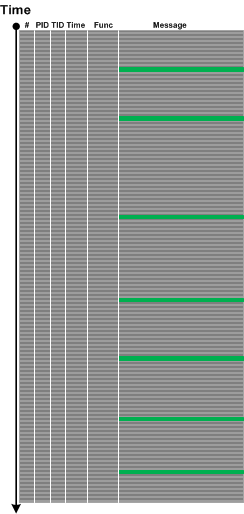
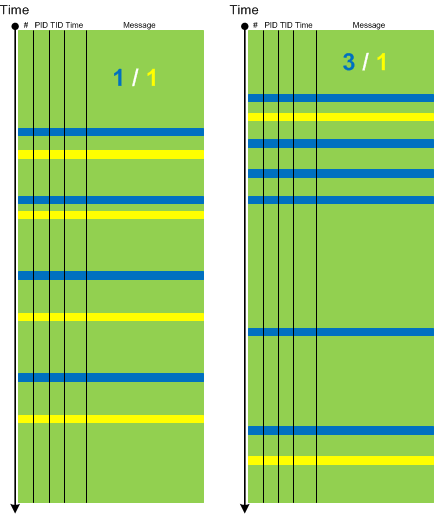
Suppose we form an adjoint thread based on some message or operation type or some other attribute:
But we do not know where to start to look backwards for any anomalies relevant to our problem:
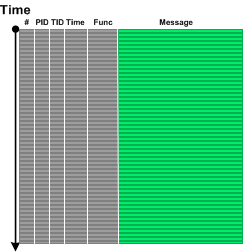
We go back to our full trace and find a problem message:
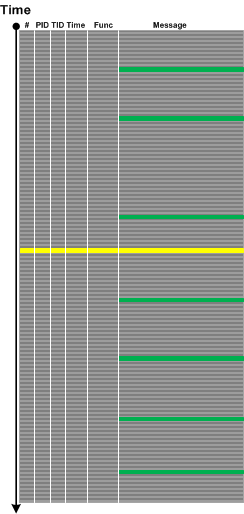
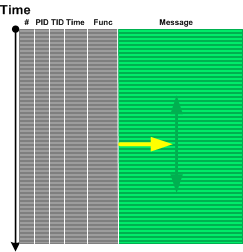
Although it is not in our adjoint thread we formed previously it is still considered as Pivot Message helping us to go backwards there:
- Dmitry Vostokov @ DumpAnalysis.org + TraceAnalysis.org -
Posted in Software Trace Analysis, Software Trace Reading, Trace Analysis Patterns | No Comments »
Thursday, March 14th, 2013
If Implementation Discourse focuses on objective technology specific discourse then Traces of Individuality pattern focuses on subjective elements in a software log and its messages. Here we mean some specific naming or tracing conventions either from an individual engineer habit or from some corporate coding standard. As an example of it consider a trace message from a catch statement:
"Surprise, surprise, should have never been caught"
More examples for this pattern will be added later.
- Dmitry Vostokov @ DumpAnalysis.org + TraceAnalysis.org -
Posted in Software Trace Analysis, Software Trace Deconstruction, Software Trace Linguistics, Software Trace Reading, Software Trace Stylistics, Trace Analysis Patterns | No Comments »
Friday, February 15th, 2013
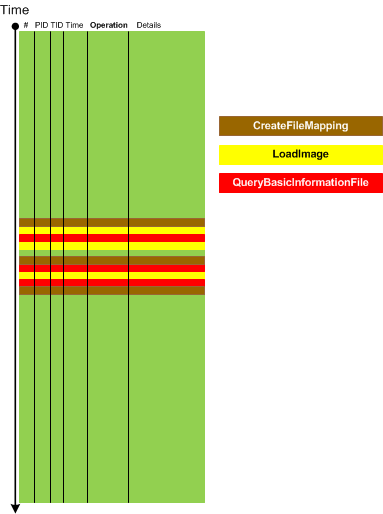
Inter-Correlation analysis between a normal and a problem logs to find a Bifurcation Point (and a possible root cause) becomes a difficult task when both traces come from different environments with widely differing Background Components. Here a new analysis pattern called Sheaf of Activities (borrowed from sheaves from mathematics) can help. Basically this pattern is also a tool in tracking properties of trace message subsets. First we find out important message types around some Activity Region where we hope to find a difference between two traces:
Then we create several Adjoint Threads from different message types, for example, based on operation type or function name:

Then we analyze subtraces separately to find out a bifurcation point in each of them and then use this knowledge to find out differences between the original full traces.
- Dmitry Vostokov @ DumpAnalysis.org + TraceAnalysis.org -
Posted in Debugging, Process Monitor Log Analysis, Software Trace Analysis, Software Trace Reading, Trace Analysis Patterns | No Comments »
Friday, February 8th, 2013
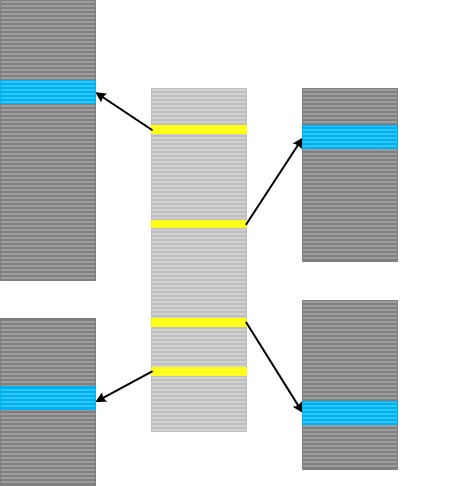
Indexical Trace pattern describes an Inter-Correlation pattern variant when we have a trace that has messages of interest pointing to specific activity regions in another trace. The latter trace can be very huge, from another computer and split into many parts (Split Trace). This pattern is very helpful when the problem needs to be diagnosed in the large split trace but we don’t know when it happened. Then an index trace that may have recorded software execution account (for example, in the case of a broker-like architecture) and can point to the right trace fragment from the split trace.
- Dmitry Vostokov @ DumpAnalysis.org + TraceAnalysis.org -
Posted in CDF Analysis Tips and Tricks, Debugging, Software Architecture, Software Trace Analysis, Software Trace Reading, Trace Analysis Patterns | No Comments »
Friday, January 11th, 2013
Static program analysis is used to eliminate certain coding errors that may lead to abnormal software behaviour. So it is naturally a part of software diagnostics but at source code level. Our goal here is to identify certain patterns directly linkable to patterns we see in memory dumps and software logs and collect them into a catalog. One such pattern candidate is called Loop Construct. It covers conditional and unconditional loops, for example, in one of modern languages:
extern bool soonToBeTrue;
int mediumValue = ...;
while (true)

{

  TRACE("Waiting");

  sleep(mediumValue);

  if (soonToBeTrue)

  {

    break;

  }

  doHeavyWork();

}
while (--pControl->aFewPasses)

{

  TRACE("Waiting");

  sleep(mediumValue);

  doHeavyWork();

}
Such loops may potentially lead to Spiking Thread memory dump analysis and High Message Current and Density trace analysis patterns. Of course, we shouldn’t suspect every loop but only some that have potential to be altered by Local Buffer Overflow (for mediumValue) or Shared Buffer Overwrite (for Control.aFewPasses) or by a race condition (soonToBeTrue).
We expect things to get more interesting when we start associating source code that uses certain API with patterns of abnormal behavior.
- Dmitry Vostokov @ DumpAnalysis.org + TraceAnalysis.org -
Posted in C and C++, Code Reading, Core Dump Analysis, Crash Dump Analysis, Crash Dump Patterns, Debugging, Security, Software Behavior Patterns, Software Diagnostics, Software Trace Analysis, Static Code Analysis Patterns, Trace Analysis Patterns, Victimware Analysis | No Comments »
Wednesday, January 9th, 2013
If you need to get various real life software traces with millions of lines from complex software environments to learn pattern-driven software log analysis you can us Process Monitor as a modeling tool. Here you can abstract from their “monitoring” and API interception context and consider trace messages as emitted from various processes and threads (like Citrix CDF traces). This approach was used in Accelerated Windows Software Trace Analysis training and Debugging TV Frames episode 0×19.
- Dmitry Vostokov @ DumpAnalysis.org + TraceAnalysis.org -
Posted in Software Trace Analysis, Software Trace Modeling, Trace Analysis Patterns | No Comments »
Friday, January 4th, 2013
Before deciding on whether to retrospect on 2012 we found that since March 14, 2008 this site has had more than 1 million visitors with more than 33% returning. So instead of just 2012 we decided to retrospect on that interval up to December 31, 2012. Google Analytics has improved since last January, 2012 and now made our task easier. So we start with the first one hundred sites referring to us:
| Source / Medium |
Visits
|
| google |
698156
|
| (direct) |
164142
|
| bing |
27923
|
| google.com |
17868
|
| windbg.org |
12994
|
| yahoo |
8682
|
| stackoverflow.com |
7194
|
| yandex |
5985
|
| windbg.dumpanalysis.org |
5375
|
| dumpanalysis.com |
5369
|
| live |
5310
|
| google.co.in |
4598
|
| blogs.msdn.com |
4385
|
| baike.baidu.com |
3475
|
| twitter.com |
2972
|
| facebook.com |
2733
|
| dumpanalysis.org |
2708
|
| images.google.com |
2314
|
| t.co |
2095
|
| baidu |
1916
|
| winvistaclub.com |
1862
|
| google.co.uk |
1449
|
| advancedwindowsdebugging.com |
1427
|
| jasonhaley.com |
1370
|
| search |
1328
|
| rsdn.ru |
1294
|
| en.wikipedia.org |
1276
|
| msn |
1256
|
| nynaeve.net |
1256
|
| blog.codeimproved.net |
1213
|
| google.de |
1074
|
| google.ca |
979
|
| reddit.com |
951
|
| bytetalk.net |
908
|
| citrixblogger.org |
819
|
| stumbleupon.com |
819
|
| linkedin.com |
780
|
| social.technet.microsoft.com |
774
|
| analyze-v.com |
757
|
| naver |
750
|
| forum.sysinternals.com |
735
|
| google.ru |
710
|
| blogs.microsoft.co.il |
693
|
| kumo.com |
678
|
| google.co.kr |
658
|
| google.com.au |
654
|
| blog.naver.com |
646
|
| reconstructer.org |
645
|
| community.citrix.com |
632
|
| blog.not-a-kernel-guy.com |
604
|
| itdatabase.com |
601
|
| advanceddotnetdebugging.com |
581
|
| serverfault.com |
564
|
| voneinem-windbg.blogspot.com |
561
|
| support.citrix.com |
555
|
| debuggingexperts.com |
549
|
| blog.miniasp.com |
527
|
| google.fr |
495
|
| caloni.com.br |
488
|
| google.com.br |
479
|
| ask |
459
|
| msuiche.net |
439
|
| insidewindows.kr |
432
|
| google.es |
430
|
| gynvael.coldwind.pl |
430
|
| blog.flexilis.com |
429
|
| aol |
418
|
| netfxharmonics.com |
416
|
| advdbg.org |
413
|
| images.google.co.uk |
401
|
| google.it |
391
|
| images.google.co.in |
391
|
| google.nl |
354
|
| serious-code.net |
340
|
| admin.itdatabase.com |
337
|
| blogs.technet.com |
334
|
| brianmadden.com |
327
|
| google.pl |
319
|
| google.com.ua |
318
|
| experts-exchange.com |
316
|
| delicious.com |
312
|
| images.google.de |
305
|
| opentask.com |
301
|
| codemachine.com |
296
|
| driveronline.org |
287
|
| google.com.tw |
282
|
| wasm.ru |
275
|
| debuglab.com |
265
|
| isisaka.com |
262
|
| literatescientist.com |
261
|
| blog.zoller.lu |
258
|
| shellexecute.wordpress.com |
257
|
| google.com.hk |
256
|
| managementbits.com |
253
|
| d.hatena.ne.jp |
251
|
| bloglines.com |
249
|
| google.com.tr |
248
|
| clausbrod.de |
246
|
| bing.com |
243
|
Next table is distribution of visits among countries:
| Country / Territory |
Visits
|
| United States |
342291
|
| India |
89303
|
| United Kingdom |
76131
|
| Russia |
46472
|
| Germany |
44472
|
| China |
40155
|
| Canada |
34781
|
| Japan |
24985
|
| France |
24084
|
| South Korea |
21056
|
| Australia |
20606
|
| Taiwan |
17949
|
| Netherlands |
15607
|
| Ireland |
15579
|
| Israel |
13514
|
| Ukraine |
13449
|
| Italy |
12542
|
| Brazil |
11834
|
| Spain |
11786
|
| Singapore |
11703
|
| Sweden |
11201
|
| Poland |
10340
|
| Romania |
9423
|
| (not set) |
8909
|
| Czech Republic |
8355
|
| Belgium |
6731
|
| Switzerland |
6624
|
| Finland |
6596
|
| Norway |
5585
|
| Malaysia |
5289
|
| Philippines |
5052
|
| Austria |
5046
|
| Denmark |
4980
|
| Hong Kong |
4914
|
| Turkey |
4728
|
| Slovakia |
4599
|
| New Zealand |
4369
|
| Portugal |
4228
|
| Argentina |
3712
|
| Belarus |
3518
|
| Hungary |
3465
|
| Bulgaria |
3301
|
| Mexico |
2960
|
| South Africa |
2945
|
| Vietnam |
2721
|
| Greece |
2712
|
| Indonesia |
2527
|
| Croatia |
1881
|
| Serbia |
1843
|
| Iran |
1842
|
| Thailand |
1726
|
| Pakistan |
1660
|
| Egypt |
1519
|
| Malta |
1422
|
| Estonia |
1385
|
| Slovenia |
1334
|
| Lithuania |
1304
|
| United Arab Emirates |
1167
|
| Chile |
1104
|
| Saudi Arabia |
1096
|
| Colombia |
1067
|
| Latvia |
922
|
| Kazakhstan |
725
|
| Peru |
649
|
| Morocco |
585
|
| Sri Lanka |
516
|
| Luxembourg |
516
|
| Moldova |
439
|
| Uruguay |
435
|
| Venezuela |
431
|
| Jordan |
425
|
| Tunisia |
425
|
| Bolivia |
418
|
| Armenia |
371
|
| Algeria |
362
|
| Costa Rica |
355
|
| Iceland |
353
|
| Panama |
352
|
| Macedonia [FYROM] |
347
|
| Bosnia and Herzegovina |
327
|
| Cyprus |
317
|
| Bangladesh |
314
|
| Nigeria |
298
|
| Puerto Rico |
296
|
| Jamaica |
251
|
| Ecuador |
248
|
| Kuwait |
239
|
| Lebanon |
218
|
| Qatar |
217
|
| Kenya |
195
|
| Georgia |
194
|
| Mongolia |
189
|
| Dominican Republic |
163
|
| Macau |
156
|
| Trinidad and Tobago |
147
|
| Bahrain |
143
|
| Uzbekistan |
142
|
| Guatemala |
141
|
| Azerbaijan |
134
|
| Mauritius |
128
|
| Oman |
117
|
| Nepal |
110
|
| El Salvador |
106
|
| Syria |
103
|
| Iraq |
102
|
| Ghana |
96
|
| Kyrgyzstan |
86
|
| Cambodia |
72
|
| Albania |
71
|
| Serbia and Montenegro |
63
|
| Ethiopia |
63
|
| Uganda |
61
|
| Brunei |
57
|
| Honduras |
55
|
| Isle of Man |
55
|
| Yemen |
55
|
| Cuba |
54
|
| Sudan |
54
|
| Palestinian Territories |
52
|
| Barbados |
49
|
| Myanmar [Burma] |
48
|
| Paraguay |
45
|
| Liechtenstein |
43
|
| Montenegro |
43
|
| Rwanda |
42
|
| Libya |
41
|
| Namibia |
41
|
| Jersey |
40
|
| Maldives |
40
|
| Turks and Caicos Islands |
39
|
| Bermuda |
38
|
| Zimbabwe |
34
|
| Fiji |
32
|
| Nicaragua |
32
|
| Tanzania |
29
|
| Réunion |
27
|
| Gibraltar |
26
|
| New Caledonia |
26
|
| Bahamas |
25
|
| Monaco |
25
|
| Netherlands Antilles |
24
|
| Aruba |
24
|
| Botswana |
24
|
| Cayman Islands |
23
|
| Angola |
22
|
| Madagascar |
20
|
| Guam |
19
|
| Afghanistan |
17
|
| Côte d’Ivoire |
17
|
| Papua New Guinea |
17
|
| Dominica |
16
|
| Guernsey |
16
|
| Guyana |
16
|
| Suriname |
16
|
| Andorra |
14
|
| Belize |
14
|
| Congo [DRC] |
14
|
| Lesotho |
14
|
| Mozambique |
13
|
| Antigua and Barbuda |
12
|
| Laos |
12
|
| French Polynesia |
11
|
| Zambia |
11
|
| Saint Lucia |
10
|
| San Marino |
10
|
| Senegal |
10
|
| Saint Vincent and the Grenadines |
10
|
| Benin |
9
|
| Guinea |
9
|
| Guadeloupe |
9
|
| Malawi |
9
|
| Turkmenistan |
9
|
| U.S. Virgin Islands |
8
|
| Faroe Islands |
7
|
| Grenada |
7
|
| Haiti |
7
|
| British Virgin Islands |
7
|
| Cameroon |
6
|
| French Guiana |
6
|
| Greenland |
6
|
| Martinique |
6
|
| Seychelles |
6
|
| Timor-Leste |
6
|
| Mali |
5
|
| Tajikistan |
5
|
| Gabon |
4
|
| Anguilla |
3
|
| Å land Islands |
3
|
| Swaziland |
3
|
| Burundi |
2
|
| Congo [Republic] |
2
|
| Cape Verde |
2
|
| Djibouti |
2
|
| Saint Kitts and Nevis |
2
|
| Liberia |
2
|
| Somalia |
2
|
| Togo |
2
|
| Vanuatu |
2
|
| Burkina Faso |
1
|
| Bhutan |
1
|
| Falkland Islands [Islas Malvinas] |
1
|
| Gambia |
1
|
| Equatorial Guinea |
1
|
| Guinea-Bissau |
1
|
| Comoros |
1
|
| Mauritania |
1
|
| Palau |
1
|
| Sierra Leone |
1
|
| Vatican City |
1
|
| Samoa |
1
|
Then the first 100 network locations:
| Service Provider |
Visits
|
| microsoft corp |
33646
|
| comcast cable communications inc. |
18544
|
| road runner holdco llc |
16529
|
| internet service provider |
12815
|
| comite gestor da internet no brasil |
10995
|
| hewlett-packard company |
10961
|
| deutsche telekom ag |
9889
|
| japan network information center |
9746
|
| verizon internet services inc. |
7851
|
| network of citrix systems inc |
6945
|
| intel corporation |
6873
|
| symantec corporation |
6812
|
| chunghwa telecom data communication business group |
6381
|
| ip pools |
6314
|
| insignium llc |
6206
|
| reliance communications ltd |
5870
|
| charter communications |
5583
|
| uunet non-portable customer assignment |
4931
|
| verizon online llc |
4900
|
| comcast cable communications holdings inc |
4700
|
| at&t internet services |
4617
|
| eircom |
4567
|
| cox communications |
4540
|
| proxad / free sas |
4451
|
| korea telecom |
4397
|
| abts (karnataka) |
4251
|
| nib (national internet backbone) |
4243
|
| chinanet guangdong province network |
4189
|
| comcast cable communications |
3896
|
| unknown |
3279
|
| xo communications |
3274
|
| chinanet shanghai province network |
3248
|
| shaw communications inc. |
3179
|
| qwest communications company llc |
3156
|
| telstra internet |
3130
|
| tw telecom holdings inc. |
3091
|
| citrix systems inc. |
3029
|
| data general corporation |
2998
|
| cox communications inc. |
2946
|
| bellsouth.net inc. |
2925
|
| optimum online (cablevision systems) |
2853
|
| china unicom beijing province network |
2850
|
| chtd chunghwa telecom co. ltd. |
2791
|
| krnic |
2786
|
| ntt communications corporation |
2779
|
| psinet inc. |
2599
|
| emc corporation |
2499
|
| comcast cable communications ip services |
2435
|
| arcor ag |
2371
|
| cisco systems inc. |
2364
|
| (not set) |
2335
|
| broadband multiplay project o/o dgm bb noc bsnl bangalore |
2285
|
| research in motion limited |
2283
|
| samtel |
2257
|
| rcs & rds s.a. |
2246
|
| computer associates international |
2166
|
| honeywell international inc. |
2106
|
| telus communications inc. |
2103
|
| customers ie |
1954
|
| sympatico hse |
1929
|
| comcast business communications llc |
1853
|
| telefonica de espana sau |
1843
|
| iinet limited |
1840
|
| ziggo consumers |
1810
|
| easynet ltd |
1758
|
| comcast business communications inc. |
1738
|
| microsoft |
1717
|
| kaspersky lab internet |
1698
|
| appense |
1687
|
| chinanet jiangsu province network |
1665
|
| dell computer corporation |
1656
|
| eircom ltd |
1644
|
| taipei taiwan |
1612
|
| abts tamilnadu |
1594
|
| network of ign arch. and design gb |
1578
|
| starhub cable vision ltd |
1555
|
| wipro technologies |
1537
|
| level 3 communications inc. |
1522
|
| tpg internet pty ltd. |
1510
|
| siemens ag |
1483
|
| microsoft corporation |
1478
|
| global crossing |
1433
|
| singnet pte ltd |
1429
|
| dynamic pools |
1426
|
| this space is statically assigned. |
1425
|
| videsh sanchar nigam ltd - india. |
1414
|
| provider local registry |
1403
|
| abts delhi |
1385
|
| qwest communications corporation |
1356
|
| kla instruments corp. |
1316
|
| telia network services |
1311
|
| cncgroup beijing province network |
1278
|
| frontier communications of america inc. |
1264
|
| telecom italia s.p.a. tin easy lite |
1257
|
| videotron ltee |
1255
|
| oracle datenbanksysteme gmbh |
1234
|
| neostrada plus |
1228
|
| suddenlink communications |
1214
|
| dynamic ip pool for broadband customers |
1202
|
| eset s.r.o. |
1200
|
Then the first 100 search keywords and phrases that led to us:
| Keyword |
Visits
|
| (not provided) |
53903
|
| kifastsystemcallret |
10644
|
| crash dump analysis |
10348
|
| crash dump |
9863
|
| ntdll!kifastsystemcallret |
4305
|
| dump analysis |
4143
|
| adplus |
3332
|
| win32 error 0n2 |
2553
|
| windbg commands |
2198
|
| memory dump analysis |
2183
|
| windbg |
2131
|
| crash dumps |
1825
|
| dumpanalysis.org |
1818
|
| nt!_gshandlercheck_seh |
1734
|
| dmitry vostokov |
1718
|
| crashdump |
1683
|
| symbol file could not be found |
1669
|
| bugcheck 3b |
1458
|
| memory dump analysis anthology |
1393
|
| crash dump analyzer |
1360
|
| warning: frame ip not in any known module. following frames may be wrong. |
1347
|
| windbg cheat sheet |
1318
|
| windbg crash dump analysis |
1271
|
| minidump analysis |
1259
|
| adplus download |
1214
|
| core dump analysis |
1167
|
| fnodobfm |
1159
|
| dumpanalysis |
1142
|
| windows 7 crash dump |
1142
|
| windbg analyze |
1118
|
| kisystemservicecopyend |
1066
|
| frame ip not in any known module |
1010
|
| getcontextstate failed, 0×80070026 |
949
|
| crash dump windows 7 |
930
|
| the stored exception information can be accessed via .ecxr. |
925
|
| windbg script |
922
|
| error: symbol file could not be found |
912
|
| vista crash dump |
895
|
| windows crash dump analysis |
888
|
| system_thread_exception_not_handled |
857
|
| анализ дампа памяти |
857
|
| dump analyzer |
847
|
| дамп памяти |
821
|
| pool corruption |
820
|
| time travel debugging |
776
|
| system_service_exception |
772
|
| kernel_mode_exception_not_handled |
741
|
| ntdll kifastsystemcallret |
741
|
| the stored exception information can be accessed via .ecxr |
734
|
| kmode_exception_not_handled |
726
|
| trap frame |
719
|
| idna trace |
695
|
| windbg crash dump |
694
|
| kiuserexceptiondispatcher |
691
|
| minidump analyzer |
672
|
| bugcheck 7e |
670
|
| kernel32!pnlsuserinfo |
643
|
| windbg scripts |
641
|
| rtlpwaitoncriticalsection |
635
|
| minidump |
628
|
| bugcheck system_service_exception |
621
|
| exception_double_fault |
597
|
| warning: stack unwind information not available. following frames may be wrong. |
584
|
| application_fault_status_breakpoint |
583
|
| crash dump vista |
582
|
| memory dump analysis tool |
576
|
| getcontextstate failed, 0xd0000147 |
575
|
| memoretics |
544
|
| dumpanalysis.org/asmpedia |
537
|
| failure_bucket_id |
524
|
| “dec 15″ module windbg |
511
|
| error: symbol file could not be found. |
511
|
| download adplus |
507
|
| basethreadinitthunk |
505
|
| dr watson vista |
505
|
| ntkrnlmp.exe crash dump |
499
|
| ntdll.dll!kifastsystemcallret |
492
|
| rtlplowfragheapfree |
488
|
| analyze minidump |
477
|
| adplus tutorial |
473
|
| application_hang_blockedon_fileio |
468
|
| bios disassembly ninjutsu uncovered |
460
|
| ntdll.kifastsystemcallret |
460
|
| analyze crash dump |
459
|
| windows dump analysis |
459
|
| debug_flr_image_timestamp |
456
|
| system_thread_exception_not_handled (7e) |
456
|
| windbg dump analysis |
446
|
| windbg hang |
438
|
| windows debugging: practical foundations |
434
|
| crash dump analysis windbg |
432
|
| dynamicbase aslr |
422
|
| crash dump analysis tool |
419
|
| nt!kebugcheckex |
414
|
| rtluserthreadstart |
414
|
| type referenced: kernel32!pnlsuserinfo |
407
|
| error: symbol file could not be found. defaulted to export symbols for ntkrnlmp.exe |
405
|
| memory dump |
403
|
| warning: frame ip not in any known module. following frames may be wrong |
399
|
| application_hang_busyhang |
398
|
Then browser stats (we have never thought that there are so many of them):
| Browser |
Visits
|
| Internet Explorer |
446051
|
| Firefox |
356686
|
| Chrome |
184535
|
| Opera |
45787
|
| Safari |
24123
|
| Mozilla |
3780
|
| Mozilla Compatible Agent |
2401
|
| Android Browser |
1337
|
| Konqueror |
1057
|
| IE with Chrome Frame |
982
|
| Opera Mini |
705
|
| SeaMonkey |
503
|
| Safari (in-app) |
197
|
| Lunascape |
144
|
| BlackBerry8900 |
128
|
| Camino |
126
|
| RockMelt |
124
|
| (not set) |
96
|
| Netscape |
72
|
| Playstation 3 |
36
|
| IUC |
34
|
| Googlebot |
29
|
| Lynx |
24
|
| Unsupported Browser Version |
22
|
| BlackBerry9630 |
21
|
| NetFront |
17
|
| BlackBerry9700 |
15
|
| Microsoft-Symbol-Server |
14
|
| BlackBerry9000 |
12
|
| Galeon |
11
|
| Midori |
9
|
| NokiaE63 |
9
|
| Yahoo! Slurp |
9
|
| BlackBerry8530 |
8
|
| BlackBerry8520 |
7
|
| PagePeeker.com |
7
|
| SAMSUNG-SGH-I617 |
7
|
| BlackBerry9530 |
6
|
| JUC |
6
|
| MSR-ISRCCrawler |
6
|
| OpenWave |
6
|
| anonimo |
5
|
| BlackBerry9300 |
5
|
| HTC_HD2_T8585 Opera |
5
|
| Nokia5233 |
5
|
| Space Bison |
5
|
| -Vasya |
4
|
| Blazer |
4
|
| Uzbl |
4
|
-^_^- Hello  |
3
|
| <?echo ‘<pre>’; system |
3
|
| 12345 |
3
|
| BlackBerry9330 |
3
|
| BlackBerry9650 |
3
|
| HTC_P3700 Opera |
3
|
| HTC_TyTN_II Mozilla |
3
|
| NOKIAN78 |
3
|
| Playstation Portable |
3
|
| PPC; 240×320; HTC_P3450 |
3
|
| undefined GoogleToolbarBB |
3
|
| anonymous |
2
|
| Empty |
2
|
| GreatBrowse |
2
|
| Helyi user agent |
2
|
| HTC_Touch_Pro2_T7373 Opera |
2
|
| HTC_Touch2_T3333 Opera |
2
|
| J2ME |
2
|
| Mozilla 5.0 |
2
|
| NokiaC1-01 |
2
|
| NokiaC3-00 |
2
|
| NokiaC7-00 |
2
|
| NokiaX2-01 |
2
|
| nwzfq |
2
|
| test |
2
|
| — |
1
|
| ?M5 |
1
|
| “PagePeeker.com” |
1
|
| <?include |
1
|
| <script>alert |
1
|
| <SCRIPT>window.location=’http: |
1
|
| 2.0.0.11 |
1
|
| 31337′ |
1
|
| 8900b |
1
|
| AltaVista Intranet V2.0 evreka.com crawler@evreka.com |
1
|
| annoying |
1
|
| AppEngine-Google; |
1
|
| BlackBerry9500 |
1
|
| BlackBerry9550 |
1
|
| bwh3_user_agent |
1
|
| Citrix |
1
|
| EBABrowser |
1
|
| EY |
1
|
| fake_user_agent Mozilla |
1
|
| FAST Enterprise Crawler 6 used by Reed Exhibitions |
1
|
| foo |
1
|
| General Browser |
1
|
| GOOGLEBOT |
1
|
| HD_mini_T5555 Opera |
1
|
| Hellbrowser 6.66 |
1
|
| holy_teacher FirePHP |
1
|
| HTC_P3490 Opera |
1
|
| HTC_P4550 Mozilla |
1
|
| HTC_Polaris Mozilla |
1
|
| HTC_Touch_3G_T3232 Opera |
1
|
| HTC_Touch_HD_T8282 Opera |
1
|
| HTC_Touch_Pro_T7272 Opera |
1
|
| HTC_Touch2_T3320 Opera |
1
|
| HTC-8900 |
1
|
| IE 8 |
1
|
| IE6 |
1
|
| iTunes |
1
|
| Keep Out |
1
|
| KraftwayBrowser2 |
1
|
| Links |
1
|
| Maemo Browser |
1
|
| Medusa |
1
|
| MERONG |
1
|
| Motorola_ES405B |
1
|
| mozilla |
1
|
| Mozilla Firefox |
1
|
| MS-OC 4.0 |
1
|
| msie |
1
|
| NCSA Mosaic |
1
|
| NightDynamo AdminPanel v0.2.1 |
1
|
| Nokia2700c-2 |
1
|
| Nokia2730c-1 |
1
|
| Nokia305 |
1
|
| Nokia5230 |
1
|
| Nokia5310XpressMusic |
1
|
| Nokia5800 XpressMusic |
1
|
| Nokia6300 |
1
|
| Nokia6700c-1 |
1
|
| NokiaC2-01 |
1
|
| NokiaC2-02 |
1
|
| NokiaC2-03 |
1
|
| NokiaC5-03 |
1
|
| nokiac6-00 |
1
|
| NokiaC6-00 |
1
|
| NOKIAE65 |
1
|
| NokiaE66 |
1
|
| NokiaE71 |
1
|
| NokiaE71-2;Mozilla |
1
|
| NokiaE72-1 |
1
|
| NokiaN-GageQD |
1
|
| NokiaN70-1 |
1
|
| NokiaNokia 6210s |
1
|
| NoneOfYourBusiness |
1
|
| nothisname_wangxiaoyang3 |
1
|
| OmniWeb |
1
|
| Palm750 |
1
|
| Peeplo Screenshot Bot |
1
|
| PerTrUsTsQuiD |
1
|
| pippos.7 |
1
|
| PPC; 480×800; HTC_Touch_HD_T8282; OpVer 34.159.1.612 |
1
|
| PriceGoblin User Agent |
1
|
| Private |
1
|
| Privoxy |
1
|
| Read Later |
1
|
| SAMSUNG-GT-E2222 |
1
|
| samsung-gt-s3653 |
1
|
| samsung-gt-s3653 UNTRUSTED |
1
|
| SAMSUNG-S8000 |
1
|
| SAMSUNG-SGH-I637 |
1
|
| Samsung-SPHM540 Polaris |
1
|
| SmallProxy 3.5.4 |
1
|
| SonyEricssonK750 |
1
|
| Surf |
1
|
| tdhbrowser |
1
|
| TiFiC Client Z |
1
|
| union update table sd_users set userid=9 where username=’coco |
1
|
| unknown |
1
|
| Unknown |
1
|
| UNTRUSTED |
1
|
| Updownerbot |
1
|
| WIN |
1
|
| WinXP SP2 |
1
|
| Wlwap |
1
|
| WM5 PIE |
1
|
| Xda_orbit_2; 240×320 |
1
|
| Xyi znat kakoi browser MRA 5.7 |
1
|
| ZooShot 0.1a |
1
|
| ZooShot 0.42 |
1
|
and finally mobile devices stats (you may find your own device there):
| Mobile Device Info |
Visits
|
| Apple iPhone |
2292
|
| Apple iPad |
1940
|
| (not set) |
1099
|
| Samsung GT-I9100 Galaxy S II |
167
|
| Apple iPod Touch |
112
|
| Asus Eee Pad Transformer TF101 |
112
|
| SonyEricsson LT15i Xperia Arc |
94
|
| Motorola Xoom |
47
|
| Samsung Galaxy Nexus |
47
|
| Samsung GT-I9000 Galaxy S |
34
|
| Samsung GT-P7510 Galaxy Tab 10.1 |
30
|
| Google Nexus S Samsung Nexus S |
26
|
| HTC EVO 4G |
26
|
| Google Nexus 7 |
21
|
| RIM BlackBerry Bold Touch 9900 Dakota |
21
|
| Samsung GT-N7000 Galaxy Note |
21
|
| Acer A500 Picasso |
17
|
| Asus Eee Pad TF201 Transformer Prime |
17
|
| HTC Desire HD |
17
|
| Motorola DroidX |
17
|
| Motorola XT862 Droid 3 |
17
|
| Samsung GT-S5830 Galaxy Ace |
17
|
| Samsung SGH-I747 Galaxy SIII |
17
|
| Samsung SGH-i917 Omnia 7 |
17
|
| Verizon Droid2 |
17
|
| Google Nexus One |
13
|
| Google Nexus One HTC Nexus One |
13
|
| HTC ADR6300 Incredible |
13
|
| Motorola Droid 2 |
13
|
| Samsung GT-P7500 P4 |
13
|
| Samsung SHW-M250K GALAXY S II (KT) |
13
|
| Apple iPod |
9
|
| BlackBerry 9780 |
9
|
| BlackBerry 9800 Torch |
9
|
| Dell Venue Pro |
9
|
| HTC Desire |
9
|
| HTC G2 HTC Sappire |
9
|
| HTC HD7 |
9
|
| HTC T9292 HD7 |
9
|
| Motorola MB860 Atrix |
9
|
| Nokia E63 |
9
|
| RIM BlackBerry 8530 Curve |
9
|
| Samsung GT-I9001 |
9
|
| Samsung GT-I9300 Galaxy S3 |
9
|
| Samsung GT-N8000 Galaxy Note 10.1 |
9
|
| Samsung GT-P1000 Galaxy Tab |
9
|
| Sharp IS03 IS03 for KDDI |
9
|
| T-Mobile myTouch4G |
9
|
| Toshiba AT100 |
9
|
| ZTE N860 |
9
|
| Acer A101 Vangogh |
4
|
| Acer A200 Picasso_E |
4
|
| Acer Acer E310 Liquid Mini |
4
|
| Asus TF300T Transformer Pad TF300T |
4
|
| BlackBerry 8520 Curve |
4
|
| BlackBerry 9900 Dakota |
4
|
| DoCoMo L-05D Optimus it |
4
|
| DoCoMo P502i |
4
|
| Fujitsu F-12C F-12C for DoCoMo |
4
|
| Google Nexus S |
4
|
| Google Wireless Transcoder |
4
|
| HTC A8181 Desire |
4
|
| HTC ADR6350 Droid Incredible 2 |
4
|
| HTC ADR6400L Thunderbolt |
4
|
| HTC ADR6400L Thunderbolt 4G |
4
|
| HTC APC715CKT EVO Design 4G |
4
|
| HTC Bravo |
4
|
| HTC Desire X0H6T |
4
|
| HTC Glacier |
4
|
| HTC Incredible S Incredible S |
4
|
| HTC Inspire 4G |
4
|
| HTC ISW12HT EVO 3D ISW12HT for KDDI |
4
|
| HTC Mozart 7 Mozart |
4
|
| HTC PC36100 EVO 4G |
4
|
| HTC PJ83100 One X |
4
|
| HTC Radar 4G |
4
|
| HTC S510e Desire S |
4
|
| HTC T7380 TouchFLO |
4
|
| HTC X515 EVO 3D |
4
|
| Huawei M860 Ascend |
4
|
| Huawei u8800 Ideos X5 |
4
|
| kddi ISW11HT HTC EVO WiMAX ISW11HT for KDDI |
4
|
| LG C900 Quantum |
4
|
| LG E900 Optimus 7 |
4
|
| LG LS670 Optimus S |
4
|
| LG MS690 Optimus M |
4
|
| LG VM670 Optimus V |
4
|
| LG VS910 4G Revolution |
4
|
| Motorola A953 MILESTONE 2 |
4
|
| Motorola ISW11M PHOTON ISW11M for KDDI |
4
|
| Motorola MB501 |
4
|
| Motorola MB525 DEFY |
4
|
| Motorola MB611 |
4
|
| Motorola MOTXT912B Droid Razr 4G |
4
|
| Motorola MZ601 Xoom |
4
|
| Motorola MZ604 Xoom |
4
|
| Motorola MZ605 Xoom |
4
|
| Motorola xt875 Droid Bionic |
4
|
| Nokia 5800d XpressMusic |
4
|
| Nokia C3-00 |
4
|
| Nokia C5-03 C5 |
4
|
| Nokia C6-00 |
4
|
| Nokia Lumia 710 |
4
|
| Nokia Lumia 800 |
4
|
| RIM BlackBerry 9300 Curve 3G |
4
|
| RIM BlackBerry 9700 Bold |
4
|
| RIM BlackBerry 9800 Torch |
4
|
| RIM Blackberry Bold Touch 9930 |
4
|
| Samsung GT i5700 Galaxy Spica |
4
|
| Samsung GT I9000T Galaxy S |
4
|
| Samsung GT-I9100G Galaxy S II |
4
|
| Samsung GT-I9100P Galaxy S II NFC |
4
|
| Samsung GT-I9103 |
4
|
| Samsung GT-I9300 Galaxy SIII |
4
|
| Samsung GT-N8010 Galaxy Note 10.1 |
4
|
| Samsung GT-P7500 Galaxy Tab 10.1 |
4
|
| Samsung SCH-I500 Fascinate |
4
|
| Samsung SCH-I535 4G Galaxy SIII |
4
|
| Samsung SGH-i717 Galaxy Note |
4
|
| Samsung SGH-I747 Galaxy S3 |
4
|
| Samsung SGH-I777 |
4
|
| Samsung SGH-I777 Galaxy S II |
4
|
| Samsung SGH-I897 Galaxy S Captivate |
4
|
| Samsung SHW-M250S GALAXY S II (SKT) |
4
|
| Samsung SPH-D700 Epic 4G |
4
|
| Samsung SWH-M110S |
4
|
| Sharp 003SH Sharp Galapagos 003SH for SoftBank |
4
|
| Softbank 001DL DELL Streak |
4
|
| SonyEricsson LT26i Xperia Arc HD |
4
|
| Xiaomi MI-ONE Plus M1 Plus |
4
|
- Dmitry Vostokov @ DumpAnalysis.org + TraceAnalysis.org -
Posted in Announcements, Crash Dump Analysis, Debugging, DumpAnalysis.org Statistics, History, Malware Analysis, Software Diagnostics, Software Diagnostics Institute, Software Engineering, Software Technical Support, Software Trace Analysis, Victimware Analysis | No Comments »
Friday, December 14th, 2012
This pattern is called Opposition Messages (borrowed from binary opposition originated in Saussure’s structuralism). It covers the following pairs of messages usually found in software traces and logs such as:
- open / close
- create / destroy
- allocate / free (deallocate)
- call / return
- enter / exit (leave)
- load / unload
- save / load
- lock / unlock
- map / unmap
The absence of an opposite may point to some problems such as synchronization and leaks or Incomplete History (wait chains). There can always be a possibility that a second term is missing due to Sparse Trace but this is a poor implementation choice that leads to confusion during troubleshooting and debugging.
- Dmitry Vostokov @ DumpAnalysis.org + TraceAnalysis.org -
Posted in Debugging, Software Trace Analysis, Software Trace Reading, Software Tracing Implementation Patterns, Trace Analysis Patterns | No Comments »
Thursday, December 13th, 2012
Some tracing tools such as Citrix CDFControl have an option to split software traces and logs into several files during long recording. Although this should be done judiciously it is really necessary sometimes. We call this pattern Split Trace. What to do if we get several trace files and we want to use some other analysis tool such as Citrix CDFAnalyzer? If we know that the problem happened just before the tracing was stopped we can look at the last few such files from the file sequence (although we recommend a circular trace here). Otherwise we can convert them into CVS files and import into Excel which also supports adjoint threading.
- Dmitry Vostokov @ DumpAnalysis.org + TraceAnalysis.org -
Posted in CDF Analysis Tips and Tricks, Debugging, Software Trace Analysis, Software Trace Analysis Tips and Tricks, Software Trace Reading, Trace Analysis Patterns | No Comments »
Wednesday, December 12th, 2012
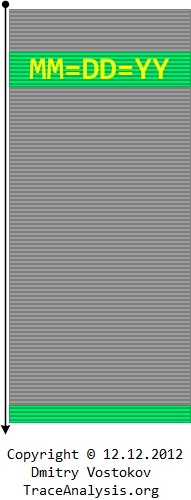
To celebrate the last unique occurrence of 12.12.12 in this Century I created a Computical Art (Computicart) picture that uses minimalist software trace analysis diagrams I use for trace and log analysis patterns made even better for Accelerated Windows Software Trace Analysis course. The following diagram symbolizes several patterns. Suppose we trace personal or world events each year and form an Adjoint Thread with messages having DD=MM=YY timestamp invariant (or filter them). Then we clearly see a Discontinuity before the next Century with much bigger Time Delta than between such messages. Also these messages form a Periodic Message Block in relation to the full trace.
- Dmitry Vostokov @ DumpAnalysis.org + TraceAnalysis.org -
Posted in Art, Computicart (Computical Art), Software Trace Analysis, Software Trace Analysis and History, Trace Analysis Patterns | No Comments »
Tuesday, December 11th, 2012
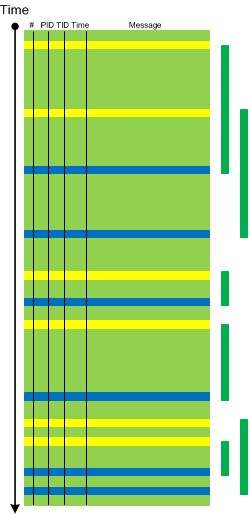
We have decided to factor out Anchor Messages example of message interleave into another pattern called Message Interleave. It covers superposition of different anchor messages, for example, process launch and exit, or DLL load and unload:
- Dmitry Vostokov @ DumpAnalysis.org + TraceAnalysis.org -
Posted in CDF Analysis Tips and Tricks, Debugging, Software Trace Analysis, Software Trace Analysis Tips and Tricks, Trace Analysis Patterns | No Comments »
Saturday, December 8th, 2012
Sometimes we don’t see anything in the trace or see very little because particular source code fragment was not covered by trace statements (see also PLOTs):
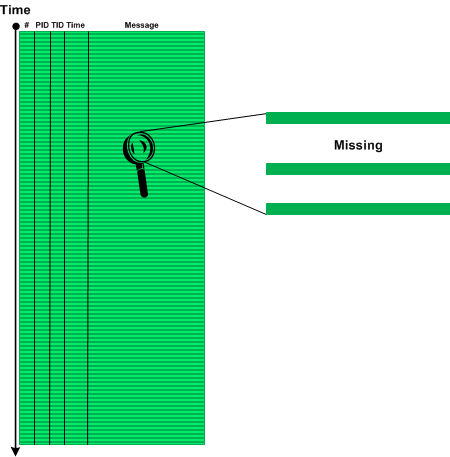
We call this pattern Sparse Trace and this is different from Missing Component pattern where some modules were not included for tracing explicitly although there is tracing code there or Visibility Limit pattern where tracing is intrinsically impossible. Often technical support and escalation engineers request to add more trace statements and software engineers extend tracing coverage iteratively as needed.
- Dmitry Vostokov @ DumpAnalysis.org + TraceAnalysis.org -
Posted in CDF Analysis Tips and Tricks, Debugging, Software Trace Analysis, Software Trace Reading, Trace Analysis Patterns | No Comments »
Sunday, November 18th, 2012
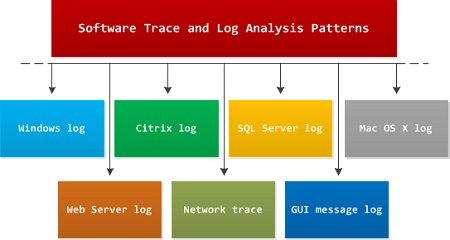
I get many questions on whether software log analysis patterns from Software Diagnostics Institute are OS or platform or product specific. My answer is that they are independent from all of them because they are based on viewing software logs as stories of computation and were discovered by application of narratological analysis (software narratology). In addition to these patterns there exist domain specific problem patterns such as wrong hotfix level or specific product error code during software installation or execution. Typical examples of support for such platform and product specific type of patterns include Microsoft Windows Problem Reporting and Citrix Auto Support.
- Dmitry Vostokov @ DumpAnalysis.org + TraceAnalysis.org -
Posted in Announcements, Debugging, Software Diagnostics, Software Narratology, Software Trace Analysis, Trace Analysis Patterns | No Comments »
Tuesday, November 13th, 2012
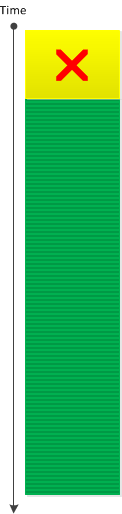
Most of the time it is not possible to trace from the beginning. Obviously, internal application tracing cannot trace anything before that application start and its early initialization. The same is for system wide tracing which cannot trace before the tracing subsystem or service starts. Therefore, each log has its Visibility Limit in addition to possible truncation or missing components:
One of solutions would be to use different tracing tools and inter-correlation to glue activities, for example, Process Monitor and CDFControl.
- Dmitry Vostokov @ DumpAnalysis.org + TraceAnalysis.org -
Posted in CDF Analysis Tips and Tricks, Software Trace Analysis, Trace Analysis Patterns | 1 Comment »
Saturday, November 3rd, 2012
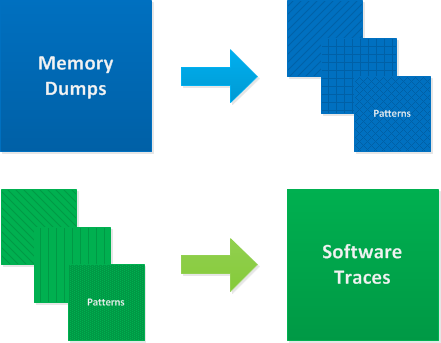
Doing memory dump analysis training for more than 2 years I found that students are divided into 2 types: those who prefer to see source code first and those who want to see a memory dump first. We actually prefer to show a memory dump first and then explore it to find certain patterns of abnormal structure and behavior. Software Diagnostics Services used this approach to design its Accelerated Windows Memory Dump Analysis and Accelerated .NET Memory Dump Analysis courses. Students explore memory dumps and debugger logs to find memory dump analysis patterns which are introduced when necessary. After that they can check source code of modeling applications if they have development experience. Accelerated Windows Software Trace Analysis course uses a different approach. It introduces all software trace analysis patterns at once because they are patterns from software narratology independent from programming languages and software platforms. After that they explore and analyze software traces and logs. We can summarize these 2 approaches on this diagram:
- Dmitry Vostokov @ DumpAnalysis.org + TraceAnalysis.org -
Posted in Crash Dump Analysis, Crash Dump Patterns, Software Diagnostics, Software Narratology, Software Trace Analysis, Trace Analysis Patterns, Training and Seminars | No Comments »
Thursday, November 1st, 2012
Relative Density pattern describes anomalies related to the semantically related pairs of trace messages, for example, “data arrival” and “data display”. Their statement densities can be put in a ratio (also called specific gravity) and compared between working and non-working scenarios. Because the total number of trace messages cancel each other we have just mutual ratio of two message types. In our hypothetical “data” example the increased ratio of “data arrival” to “data display” messages accounts for reported visual data loss and sluggish GUI.
- Dmitry Vostokov @ DumpAnalysis.org + TraceAnalysis.org -
Posted in Software Trace Analysis, Trace Analysis Patterns, UI Problem Analysis Patterns | 1 Comment »
Friday, October 26th, 2012
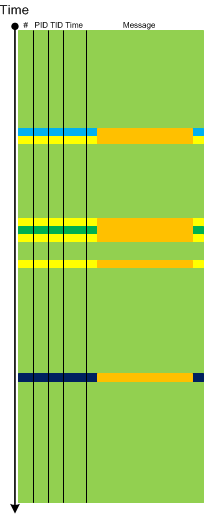
If trace messages contain some character or formatted data that is passed from module to module or between threads and processes it is possible to trace that data and form a Data Flow thread similar to an adjoint thread we have when we filter by a specific message. However, in the former case we have different message types.
- Dmitry Vostokov @ DumpAnalysis.org + TraceAnalysis.org -
Posted in Software Trace Analysis, Software Trace Reading, Trace Analysis Patterns | No Comments »
Sunday, October 21st, 2012
Empty Trace is another trivial missing pattern that we need to add to make software log analysis pattern system complete. It ranges from a totally empty trace message list where only a meta-trace header (if any) describing overall trace structure is present to a few messages where we expect thousands. This is also an extreme case of Truncated Trace, No Activity and Missing Component patterns for a trace taken as a whole. Note, that an empty trace file doesn’t necessarily have a zero file size because a tracing architecture may preallocate some file space for block data writing.
- Dmitry Vostokov @ DumpAnalysis.org + TraceAnalysis.org -
Posted in CDF Analysis Tips and Tricks, Software Technical Support, Software Trace Analysis, Trace Analysis Patterns | No Comments »
Sunday, October 21st, 2012
While working on Accelerated Windows Software Trace Analysis training I discovered some missing patterns needed for completeness despite their triviality. One of them is called Error Message. Here an error is reported either explicitly (”operation failed”) or implicitly as an operation status result such as 0xC00000XX. Sometimes, a trace message designer specifies that the number value was supplied for information only and should be ignored. Some error messages may contain information that is not relevant for the current software incident, the so called false positive errors. Some tracing architectures and tools include message information category for errors, such as Citrix CDF (ETW-based) where you filter by error category to get an adjoint thread. Note, that the association of a trace statement with an error category is left at the discretion of an engineer writing code and information category messages may contain implicit errors such as last error and return status reports.
- Dmitry Vostokov @ DumpAnalysis.org + TraceAnalysis.org -
Posted in CDF Analysis Tips and Tricks, Debugging, Software Trace Analysis, Trace Analysis Patterns | 2 Comments »
Wednesday, October 10th, 2012
The case of an error reporting fault chain led me to First Fault Stack Trace memory dump analysis pattern that corresponds to First Fault software diagnostics pattern proper. Here the term first fault is used for an exception that was either ignored by surrounding code or led to other exceptions or error message boxes with stack traces that masked the first one. Typical examples where it is sometimes possible to get a first exception stack trace include but not limited to:
It is also sometimes possible unless a stack region was paged out to get partial stack traces from execution residue when the sequence of return addresses was partially overwritten by subsequently executed code.
- Dmitry Vostokov @ DumpAnalysis.org + TraceAnalysis.org -
Posted in .NET Debugging, Crash Dump Analysis, Crash Dump Patterns, Debugging, First Fault Software Diagnostics, Software Diagnostics, Software Diagnostics Patterns, Software Trace Analysis, Trace Analysis Patterns | No Comments »