Archive for the ‘Science of Memory Dump Analysis’ Category
Friday, September 18th, 2009
The notion of transmigration of memories in Memoidealism has its similarity with Orphicism. The notions of limited (memories) and unlimited memory (Memory), and “things are memories” similar to Pythagoreanism view on Limited and Unlimited, and “things are numbers”.
- Dmitry Vostokov @ DumpAnalysis.org -
Posted in Memoidealism, Memory Religion (Memorianity), Metaphysics of Memory Worldview, Philosophy, Science of Memory Dump Analysis | No Comments »
Monday, September 7th, 2009
Consider this example mapping (taken metaphorically from the mathematical notion of an injection) of one domain of knowledge to another:
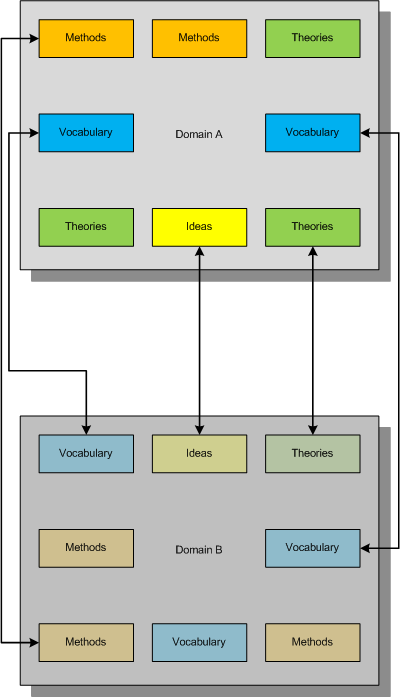
This mapping between concepts and ideas was once called “bijectivism” but was trivially described either as one to one mapping between two domains (like physical vs. mathematical) or fusing different concepts together to get another emerging concept. I myself proposed the similar mapping and called it a metaphorical bijection.
Now consider another mapping metaphorically equivalent to a mathematical notion of a surjection where all constituents of the second domain are covered metaphorically by the first domain:
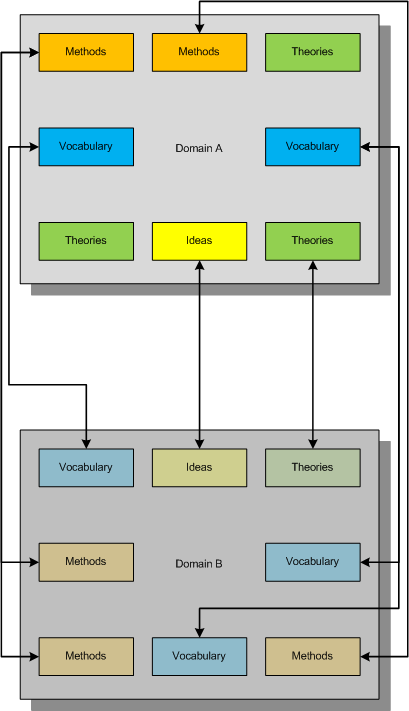
What we strive for is to establish the complete bijective mapping and reorganize our knowledge of both domains to achieve that:
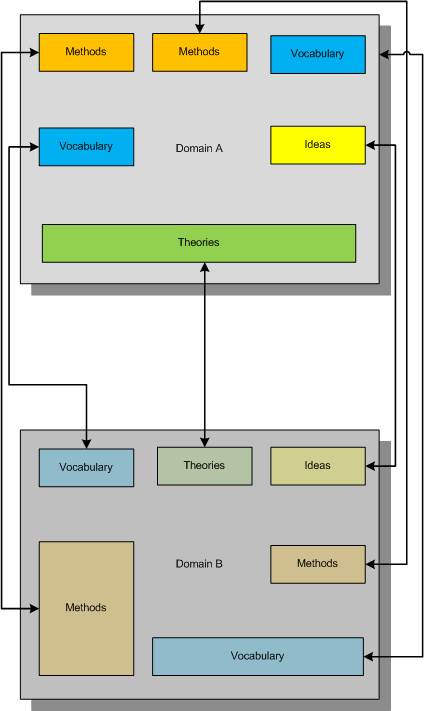
In diagrams above small boxes can represent sets of ideas, methods, etc. or individual ideas, methods, etc. The established metaphorical bijection can divide sets or combine them if needed. There can be several such bijections, of course, and we can use other methods of inquiry (for example, the scientific method) to choose between competing metaphorical bijections.
Useful mnemonic:
BEIS (B=I+S or to BE IS …)
Bijectionism Equals Injection + Surjection
Another mnemonic:
BET (B=T or to BE Transformation…)
Bijectionism Equals Transformation
Note also the second letter of Alef-Beis or Alef-Bet, the letter of Light that has interpretation of Creation in Biblical Hebrew.
More on this later as I need to come back to DebugWare patterns.
- Dmitry Vostokov @ DumpAnalysis.org -
Posted in Announcements, Memiotics (Memory Semiotics), Memoidealism, Memoretics, New Acronyms, New Words, Philosophy, Science of Memory Dump Analysis, Science of Software Tracing, Troubleshooting Methodology | 5 Comments »
Sunday, August 9th, 2009
Last week I was comparing the existing collection of memory dump analysis patterns to the collection of trace analysis patterns (in formation) in the search of isomorphism (or more correctly, general morphism) similar to Missing Component pattern. It is not a coincidence that such pattern pairs can be formed. For example, it is possible to discern deadlocks from both crash dumps and software traces (if appropriate information is available there). Fundamentally, it is implied by the definition of a software trace as some sort of a memory dump. And we can see traces in memory dumps too, for example, Execution Residue pattern. Because raw stack data resides in stack pages and in contemporary operating systems they are created from zero pages (metaphorically, out of the void) we can say that stack regions of threads are sorted by their creation time, for example, in this process user memory dump:
0:017> !runaway 4

 Elapsed Time

  Thread       Time

   0:49c       0 days 5:16:31.076

   4:4d8       0 days 5:16:30.967

   3:4d0       0 days 5:16:30.967

   2:4cc       0 days 5:16:30.967

   1:4c8       0 days 5:16:30.967

   5:4e8       0 days 5:16:30.936

   6:b6c       0 days 5:16:15.695

   7:b70       0 days 5:16:15.679

   9:b88       0 days 5:16:15.586

   8:b84       0 days 5:16:15.586

  11:348       0 days 5:16:12.934

  10:bfc       0 days 5:16:12.934

  12:1200      0 days 5:15:16.528

  15:1298      0 days 5:15:15.220

  14:1290      0 days 5:15:15.220

  13:128c      0 days 5:15:15.220

  17:12e4      0 days 5:15:13.257

  16:12dc      0 days 5:15:13.257

  18:12ec      0 days 5:15:13.117

  20:12f4      0 days 5:15:13.085

  19:12f0      0 days 5:15:13.085

  21:17a0      0 days 5:13:16.321

  22:1628      0 days 5:13:15.729

  24:1778      0 days 1:35:50.773

  23:17ec      0 days 1:35:50.773

  25:1570      0 days 1:27:54.190

  26:1724      0 days 1:27:10.151

  27:1490      0 days 0:05:46.732

  28:1950      0 days 0:02:28.153

  29:19b4      0 days 0:00:58.108

  30:177c      0 days 0:00:38.358

  31:1798      0 days 0:00:23.351

  32:1a7c      0 days 0:00:08.343
If we have complete memory dumps we can also account for other processes and their elapsed time. Within stack pages we have partial stack traces but do not have exact timing information between them except for stack frames from the current frozen thread stack trace or, if we are lucky, from a partial stack trace from the past execution. However, the timing between frames from different stacks is undefined and we can only guess it from higher level considerations like semantics of procedure calls and other information.
These considerations and the notion of a poset (partially ordered set) let me thinking about memory dumps as posets. I even created my interpretation of POSET abbreviation for this occasion:
POSET
Partially Ordered Software Execution Trace
- Dmitry Vostokov @ DumpAnalysis.org -
Posted in Crash Dump Analysis, Crash Dump Patterns, Debugging, Mathematics of Debugging, New Acronyms, Science of Memory Dump Analysis, Science of Software Tracing, Software Trace Analysis | No Comments »
Thursday, August 6th, 2009
The hierarchy of Ψ1, …, Ψ8, …, Ψ16, …, Ψ32, …, Ψ64, …, …, …, ΨΨ numbers where the subscript denotes the number of bits a memory address can have, so Ψ32 and Ψ64 are memorillion and quadrimemorillion of memory dumps respectively. We only need to figure out the meaning of Ψ0 and ΨΨ. Perhaps there is some meaning in Dirac notation here: <Ψ0|ΨΨ>. More on this later because I have to finish this week the book x64 Windows Debugging: Practical Foundations and write an errata file for the previous x86 version of the book series.
Note: Ψ is an M upside down.
- Dmitry Vostokov @ DumpAnalysis.org -
Posted in Crash Dump Analysis, Crash Dump Patterns, Fun with Crash Dumps, Futuristic Memory Dump Analysis, Intelligent Memory Movement, Psi-computation, Science of Memory Dump Analysis | No Comments »
Monday, July 27th, 2009
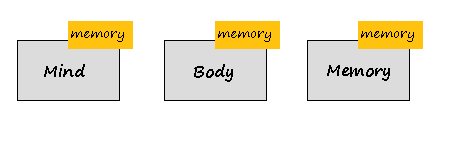
If memory is the basis of everything we might think that memoidealism is a kind of dual aspect monism or plural aspect monism, where mind, body and perhaps many other aspects are manifestations of one single memory substance. Or perhaps, memory is the same as matter or the realm of ideas (materialism or some sort of idealism), and memoidealism is the kind of monism. Or memory is the same or not the same as mind or matter and can be associated with one side of dualism. Not at all, memory is the aspect or attribute of mind, body and other substances, possibly itself. This can be illustrated on the following picture:
If there are only 2 substances then we have monistic aspect dualism as an extension of monism, for example, the extension of idealism:

or the extension of materialism (memuonic theory, memuonics):

Therefore, Memory is a substance and an aspect (attribute) at the same time. This is the essence of MAP (Monistic Aspect Pluralism).
- Dmitry Vostokov @ DumpAnalysis.org -
Posted in Memoidealism, Memuonics, New Acronyms, Philosophy, Science of Memory Dump Analysis | 3 Comments »
Tuesday, July 14th, 2009
What gives rise to intelligence in memory medium? Apparently the drive towards infinity via power set or the so called exponentiation, where patterns, subsets of memory, are combined in their totality to form even bigger memory space. Imagine how many subsets can be formed from just one complete 4Gb memory dump?
We have 232 unique byte pairs (address, value)
so we have 2232 possible subsets.
- Dmitry Vostokov @ DumpAnalysis.org -
Posted in Fun with Crash Dumps, Intelligent Memory Movement, Science of Memory Dump Analysis | No Comments »
Sunday, July 12th, 2009
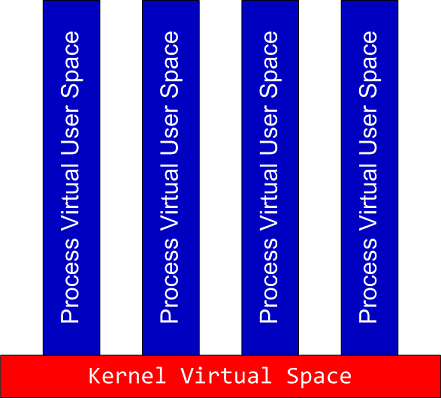
When complete memory dumps are huge (in case of x64 systems) we can dump specific processes and then force a kernel memory dump. Here we have a product of spaces similar to a fiber bundle illustrated by the following intuitive picture:
- Dmitry Vostokov @ DumpAnalysis.org -
Posted in Crash Dump Analysis, Debugging, Mathematics of Debugging, Science of Memory Dump Analysis | 1 Comment »
Thursday, July 9th, 2009
There are many books and articles titled “Large-scale Structure of X”, where X can be Space-Time, Cosmos or Universe. Here is the large-scale structure of 12Gb complete memory dump:

The image was generated with the help of ImageMagick. The dump file was interpreted as a raw RGBA image with 8-bits per color:
C:\MemoryDumps>convert -size 56751x56751 -depth 8

-resize 450x450 rgba:complete.dmp dump_12Gb_rgba_8_sq.jpg
The width and height were calculated as sqrt(filesize/4).
Complete memory dumps are physical memory dumps where modularized structure of virtual space of kernel and process memory is not expected but we see some structure nevertheless.
I’ve also created two pages with dump slices. Some viewers do not handle files with more that 32767 pixels in one dimension so I split 450×56751 slice into two:
Complete Memory Dump Slice Part 1 (11Mb JPEG)
Complete Memory Dump Slice Part 2 (10Mb JPEG)
- Dmitry Vostokov @ DumpAnalysis.org -
Posted in Art, Fun with Crash Dumps, Memory Visualization, Philosophy, Science of Memory Dump Analysis | No Comments »
Friday, June 19th, 2009
Following the meaning of DATA and memory dump world view via universal memory dumps I finally deciphered the acronym DUMP:
Digital Universal Memory Phase
This is the view from phase space perspective. From the point of phase space perspective we can also say:
Digital Universal Memory Point
It was the letter P that I was thinking hard about. Fortunately, when I opened Oxford Advanced Learner’s Dictionary on P section, it was “phase” word that grabbed my attention. Familiarity with classical physics and its Hamiltonian formulation provided the necessary glue.
- Dmitry Vostokov @ DumpAnalysis.org -
Posted in Crash Dump Analysis, Fun with Crash Dumps, New Acronyms, Philosophy, Science of Memory Dump Analysis | No Comments »
Tuesday, June 9th, 2009
I was reading General Chemistry book on the way to my office today and found a nice basic chemical formula representation for processes in memory. In this nomenclature, the class of modules developed by a particular vendor constitutes an ”element”. For example, M is for Microsoft modules, C is for Citrix modules, etc. Individual modules of particular elements are similar to “atoms” and denoted as numbers in subscript. For example, net.exe command running in a typical Citrix terminal services environment has the following loaded modules where I highlighted Citrix modules in blue and Microsoft modules in red:
0:000> lm1m

net

wdmaudhook

tzhook

twnhook

scardhook

mmhook

mfaphook

cxinjime

CtxSbxHook

MPR

NETAPI32

Secur32

USER32

msvcrt

GDI32

RPCRT4

kernel32

ADVAPI32

MSVCR71

ntdll
Therefore the formula is this:
M12C8.
I put the element of the main process module first in such formulae.
The formula for IE process from the following case study:
M126A5U
where A is for Adobe modules and U is for an unknown module that needs identification, see Unknown Component pattern.
These formulas can useful to highlight various hooksware components and distinguish memory dumps generated after eliminating modules for troubleshooting and debugging purposes. It also forms the basis for one of many classificatory schemes for the purposes of micro- and macro-taxonomy of software discussed in the forthcoming book:
The Variety of Software: The Richness of Computation (ISBN: 978-1906717544)
In the forthcoming parts I’m also going to discuss the structural formulas as well, similar to the ones used in organic chemistry.
- Dmitry Vostokov @ DumpAnalysis.org -
Posted in Announcements, Chemistry, Crash Dump Analysis, Fun with Crash Dumps, Science of Memory Dump Analysis | No Comments »
Friday, June 5th, 2009
Quantum computation, quantum memory and quantum information are hot topics today. Unfortunately quantum mechanics forbids perfect (ideal) memory dumps due to the so called no cloning theorem. Still it is possible to get inconsistent (imperfect) memory dumps and perfect memory dumps can be made from quantum computer simulators. The analysis of quantum memory snapshots is the domain of Quantum Memoretics.
- Dmitry Vostokov @ DumpAnalysis.org -
Posted in Crash Dump Analysis, Debugging, Memoretics, Science of Memory Dump Analysis | No Comments »
Saturday, May 23rd, 2009
Universal memory dumps come from astronomical observations:
Dumps “are meaningless without” symbols “to interpret them.”
Raymond Arthur Lyttleton, Quoted in Astroparticle Physics, page 50
- Dmitry Vostokov @ DumpAnalysis.org -
Posted in Bugtations, Crash Dump Analysis, Crash Dumps for Dummies, Debugging, Minidump Analysis, Philosophy, Science of Memory Dump Analysis, Software Technical Support | No Comments »
Monday, May 4th, 2009
On universal memory dumps:
“[…] the first man who noticed the analogy between a” dump “and” an observation “made a notable advance in the history of thought.”
Alfred North Whitehead, Science and the Modern World
- Dmitry Vostokov @ DumpAnalysis.org -
Posted in Bugtations, Crash Dump Analysis, Crash Dump Patterns, Debugging, Memoidealism, Philosophy, Science of Memory Dump Analysis | No Comments »
Friday, May 1st, 2009
Urstoff of Anaximenes is Air much like Memory in memoidealism. How do concrete objects develop from invisible Air? Through the process of condensation and rarefaction, quality arises from quantity (reduction process). Eternity of Urstoff is one of the main features of Milesian philosophers and memory religion. No additional worlds are possible in their philosophies. They are “materialists” because of their material Urstoff. Memoidealists are “idealists” because of their ideal notion of Memory.
- Dmitry Vostokov @ DumpAnalysis.org -
Posted in Memoidealism, Memory Religion (Memorianity), Metaphysics of Memory Worldview, Philosophy, Science of Memory Dump Analysis | No Comments »
Wednesday, April 29th, 2009
Indeterminate infinite Urstoff, out of which emerges the plurality of worlds that come and go, is the foundation of Anaximander philosophy. In memoidealism, Memory is indeterminate in the sense that it doesn’t represent determinate material substance. It is actually infinite too. The crucial feature of memoidealistic notion of memory is the fact that coming into existence plurality doesn’t perish. It is saved. In some sense Memory is apeiron of memoidealism.
- Dmitry Vostokov @ DumpAnalysis.org -
Posted in Memoidealism, Metaphysics of Memory Worldview, Philosophy, Science of Memory Dump Analysis | No Comments »
Monday, April 27th, 2009
Memoidealism is characterized by the unity of philosophy and (computer) science. It has deep roots in practical memory (dump) analysis. The interpretation of observations as memory snapshots (universal memory dumps) leads to the declaration of Memory to be the One (or the First Principle) like Water in Thales practical scientific philosophy. We also observe that processes are memory snapshots as well, through their observational data. We try to understand the plurality of experiences through the unity of memory (the so called Unity in Difference).
- Dmitry Vostokov @ DumpAnalysis.org -
Posted in Memoidealism, Metaphysics of Memory Worldview, Philosophy, Science of Memory Dump Analysis | No Comments »
Wednesday, April 22nd, 2009
If we assume the model-based definition of software defects we can easily see that any changes to an underlying model can surface the new unanticipated defects and hide the known ones. New and evolving disciplines like software security engineering can change our views about solid code and create defects by introducing non-functional constraints on models. Another aspect of this is the interaction of a human debugger with code, the very act of reading code can create defects. However the latter effect is controversial and belongs to the evolving quantum theory of software defects (see my previous post about bugtanglement).
- Dmitry Vostokov @ DumpAnalysis.org -
Posted in Debugging, Philosophy, Science of Memory Dump Analysis, Security | No Comments »
Thursday, April 16th, 2009
A number of Copernican revolutions occurred or announced in various branches of various sciences. Now it’s my turn to say that action-based ”earth-centric” debugging is replaced by memory (dump) analysis as a “heliocentric” foundation of debugging. Because even in live debugging we have memory snapshots and differential memory analysis. Traces in trace-based debugging is another example of universal memory dumps. Therefore memory (dump) analysis comes first.
- Dmitry Vostokov @ DumpAnalysis.org -
Posted in Crash Dump Analysis, Debugging, Philosophy, Science of Memory Dump Analysis | No Comments »
Sunday, March 29th, 2009
Previously announced Memory Analysis and Debugging Institute was registered in the Republic of Ireland (No. 382026) last week.
- Dmitry Vostokov @ DumpAnalysis.org -
Posted in Announcements, Crash Dump Analysis, Debugging, Education and Research, History, Memory Analysis Forensics and Intelligence, Memory Visualization, Philosophy, Riemann Programming Language, Science of Memory Dump Analysis, Security, Software Technical Support, Testing, Training and Seminars | No Comments »
Tuesday, March 24th, 2009
In this part we start our discussion of Urstoff (Ger.), the primitive, primordial and basic element of everything and relation of memoidealism to Ionian school. In memoidealism, Memory serves the role of Urstoff as permanent primary element behind the process of state transition changes (technically speaking). In contrast, Ionians considered Urstoff to be of a material nature, for example, air (Anaximenes), fire (Heraclitus) or water (Thales). This abstraction (abstract materialism) of material elements parallels memory abstraction in memoidealism. Another parallel is the unity of science and philosophy.
- Dmitry Vostokov @ DumpAnalysis.org -
Posted in Memoidealism, Memory Religion (Memorianity), Metaphysics of Memory Worldview, Philosophy, Science of Memory Dump Analysis | 2 Comments »