What is a Software Defect?
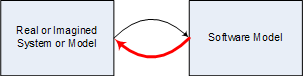
Software can be considered as models of real or imagined systems which may be models themselves. Any modeling act involves a mapping between a system and a model that preserves causal, ordering and inclusion relationships and a mapping from the model to the system that translates emerging relationships and causal structures back to that system. The latter I call modeling expectations and any observed deviations in structure and behavior between the model and the system I call software defects which can be functional failures, error messages, crashes or hangs (red line on diagrams below):
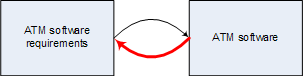
Consider ATM software as a venerable example. It models imagined world of ATM transactions which we call ATM software requirements. The latter specifies ACID (atomic, consistent, isolated and durable) transaction rules. If they are broken by the written software we have the defect:
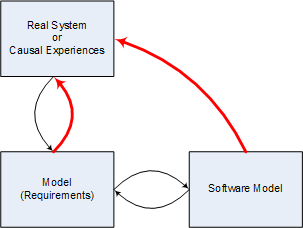
What are software requirements? They are models of real or imagined systems or can be models of past causal and relationship experiences. If requirements are wrong they do not translate back and we still consider software as having a defect:
Translating this to ATM example we have:
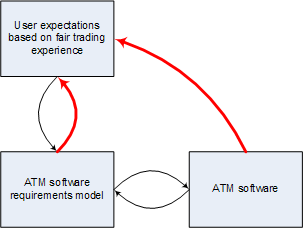
Another example where the perceived absence of failures can be considered as a defect is the program designed to model memory leaks that might not be leaking due to a defect in its source code.
Now we can answer the question ”What is a memory corruption?” which is the topic of the next post.
- Dmitry Vostokov @ DumpAnalysis.org -
April 22nd, 2009 at 10:37 am
[…] - The Year of Dump Analysis 2011 (0×7DB) - 2020 (0×7E4) The Debugging Decade If we adopt the model-based definition of software defects we can easily see that any changes to the model can surface the new unanticipated defects and […]
September 28th, 2009 at 2:38 pm
[…] was recently revisiting my old post about model-based definition of software defects in relation to their forthcoming classification. When thinking I recalled a three worlds diagram […]