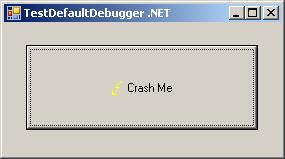
.NET programs also crash either from defects in .NET runtime (Common Language Runtime, CLR) or from non-handled runtime exceptions in managed code executed by .NET virtual machine. The latter exceptions are re-thrown from .NET runtime to be handled by operating system and intercepted by native debuggers. Therefore our next crash dump analysis pattern is called Managed Code Exception.
When you get a dump from .NET application it is the dump from a native process. !analyze -v output can usually tell you that exception is actually CLR exception and give you other hints to look at managed code stack (CLR stack):
FAULTING_IP:

kernel32!RaiseException+53

77e4bee7 5e              pop     esi
EXCEPTION_RECORD:  ffffffff -- (.exr 0xffffffffffffffff)

ExceptionAddress: 77e4bee7 (kernel32!RaiseException+0x00000053)

   ExceptionCode: e0434f4d (CLR exception)

   ExceptionFlags: 00000001

NumberParameters: 1

   Parameter[0]: 80131604
DEFAULT_BUCKET_ID: CLR_EXCEPTION
PROCESS_NAME: mmc.exe
ERROR_CODE: (NTSTATUS) 0xe0434f4d - <Unable to get error code text>
MANAGED_STACK: !dumpstack -EE

No export dumpstack found
STACK_TEXT:

05faf3d8 79f97065 e0434f4d 00000001 00000001 kernel32!RaiseException+0x53

WARNING: Stack unwind information not available. Following frames may be wrong.

05faf438 7a0945a4 023f31e0 00000000 00000000 mscorwks!DllCanUnloadNowInternal+0×37a9

05faf4fc 00f2f00a 02066be4 02085ee8 023d0df0 mscorwks!CorLaunchApplication+0×12005

05faf500 02066be4 02085ee8 023d0df0 023d0e2c 0xf2f00a

05faf504 02085ee8 023d0df0 023d0e2c 05e00dfa 0×2066be4

05faf508 023d0df0 023d0e2c 05e00dfa 023d0e10 0×2085ee8

05faf50c 023d0e2c 05e00dfa 023d0e10 05351d30 0×23d0df0

05faf510 05e00dfa 023d0e10 05351d30 023d0e10 0×23d0e2c
FOLLOWUP_IP:

mscorwks!DllCanUnloadNowInternal+37a9

79f97065 c745fcfeffffff  mov     dword ptr [ebp-4],0FFFFFFFEh
SYMBOL_NAME: mscorwks!DllCanUnloadNowInternal+37a9
MODULE_NAME: mscorwks
IMAGE_NAME: mscorwks.dll
PRIMARY_PROBLEM_CLASS: CLR_EXCEPTION
BUGCHECK_STR: APPLICATION_FAULT_CLR_EXCEPTION
Sometimes you can see mscorwks.dll on raw stack or see it loaded and find it on other thread stacks than the current one.
When you get such hints you might want to get managed code stack as well. First you need to load the appropriate WinDbg SOS extension (Son of Strike) corresponding to .NET runtime version. This can be done by the following command:
0:015> .loadby sos mscorwks
You can check which SOS extension version was loaded this by using .chain command:
0:015> .chain

Extension DLL search Path:

...

...

...

Extension DLL chain:

    C:\WINDOWS\Microsoft.NET\Framework\v2.0.50727\sos: image 2.0.50727.42, API 1.0.0, built Fri Sep 23 08:27:26 2005

        [path: C:\WINDOWS\Microsoft.NET\Framework\v2.0.50727\sos.dll]

    dbghelp: image 6.6.0007.5, API 6.0.6, built Sat Jul 08 21:11:32 2006

        [path: C:\Program Files\Debugging Tools for Windows\dbghelp.dll]

    ext: image 6.6.0007.5, API 1.0.0, built Sat Jul 08 21:10:52 2006

        [path: C:\Program Files\Debugging Tools for Windows\winext\ext.dll]

    exts: image 6.6.0007.5, API 1.0.0, built Sat Jul 08 21:10:48 2006

        [path: C:\Program Files\Debugging Tools for Windows\WINXP\exts.dll]

    uext: image 6.6.0007.5, API 1.0.0, built Sat Jul 08 21:11:02 2006

        [path: C:\Program Files\Debugging Tools for Windows\winext\uext.dll]

    ntsdexts: image 6.0.5457.0, API 1.0.0, built Sat Jul 08 21:29:38 2006

        [path: C:\Program Files\Debugging Tools for Windows\WINXP\ntsdexts.dll]
Then you can use !dumpstack to dump the current stack or !EEStack command to dump all thread stacks. The native stack trace would be mixed with managed stack trace:
0:015> !dumpstack

OS Thread Id: 0x16e8 (15)

Current frame: kernel32!RaiseException+0x53

ChildEBP RetAddr Caller,Callee

05faf390 77e4bee7 kernel32!RaiseException+0x53, calling ntdll!RtlRaiseException

05faf3a8 79e814da mscorwks!Binder::RawGetClass+0x23, calling mscorwks!Module::LookupTypeDef

05faf3bc 79e87ff4 mscorwks!Binder::IsClass+0x21, calling mscorwks!Binder::RawGetClass

05faf3c8 79f958b8 mscorwks!Binder::IsException+0x13, calling mscorwks!Binder::IsClass

05faf3d8 79f97065 mscorwks!RaiseTheExceptionInternalOnly+0x226, calling kernel32!RaiseException

05faf438 7a0945a4 mscorwks!JIT_Throw+0xd0, calling mscorwks!RaiseTheExceptionInternalOnly

05faf4ac 7a0944ea mscorwks!JIT_Throw+0x1e, calling mscorwks!LazyMachStateCaptureState

05faf4c8 793d424e (MethodDesc 0x7924ad68 +0x2e System.Threading.WaitHandle.WaitOne(Int64, Boolean)), calling mscorwks!WaitHandleNative::CorWaitOneNative

05faf4fc 00f2f00a (MethodDesc 0x4f97500 +0x9a Ironring.Management.MMC.SnapinBase+MmcWindow.Invoke(System.Delegate, System.Object[])), calling mscorwks!JIT_Throw

05faf510 05e00dfa (MethodDesc 0×4f98fd8 +0xca MyNamespace.MyClass.MyMethod(Boolean)), calling 05fc7124

05faf55c 00f62fbc (MethodDesc 0×4f95f90 +0×16f4 MyNamespace.MyClass.MyMethod.Initialise(System.Object))

05faf740 793d912f (MethodDesc 0×7925fc70 +0×2f System.Threading._ThreadPoolWaitCallback.WaitCallback_Context(System.Object))

05faf748 793683dd (MethodDesc 0×7913f3d0 +0×81 System.Threading.ExecutionContext.Run(System.Threading.ExecutionContext, System.Threading.ContextCallback, System.Object))

05faf75c 793d9218 (MethodDesc 0×7925fc80 +0×6c System.Threading._ThreadPoolWaitCallback.PerformWaitCallback(System.Object)), calling (MethodDesc 0×7913f3d0 +0 System.Threading.ExecutionContext.Run(System.Threading.ExecutionContext, System.Threading.ContextCallback, System.Object))

05faf774 79e88f63 mscorwks!CallDescrWorker+0×33

05faf784 79e88ee4 mscorwks!CallDescrWorkerWithHandler+0xa3, calling mscorwks!CallDescrWorker

05faf804 79f20212 mscorwks!DispatchCallBody+0×1e, calling mscorwks!CallDescrWorkerWithHandler

05faf824 79f201bc mscorwks!DispatchCallDebuggerWrapper+0×3d, calling mscorwks!DispatchCallBody

05faf888 79f2024b mscorwks!DispatchCallNoEH+0×51, calling mscorwks!DispatchCallDebuggerWrapper

05faf8bc 7a07bdf0 mscorwks!Holder,2>::~Holder,2>+0xbb, calling mscorwks!DispatchCallNoEH

05faf90c 77e61d1e kernel32!WaitForSingleObjectEx+0xac, calling ntdll!ZwWaitForSingleObject

05faf91c 79ecb4a4 mscorwks!Thread::UserResumeThread+0xfb

05faf92c 79ecb442 mscorwks!Thread::DoADCallBack+0×355, calling mscorwks!Thread::UserResumeThread+0xae

05faf950 79e74afe mscorwks!Thread::EnterRuntimeNoThrow+0×9b, calling mscorwks!_EH_epilog3

05faf988 79e77fe8 mscorwks!PEImage::LoadImage+0×1e1, calling mscorwks!_SEH_epilog4

05faf9c0 79ecb364 mscorwks!Thread::DoADCallBack+0×541, calling mscorwks!Thread::DoADCallBack+0×2a5

05faf9fc 7a0e1b7e mscorwks!Thread::DoADCallBack+0×575, calling mscorwks!Thread::DoADCallBack+0×4d4

05fafa24 7a0e1bab mscorwks!ManagedThreadBase::ThreadPool+0×13, calling mscorwks!Thread::DoADCallBack+0×550

05fafa38 7a07cae8 mscorwks!QueueUserWorkItemCallback+0×9d, calling mscorwks!ManagedThreadBase::ThreadPool

05fafa54 7a07ca48 mscorwks!QueueUserWorkItemCallback, calling mscorwks!UnwindAndContinueRethrowHelperAfterCatch

05fafa90 7a110f08 mscorwks!ThreadpoolMgr::ExecuteWorkRequest+0×40

05fafaa8 7a112328 mscorwks!ThreadpoolMgr::WorkerThreadStart+0×1f2, calling mscorwks!ThreadpoolMgr::ExecuteWorkRequest

05fafad0 79e7839d mscorwks!EEHeapFreeInProcessHeap+0×21, calling mscorwks!EEHeapFree

05fafae0 79e782dc mscorwks!operator delete[]+0×30, calling mscorwks!EEHeapFreeInProcessHeap

05fafb14 79ecb00b mscorwks!Thread::intermediateThreadProc+0×49

05fafb48 77e65512 kernel32!FlsSetValue+0xc7, calling kernel32!_SEH_epilog

05fafb6c 75da14d0 sxs!_calloc_crt+0×19, calling sxs!calloc

05fafb80 77e65512 kernel32!FlsSetValue+0xc7, calling kernel32!_SEH_epilog

05fafb88 75da1401 sxs!_CRT_INIT+0×17e, calling sxs!_initptd

05fafb8c 75da1408 sxs!_CRT_INIT+0×185, calling kernel32!GetCurrentThreadId

05fafb9c 30403805 MMCFormsShim!DllMain+0×15, calling MMCFormsShim!PrxDllMain

05fafbb0 30418b69 MMCFormsShim!__DllMainCRTStartup+0×7a, calling MMCFormsShim!DllMain

05fafbdc 75de0e4c sxs!_SxsDllMain+0×87, calling sxs!DllStartup_CrtInit

05fafbf0 30418bf9 MMCFormsShim!__DllMainCRTStartup+0×10a, calling MMCFormsShim!__SEH_epilog4

05fafbf4 30418c22 MMCFormsShim!_DllMainCRTStartup+0×1d, calling MMCFormsShim!__DllMainCRTStartup

05fafbfc 7c81a352 ntdll!LdrpCallInitRoutine+0×14

05fafc24 7c82ee8b ntdll!LdrpInitializeThread+0×1a5, calling ntdll!RtlLeaveCriticalSection

05fafc2c 7c82edec ntdll!LdrpInitializeThread+0×18f, calling ntdll!_SEH_epilog

05fafc7c 7c82ed71 ntdll!LdrpInitializeThread+0xd8, calling ntdll!RtlActivateActivationContextUnsafeFast

05fafc80 7c82ed35 ntdll!LdrpInitializeThread+0×12c, calling ntdll!RtlDeactivateActivationContextUnsafeFast

05fafcb4 7c82edec ntdll!LdrpInitializeThread+0×18f, calling ntdll!_SEH_epilog

05fafcb8 7c827c3b ntdll!NtTestAlert+0xc

05fafcbc 7c82ecb1 ntdll!_LdrpInitialize+0×1de, calling ntdll!_SEH_epilog

05fafd10 7c82ecb1 ntdll!_LdrpInitialize+0×1de, calling ntdll!_SEH_epilog

05fafd14 7c826d9b ntdll!NtContinue+0xc

05fafd18 7c8284da ntdll!KiUserApcDispatcher+0×3a, calling ntdll!NtContinue

05faffa4 79ecaff9 mscorwks!Thread::intermediateThreadProc+0×37, calling mscorwks!_alloca_probe_16

05faffb8 77e64829 kernel32!BaseThreadStart+0×34
.NET language symbolic names are usually reconstructed from .NET assembly metadata.
You can examine a CLR exception and get managed stack trace by using !PrintException and !CLRStack commands, for example:
0:014> !PrintException

Exception object: 02320314

Exception type: System.Reflection.TargetInvocationException

Message: Exception has been thrown by the target of an invocation.

InnerException: System.Runtime.InteropServices.COMException, use !PrintException 023201a8 to see more

StackTrace (generated):

    SP       IP       Function

    075AF4FC 016BFD9A Ironring.Management.MMC.SnapinBase+MmcWindow.Invoke(System.Delegate, System.Object[])

    ...

    ...

    ...

    075AF740 793D87AF System.Threading._ThreadPoolWaitCallback.WaitCallback_Context(System.Object)

    075AF748 793608FD System.Threading.ExecutionContext.Run(System.Threading.ExecutionContext, System.Threading.ContextCallback, System.Object)

    075AF760 793D8898 System.Threading._ThreadPoolWaitCallback.PerformWaitCallback(System.Object)
StackTraceString: <none>

HResult: 80131604
0:014> !PrintException 023201a8

Exception object: 023201a8

Exception type: System.Runtime.InteropServices.COMException

Message: Error HRESULT E_FAIL has been returned from a call to a COM component.

InnerException: <none>

StackTrace (generated):

    SP       IP       Function

    00000000 00000001 Ironring.Management.MMC.IMMCFormsShim.HostUserControl3(System.Object, System.Object, System.String, System.String, Int32, Int32)

    0007F724 073875B9 Ironring.Management.MMC.FormNode.SetShimControl(System.Object)

    0007F738 053D9DDE Ironring.Management.MMC.FormNode.set_ControlType(System.Type)

    ...

    ...

    ...
StackTraceString: <none>

HResult: 80004005
0:014> !CLRStack

OS Thread Id: 0x11ec (14)

ESP       EIP

075af4fc 016bfd9a Ironring.Management.MMC.SnapinBase+MmcWindow.Invoke(System.Delegate, System.Object[])

...

...

...

075af740 793d87af System.Threading._ThreadPoolWaitCallback.WaitCallback_Context(System.Object)

075af748 793608fd System.Threading.ExecutionContext.Run(System.Threading.ExecutionContext, System.Threading.ContextCallback, System.Object)

075af760 793d8898 System.Threading._ThreadPoolWaitCallback.PerformWaitCallback(System.Object)

075af8f0 79e7be1b [GCFrame: 075af8f0]
!help command gives the list of other available SOS extension commands:
0:014> !help
Object Inspection
DumpObj (do)

DumpArray (da)

DumpStackObjects (dso)

DumpHeap

DumpVC

GCRoot

ObjSize

FinalizeQueue

PrintException (pe)

TraverseHeap
Examining code and stacks
Threads

CLRStack

IP2MD

U

DumpStack

EEStack

GCInfo

EHInfo

COMState

BPMD
Examining CLR data structures
DumpDomain

EEHeap

Name2EE

SyncBlk

DumpMT

DumpClass

DumpMD

Token2EE

EEVersion

DumpModule

ThreadPool

DumpAssembly

DumpMethodSig

DumpRuntimeTypes

DumpSig

RCWCleanupList

DumpIL
Diagnostic Utilities
VerifyHeap

DumpLog

FindAppDomain

SaveModule

GCHandles

GCHandleLeaks

VMMap

VMStat

ProcInfo

StopOnException (soe)

MinidumpMode
Other
FAQ
If you are new to .NET and interested in .NET debugging I would recommend 3 books:
Essential .NET, Volume I: The Common Language Runtime


Debugging Microsoft .NET 2.0 Applications

Advanced .NET Debugging

Expert .NET 2.0 IL Assembler

- Dmitry Vostokov @ DumpAnalysis.org -