Microsoft gives sneak preview of Debugging Studio
Tuesday, April 1st, 2008This looks really cool:
http://www.microsoft.com/whdc/devstudio/default.mspx
- Dmitry Vostokov @ DumpAnalysis.org -
This looks really cool:
http://www.microsoft.com/whdc/devstudio/default.mspx
- Dmitry Vostokov @ DumpAnalysis.org -
This is an attempt to revive the forum closed a year ago due to the lack of interest during that time. Now the number of visitors has increased by an order of magnitude and I get more and more requests to help with crash dump analysis but I cannot guarantee immediate response. Therefore I upgraded and reopened Crash Dump Analysis and Debugging Forum and encourage using it. In order to prevent spammers gaining access any new registration has to be approved by me (usually in less than 24 hours).
- Dmitry Vostokov @ DumpAnalysis.org -
Just a short note. Suppose we have a complete memory dump and we want to check critical sections to see any anomalies. We can do this by using !for_each_process extension command:
0: kd> !for_each_process ".process /r /p @#Process; !ntsdexts.locks"
Implicit process is now a59a4648
Loading User Symbols
NTSDEXTS: Unable to resolve ntdll!RtlCriticalSectionList
NTSDEXTS: Please check your symbols
Implicit process is now a553cd88
Loading User Symbols
....
Scanned 11 critical sections
Implicit process is now a518b1b0
Loading User Symbols
....
Scanned 105 critical sections
Implicit process is now a513a348
Loading User Symbols
....
Scanned 977 critical sections
Implicit process is now a5659d88
Loading User Symbols
....
Scanned 438 critical sections
Implicit process is now a551abb8
Loading User Symbols
....
...
...
...
...
Here the first NTSDEXTS warning is normal because we don’t have user space for System process.
- Dmitry Vostokov @ DumpAnalysis.org -
Sometimes we have processes that actively monitor debugger attachments to prevent reverse engineering and terminate themselves if such attempts are detected. Some of them use very simple methods to achieve this like creating a thread that periodically calls IsDebuggerPresent API or waits for debugger events. In such cases attempts of any application to actively attach to these processes result in their termination.
Consider the following stack trace from the postmortem crash dump saved by NTSD on Windows Server 2003:
0:000> kL
ChildEBP RetAddr
00fefbcc 098b84a1 kernel32!RaiseException+0x53
...
...
...
00fefd28 0116a86a component!_CRT_INIT+0x187
00fefd6c 0116a8e6 component!__DllMainCRTStartup+0xb7
00fefd74 7c81a352 component!_DllMainCRTStartup+0x1d
00fefd94 7c830e70 ntdll!LdrpCallInitRoutine+0x14
00fefe4c 77e668a3 ntdll!LdrShutdownProcess+0x182
00feff38 77e66905 kernel32!_ExitProcess+0x43
00feff4c 00561ab9 kernel32!ExitProcess+0x14
00feffb8 77e64829 application!foo+0x41
00feffec 00000000 kernel32!BaseThreadStart+0x34
Disassembling application!foo shows the call to WaitForDebugEvent API:
0:000> u application!foo
application!foo:
00561a78 push ebp
00561a79 mov ebp,esp
00561a7b sub esp,60h
00561a7e push 0FFFFFFFFh
00561a80 lea eax,[ebp-60h]
00561a83 push eax
00561a84 call dword ptr [application!_imp__WaitForDebugEvent (00655224)]
00561a8a mov eax,dword ptr [ebp+8]
We also see it on the raw stack which might also help in more complex cases:
0:000> !teb
TEB at 7ffdd000
ExceptionList: 00fefbf8
StackBase: 00ff0000
StackLimit: 00fef000
SubSystemTib: 00000000
FiberData: 00001e00
ArbitraryUserPointer: 00000000
Self: 7ffdd000
EnvironmentPointer: 00000000
ClientId: 000063fc . 00003270
RpcHandle: 00000000
Tls Storage: 00000000
PEB Address: 7ffdb000
LastErrorValue: 0
LastStatusValue: c0000034
Count Owned Locks: 0
HardErrorMode: 0
0:000> dds 00fef000 00ff0000
...
...
...
00fefecc 00000000
00fefed0 00feff48
00fefed4 77e9c4d7 kernel32!WaitForDebugEvent+0×66
00fefed8 c0000008
00fefedc 00000000
00fefee0 77e41ef3 kernel32!SleepEx+0×91
00fefee4 00000000
00fefee8 00000000
…
…
…
How would we find what process was trying to attach to our application? Let’s go with pure crash dump analysis approach. We can take the advantage of RaiseException call and get a kernel or a complete memory dump to examine all running processes and their threads. In order to model this I created a small program that simulates the behavior shown above:
// IsDebuggerPresent64
#include "stdafx.h"
#include "windows.h"
int _tmain(int argc, _TCHAR* argv[])
{
while (1)
{
IsDebuggerPresent()
? puts ("Yes"),
RaiseException(0x12345678,
0, 0, NULL)
: puts ("No");
Sleep(5000);
}
return 0;
}
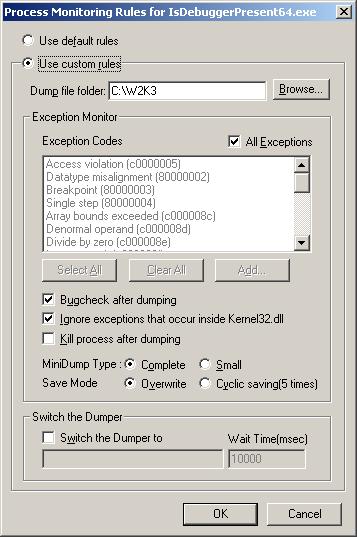
Then I configured Process Monitoring Rules in Userdump Process Dumper Control Panel applet to bugcheck the system after dumping:
Then I asked one of my friends to debug the running instance of that application and let me know if there was any sudden BSOD. Indeed there was one and I got my complete memory dump (although kernel dump would suffice here). Let’s look at it.
We see that our process has an open debug port and its main thread is suspended:
kd> !process /r /p fffffadfe73f9c20
PROCESS fffffadfe73f9c20
SessionId: 0 Cid: 0e4c Peb: 7fffffd4000 ParentCid: 0e54
DirBase: 2c472000 ObjectTable: fffffa80006f1690 HandleCount: 12.
Image: IsDebuggerPresent64.exe
VadRoot fffffadfe6ef3e30 Vads 26 Clone 0 Private 97. Modified 0. Locked 0.
DeviceMap fffffa8000930540
Token fffffa80030e7910
ElapsedTime 00:00:03.062
UserTime 00:00:00.000
KernelTime 00:00:00.000
QuotaPoolUsage[PagedPool] 16288
QuotaPoolUsage[NonPagedPool] 3488
Working Set Sizes (now,min,max) (1322, 50, 345) (5288KB, 200KB, 1380KB)
PeakWorkingSetSize 1322
VirtualSize 7 Mb
PeakVirtualSize 7 Mb
PageFaultCount 1314
MemoryPriority BACKGROUND
BasePriority 8
CommitCharge 107
DebugPort fffffadfe6ec9040
THREAD fffffadfe69a2bf0 Cid 0e4c.0e74 Teb: 000007fffffde000 Win32Thread: 0000000000000000 WAIT: (Unknown) KernelMode Non-Alertable
SuspendCount 1
fffffadfe69a2e90 Semaphore Limit 0×2
Not impersonating
DeviceMap fffffa8000930540
Owning Process fffffadfe73f9c20 Image: IsDebuggerPresent64.exe
Wait Start TickCount 37247 Ticks: 49 (0:00:00:00.765)
Context Switch Count 45
UserTime 00:00:00.000
KernelTime 00:00:00.000
Win32 Start Address IsDebuggerPresent64 (0×00000001400013b0)
Start Address kernel32!BaseProcessStart (0×0000000077d59620)
Stack Init fffffadfdf7b5e00 Current fffffadfdf7b54f0
Base fffffadfdf7b6000 Limit fffffadfdf7b0000 Call 0
Priority 12 BasePriority 8 PriorityDecrement 2
Child-SP RetAddr Call Site
fffffadf`df7b5530 fffff800`0103b063 nt!KiSwapContext+0x85
fffffadf`df7b56b0 fffff800`0103c403 nt!KiSwapThread+0xc3
fffffadf`df7b56f0 fffff800`0105dc7c nt!KeWaitForSingleObject+0x528
fffffadf`df7b5780 fffff800`0105db2b nt!KiSuspendThread+0x2c
fffffadf`df7b57c0 fffff800`01058e71 nt!KiDeliverApc+0x20a
fffffadf`df7b5840 fffff800`0103c403 nt!KiSwapThread+0xde
fffffadf`df7b5880 fffffadf`dfd4a20c nt!KeWaitForSingleObject+0x528
fffffadf`df7b5910 fffffadf`dfd4a3be userdump!UdpCompleteExceptionForwarding+0x11c
fffffadf`df7b5990 fffffadf`dfd49dd8 userdump!UdpForwardException+0x13e
fffffadf`df7b59c0 fffff800`012ce9cf userdump!UdIoctl+0x618
fffffadf`df7b5a70 fffff800`012df026 nt!IopXxxControlFile+0xa5a
fffffadf`df7b5b90 fffff800`010410fd nt!NtDeviceIoControlFile+0x56
fffffadf`df7b5c00 00000000`77ef0a5a nt!KiSystemServiceCopyEnd+0x3 (TrapFrame @ fffffadf`df7b5c70)
If we search for a process that has NtWaitForDebugEvent function present on one of its stack traces we would find the debugger:
kd> !stacks 2 nt!NtWaitForDebugEvent
...
...
...
[fffffadfe63da3b0 ntsd.exe]
e54.000e50 fffffadfe6afbbf0 ffff6e8a Blocked nt!KiSwapContext+0×85
nt!KiSwapThread+0xc3
nt!KeWaitForSingleObject+0×528
nt!NtWaitForDebugEvent+0×342
nt!KiSystemServiceCopyEnd+0×3
ntdll!ZwWaitForDebugEvent+0xa
dbgeng!LiveUserDebugServices::WaitForEvent+0xee
dbgeng!LiveUserTargetInfo::WaitForEvent+0×488
dbgeng!RawWaitForEvent+0×23c
dbgeng!DebugClient::WaitForEvent+0×96
ntsd!MainLoop+0xb7
ntsd!main+0×18e
ntsd!mainCRTStartup+0×171
kernel32!BaseProcessStart+0×29
We see that it is NTSD.
- Dmitry Vostokov @ DumpAnalysis.org -
The case when a function pointer or a return address becomes a Wild Pointer and EIP or RIP value lies in a valid region of memory the execution path may continue through a region called Wild Code. This might loop on itself or eventually reach non-executable or invalid pages and produce an exception. Local Buffer Overflow might lead to this behavior and also data corruption that overwrites function pointers with valid memory addresses.
My favorite example is when a function pointer points to zeroed pages with EXECUTE page attribute. What will happen next when we dereference it? All zeroes are perfect x86/x64 code:
0:001> dd 0000000`771afdf0
00000000`771afdf0 00000000 00000000 00000000 00000000
00000000`771afe00 00000000 00000000 00000000 00000000
00000000`771afe10 00000000 00000000 00000000 00000000
00000000`771afe20 00000000 00000000 00000000 00000000
00000000`771afe30 00000000 00000000 00000000 00000000
00000000`771afe40 00000000 00000000 00000000 00000000
00000000`771afe50 00000000 00000000 00000000 00000000
00000000`771afe60 00000000 00000000 00000000 00000000
0:001> u
ntdll!DbgUserBreakPoint:
00000000`771afe00 0000 add byte ptr [rax],al
00000000`771afe02 0000 add byte ptr [rax],al
00000000`771afe04 0000 add byte ptr [rax],al
00000000`771afe06 0000 add byte ptr [rax],al
00000000`771afe08 0000 add byte ptr [rax],al
00000000`771afe0a 0000 add byte ptr [rax],al
00000000`771afe0c 0000 add byte ptr [rax],al
00000000`771afe0e 0000 add byte ptr [rax],al
Now if RAX points to a valid memory page with WRITE attribute the code will modify the first byte at that address:
0:001> dq @rax
000007ff`fffdc000 00000000`00000000 00000000`035a0000
000007ff`fffdc010 00000000`0359c000 00000000`00000000
000007ff`fffdc020 00000000`00001e00 00000000`00000000
000007ff`fffdc030 000007ff`fffdc000 00000000`00000000
000007ff`fffdc040 00000000`0000142c 00000000`00001504
000007ff`fffdc050 00000000`00000000 00000000`00000000
000007ff`fffdc060 000007ff`fffd8000 00000000`00000000
000007ff`fffdc070 00000000`00000000 00000000`00000000
Therefore the code will be perfectly executed:
0:001> t
ntdll!DbgBreakPoint+0x2:
00000000`771afdf2 0000 add byte ptr [rax],al ds:000007ff`fffdc000=00
0:001> t
ntdll!DbgBreakPoint+0x4:
00000000`771afdf4 0000 add byte ptr [rax],al ds:000007ff`fffdc000=00
0:001> t
ntdll!DbgBreakPoint+0x6:
00000000`771afdf6 0000 add byte ptr [rax],al ds:000007ff`fffdc000=00
0:001> t
ntdll!DbgBreakPoint+0x8:
00000000`771afdf8 0000 add byte ptr [rax],al ds:000007ff`fffdc000=00
0:001> t
ntdll!DbgBreakPoint+0xa:
00000000`771afdfa 0000 add byte ptr [rax],al ds:000007ff`fffdc000=00
- Dmitry Vostokov @ DumpAnalysis.org -
Symbolless Analysis is another anti-pattern when an engineer either in a hurry or due to laziness doesn’t apply proper symbols and relies only on timestamps and module/offsets or trusts what WinDbg says and ignores symbol warnings. I usually apply symbols even in obvious cases and in hard ones strive to apply them until all possibilities are exhausted including search using PDBFinder.
Another weak variant is called Imageless Analysis when an engineer doesn’t specify proper Executable Image Search Path when it is necessary perhaps due to ignorance or just plain laziness again. Please see Minidump Analysis example for proper minidump analysis.
- Dmitry Vostokov @ DumpAnalysis.org -
When we have a crash dump WinDbg tells us the time of the crash:
1: kd> vertarget
Windows Vista Kernel Version 6000 MP (2 procs) Free x64
Product: WinNt, suite: TerminalServer SingleUserTS
Built by: 6000.16575.amd64fre.vista_gdr.071009-1548
Kernel base = 0xfffff800`01c00000 PsLoadedModuleList = 0xfffff800`01d9af70
Debug session time: Tue Jan 29 11:03:52.572 2008 (GMT+0)
System Uptime: 0 days 0:12:06.648
However I couldn’t find the similar command in GDB documentation.
One option is to check core file timestamp. For kernel core files perhaps there is some kernel variable we can examine too (I’m interested in FreeBSD here).
If anyone knows about GDB command that shows the time of a crash or any other method please let me know. Any hints are greatly appreciated!
- Dmitry Vostokov @ DumpAnalysis.org -
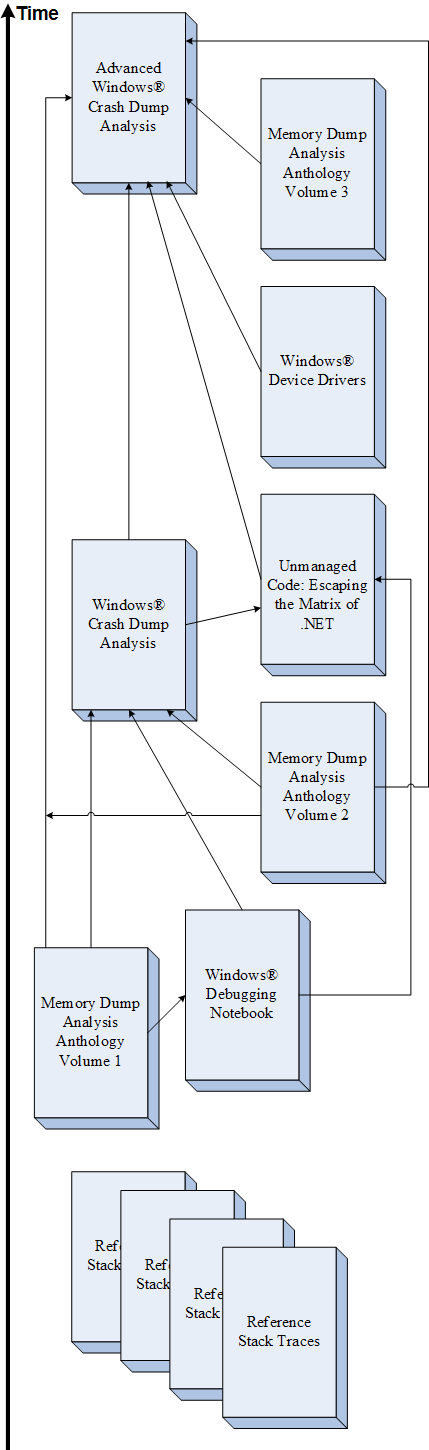
It may appear that I have announced too many titles but they all fall into the well-defined publishing roadmap (excluding a couple of publishing digressions like Debugware book):

This is a high level illustration of global incremental and iterative parts of IIPP (Iterative and Incremental Publishing Process) that I coined some months earlier. More about local iterative and incremental parts in one of my next posts.
- Dmitry Vostokov @ DumpAnalysis.org -
This is planned for publication after Windows® Crash Dump Analysis book. Preliminary information is:
(*) subject to change
- Dmitry Vostokov @ DumpAnalysis.org -
Although the first volume has not been published yet (scheduled for 15th of April, 2008) the planning for the second volume has already begun. Preliminary information is:
Hardcover version is also planned. PDF version will be available for download too.
(*) subject to change
- Dmitry Vostokov @ DumpAnalysis.org -
There is a good Microsoft white paper about !ndiskd commands to interrogate kernel dumps:
Applying !ndiskd.protocols command we can see that there are more protocols added to Vista:
Windows Server 2003 SP2:
kd> !ndiskd.protocols
Protocol 862db330: NDISUIO
Open 86420650 - Miniport: 862e2ab0 AMD PCNET Family PCI Ethernet Adapter
Protocol 86324780: TCPIP_WANARP
Open 86324008 - Miniport: 863a2130 WAN Miniport (IP)
Protocol 86318790: TCPIP
Open 8637c008 - Miniport: 862e2ab0 AMD PCNET Family PCI Ethernet Adapter
Protocol 863e3c28: NDPROXY
Open 8639e0d0 - Miniport: 86361530 Direct Parallel
Open 8639bb48 - Miniport: 86361530 Direct Parallel
Open 863e48b0 - Miniport: 863e3130 WAN Miniport (L2TP)
Open 86404008 - Miniport: 863e3130 WAN Miniport (L2TP)
Protocol 863a9d80: RASPPPOE
Protocol 863a9008: NDISWAN
Open 863e3ab0 - Miniport: 86361530 Direct Parallel
Open 86398c30 - Miniport: 862c4530 WAN Miniport (PPTP)
Open 864618f8 - Miniport: 8637a870 WAN Miniport (PPPOE)
Open 86468a28 - Miniport: 863e3130 WAN Miniport (L2TP)
Vista:
1: kd> !ndiskd.protocols
Protocol fffffa8004569580: RSPNDR
Open fffffa8004566a20 - Miniport: fffffa80039711a0 Broadcom NetXtreme 57xx Gigabit Controller
Protocol fffffa80043a4900: LLTDIO
Open fffffa800428a1d0 - Miniport: fffffa80039711a0 Broadcom NetXtreme 57xx Gigabit Controller
Protocol fffffa8003f6c820: WANARPV6
Open fffffa8003f1c010 - Miniport: fffffa800399f1a0 WAN Miniport (IPv6)
Protocol fffffa8003f6cd20: WANARP
Open fffffa8003f1c670 - Miniport: fffffa80039d61a0 WAN Miniport (IP)
Protocol fffffa8003eedb10: TCPIP6TUNNEL
Open fffffa8003f33010 - Miniport: fffffa800396c1a0 isatap.company.com
Open fffffa8003f0f010 - Miniport: fffffa80038f21a0 Teredo Tunneling Pseudo-Interface
Protocol fffffa8003eeb580: TCPIPTUNNEL
Protocol fffffa8003eeb010: TCPIP6
Open fffffa8003f452e0 - Miniport: fffffa80039711a0 Broadcom NetXtreme 57xx Gigabit Controller
Protocol fffffa8003ee90d0: TCPIP
Open fffffa8003ffc480 - Miniport: fffffa80039711a0 Broadcom NetXtreme 57xx Gigabit Controller
Protocol fffffa8003c56010: NDPROXY
Open fffffa8003d41450 - Miniport: fffffa800399d1a0 WAN Miniport (L2TP)
Open fffffa8003d41a30 - Miniport: fffffa800399d1a0 WAN Miniport (L2TP)
Protocol fffffa80039ad790: RASPPPOE
Protocol fffffa80039af4e0: NDISWAN
Open fffffa8004737a10 - Miniport: fffffa8004a321a0 RAS Async Adapter
Open fffffa8003bf8ac0 - Miniport: fffffa80039c21a0 WAN Miniport (PPTP)
Open fffffa8003c5cac0 - Miniport: fffffa80039c01a0 WAN Miniport (PPPOE)
Open fffffa8003c565a0 - Miniport: fffffa800399d1a0 WAN Miniport (L2TP)
I noticed this extension when I got a bugcheck from the 3rd-party custom protocol driver:
SYSTEM_PTE_MISUSE (da)
The stack trace identifies the guilty driver.
Arguments:
Arg1: 00000400, Type of error.
Arg2: f7a9a413
Arg3: 00000001
Arg4: 00000000
0: kd> kL
ChildEBP RetAddr
f5c68a68 8083b6e1 nt!KeBugCheckEx+0x1b
f5c68a90 8083d478 nt!MiRemoveIoSpaceMap+0x5d
f5c68b38 f5b6ebea nt!MmUnmapIoSpace+0x10c
WARNING: Stack unwind information not available. Following frames may be wrong.
f5c68b90 f5b69abe protocol!foo2+0x28ac
f5c68bf4 f70fd4be protocol!foo+0x1aa0
f5c68c90 f70fd2fc NDIS!ndisInitializeBinding+0x189
f5c68d18 f70fce48 NDIS!ndisCheckAdapterBindings+0xd9
f5c68d98 f70fca66 NDIS!ndisCheckProtocolBindings+0xd2
f5c68dac 80949b7c NDIS!ndisWorkerThread+0x74
f5c68ddc 8088e062 nt!PspSystemThreadStartup+0x2e
00000000 00000000 nt!KiThreadStartup+0x16
Arg1 0×400 one tells us this (from WinDbg help):
| 0×400 | The base address of the I/O space mapping | The number of pages to be freed | 0 | (Windows XP and later only) The caller is trying to free an I/O space mapping that the system is unaware of. |
PTE looks unknown indeed:
0: kd> !pte f7a9a413
VA f7a9a413
PDE at 00000000C0603DE8 PTE at 00000000C07BD4D0
contains 0000000000A87863 contains 0000000000000000
pfn a87 —DA–KWEV
We can see this protocol in the list:
0: kd> !ndiskd.protocols
Protocol 89df10a0: CustomProtocol
Open 89b4e6d8 - Miniport: 8a59d290 Broadcom BCM5708S NetXtreme II GigE (NDIS VBD Client)
Protocol 8918f248: NDISUIO
Protocol 89dd8008: TCPIP_WANARP
Open 8a4da6f0 - Miniport: 8a50a9e8 WAN Miniport (IP)
Protocol 89b4ec88: TCPIP
Protocol 8a4cd5a0: NDPROXY
Open 8a59b128 - Miniport: 8a58eab0 Direct Parallel
Open 8a59b328 - Miniport: 8a58eab0 Direct Parallel
Open 8a4f1580 - Miniport: 8a58a328 WAN Miniport (L2TP)
Open 8a507008 - Miniport: 8a58a328 WAN Miniport (L2TP)
Protocol 8a4e7008: RASPPPOE
Protocol 8a5cb490: NDISWAN
Open 8a59b988 - Miniport: 8a58eab0 Direct Parallel
Open 8a5976c0 - Miniport: 8a591628 WAN Miniport (PPTP)
Open 8a594468 - Miniport: 8a4e93f0 WAN Miniport (PPPOE)
Open 8a4d3580 - Miniport: 8a58a328 WAN Miniport (L2TP)
- Dmitry Vostokov @ DumpAnalysis.org -
This morning I got the following bugcheck on my home Apple MacMini running Windows Vista:
IRQL_NOT_LESS_OR_EQUAL (a)
An attempt was made to access a pageable (or completely invalid) address at an interrupt request level (IRQL) that is too high. This is usually caused by drivers using improper addresses.
If a kernel debugger is available get the stack backtrace.
Arguments:
Arg1: a112883e, memory referenced
Arg2: 0000001b, IRQL
Arg3: 00000000, bitfield :
bit 0 : value 0 = read operation, 1 = write operation
bit 3 : value 0 = not an execute operation, 1 = execute operation (only on chips which support this level of status)
Arg4: 81c28750, address which referenced memory
READ_ADDRESS: a112883e Paged pool
The address belongs to paged pool indeed:
0: kd> !pool a112883e
Pool page a112883e region is Paged pool
a1128000 size: 6d0 previous size: 0 (Allocated) Toke (Protected)
a11286d0 size: 8 previous size: 6d0 (Free) SeSd
a11286d8 size: a8 previous size: 8 (Allocated) SpSy
a1128780 size: 10 previous size: a8 (Free) AlEB
*a1128790 size: 1a0 previous size: 10 (Allocated) *KFlt
Owning component : Unknown (update pooltag.txt)
a1128930 size: 6d0 previous size: 1a0 (Allocated) Toke (Protected)
Search for KFlt tag points to KeyMagic.sys:
C:\Windows\system32>findstr /S /m /l hKFlt *.sys
drivers\KeyMagic.sys
DriverStore\FileRepository\keymagic.inf_c8736569\KeyMagic.sys
When we look at the trap address we notice that it seems to be valid:
TRAP_FRAME: 85bdf8e8 -- (.trap 0xffffffff85bdf8e8)
ErrCode = 00000000
eax=a1128828 ebx=00000001 ecx=81d323c0 edx=00000000 esi=84ca6f38 edi=84ca6f40
eip=81c28750 esp=85bdf95c ebp=85bdf970 iopl=0 nv up ei pl zr na pe nc
cs=0008 ss=0010 ds=0023 es=0023 fs=0030 gs=0000 efl=00010246
nt!KeSetEvent+0x4d:
81c28750 385816 cmp byte ptr [eax+16h],bl ds:0023:a112883e=01
However as explained in Another look at page faults post we have a page in transition and this violates IRQL contract:
0: kd> !pte a112883e
VA a112883e
PDE at 00000000C0602840 PTE at 00000000C0508940
contains 000000001CEC5863 contains 000000001AFB48C2
pfn 1cec5 ---DA--KWEV not valid
Transition: 1afb4
Protect: 6 - ReadWriteExecute
When we look at stack trace parameters we notice that the first parameter passed to KeSetEvent function belongs to nonpaged pool:
STACK_TEXT:
85bdf8e8 81c28750 badb0d00 00000000 00000000 nt!KiTrap0E+0x2ac
85bdf970 876394df 84ca6f0000000000 00000000 nt!KeSetEvent+0×4d
WARNING: Stack unwind information not available. Following frames may be wrong.
85bdf98c 8763a145 84ca68a0 8399e3b8 85bdf9ac KeyMagic+0×14df
85bdf99c 806f57a0 7b359920 7c98c800 85bdf9d4 KeyMagic+0×2145
85bdf9ac 806f514e 8399e3b8 8070e2a0 8399e3b8 Wdf01000!FxPkgPnp::PnpEventFailedOwnHardware+0×3b
0: kd> !pool 84ca6f00
Pool page 84ca6f00 region is Nonpaged pool
84ca6000 size: 2b8 previous size: 0 (Allocated) Thre (Protected)
84ca62b8 size: 10 previous size: 2b8 (Free) ....
84ca62c8 size: 48 previous size: 10 (Allocated) Vadl
84ca6310 size: 30 previous size: 48 (Allocated) Ntfn
84ca6340 size: 38 previous size: 30 (Allocated) usbp
84ca6378 size: 98 previous size: 38 (Allocated) NDam
84ca6410 size: 188 previous size: 98 (Allocated) NDoa
84ca6598 size: 8 previous size: 188 (Free) FOCX
84ca65a0 size: 30 previous size: 8 (Allocated) UHUB
84ca65d0 size: 20 previous size: 30 (Allocated) Wnln
84ca65f0 size: 28 previous size: 20 (Allocated) Io
84ca6618 size: 18 previous size: 28 (Allocated) Ala6
84ca6630 size: 98 previous size: 18 (Allocated) NDam
*84ca66c8 size: 938 previous size: 98 (Allocated) *KeyM
Owning component : Unknown (update pooltag.txt)
However it is not a pointer to a valid _KEVENT structure:
0: kd> dt -r _KEVENT 84ca6f00
Wdf01000!_KEVENT
+0x000 Header : _DISPATCHER_HEADER
+0x000 Type : 0xc8 ''
+0x001 Abandoned : 0x87 ''
+0x001 Absolute : 0x87 ''
+0x001 NpxIrql : 0x87 ''
+0x001 Signalling : 0x87 ''
+0x002 Size : 0x12 ''
+0x002 Hand : 0x12 ''
+0x003 Inserted : 0xa1 ''
+0x003 DebugActive : 0xa1 ''
+0x003 DpcActive : 0xa1 ''
+0x000 Lock : -1592621112
+0x004 SignalState : -1592621112
+0x008 WaitListHead : _LIST_ENTRY [ 0x40000 - 0x0 ]
+0x000 Flink : 0x00040000 _LIST_ENTRY
+0x004 Blink : (null)
Moreover we see from disassembly and nonpaged pool entry contents that KeSetEvent function tried to dereference wrong WaitListHead that points to paged pool (the same pool entry that caused the bugcheck):
0: kd> uf nt!KeSetEvent
nt!KeSetEvent:
81c28703 mov edi,edi
81c28705 push ebp
81c28706 mov ebp,esp
81c28708 push ecx
81c28709 push ecx
81c2870a push ebx
81c2870b push esi
81c2870c mov esi,dword ptr [ebp+8]
81c2870f xor ebx,ebx
81c28711 inc ebx
81c28712 cmp byte ptr [esi],0
81c28715 push edi
81c28716 jne nt!KeSetEvent+0x27 (81c2872a)
nt!KeSetEvent+0x15:
81c28718 cmp dword ptr [esi+4],ebx
81c2871b jne nt!KeSetEvent+0x27 (81c2872a)
nt!KeSetEvent+0x1a:
81c2871d cmp byte ptr [ebp+10h],0
81c28721 jne nt!KeSetEvent+0x27 (81c2872a)
nt!KeSetEvent+0x20:
81c28723 mov eax,ebx
81c28725 jmp nt!KeSetEvent+0xcf (81c287d6)
nt!KeSetEvent+0x27:
81c2872a xor ecx,ecx
81c2872c call dword ptr [nt!_imp_KeAcquireQueuedSpinLockRaiseToSynch (81c010a4)]
81c28732 mov byte ptr [ebp+8],al ; clears the first byte of 84ca6f00 so PKEVENT could have been any 84ca6fXX
81c28735 mov eax,dword ptr [esi+4]
81c28738 test eax,eax
81c2873a mov dword ptr [ebp-4],eax
81c2873d mov dword ptr [esi+4],ebx
81c28740 jne nt!KeSetEvent+0×9a (81c287a1)
nt!KeSetEvent+0x3f:
81c28742 lea edi,[esi+8]
81c28745 cmp dword ptr [edi],edi
81c28747 je nt!KeSetEvent+0x9a (81c287a1)
nt!KeSetEvent+0x46:
81c28749 cmp byte ptr [esi],0
81c2874c mov eax,dword ptr [edi]
81c2874e jne nt!KeSetEvent+0x70 (81c28775)
nt!KeSetEvent+0x4d:
81c28750 cmp byte ptr [eax+16h],bl
81c28753 mov ecx,dword ptr [eax+8]
81c28756 push dword ptr [ebp+0Ch]
81c28759 jne nt!KeSetEvent+0x5e (81c28761)
nt!KeSetEvent+0x58:
81c2875b movzx edx,word ptr [eax+14h]
81c2875f jmp nt!KeSetEvent+0x63 (81c28766)
nt!KeSetEvent+0x5e:
81c28761 mov edx,100h
nt!KeSetEvent+0x63:
81c28766 call nt!KiUnwaitThread (81ca9097)
81c2876b mov eax,dword ptr [edi]
81c2876d cmp eax,edi
81c2876f je nt!KeSetEvent+0x9a (81c287a1)
nt!KeSetEvent+0x6e:
81c28771 jmp nt!KeSetEvent+0x4d (81c28750)
nt!KeSetEvent+0x70:
81c28775 cmp byte ptr [eax+16h],bl
81c28778 mov ecx,dword ptr [eax+8]
81c2877b push dword ptr [ebp+0Ch]
81c2877e je nt!KeSetEvent+0x8d (81c28794)
nt!KeSetEvent+0x7b:
81c28780 mov edx,100h
81c28785 call nt!KiUnwaitThread (81ca9097)
81c2878a mov eax,dword ptr [edi]
81c2878c cmp eax,edi
81c2878e je nt!KeSetEvent+0x9a (81c287a1)
nt!KeSetEvent+0x8b:
81c28790 jmp nt!KeSetEvent+0x70 (81c28775)
nt!KeSetEvent+0x8d:
81c28794 and dword ptr [esi+4],0
81c28798 movzx edx,word ptr [eax+14h]
81c2879c call nt!KiUnwaitThread (81ca9097)
nt!KeSetEvent+0x9a:
81c287a1 cmp byte ptr [ebp+10h],0
81c287a5 je nt!KeSetEvent+0xb2 (81c287b9)
nt!KeSetEvent+0xa0:
81c287a7 mov eax,dword ptr fs:[00000124h]
81c287ad mov cl,byte ptr [ebp+8]
81c287b0 or dword ptr [eax+68h],8
81c287b4 mov byte ptr [eax+5Eh],cl
81c287b7 jmp nt!KeSetEvent+0xcc (81c287d3)
nt!KeSetEvent+0xb2:
81c287b9 mov ecx,dword ptr fs:[20h]
81c287c0 add ecx,418h
81c287c6 call nt!KeReleaseQueuedSpinLockFromDpcLevel (81c8bf0c)
81c287cb push dword ptr [ebp+8]
81c287ce call nt!KiExitDispatcher (81ca9c12)
nt!KeSetEvent+0xcc:
81c287d3 mov eax,dword ptr [ebp-4]
nt!KeSetEvent+0xcf:
81c287d6 pop edi
81c287d7 pop esi
81c287d8 pop ebx
81c287d9 leave
81c287da ret 0Ch
0: kd> dd 84ca6f00 84ca6fff
84ca6f00 a11287c8 a11287c8 00040000 00000000
84ca6f10 a11287e0 a11287e0 00040000 00000000
84ca6f20 a11287f8 a11287f8 00040000 00000000
84ca6f30 a1128810 a1128810 00040000 00000001
84ca6f40 a1128828 a1128828 00040000 00000000
84ca6f50 a1128840 a1128840 00040000 00000000
84ca6f60 a1128858 a1128858 00040000 00000000
84ca6f70 a1128888 a1128888 00040000 00000000
84ca6f80 a11288a0 a11288a0 00040000 00000000
84ca6f90 a1128870 a1128870 00040000 00000000
84ca6fa0 a11288b8 a11288b8 00040000 00000000
84ca6fb0 a11288d0 a11288d0 00040000 00000000
84ca6fc0 a11288e8 a11288e8 00040000 00000000
84ca6fd0 a1128900 a1128900 00040000 00000000
84ca6fe0 a1128918 a1128918 5e55aec0 6003be28
84ca6ff0 60181fe8 00000000 00000000 00000000
0: kd> !pool a11287c8
Pool page a11287c8 region is Paged pool
a1128000 size: 6d0 previous size: 0 (Allocated) Toke (Protected)
a11286d0 size: 8 previous size: 6d0 (Free) SeSd
a11286d8 size: a8 previous size: 8 (Allocated) SpSy
a1128780 size: 10 previous size: a8 (Free) AlEB
*a1128790 size: 1a0 previous size: 10 (Allocated) *KFlt
Owning component : Unknown (update pooltag.txt)
a1128930 size: 6d0 previous size: 1a0 (Allocated) Toke (Protected)
Let’s look at our stack trace:
0: kd> !thread 82f49020 1f
THREAD 82f49020 Cid 0004.0034 Teb: 00000000 Win32Thread: 00000000 RUNNING on processor 0
IRP List:
8391e008: (0006,02b0) Flags: 00000000 Mdl: 00000000
Not impersonating
DeviceMap 85c03048
Owning Process 82f00ab0 Image: System
Wait Start TickCount 4000214 Ticks: 0
Context Switch Count 21886
UserTime 00:00:00.000
KernelTime 00:00:00.421
Win32 Start Address nt!ExpWorkerThread (0x81c78ea3)
Stack Init 85be0000 Current 85bdf7c0 Base 85be0000 Limit 85bdd000 Call 0
Priority 14 BasePriority 12 PriorityDecrement 0 IoPriority 2 PagePriority 5
ChildEBP RetAddr
85bdf8e8 81c28750 nt!KiTrap0E+0x2ac (TrapFrame @ 85bdf8e8)
85bdf970 876394df nt!KeSetEvent+0x4d
WARNING: Stack unwind information not available. Following frames may be wrong.
85bdf98c 8763a145 KeyMagic+0x14df
85bdf99c 806f57a0 KeyMagic+0x2145
85bdf9ac 806f514e Wdf01000!FxPkgPnp::PnpEventFailedOwnHardware+0x3b
85bdf9d4 806f5ea9 Wdf01000!FxPkgPnp::PnpEnterNewState+0x15c
85bdf9fc 806f61b3 Wdf01000!FxPkgPnp::PnpProcessEventInner+0x1f5
85bdfa20 806ecf6b Wdf01000!FxPkgPnp::PnpProcessEvent+0x1c8
85bdfa2c 806f34b4 Wdf01000!FxPkgPnp::PnpSurpriseRemoval+0x29
85bdfa38 806edf86 Wdf01000!FxPkgFdo::_PnpSurpriseRemoval+0x10
85bdfa5c 806d7d0a Wdf01000!FxPkgPnp::Dispatch+0x26e
85bdfa68 806d7f0f Wdf01000!FxDevice::Dispatch+0x7f
85bdfa84 81c27f83 Wdf01000!FxDevice::DispatchWithLock+0x5d
85bdfa9c a4966e7f nt!IofCallDriver+0x63
85bdfac0 a496c9ae hidbth!HidBthCallDriverSynchronous+0x55
85bdfae0 85ac5a5d hidbth!HidBthPnP+0x68
85bdfaf4 85acd4c2 HIDCLASS!HidpCallDriver+0x3f
85bdfb10 85acd62e HIDCLASS!HidpFdoPnp+0x60
85bdfb20 85ac64fd HIDCLASS!HidpIrpMajorPnp+0x1e
85bdfb30 81c27f83 HIDCLASS!HidpMajorHandler+0x79
85bdfb48 81daf465 nt!IofCallDriver+0x63
85bdfb7c 81daf6cb nt!IopSynchronousCall+0xce
85bdfbd8 81da5da4 nt!IopRemoveDevice+0xd5
85bdfc00 81da5c97 nt!PnpSurpriseRemoveLockedDeviceNode+0xbd
85bdfc14 81da5f17 nt!PnpDeleteLockedDeviceNode+0x1f
85bdfc44 81daa554 nt!PnpDeleteLockedDeviceNodes+0x4c
85bdfd04 81daabe1 nt!PnpProcessQueryRemoveAndEject+0x572
85bdfd1c 81da9743 nt!PnpProcessTargetDeviceEvent+0x38
85bdfd44 81c78fa0 nt!PnpDeviceEventWorker+0x201
85bdfd7c 81e254e0 nt!ExpWorkerThread+0xfd
85bdfdc0 81c9159e nt!PspSystemThreadStartup+0x9d
00000000 00000000 nt!KiThreadStartup+0x16
IRP and device examination shows that KeyMagic is a lower filter driver to bluetooth HID driver and an upper filter driver to BthEnum (see Bluetooth Driver Stack WDK article):
0: kd> !irp 8391e008
Irp is active with 16 stacks 14 is current (= 0x8391e24c)
No Mdl: No System Buffer: Thread 82f49020: Irp stack trace.
cmd flg cl Device File Completion-Context
[ 0, 0] 0 0 00000000 00000000 00000000-00000000
Args: 00000000 00000000 00000000 00000000
[ 0, 0] 0 0 00000000 00000000 00000000-00000000
Args: 00000000 00000000 00000000 00000000
[ 0, 0] 0 0 00000000 00000000 00000000-00000000
Args: 00000000 00000000 00000000 00000000
[ 0, 0] 0 0 00000000 00000000 00000000-00000000
Args: 00000000 00000000 00000000 00000000
[ 0, 0] 0 0 00000000 00000000 00000000-00000000
Args: 00000000 00000000 00000000 00000000
[ 0, 0] 0 0 00000000 00000000 00000000-00000000
Args: 00000000 00000000 00000000 00000000
[ 0, 0] 0 0 00000000 00000000 00000000-00000000
Args: 00000000 00000000 00000000 00000000
[ 0, 0] 0 0 00000000 00000000 00000000-00000000
Args: 00000000 00000000 00000000 00000000
[ 0, 0] 0 0 00000000 00000000 00000000-00000000
Args: 00000000 00000000 00000000 00000000
[ 0, 0] 0 0 00000000 00000000 00000000-00000000
Args: 00000000 00000000 00000000 00000000
[ 0, 0] 0 0 00000000 00000000 00000000-00000000
Args: 00000000 00000000 00000000 00000000
[ 0, 0] 0 0 00000000 00000000 00000000-00000000
Args: 00000000 00000000 00000000 00000000
[ 0, 0] 0 0 00000000 00000000 00000000-00000000
Args: 00000000 00000000 00000000 00000000
>[ 1b,17] 0 e1 a1b9b120 00000000 a4966d36-85bdfab0 Success Error Cancel pending
\Driver\KeyMagic hidbth!HidBthSynchronousCompletion
Args: 00000000 00000000 00000000 00000000
[ 1b,17] 0 0 8a1fc030 00000000 00000000-00000000
\Driver\HidBth
Args: 00000000 00000000 00000000 00000000
[ 1b,17] 0 0 8a1fc030 00000000 00000000-00000000
\Driver\HidBth
Args: 00000000 00000000 00000000 00000000
0: kd> !devobj 8a1fc030
Device object (8a1fc030) is for:
_HID00000006 \Driver\HidBth DriverObject 836225e0
Current Irp 00000000 RefCount 0 Type 00000022 Flags 00002050
Dacl 85c60218 DevExt 8a1fc0e8 DevObjExt 8a1fce98
ExtensionFlags (0x00000800)
Unknown flags 0x00000800
AttachedTo (Lower) a1b9b120 \Driver\KeyMagic
Device queue is not busy.
0: kd> !devobj a1b9b120
Device object (a1b9b120) is for:
\Driver\KeyMagic DriverObject 83712d70
Current Irp 00000000 RefCount 0 Type 00000022 Flags 00002004
DevExt 84ca68a0 DevObjExt a1b9b1f0
ExtensionFlags (0x00000800)
Unknown flags 0x00000800
AttachedDevice (Upper) 8a1fc030 \Driver\HidBth
AttachedTo (Lower) 8a1ef030 \Driver\BthEnum
Device queue is not busy.
0: kd> !devstack 8a1ef030
!DevObj !DrvObj !DevExt ObjectName
8a1fc030 \Driver\HidBth 8a1fc0e8 _HID00000006
a1b9b120 \Driver\KeyMagic 84ca68a0
> 8a1ef030 \Driver\BthEnum 8a1ef0e8 00000068
lmv command doesn’t show detailed module information:
0: kd> lmv m KeyMagic
start end module name
87638000 87642000 KeyMagic (no symbols)
Loaded symbol image file: KeyMagic.sys
Image path: \SystemRoot\system32\DRIVERS\KeyMagic.sys
Image name: KeyMagic.sys
Timestamp: Thu Aug 30 22:59:01 2007 (46D73DA5)
CheckSum: 0000B906
ImageSize: 0000A000
Translations: 0000.04b0 0000.04e0 0409.04b0 0409.04e0
But dumping the module contents shows more (Unknown Component pattern):
0: kd> dc 87638000 87642000
...
...
...
8763b120 \.r.e.g.i.s.t.r.
8763b130 y.\.m.a.c.h.i.n.
8763b140 e.\.S.y.s.t.e.m.
8763b150 \.C.u.r.r.e.n.t.
8763b160 C.o.n.t.r.o.l.S.
8763b170 e.t.\.S.e.r.v.i.
8763b180 c.e.s.\.k.e.y.m.
8763b190 a.g.i.c.....FILT
8763b1a0 ER_EXTENSION....
8763b1b0 NEW_LAYOUT..OLD_
8763b1c0 LAYOUT..UNKNOWN_
8763b1d0 LAYOUT..EXTERNAL
8763b1e0 _BLUETOOTH..EXTE
8763b1f0 RNAL_CORDED.INTE
8763b200 RNAL....UNKNOWN_
8763b210 TYPE....JIS.ANSI
8763b220 ....ISO.UNKNOWN_
8763b230 LANG............
8763b240 u.....%.........
8763b250 ................
8763b260 ............K.m.
8763b270 d.f.L.i.b.r.a.r.
8763b280 y...RSDS.....W.M
8763b290 .V..A..e....c:\b
8763b2a0 wa\applekeyboard
8763b2b0 win-200.1.4\srcr
8763b2c0 oot\applekeyboar
8763b2d0 d\objfre_wlh_x86
8763b2e0 \i386\KeyMagic.p
8763b2f0 db…………..
8763b300 …………….
…
…
…
Therefore we have enough evidence for KeyMagic.sys to contact the vendor for updates or remove it. The latter is better because I don’t use Apple wireless keyboard but the driver is present on my system. To be absolutely sure we can enable IRQL checking in Driver Verifier for KeyMagic.sys.
- Dmitry Vostokov @ DumpAnalysis.org -
This is a forthcoming reference book for technical support and escalation engineers troubleshooting and debugging complex software issues. The book is also invaluable for software maintenance and development engineers debugging unmanaged, managed and native code.
- Dmitry Vostokov @ DumpAnalysis.org -
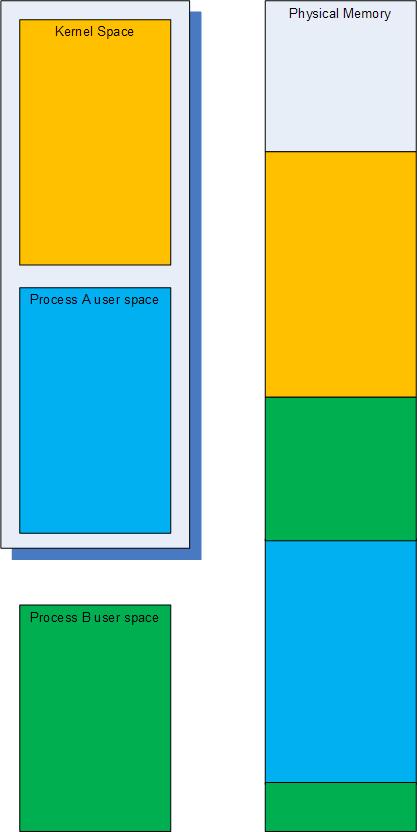
We all know about s memory search WinDbg command but it only searches the current virtual memory range. This is fine if we have a kernel memory or a user dump where we have uniform virtual space but for complete memory dumps we have many virtual to physical address mappings to cover user space of various processes. This is better illustrated on the following highly simplified picture where the typical current virtual space in a complete memory dump is enclosed in the shadowed box and consists of the kernel space and process A virtual address space ranges:

Therefore some data will be present in physical memory but not accessible through virtual memory search. To search through all physical memory there is !search WinDbg command and by default it searches for specific 32-bit value on 32-bit Windows and 64-bit value on 64-bit Windows. The latter means that we can search for 8 character string fragments on 64-bit Windows. For example, if we want to search for occurrences of ”ImaSrv.exe” string we can specify “ImaS” on 32-bit platform and “ImaSrv.e” on 64-bit platform. Taking into account little endian byte ordering we get the following hexadecimal equivalents:
0: kd> .formats 'SamI'
Evaluate expression:
Hex: 53616d49
Decimal: 1398893897
Octal: 12330266511
Binary: 01010011 01100001 01101101 01001001
Chars: SamI
Time: Wed Apr 30 22:38:17 2014
Float: low 9.68201e+011 high 0
Double: 6.91145e-315
0: kd> .formats 'e.vrSamI'
Evaluate expression:
Hex: 652e7672`53616d49
Decimal: 7290895080156654921
Octal: 0624563547112330266511
Binary: 01100101 00101110 01110110 01110010 01010011 01100001 01101101 01001001
Chars: e.vrSamI
Time: Mon Dec 5 23:20:15.665 24704 (GMT+0)
Float: low 9.68201e+011 high 5.14923e+022
Double: 2.46885e+179
Physical memory search gives us plenty of results:
0: kd> !search 53616d49
Searching PFNs in range 00000001 - 0013FFFF for [53616D49 - 53616D49]
Pfn Offset Hit Va Pte
- - - - - - - - - - - - - - - - - - - - - - - - - - -
000079FA 000004C4 53616D49 A3AFB4C4 C051D7D8
a3afb340+0x184 : Proc (Protected) -- Process objects
00011442 00000848 53616D49 66EC2848 C0337610
00011442 0000093C 53616D49 66EC293C C0337610
0001328A 000009F4 43616D49 672E59F4 C0339728
000156F6 000009F4 43616D49 672E59F4 C0339728
00018C7C 000009DC 43616D49 671F49DC C0338FA0
0001ADF0 000003D4 52616D49 00000000 DC3E3B48
0001ADF0 000003E4 52616D49 00000000 DC3E3B48
00020BCE 000009DC 43616D49 671F49DC C0338FA0
...
...
...
We can dump either a virtual address if it is available and valid by using normal d* commands or dump a physical address by using their !d* extension equivalents, for example:
Pfn Offset Hit Va Pte
- - - - - - - - - - - - - - - - - - - - - - - - - - -
00011442 00000848 53616D49 66EC2848 C0337610
0: kd> !dc 11442000+00000848
#11442848 53616d49 65747379 6c642e6d 0000006c ImaSystem.dll...
#11442858 00000000 00000000 00000000 45cd0da0 ...............E
#11442868 00000000 0000293c 00000001 00000012 ....<)..........
#11442878 00000012 00002888 000028d0 00002918 .....(...(...)..
#11442888 00001160 000010b0 00001020 00001000 `....... .......
#11442898 00001130 00001010 000010a0 00001030 0...........0...
#114428a8 000020d8 000020cc 00001300 000013c0 . ... ..........
#114428b8 00001200 00001050 00001040 00001080 ....P...@.......
Note: Physical addresses are formed from PFN (Page Frame Numbers) by shifting them to the left by 12 bits (by adding 3 zeroes to the left). For example: 00011442 -> 11442000.
The cool feature of !search command is that it automatically recognizes pool tags and in our case it has found the process object:
Pfn Offset Hit Va Pte
- - - - - - - - - - - - - - - - - - - - - - - - - - -
000079FA 000004C4 53616D49 A3AFB4C4 C051D7D8
a3afb340+0×184 : Proc (Protected) — Process objects
…
…
…
0: kd> !pool A3AFB4C4
Pool page a3afb340 region is Nonpaged pool
a3afb000 size: 120 previous size: 0 (Allocated) MQAC
a3afb120 size: 20 previous size: 120 (Allocated) VadS
a3afb140 size: 98 previous size: 20 (Allocated) File (Protected)
a3afb1d8 size: 30 previous size: 98 (Allocated) MQAC
a3afb208 size: 20 previous size: 30 (Allocated) VadS
a3afb228 size: 28 previous size: 20 (Free) CcBc
a3afb250 size: 30 previous size: 28 (Allocated) Vad
a3afb280 size: 30 previous size: 30 (Allocated) Vad
a3afb2b0 size: 20 previous size: 30 (Allocated) VadS
a3afb2d0 size: 40 previous size: 20 (Allocated) SeTd
a3afb310 size: 30 previous size: 40 (Allocated) Vad
*a3afb340 size: 298 previous size: 30 (Allocated) *Proc (Protected)
Pooltag Proc : Process objects, Binary : nt!ps
a3afb5d8 size: 8 previous size: 298 (Free) Irp
a3afb5e0 size: 20 previous size: 8 (Allocated) VadS
a3afb600 size: 8 previous size: 20 (Free) Irp
a3afb608 size: 30 previous size: 8 (Allocated) Even (Protected)
a3afb638 size: 30 previous size: 30 (Allocated) Vad
a3afb668 size: 40 previous size: 30 (Allocated) Vadl
a3afb6a8 size: 70 previous size: 40 (Allocated) NWFS
a3afb718 size: 30 previous size: 70 (Allocated) Vad
a3afb748 size: 28 previous size: 30 (Allocated) NpFr Process: a3afb360
a3afb770 size: 98 previous size: 28 (Allocated) File (Protected)
a3afb808 size: 60 previous size: 98 (Allocated) MmCa
a3afb868 size: 98 previous size: 60 (Allocated) File (Protected)
a3afb900 size: 30 previous size: 98 (Allocated) Even (Protected)
a3afb930 size: 20 previous size: 30 (Allocated) VadS
a3afb950 size: 98 previous size: 20 (Allocated) File (Protected)
a3afb9e8 size: 30 previous size: 98 (Allocated) MQAC
a3afba18 size: 120 previous size: 30 (Allocated) MQAC
a3afbb38 size: 50 previous size: 120 (Allocated) NpFc Process: a5659d88
a3afbb88 size: 20 previous size: 50 (Allocated) Port
a3afbba8 size: 98 previous size: 20 (Allocated) File (Protected)
a3afbc40 size: 30 previous size: 98 (Allocated) MQAC
a3afbc70 size: 120 previous size: 30 (Allocated) MQAC
a3afbd90 size: 270 previous size: 120 (Allocated) Thre (Protected)
0: kd> dc A3AFB4C4 l10
a3afb4c4 53616d49 652e7672 00006578 00000000 ImaSrv.exe......
a3afb4d4 00000000 00000000 00000000 a3afbfd4 ................
a3afb4e4 a282fe44 00000000 f7a60500 0000004c D...........L...
a3afb4f4 001f07fb 00008005 00000000 7ffdd000 ................
Seems the search has found ImageFileName field of _EPROCESS structure. The field has 0×164 offset and we can dump the whole structure:
0: kd> dt _EPROCESS A3AFB4C4-0x164
ntdll!_EPROCESS
+0x000 Pcb : _KPROCESS
+0x078 ProcessLock : _EX_PUSH_LOCK
+0x080 CreateTime : _LARGE_INTEGER 0x1c86f66`5b95204a
+0x088 ExitTime : _LARGE_INTEGER 0x0
+0x090 RundownProtect : _EX_RUNDOWN_REF
+0x094 UniqueProcessId : 0x000009d0
+0x098 ActiveProcessLinks : _LIST_ENTRY [ 0xa3af2598 - 0xa3b0a0b8 ]
+0x0a0 QuotaUsage : [3] 0x17030
+0x0ac QuotaPeak : [3] 0x18028
+0x0b8 CommitCharge : 0x37b6
+0x0bc PeakVirtualSize : 0x132d4000
+0x0c0 VirtualSize : 0x12d64000
+0x0c4 SessionProcessLinks : _LIST_ENTRY [ 0xa3af25c4 - 0xa3b0a0e4 ]
+0x0cc DebugPort : (null)
+0x0d0 ExceptionPort : 0xd738e828
+0x0d4 ObjectTable : 0xdc23a008 _HANDLE_TABLE
+0x0d8 Token : _EX_FAST_REF
+0x0dc WorkingSetPage : 0x11741f
+0x0e0 AddressCreationLock : _KGUARDED_MUTEX
+0x100 HyperSpaceLock : 0
+0x104 ForkInProgress : (null)
+0x108 HardwareTrigger : 0
+0x10c PhysicalVadRoot : 0xa3c21448 _MM_AVL_TABLE
+0x110 CloneRoot : (null)
+0x114 NumberOfPrivatePages : 0x318d
+0x118 NumberOfLockedPages : 7
+0x11c Win32Process : 0xbc33d968
+0x120 Job : (null)
+0x124 SectionObject : 0xdc2710c8
+0x128 SectionBaseAddress : 0x00400000
+0x12c QuotaBlock : 0xa3bb2f38 _EPROCESS_QUOTA_BLOCK
+0x130 WorkingSetWatch : (null)
+0x134 Win32WindowStation : 0x00000078
+0x138 InheritedFromUniqueProcessId : 0x00000228
+0x13c LdtInformation : (null)
+0x140 VadFreeHint : (null)
+0x144 VdmObjects : (null)
+0x148 DeviceMap : 0xd7d0ff30
+0x14c Spare0 : [3] (null)
+0x158 PageDirectoryPte : _HARDWARE_PTE_X86
+0x158 Filler : 0
+0x160 Session : 0xf79d5000
+0×164 ImageFileName : [16] “ImaSrv.exe”
+0×174 JobLinks : _LIST_ENTRY [ 0×0 - 0×0 ]
+0×17c LockedPagesList : (null)
+0×180 ThreadListHead : _LIST_ENTRY [ 0xa3afbfd4 - 0xa282fe44 ]
+0×188 SecurityPort : (null)
+0×18c PaeTop : 0xf7a60500
+0×190 ActiveThreads : 0×4c
+0×194 GrantedAccess : 0×1f07fb
+0×198 DefaultHardErrorProcessing : 0×8005
+0×19c LastThreadExitStatus : 0
+0×1a0 Peb : 0×7ffdd000 _PEB
+0×1a4 PrefetchTrace : _EX_FAST_REF
+0×1a8 ReadOperationCount : _LARGE_INTEGER 0xf01d3
+0×1b0 WriteOperationCount : _LARGE_INTEGER 0×3b08c
+0×1b8 OtherOperationCount : _LARGE_INTEGER 0×67845
+0×1c0 ReadTransferCount : _LARGE_INTEGER 0×9b087eec
+0×1c8 WriteTransferCount : _LARGE_INTEGER 0×39f8a27a
+0×1d0 OtherTransferCount : _LARGE_INTEGER 0×25dd749
+0×1d8 CommitChargeLimit : 0
+0×1dc CommitChargePeak : 0×394b
+0×1e0 AweInfo : (null)
+0×1e4 SeAuditProcessCreationInfo : _SE_AUDIT_PROCESS_CREATION_INFO
+0×1e8 Vm : _MMSUPPORT
+0×230 MmProcessLinks : _LIST_ENTRY [ 0xa3af2730 - 0xa3b0a250 ]
+0×238 ModifiedPageCount : 0xc835
+0×23c JobStatus : 0
+0×240 Flags : 0×4d0801
+0×240 CreateReported : 0y1
+0×240 NoDebugInherit : 0y0
+0×240 ProcessExiting : 0y0
+0×240 ProcessDelete : 0y0
+0×240 Wow64SplitPages : 0y0
+0×240 VmDeleted : 0y0
+0×240 OutswapEnabled : 0y0
+0×240 Outswapped : 0y0
+0×240 ForkFailed : 0y0
+0×240 Wow64VaSpace4Gb : 0y0
+0×240 AddressSpaceInitialized : 0y10
+0×240 SetTimerResolution : 0y0
+0×240 BreakOnTermination : 0y0
+0×240 SessionCreationUnderway : 0y0
+0×240 WriteWatch : 0y0
+0×240 ProcessInSession : 0y1
+0×240 OverrideAddressSpace : 0y0
+0×240 HasAddressSpace : 0y1
+0×240 LaunchPrefetched : 0y1
+0×240 InjectInpageErrors : 0y0
+0×240 VmTopDown : 0y0
+0×240 ImageNotifyDone : 0y1
+0×240 PdeUpdateNeeded : 0y0
+0×240 VdmAllowed : 0y0
+0×240 SmapAllowed : 0y0
+0×240 CreateFailed : 0y0
+0×240 DefaultIoPriority : 0y000
+0×240 Spare1 : 0y0
+0×240 Spare2 : 0y0
+0×244 ExitStatus : 259
+0×248 NextPageColor : 0xf91e
+0×24a SubSystemMinorVersion : 0 ”
+0×24b SubSystemMajorVersion : 0×4 ”
+0×24a SubSystemVersion : 0×400
+0×24c PriorityClass : 0×6 ”
+0×250 VadRoot : _MM_AVL_TABLE
+0×270 Cookie : 0×5a583219
We can also see that by default !search command finds entries differing in a single bit, for example:
Pfn Offset Hit Va Pte
- - - - - - - - - - - - - - - - - - - - - - - - - - -
...
...
...
00011442 0000093C 53616D49 66EC293C C0337610
0001328A 000009F4 43616D49 672E59F4 C0339728
…
…
…
0: kd> !dc 0001328A9F4
#1328a9f4 43616d49 6f6d6d6f 64702e6e 00000062 ImaCommon.pdb...
#1328aa04 672e7170 00000000 00000000 ffffffff pq.g............
#1328aa14 00000000 00000000 672e5a04 00000000 .........Z.g....
#1328aa24 00000000 00000000 00000001 672e5a1c .............Z.g
#1328aa34 00000000 00000000 00000000 672e7170 ............pq.g
#1328aa44 672e5a24 00000000 00000000 00004c24 $Z.g........$L..
#1328aa54 00000000 00000000 00000000 00000000 ................
#1328aa64 00000000 672e7138 00000000 ffffffff ....8q.g........
In the case of kernel memory dumps physical memory search might be better alternative to virtual memory search if we need to see pool tags corresponding to search hits or search for data differing in some bits, for example:
3: kd> .ignore_missing_pages 1
Suppress kernel summary dump missing page error message
3: kd> s -d 80000000 L?20000000 53616d49
86a6eeec 53616d49 652e7672 00006578 00000000 ImaSrv.exe......
3: kd> !search 53616d49
Debuggee is a kernel summary dump, some physical pages may not be present.
Searches will miss hits from those pages.
Searching PFNs in range 00000001 - 0007FFFF for [53616D49 - 53616D49]
Pfn Offset Hit Va Pte
- - - - - - - - - - - - - - - - - - - - - - - - - - -
00005DED 00000EEC 53616D49 86A6EEEC C021A9B8
86a6ed68+0x184 : Proc (Protected) -- Process objects
Search done.
- Dmitry Vostokov @ DumpAnalysis.org -
This is a forthcoming book about .NET debugging seen in a wider context than .NET runtime environment (CLR). There is the whole new generation of .NET software developers, designers and architects thinking in terms of managed code and associated concepts. However CLR runs in unmanaged environment which finally interfaces with native code. Therefore understanding unmanaged and native code is vital for successful debugging of real customer problems. Preliminary information is:
(*) subject to change
- Dmitry Vostokov @ DumpAnalysis.org -
Thanks to everyone responded online and privately to proposed draft covers for forthcoming MDAA volumes. As some commented the original one looks good on the shelf so the final decision will be made when I print both variants for comparison. Supporters of the original cover proposed the following modification:

Also there will be surprise on the back cover of the book
PS. I decided to read couple of books about book design and manufacturing to get clearer picture about the whole process.
- Dmitry Vostokov @ DumpAnalysis.org -
I’m coming back to my old Insufficient Memory pattern range (see Committed Memory, Handle Leak, Kernel Pool, PTE). This post discusses the user space case when we don’t have enough virtual memory available for reservation due to memory fragmentation. For example, a java virtual machine is pre-allocating memory for its garbage-collected heap. However after installing some 3rd-party software the amount of pre-allocated memory is less than expected. In such cases it is possible to do comparative memory dump analysis to see the difference in virtual address spaces. Original memory dump has this module distribution in memory:
0:000> lm
start end module name
00400000 0040b000 javaw (deferred)
009e0000 009e7000 hpi (deferred)
00a30000 00a3e000 verify (deferred)
00a40000 00a59000 java (deferred)
00a60000 00a6d000 zip (deferred)
03ff0000 03fff000 net (deferred)
040a0000 040a8000 nio (deferred)
040b0000 0410a000 hnetcfg (deferred)
041d0000 042e2000 awt (deferred)
04540000 04591000 fontmanager (deferred)
04620000 04670000 msctf (deferred)
047c0000 047de000 jpeg (deferred)
05820000 05842000 dcpr (deferred)
05920000 05932000 pkcs11wrapper (deferred)
08000000 08139000 jvm (deferred)
10000000 100e0000 moduleA (deferred)
68000000 68035000 rsaenh (deferred)
6e220000 6e226000 RMProcessLink (deferred)
71ae0000 71ae8000 wshtcpip (deferred)
71b20000 71b61000 mswsock (deferred)
71bf0000 71bf8000 ws2help (deferred)
71c00000 71c17000 ws2_32 (deferred)
71c20000 71c32000 tsappcmp (deferred)
71c40000 71c97000 netapi32 (deferred)
73070000 73097000 winspool (deferred)
76290000 762ad000 imm32 (deferred)
76920000 769e2000 userenv (deferred)
76aa0000 76acd000 winmm (deferred)
76b70000 76b7b000 psapi (deferred)
76ed0000 76efa000 dnsapi (deferred)
76f10000 76f3e000 wldap32 (deferred)
76f50000 76f63000 secur32 (deferred)
76f70000 76f77000 winrnr (deferred)
76f80000 76f85000 rasadhlp (deferred)
77380000 77411000 user32 (deferred)
77670000 777a9000 ole32 (deferred)
77ba0000 77bfa000 msvcrt (deferred)
77c00000 77c48000 gdi32 (deferred)
77c50000 77cef000 rpcrt4 (deferred)
77e40000 77f42000 kernel32 (deferred)
77f50000 77feb000 advapi32 (deferred)
78130000 781cb000 msvcr80 (deferred)
7c800000 7c8c0000 ntdll (pdb symbols)
We see the big gap between 100e0000 and 68000000 addresses. This means that it is theoretically possible to reserve and/or commit up to 57F20000 bytes (about 1.4Gb). !address WinDbg command shows that at least 1.1Gb region (shown in bold below) was reserved indeed:
0:000> !address
00000000 : 00000000 - 00010000
Type 00000000
Protect 00000001 PAGE_NOACCESS
State 00010000 MEM_FREE
Usage RegionUsageFree
00010000 : 00010000 - 00001000
Type 00020000 MEM_PRIVATE
Protect 00000004 PAGE_READWRITE
State 00001000 MEM_COMMIT
Usage RegionUsageEnvironmentBlock
00011000 : 00011000 - 0000f000
Type 00000000
Protect 00000001 PAGE_NOACCESS
State 00010000 MEM_FREE
Usage RegionUsageFree
00020000 : 00020000 - 00001000
Type 00020000 MEM_PRIVATE
Protect 00000004 PAGE_READWRITE
State 00001000 MEM_COMMIT
Usage RegionUsageProcessParametrs
00021000 : 00021000 - 0000f000
Type 00000000
Protect 00000001 PAGE_NOACCESS
State 00010000 MEM_FREE
Usage RegionUsageFree
00030000 : 00030000 - 00003000
Type 00020000 MEM_PRIVATE
Protect 00000140 <unk>
State 00001000 MEM_COMMIT
Usage RegionUsageStack
Pid.Tid 97c.1b3c
...
...
...
100e0000 : 100e0000 - 000a0000
Type 00020000 MEM_PRIVATE
Protect 00000040 PAGE_EXECUTE_READWRITE
State 00001000 MEM_COMMIT
Usage RegionUsageIsVAD
10180000 - 05cc0000
Type 00020000 MEM_PRIVATE
State 00002000 MEM_RESERVE
Usage RegionUsageIsVAD
15e40000 - 004f3000
Type 00020000 MEM_PRIVATE
Protect 00000040 PAGE_EXECUTE_READWRITE
State 00001000 MEM_COMMIT
Usage RegionUsageIsVAD
16333000 - 45bad000
Type 00020000 MEM_PRIVATE
State 00002000 MEM_RESERVE
Usage RegionUsageIsVAD
5bee0000 - 00ac0000
Type 00020000 MEM_PRIVATE
Protect 00000040 PAGE_EXECUTE_READWRITE
State 00001000 MEM_COMMIT
Usage RegionUsageIsVAD
5c9a0000 - 03540000
Type 00020000 MEM_PRIVATE
State 00002000 MEM_RESERVE
Usage RegionUsageIsVAD
5fee0000 : 5fee0000 - 00120000
Type 00000000
Protect 00000001 PAGE_NOACCESS
State 00010000 MEM_FREE
Usage RegionUsageFree
…
…
…
Looking at the problem memory dump we see that the gap is smaller (less than 1.1Gb):
0:000> lm
start end module name
00400000 0040b000 javaw (deferred)
08000000 08139000 jvm (deferred)
10000000 10007000 hpi (deferred)
51120000 511bb000 msvcr80 # (private pdb symbols)
520f0000 520fe000 verify (deferred)
52100000 52119000 java (deferred)
52120000 5212d000 zip (deferred)
52130000 5213f000 net (deferred)
52140000 52148000 nio (deferred)
52150000 52262000 awt (deferred)
52270000 522c1000 fontmanager (deferred)
522d0000 52320000 MSCTF (deferred)
52330000 5234e000 jpeg (deferred)
52350000 52372000 dcpr (deferred)
52510000 52522000 pkcs11wrapper (deferred)
5f270000 5f2ca000 hnetcfg (deferred)
60000000 60029000 3rdPartyHook (deferred)
61e80000 61e86000 detoured (export symbols)
68000000 68035000 rsaenh (deferred)
71ae0000 71ae8000 wshtcpip (deferred)
71b20000 71b61000 mswsock (deferred)
71bf0000 71bf8000 ws2help (deferred)
71c00000 71c17000 ws2_32 (deferred)
71c20000 71c32000 tsappcmp (deferred)
71c40000 71c97000 netapi32 (deferred)
73070000 73097000 winspool (deferred)
76290000 762ad000 imm32 (deferred)
76920000 769e2000 userenv (deferred)
76aa0000 76acd000 winmm (deferred)
76b70000 76b7b000 psapi (deferred)
76ed0000 76efa000 dnsapi (deferred)
76f10000 76f3e000 wldap32 (deferred)
76f50000 76f63000 secur32 (deferred)
76f70000 76f77000 winrnr (deferred)
76f80000 76f85000 rasadhlp (deferred)
77380000 77411000 user32 (pdb symbols)
77670000 777a9000 ole32 (deferred)
77ba0000 77bfa000 msvcrt (deferred)
77c00000 77c48000 gdi32 (deferred)
77c50000 77cef000 rpcrt4 (deferred)
77e40000 77f42000 kernel32 (pdb symbols)
77f50000 77feb000 advapi32 (pdb symbols)
7c340000 7c396000 msvcr71 (deferred)
7c800000 7c8c0000 ntdll (pdb symbols)
!address command shows that less memory was reserved in the latter case (about 896Mb):
0:000> !address
...
...
...
10010000 : 10010000 - 000a0000
Type 00020000 MEM_PRIVATE
Protect 00000040 PAGE_EXECUTE_READWRITE
State 00001000 MEM_COMMIT
Usage RegionUsageIsVAD
100b0000 - 04a70000
Type 00020000 MEM_PRIVATE
State 00002000 MEM_RESERVE
Usage RegionUsageIsVAD
14b20000 - 004a6000
Type 00020000 MEM_PRIVATE
Protect 00000040 PAGE_EXECUTE_READWRITE
State 00001000 MEM_COMMIT
Usage RegionUsageIsVAD
14fc6000 - 3804a000
Type 00020000 MEM_PRIVATE
State 00002000 MEM_RESERVE
Usage RegionUsageIsVAD
4d010000 - 00ac0000
Type 00020000 MEM_PRIVATE
Protect 00000040 PAGE_EXECUTE_READWRITE
State 00001000 MEM_COMMIT
Usage RegionUsageIsVAD
4dad0000 - 03540000
Type 00020000 MEM_PRIVATE
State 00002000 MEM_RESERVE
Usage RegionUsageIsVAD
51010000 : 51010000 - 00110000
Type 00000000
Protect 00000001 PAGE_NOACCESS
State 00010000 MEM_FREE
Usage RegionUsageFree
…
…
…
Looking at module list again we notice that most java runtime modules were shifted to 50000000 address range. We also notice that new 3rdPartyHook and detoured modules appear in our problem memory dump.
Module information is missing for detoured module:
0:000> lmv m detoured
start end module name
61e80000 61e86000 detoured (deferred)
Image path: C:\WINDOWS\system32\detoured.dll
Image name: detoured.dll
Timestamp: Thu Feb 07 04:14:16 2008 (47AA8598)
CheckSum: 0000EF91
ImageSize: 00006000
File version: 0.0.0.0
Product version: 0.0.0.0
File flags: 0 (Mask 0)
File OS: 0 Unknown Base
File type: 0.0 Unknown
File date: 00000000.00000000
Translations: 0000.04b0 0000.04e0 0409.04b0 0409.04e0
However applying Unknown Component pattern we see that is Microsoft Research Detours Package:
0:000> db 61e80000 61e86000
61e80000 MZ..............
61e80010 ........@.......
61e80020 ................
61e80030 ................
61e80040 ........!..L.!Th
61e80050 is program canno
61e80060 t be run in DOS
61e80070 mode....$.......
61e80080 5...q...q...q...
61e80090 ....r...q...p...
61e800a0 V%..p...V%..p...
61e800b0 V%..p...V%..p...
61e800c0 Richq...........
61e800d0 ................
61e800e0 PE..L......G....
61e800f0 .......!........
61e80100 ................
...
...
...
...
61e84390 ..P.r.o.d.u.c.t.
61e843a0 N.a.m.e…..M.i.
61e843b0 c.r.o.s.o.f.t. .
61e843c0 R.e.s.e.a.r.c.h.
61e843d0 .D.e.t.o.u.r.s.
61e843e0 .P.a.c.k.a.g.e.
61e843f0 ….j.#…P.r.o.
61e84400 d.u.c.t.V.e.r.s.
61e84410 i.o.n…P.r.o.f.
61e84420 e.s.s.i.o.n.a.l.
61e84430 .V.e.r.s.i.o.n.
61e84440 .2…1. .B.u.i.
61e84450 l.d._.2.1.0…..
61e84460 D…..V.a.r.F.i.
…
…
…
0:000> du 61e843a0+C
61e843ac "Microsoft Research Detours Packa"
61e843ec "ge"
We can also see that 3rdPartyHook module imports this library and lots of kernel32 API related to memory allocation, file mapping and loading DLLs (see No Component Symbols pattern):
0:000> !dh 60000000
...
...
...
OPTIONAL HEADER VALUES
10B magic #
8.00 linker version
18000 size of code
F000 size of initialized data
0 size of uninitialized data
13336 address of entry point
1000 base of code
----- new -----
60000000 image base
1000 section alignment
1000 file alignment
2 subsystem (Windows GUI)
4.00 operating system version
0.00 image version
4.00 subsystem version
29000 size of image
1000 size of headers
3376F checksum
00100000 size of stack reserve
00001000 size of stack commit
00100000 size of heap reserve
00001000 size of heap commit
0 [ 0] address [size] of Export Directory
218CC [ 8C] address [size] of Import Directory
25000 [ 5F4] address [size] of Resource Directory
0 [ 0] address [size] of Exception Directory
28000 [ 19E0] address [size] of Security Directory
26000 [ 2670] address [size] of Base Relocation Directory
19320 [ 1C] address [size] of Debug Directory
0 [ 0] address [size] of Description Directory
0 [ 0] address [size] of Special Directory
0 [ 0] address [size] of Thread Storage Directory
1F3C0 [ 40] address [size] of Load Configuration Directory
0 [ 0] address [size] of Bound Import Directory
19000 [ 2B0] address [size] of Import Address Table Directory
0 [ 0] address [size] of Delay Import Directory
0 [ 0] address [size] of COR20 Header Directory
0 [ 0] address [size] of Reserved Directory
…
…
…
0:000> dds 60000000+19000 60000000+19000+2B0
60019064 7c82b0dc ntdll!RtlReAllocateHeap
60019068 77e4ec39 kernel32!HeapDestroy
6001906c 77e41fba kernel32!GetSystemTimeAsFileTime
60019070 77e619d1 kernel32!GetTickCount
60019074 77e69577 kernel32!QueryPerformanceCounter
60019078 7c82a9be ntdll!RtlSizeHeap
6001907c 77e82060 kernel32!SetUnhandledExceptionFilter
60019080 77e7690d kernel32!UnhandledExceptionFilter
60019084 77e42004 kernel32!TerminateProcess
60019088 7c82a136 ntdll!RtlRestoreLastWin32Error
6001908c 77e77a5f kernel32!SuspendThread
60019090 77e76a26 kernel32!SetThreadContext
60019094 77e77ae3 kernel32!GetThreadContext
60019098 77e73347 kernel32!FlushInstructionCache
6001909c 77e5f38b kernel32!ResumeThread
600190a0 77e616a8 kernel32!InterlockedCompareExchange
600190a4 77e645a9 kernel32!VirtualAlloc
600190a8 77e41fe3 kernel32!VirtualProtect
600190ac 77e66ed1 kernel32!VirtualQuery
600190b0 77e44960 kernel32!GetLogicalDriveStringsA
600190b4 77eab401 kernel32!GetVolumeNameForVolumeMountPointA
600190b8 77e6794d kernel32!GetACP
600190bc 77e6f3cf kernel32!GetLocaleInfoA
600190c0 77e622b7 kernel32!GetThreadLocale
600190c4 77e69d74 kernel32!GetVersionExA
600190c8 77e4beab kernel32!RaiseException
600190cc 77e60037 kernel32!GetSystemDirectoryA
600190d0 77e52bf4 kernel32!GetWindowsDirectoryA
600190d4 77e5c7a8 kernel32!lstrcmpA
600190d8 77e46c99 kernel32!OutputDebugStringA
600190dc 77e5bd7d kernel32!CreateEventA
600190e0 77e62311 kernel32!SetEvent
600190e4 77e51281 kernel32!ExpandEnvironmentStringsA
600190e8 77e9f365 kernel32!MoveFileA
600190ec 77e5da00 kernel32!IsDebuggerPresent
600190f0 77e9e4b1 kernel32!QueryDosDeviceA
600190f4 7c829e08 ntdll!RtlGetLastWin32Error
600190f8 77e63d7a kernel32!GetProcAddress
600190fc 77e41dc6 kernel32!LoadLibraryA
60019100 7c829e17 ntdll!RtlFreeHeap
60019104 77e62419 kernel32!LocalFree
60019108 7c829fd6 ntdll!RtlAllocateHeap
6001910c 77e63ec7 kernel32!GetProcessHeap
60019110 77ea2186 kernel32!VerifyVersionInfoA
60019114 7c81379f ntdll!VerSetConditionMask
60019118 77e63143 kernel32!WideCharToMultiByte
6001911c 77e70550 kernel32!SizeofResource
60019120 77e6b11b kernel32!SetHandleCount
60019124 77e69bf9 kernel32!LoadResource
60019128 77e511e1 kernel32!FindResourceA
6001912c 77e7388c kernel32!FindResourceExA
60019130 77e5be30 kernel32!lstrlenA
60019134 77e424de kernel32!Sleep
60019138 77ea2cb1 kernel32!WaitNamedPipeA
6001913c 77e63e6f kernel32!CloseHandle
60019140 77e5e123 kernel32!OpenEventA
60019144 77e622c9 kernel32!lstrlenW
60019148 77e62fc7 kernel32!GetCurrentThreadId
6001914c 77e5fdd4 kernel32!OpenProcess
60019150 77e63c78 kernel32!GetCurrentProcessId
60019154 7c81a3ab ntdll!RtlLeaveCriticalSection
60019158 7c81a360 ntdll!RtlEnterCriticalSection
6001915c 77e4cabf kernel32!GetComputerNameA
60019160 77e6f032 kernel32!ProcessIdToSessionId
60019164 77e645ff kernel32!GetModuleFileNameA
60019168 77e6474a kernel32!GetModuleHandleA
6001916c 77e62f9d kernel32!GetCurrentProcess
60019170 77e49968 kernel32!GetCurrentDirectoryA
60019174 77e61c7b kernel32!WaitForSingleObject
60019178 77e63868 kernel32!GetCurrentThread
6001917c 7c82c988 ntdll!RtlDeleteCriticalSection
60019180 77e67861 kernel32!InitializeCriticalSection
60019184 77e6b1a1 kernel32!FreeLibrary
60019188 77e63f41 kernel32!UnmapViewOfFile
6001918c 77e643f1 kernel32!MapViewOfFile
60019190 77e6b65f kernel32!OpenFileMappingA
60019194 77e61694 kernel32!InterlockedExchange
60019198 77e4d2fb kernel32!DeleteFileA
...
...
...
60019294 00000000
60019298 61e81000 detoured!Detoured
6001929c 00000000
…
…
…
This warrants the suspicion that 3rdPartyHook somehow optimized the virtual address space for its own purposes and this resulted in more fragmented virtual address space.
- Dmitry Vostokov @ DumpAnalysis.org -
Suppose we got a kernel, complete or minidump from Windows running under Xen hypervisor. How would we distinguish it from a memory dump of Windows running on non-virtualized hardware? We can check machine id:
kd> !sysinfo machineid
Machine ID Information [From Smbios 2.4, DMIVersion 36, Size=348]
BiosMajorRelease = 3
BiosMinorRelease = 1
BiosVendor = Xen
BiosVersion = 3.1.0
SystemManufacturer = Xen
SystemProductName = HVM domU
SystemVersion = 3.1.0
and drivers:
kd> lm m *xen*
start end module name
f6012000 f605f000 dump_xenvbd (deferred)
f794b000 f795c000 xennet (deferred)
f82c0000 f830d000 xenvbd (deferred)
f845f000 f846b000 XENUTIL (deferred)
f84cf000 f84db000 dump_XENUTIL (deferred)
Note: similar information can be checked for VMWare and Virtual PC.
- Dmitry Vostokov @ DumpAnalysis.org -
Here is an additional kernel space example to my old Dynamic Memory Corruption pattern. If kernel pools are corrupt then calls that allocate or free memory result in bugchecks C2 or 19 and in other less frequent bugchecks (from Google stats):
|
BugCheck C2: BAD_POOL_CALLER |
1600 |
|
BugCheck 19: BAD_POOL_HEADER |
434 |
|
BugCheck C5: DRIVER_CORRUPTED_EXPOOL |
207 |
|
BugCheck DE: POOL_CORRUPTION_IN_FILE_AREA |
106 |
|
BugCheck D0: DRIVER_CORRUPTED_MMPOOL |
8 |
|
BugCheck D6: DRIVER_PAGE_FAULT_BEYOND_END_OF_ALLOCATION |
3 |
|
BugCheck CD: PAGE_FAULT_BEYOND_END_OF_ALLOCATION |
2 |
|
BugCheck C6: DRIVER_CAUGHT_MODIFYING_FREED_POOL |
0 |
Bug Checks 0xC2 and 0×19 have parameters in bugcheck arguments that tell the type of detected pool corruption. Refer to WinDbg help for details or use the variant of !analyze command where you can supply optional bugcheck arguments:
1: kd> !analyze -show c2
BAD_POOL_CALLER (c2)
The current thread is making a bad pool request. Typically this is at a bad IRQL level or double freeing the same allocation, etc.
Arguments:
Arg1: 00000000, The caller is requesting a zero byte pool allocation.
Arg2: 00000000, zero.
Arg3: 00000000, the pool type being allocated.
Arg4: 00000000, the pool tag being used.
1: kd> !analyze -show 19 2 1 1 1
BAD_POOL_HEADER (19)
The pool is already corrupt at the time of the current request.
This may or may not be due to the caller.
The internal pool links must be walked to figure out a possible cause of
the problem, and then special pool applied to the suspect tags or the driver
verifier to a suspect driver.
Arguments:
Arg1: 00000002, the verifier pool pattern check failed. The owner has likely corrupted the pool block
Arg2: 00000001, the pool entry being checked.
Arg3: 00000001, size of the block.
Arg4: 00000001, 0.
If we enable special pool on suspected drivers we might get these bugchecks too with the following Google frequency:
|
BugCheck C1: SPECIAL_POOL_DETECTED_MEMORY_CORRUPTION |
59 |
|
BugCheck D5: DRIVER_PAGE_FAULT_IN_FREED_SPECIAL_POOL |
5 |
|
BugCheck CC: PAGE_FAULT_IN_FREED_SPECIAL_POOL |
1 |
Here is one example of nonpaged pool corruption detected during free operation with the following !analyze -v output:
BAD_POOL_HEADER (19)
The pool is already corrupt at the time of the current request.
This may or may not be due to the caller.
The internal pool links must be walked to figure out a possible cause of
the problem, and then special pool applied to the suspect tags or the driver
verifier to a suspect driver.
Arguments:
Arg1: 00000020, a pool block header size is corrupt.
Arg2: a34583b8, The pool entry we were looking for within the page.
Arg3: a34584f0, The next pool entry.
Arg4: 0a270001, (reserved)
POOL_ADDRESS: a34583b8 Nonpaged pool
PROCESS_NAME: process.exe
CURRENT_IRQL: 2
STACK_TEXT:
b80a60cc 808927bb nt!KeBugCheckEx+0x1b
b80a6134 80892b6f nt!ExFreePoolWithTag+0x477
b80a6144 b9591400 nt!ExFreePool+0xf
WARNING: Stack unwind information not available. Following frames may be wrong.
b80a615c b957b954 driver+0x38400
b80a617c b957d482 driver+0x22954
b80a61c0 b957abf4 driver+0x24482
b80a6260 b957ccef driver+0x21bf4
b80a62a8 8081df65 driver+0x23cef
b80a62bc f721ac45 nt!IofCallDriver+0x45
b80a62e4 8081df65 fltMgr!FltpDispatch+0x6f
b80a62f8 b99de70b nt!IofCallDriver+0x45
b80a6308 b99da6ee filter!Dispatch+0xfb
b80a6318 8081df65 filter!dispatch+0x6e
b80a632c b9bdebfe nt!IofCallDriver+0x45
b80a6334 8081df65 2ndfilter!Redirect+0x7ea
b80a6348 b9bd1756 nt!IofCallDriver+0x45
b80a6374 b9bd1860 3rdfilter!PassThrough+0x136
b80a6384 8081df65 3rdfilter!Dispatch+0x80
b80a6398 808f5437 nt!IofCallDriver+0x45
b80a63ac 808ef963 nt!IopSynchronousServiceTail+0x10b
b80a63d0 8088978c nt!NtQueryDirectoryFile+0x5d
b80a63d0 7c8285ec nt!KiFastCallEntry+0xfc
00139524 7c8274eb ntdll!KiFastSystemCallRet
00139528 77e6ba40 ntdll!NtQueryDirectoryFile+0xc
00139830 77e6bb5f kernel32!FindFirstFileExW+0x3d5
00139850 6002665e kernel32!FindFirstFileW+0x16
00139e74 60026363 process+0x2665e
0013a328 60027852 process+0x26363
0013a33c 60035b58 process+0x27852
0013b104 600385ff process+0x35b58
0013b224 612cb643 process+0x385ff
0013b988 612cc109 dll!FileDialog+0xc53
0013bba0 612cb47b dll!FileDialog+0x1719
0013c2c0 7739b6e3 dll!FileDialog+0xa8b
0013c2ec 77395f82 USER32!InternalCallWinProc+0x28
0013c368 77395e22 USER32!UserCallDlgProcCheckWow+0x147
0013c3b0 7739c9c6 USER32!DefDlgProcWorker+0xa8
0013c3d8 7c828536 USER32!__fnDWORD+0x24
0013c3d8 808308f4 ntdll!KiUserCallbackDispatcher+0x2e
b80a66b8 8091d6d1 nt!KiCallUserMode+0x4
b80a6710 bf8a2622 nt!KeUserModeCallback+0x8f
b80a6794 bf8a2517 win32k!SfnDWORD+0xb4
b80a67dc bf8a13d9 win32k!xxxSendMessageToClient+0x133
b80a6828 bf85ae67 win32k!xxxSendMessageTimeout+0x1a6
b80a684c bf8847a1 win32k!xxxWrapSendMessage+0x1b
b80a6868 bf8c1459 win32k!NtUserfnNCDESTROY+0x27
b80a68a0 8088978c win32k!NtUserMessageCall+0xc0
b80a68a0 7c8285ec nt!KiFastCallEntry+0xfc
0013c3d8 7c828536 ntdll!KiFastSystemCallRet
0013c3d8 808308f4 ntdll!KiUserCallbackDispatcher+0x2e
b80a6b7c 8091d6d1 nt!KiCallUserMode+0x4
b80a6bd4 bf8a2622 nt!KeUserModeCallback+0x8f
b80a6c58 bf8a23a0 win32k!SfnDWORD+0xb4
b80a6ca0 bf8a13d9 win32k!xxxSendMessageToClient+0x118
b80a6cec bf85ae67 win32k!xxxSendMessageTimeout+0x1a6
b80a6d10 bf8c148c win32k!xxxWrapSendMessage+0x1b
b80a6d40 8088978c win32k!NtUserMessageCall+0x9d
b80a6d40 7c8285ec nt!KiFastCallEntry+0xfc
0013f474 7c828536 ntdll!KiFastSystemCallRet
0013f4a0 7739d1ec ntdll!KiUserCallbackDispatcher+0x2e
0013f4dc 7738cf29 USER32!NtUserMessageCall+0xc
0013f4fc 612d3276 USER32!SendMessageA+0x7f
0013f63c 611add41 dll!SubWindow+0x3dc6
0013f658 7739b6e3 dll!SetWindowText+0x37a1
0013f684 7739b874 USER32!InternalCallWinProc+0x28
0013f6fc 7739ba92 USER32!UserCallWinProcCheckWow+0x151
0013f764 7739bad0 USER32!DispatchMessageWorker+0x327
0013f774 61221ca8 USER32!DispatchMessageW+0xf
0013f7e0 0040156d dll!MainLoop+0x2c8
0013ff24 00401dfa process+0x156d
0013ffc0 77e6f23b process+0x1dfa
0013fff0 00000000 kernel32!BaseProcessStart+0x23
MODULE_NAME: driver
IMAGE_NAME: driver.sys
We see that WinDbg pointed to driver.sys by using a procedure described in one of my old minidump analysis posts: BugCheck C2 Minidump Analysis.
However any OS component could corrupt the pool prior to detection as the bugcheck description says: “The pool is already corrupt at the time of the current request.”. What other evidence can reinforce our belief in driver.sys? Let’s look at our pool entry tag first:
1: kd> !pool a34583b8
Pool page a34583b8 region is Nonpaged pool
a3458000 size: 270 previous size: 0 (Allocated) Thre (Protected)
a3458270 size: 10 previous size: 270 (Free) RxIr
a3458280 size: 40 previous size: 10 (Allocated) Vadl
a34582c0 size: 98 previous size: 40 (Allocated) File (Protected)
a3458358 size: 8 previous size: 98 (Free) Vadl
a3458360 size: 50 previous size: 8 (Allocated) Gsem
a34583b0 size: 8 previous size: 50 (Free) CcSc
*a34583b8 size: 138 previous size: 8 (Allocated) *DRIV
Owning component : Unknown (update pooltag.txt)
a34584f0 is not a valid large pool allocation, checking large session pool…
a34584f0 is freed (or corrupt) pool
Bad allocation size @a34584f0, zero is invalid
***
*** An error (or corruption) in the pool was detected;
*** Attempting to diagnose the problem.
***
*** Use !poolval a3458000 for more details.
***
Pool page [ a3458000 ] is __inVALID.
Analyzing linked list...
[ a34583b8 --> a34583d8 (size = 0x20 bytes)]: Corrupt region
[ a34583f8 --> a34585e8 (size = 0x1f0 bytes)]: Corrupt region
Scanning for single bit errors...
None found
We see that the tag is DRIV and we know either from association or from similar problems in the past that it belongs to driver.sys. Let’s dump our pool entry contents to see if there are any symbolic hints in it:
1: kd> dps a34583b8
a34583b8 0a270001
a34583bc 5346574e
a34583c0 00000000
a34583c4 00000000
a34583c8 b958f532 driver+0×36532
a34583cc a3471010
a34583d0 0000012e
a34583d4 00000001
a34583d8 00041457
a34583dc 05af0026
a34583e0 00068002
a34583e4 7b9ec6f5
a34583e8 ffffff00
a34583ec 73650cff
a34583f0 7461445c
a34583f4 97a10061
a34583f8 ff340004
a34583fc c437862a
a3458400 6a000394
a3458404 00000038
a3458408 00000000
a345840c bf000000
a3458410 bf0741b5
a3458414 f70741b5
a3458418 00000000
a345841c 00000000
a3458420 00000000
a3458424 00000000
a3458428 05000000
a345842c 34303220
a3458430 31323332
a3458434 ff322d36
Indeed we see the possible code pointer driver+0×36532 and the code around this address looks normal:
3: kd> .asm no_code_bytes
Assembly options: no_code_bytes
3: kd> u b958f532
driver+0x36532:
b958f532 push 2Ch
b958f534 push offset driver+0x68d08 (b95c1d08)
b958f539 call driver+0x65c50 (b95bec50)
b958f53e mov byte ptr [ebp-19h],0
b958f542 and dword ptr [ebp-24h],0
b958f546 call dword ptr [driver+0x65f5c (b95bef5c)]
b958f54c mov ecx,dword ptr [ebp+0Ch]
b958f54f cmp eax,ecx
3: kd> ub b958f532
driver+0x36528:
b958f528 leave
b958f529 ret 18h
b958f52c int 3
b958f52d int 3
b958f52e int 3
b958f52f int 3
b958f530 int 3
b958f531 int 3
- Dmitry Vostokov @ DumpAnalysis.org -
I read science fiction from time to time now (I was a big fan of it back to school and university days) but I cannot recall memory dumps mentioned explicitly in such books. I’ve just finished reading Dan Simmons’s The Fall of Hyperion book (the sequel to Hyperion book that I read previously) and I recall in chapter 33 on page 303 a poetic description of a process crash (italics are mine):
“Johnny twists a second in the AI’s massive grip (fault injection?), and then his analog - Keats’s small but beautiful body (GUI?) - is torn, compacted, smashed into an unrecognizable mass (corrupt dump?) which Ummon sets against his megalith flesh (private bytes?), absorbing the analogs’s remains (overwriting discarded pages?) back into the orange-and-red depths of itself (working set?).”
PS: Hyperion and The Fall of Hyperion is the best science fiction I have ever read and highly recommend:
I continue looking for crash dumps in Dan Simmons’s Endymion and Rise of Endymion books which are on my lunch time reading list as soon as I finish Global Conspiracy book I’m reading now.
- Dmitry Vostokov @ DumpAnalysis.org -