Archive for March 11th, 2012

Writing and Validation of Historical Narratives (Part 1)

Sunday, March 11th, 2012

Software narratological approach can be useful for writing, analyzing and validating historical narratives. Trace and event log messages play the role of historical events where process ids are assigned to particular historical institutions and their representatives. Threads serve the role of historical entities like persons. Modules play the role of shared ideologies. We already use this approach for writing history books.

This can also work on a different level such as analyzing a history of debugging as a sequence of troubleshooting and debugging stories. More on this later as I plan to provide concrete examples from history. For the time being please read how software narratology and memoretics (the study of memory snapshots) help fiction writers as well.

- Dmitry Vostokov @ DumpAnalysis.org + TraceAnalysis.org -
Software Problem Description Patterns (Part 1)

Sunday, March 11th, 2012

The development of SPDL requires extending pattern-driven analysis approach to software problems such as software defect and software incident descriptions. Such a pattern language should help with accurate problem identification and problem resolution through software behaviour analysis and with choosing, for example, appropriate workaround patterns or, for a debugging strategy, unified debugging patterns. This can also be applicable to software security incident descriptions as well.

For this first part, we introduce a pattern called, Problem Summary. This is a very short description that summarizes the essence of the problem from a submitter point of view such as a software user or a technical support engineer. Whether it is correct or incorrect is another problem itself but the missing summary usually requires close reading of the whole problem description text and analyze together various relevant parts to reconstruct the summary.

- Dmitry Vostokov @ DumpAnalysis.org + TraceAnalysis.org -
Software Narratology Square

Sunday, March 11th, 2012

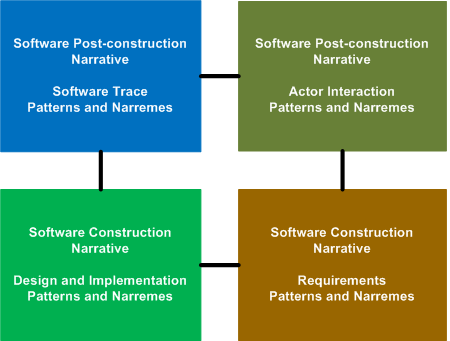
After introducing software narrative planes it is logical to expand the field of software narratology to cover the whole domain of software construction and post-construction. We therefore combine both pairs of planes to create a narratological square:

Please also register for the forthcoming free Webinar: Introduction to Software Narratology where I plan to provide a coherent overview of the recent developments in this new field.

- Dmitry Vostokov @ DumpAnalysis.org + TraceAnalysis.org -
Software Narrative Planes

Sunday, March 11th, 2012

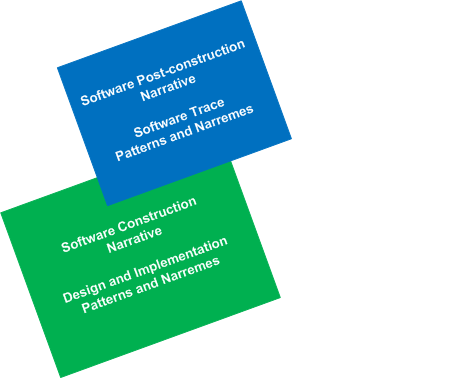
Based on an idea of expression and content planes from glossematics with a basic unit of glosseme we can organize software traces with corresponding patterns and software trace narremes (basic units of software narrative such as traces and event logs) into 2 planes: software trace narrative plane (expression) with narremes and the corresponding program lines of traces (PLOTs) source code and design plane (content) with their own set of construction narremes such as collaboration of software constructs. All this corresponds to the following diagram:

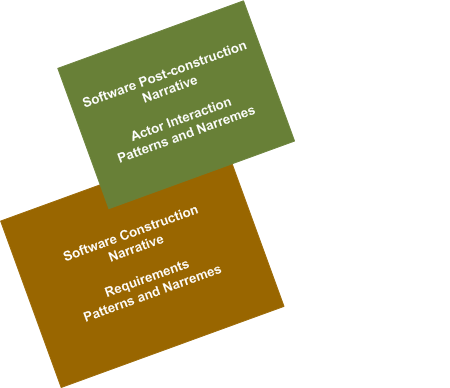
The same can be said about actor interaction level of software construction (what ought to be) and post-construction (what is) phases having their own construction and post-construction narratives, patterns and narremes such as in requirements (use cases) and in problem and software incident descriptions:

In the forthcoming articles I provide more examples and explanations including specific software narremes useful from the practical post-construction software problem solving perspective. Please also register for the forthcoming free Webinar: Introduction to Software Narratology where I plan to provide a coherent overview of this new field.

- Dmitry Vostokov @ DumpAnalysis.org + TraceAnalysis.org -