Archive for August, 2008

DebugWare Patterns (Part 3)

Monday, August 4th, 2008

Many products have lots of configuration parameters stored in OS configuration database, Windows registry. Some of parameters are internal and some are public but never exposed via product GUI or management consoles. Configuration parameters can be related to product functionality or can make troubleshooting and debugging easier, for example, additional tracing parameters to set the verbosity level of debugging output or enable additional safety checks. These parameters can be scattered across different registry branches or keys. Therefore another pattern frequently seen in troubleshooting and debugging tools is called:

Configuration Wrapper

Here excellent example is Microsoft tool:

Gflags

- Dmitry Vostokov @ DumpAnalysis.org -
WinDbg shortcuts: .quit_lock

Sunday, August 3rd, 2008

I always have 10-20 or more simultaneously opened debugging sessions (mostly crash dump files) and sometimes I quit the wrong one accidentally or by mistake. After that I have to repeat some commands if I forgot to open a log file. I was very pleased to find today that there is a special WinDbg meta-command that prevents you from such accidents:

.quit_lock command sets a password to prevent you from accidentally ending the debugging session (from WinDbg help).

Here is an example:

0:001> .quit_lock
No quit lock

0:001> .quit_lock /s "password"
Quit lock string is 'password'

0:001> q
.quit_lock -q required to unlock 'q'

0:001> .quit_lock -q "password"
Quit lock removed

- Dmitry Vostokov @ DumpAnalysis.org -

Dr. Debugalov’s Interaction Diagrams (DIDs)

Saturday, August 2nd, 2008

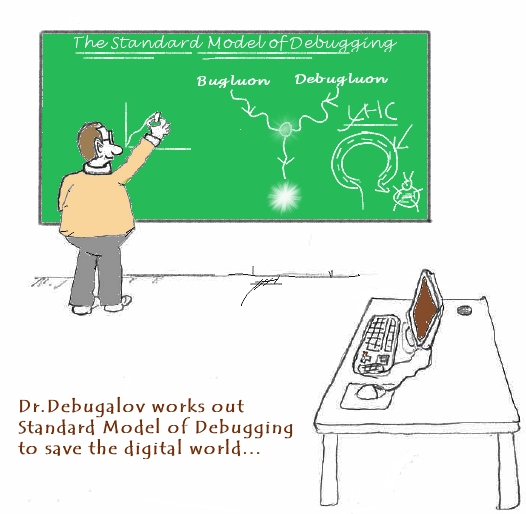
New cartoon from Narasimha Vedala, Science series, illustrates bugluon-debugluon interactions:

Dr. Debugalov works out Standard Model of Debugging to save the digital world

DBG_AntiParticles from Narasimha Vedala (click to enlarge)

For complete explanation, see:

The Standard Model of Debugging

- Dmitry Vostokov @ DumpAnalysis.org -

The Standard Model of Debugging

Friday, August 1st, 2008

This model was inspired by Large Hadron Collider (LHC) and NV’s Debugon. It is a simply-symmetrical model consisting of Bugluon - Debugluon pair of particles where one is a particle and the other is the corresponding antiparticle. The interaction between them is completely of non-gravitational nature. When they annihilate we get the light at the end of a long debugging tunnel, called Large Hard-debugging Collider (LHC). A bugluon particle moving in memory space usually leaves traces and various defects. A photographic picture of tracks left by bugluons is called a memory space dump. The analysis of various track patterns is called memory dump analysis :-)

- Dmitry Vostokov @ DumpAnalysis.org -