Archive for July 26th, 2008

New C/C++ debugging book

Saturday, July 26th, 2008

Just noticed that the new book will be published this August:

The Developer’s Guide to Debugging

Buy from Amazon

Table of contents is available here:

Springer (ISBN: 978-1-4020-5539-3 TOC)

I’ve pre-ordered it and once I get it and read it I’ll post a review.

- Dmitry Vostokov @ DumpAnalysis.org -

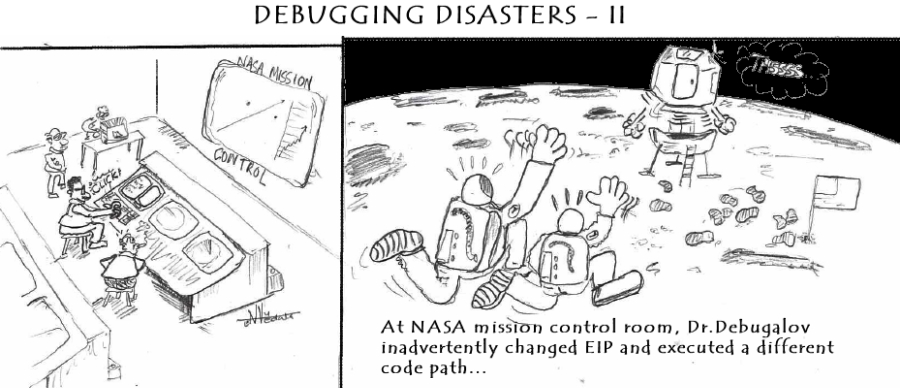
Dr. Debugalov and Debugging Disaster at NASA

Saturday, July 26th, 2008

New cartoon from Narasimha Vedala, Debugging Disasters series (click on it to enlarge):

Debugging Disasters II

DBG_DebuggingDisasters2 from Narasimha Vedala (click to enlarge)

- Dmitry Vostokov @ DumpAnalysis.org -

WinDbg shortcuts: .exptr

Saturday, July 26th, 2008

Some WinDbg commands are very useful as shortcuts to common debugging actions. While working on Windows Debugging Notebook I constantly discover them and here is the first one: .exptr

“The .exptr command displays an EXCEPTION_POINTERS structure.” (from WinDbg help)

When looking at hidden exceptions and manual crash dumps we need information from this structure and this command provides a convenient way to see both exception record and exception context in one unified output:

0:003> kv
ChildEBP RetAddr  Args to Child             
00b3e11c 7c822124 7c83970f 0000004c 00000000 ntdll!KiFastSystemCallRet
00b3e120 7c83970f 0000004c 00000000 00000000 ntdll!NtWaitForSingleObject+0xc
00b3e15c 7c839620 00000000 00000004 00000001 ntdll!RtlpWaitOnCriticalSection+0x19c
00b3e17c 7c832ad0 7c889d94 09150000 7c889e0c ntdll!RtlEnterCriticalSection+0xa8
00b3e1b0 77e68de4 00000001 00000000 00b3e1ec ntdll!LdrLockLoaderLock+0xe4
00b3e210 77e98fae 09150000 00b3e5b0 00000104 kernel32!GetModuleFileNameW+0x77
00b3e24c 77e76d5f 091518b8 00b3e5a4 00000000 kernel32!FillUEFInfo+0x51
00b3e8d4 77e84269 00b3e8fc 77e6b831 00b3e904 kernel32!UnhandledExceptionFilter+0xec
00b3e8dc 77e6b831 00b3e904 00000000 00b3e904 kernel32!BaseThreadStart+0×4a
00b3e904 7c82eeb2 00b3e9e8 00b3ffdc 00b3ea04 kernel32!_except_handler3+0×61
00b3e928 7c82ee84 00b3e9e8 00b3ffdc 00b3ea04 ntdll!ExecuteHandler2+0×26
00b3e9d0 7c82ecc6 00b38000 00b3ea04 00b3e9e8 ntdll!ExecuteHandler+0×24
00b3e9d0 7c832335 00b38000 00b3ea04 00b3e9e8 ntdll!KiUserExceptionDispatcher+0xe (CONTEXT @ 00b3ea04)
00b3eeec 77e67319 00090000 00000000 0000056a ntdll!RtlAllocateHeap+0×9e3
[…]

0:003> .exptr 00b3e8fc

----- Exception record at 00b3e9e8:
ExceptionAddress: 7c832335 (ntdll!RtlAllocateHeap+0x000009e3)
   ExceptionCode: c0000005 (Access violation)
  ExceptionFlags: 00000000
NumberParameters: 2
   Parameter[0]: 00000001
   Parameter[1]: 0008019d
Attempt to write to address 0008019d

----- Context record at 00b3ea04:
eax=0325f1f0 ebx=00000051 ecx=00090000 edx=00090400 esi=0008019d edi=0325f1e8
eip=7c832335 esp=00b3ecd0 ebp=00b3eeec iopl=0 nv up ei ng nz na po cy
cs=001b  ss=0023  ds=0023  es=0023  fs=003b  gs=0000  efl=00010283
ntdll!RtlAllocateHeap+0x9e3:
7c832335 8906            mov     dword ptr [esi],eax  ds:0023:0008019d=01000002

- Dmitry Vostokov @ DumpAnalysis.org -
Dr. Debugalov and Octopus

Saturday, July 26th, 2008

New cartoon from Narasimha Vedala (untold Spiderman tales):

SPIDERMAN 2 - Doc Octopus Gets a Fix

DBG_OctopusDebug from Narasimha Vedala (click to enlarge)

- Dmitry Vostokov @ DumpAnalysis.org -

Crash Dump Analysis Patterns (Part 72)

Saturday, July 26th, 2008

It is important to save crash dumps at the right time, for example, when an error message box is shown as discussed in one of my previous posts:

Crash Dumps for Dummies (Part 7) 

However, sometimes crash dumps are saved after a visual indicator of the problem disappeared and the opportunity to see the stack trace was gone. This pattern is called Lost Opportunity. Here is one example of a service memory dump saved manually after it became unresponsive. In the dump file there was only one thread left excluding the thread created by a debugger:

0:001> ~*kv

   0  Id: a3c.700 Suspend: 1 Teb: 7ff59000 Unfrozen
ChildEBP RetAddr  Args to Child             
1178fd60 7c822124 77e6bad8 00000574 00000000 ntdll!KiFastSystemCallRet
1178fd64 77e6bad8 00000574 00000000 00000000 ntdll!NtWaitForSingleObject+0xc
1178fdd4 77e6ba42 00000574 ffffffff 00000000 kernel32!WaitForSingleObjectEx+0xac
1178fde8 67e223dd 00000574 ffffffff 1178fe10 kernel32!WaitForSingleObject+0x12
1178fdfc 7c82257a 67e20000 00000000 00000001 componentA!DllInitialize+0xed
1178fe1c 7c8118b0 67e222f0 67e20000 00000000 ntdll!LdrpCallInitRoutine+0x14
1178feb8 77e53002 00000000 00000000 00000000 ntdll!LdrShutdownProcess+0x130
1178ffa4 77e53065 c0000005 77e8f3b0 ffffffff kernel32!_ExitProcess+0×43
1178ffb8 77e84277 c0000005 00000000 00000000 kernel32!ExitProcess+0×14
1178ffec 00000000 77c5de6d 0a078138 00000000 kernel32!BaseThreadStart+0×5f

#  1  Id: a3c.18bc Suspend: 1 Teb: 7ffde000 Unfrozen
ChildEBP RetAddr  Args to Child             
0a6cffc8 7c845ea0 00000005 00000004 00000001 ntdll!DbgBreakPoint
0a6cfff4 00000000 00000000 00905a4d 00000003 ntdll!DbgUiRemoteBreakin+0x36

We also see exception code 0xc0000005 as ExitProcess parameter. The raw stack reveals the call to NtRaiseHardError function that definitely resulted in some error message box:

0:001> ~0s
[...]

0:000> !teb
TEB at 7ff59000
    ExceptionList:        1178fdc4
    StackBase:            11790000
    StackLimit:           11789000
    SubSystemTib:         00000000
    FiberData:            00001e00
    ArbitraryUserPointer: 00000000
    Self:                 7ff59000
    EnvironmentPointer:   00000000
    ClientId:             00000a3c . 00000700
    RpcHandle:            00000000
    Tls Storage:          00000000
    PEB Address:          7ffdf000
    LastErrorValue:       0
    LastStatusValue:      c0000008
    Count Owned Locks:    0
    HardErrorMode:        0

0:000> dds 11789000  11790000
11789000  00000000
11789004  00000000
11789008  00000000
1178900c  00000000
11789010  00000000
[...]
1178f058  0a4016f4
1178f05c  1178efe0
1178f060  695040c4 <Unloaded_faultrep.dll>+0x40c4
1178f064  7ffdf000
1178f068  00000000
1178f06c  0a4016f4
1178f070  0a4016f4
1178f074  00000000
1178f078  1178f06c
1178f07c  0a4016b8
1178f080  0a4016b8
1178f084  1178efa0
1178f088  7c821b74 ntdll!NtRaiseHardError+0xc
1178f08c  77e99af9 kernel32!UnhandledExceptionFilter+0×54b
1178f090  d0000144
1178f094  00000004
1178f098  00000000
1178f09c  1178f164
1178f0a0  00000001
1178f0a4  77e996a7 kernel32!UnhandledExceptionFilter+0×873
1178f0a8  00000000
1178f0ac  00000000
1178f0b0  00000000
1178f0b4  02f049f0
1178f0b8  1178f13c
1178f0bc  00000000
[…]

It was that time when the dump should have been saved. See also Process crash - getting the dump manually post for another example and full explanation.

- Dmitry Vostokov @ DumpAnalysis.org -
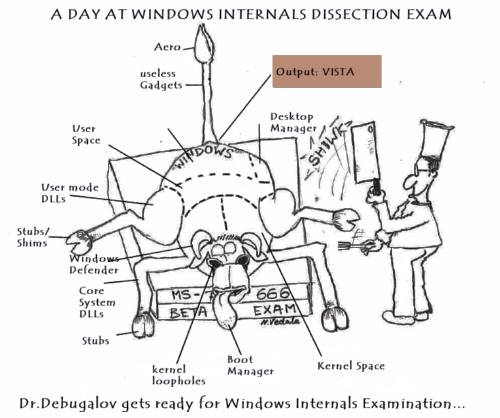
Dr. Debugalov dissects Windows Internals

Saturday, July 26th, 2008

New cartoon from Narasimha Vedala provides an artist perspective:

A Day at Windows Internals Dissection Exam

DBG_DocAttemptsWindowsInternalsExam from Narasimha Vedala (click to enlarge)

- Dmitry Vostokov @ DumpAnalysis.org -

Heap and spike: pattern cooperation

Saturday, July 26th, 2008

This is another case study showing how different patterns interact. It was reported that the service was spiking CPU (see Spiking Thread pattern) and other processes couldn’t communicate with it (see Coupled Processes pattern). The dump was saved using userdump.exe and !runaway command showed that the thread #18 was consuming CPU mostly in user mode:

0:018> !runaway 0y11
 User Mode Time
  Thread       Time
  18:6080      0 days 20:46:57.156
   3:2838      0 days 0:00:00.203
   5:53a0      0 days 0:00:00.093
  16:44a8      0 days 0:00:00.078
  17:2ad8      0 days 0:00:00.046
  19:5834      0 days 0:00:00.015
[…]
   0:57d4      0 days 0:00:00.000
 Kernel Mode Time
  Thread       Time
   5:53a0      0 days 0:00:03.328
   3:2838      0 days 0:00:01.046
  16:44a8      0 days 0:00:00.937
  18:6080      0 days 0:00:00.765
  17:2ad8      0 days 0:00:00.531
  19:5834      0 days 0:00:00.171
  20:3174      0 days 0:00:00.140
[…]

Its thread stack revealed runtime heap manipulation function on top of it:

0:018> ~18kL
ChildEBP RetAddr 
0207f748 77e673ca ntdll!RtlFreeHeap+0×4a5
0207f7b0 77e67690 kernel32!BasepComputeProcessPath+0×395
0207f7b0 77e67690 kernel32!BaseComputeProcessDllPath+0xe3
0207f7f0 77e41b95 kernel32!BaseComputeProcessDllPath+0xe3
0207f850 710f43d9 kernel32!LoadLibraryExW+0×14e
[…]

The parameters to RtlFreeHeap call are described in the following MSDN article:

http://msdn.microsoft.com/en-us/library/ms796710.aspx

We see that the code was freeing the heap block with the address 0×02f88278 and it was located in the first heap 0×00090000:

0:018> ~18kv
ChildEBP RetAddr  Args to Child             
0207f748 77e673ca 00090000 00000000 02f88278 ntdll!RtlFreeHeap+0×4a5
[…]

0:018> !heap
Index   Address  Name      Debugging options enabled
  1:   00090000               
  2:   00190000               
  3:   003b0000               
  4:   00340000               
  5:   00380000               
  6:   007d0000               
  7:   008e0000               
  8:   00a40000               
  9:   00ae0000               
 10:   00c60000               
 11:   00cf0000               
 12:   00d30000               
 13:   00d40000               
 14:   00ed0000               
 15:   01010000               
 16:   01090000               
 17:   00a20000               
 18:   00c90000               
 19:   00fd0000               
 20:   01690000               
 21:   01b30000               
 22:   01b50000               
 23:   01c20000               
 24:   01e50000               
 25:   01f20000               
 26:   01f30000               
 27:   01f40000
               

Could it be the case that the heap was corrupt? We can validate it:

0:018> !heap -s 00090000
Walking the heap 00090000 .HEAP 00090000 (Seg 00090640) At 00184998 Error: invalid block size

.List corrupted: (Blink->Flink = 00000000) != (Block = 02f88278)
HEAP 00090000 (Seg 02f80000) At 02f88270 Error: block list entry corrupted

[...]

The output shows our block 0×02f88278 too but this could also be the effect of False Positive Corruption, the fact that the heap control structures had not been updated yet: the thread is inside heap manipulation function. 

When looking at critical sections and other threads we also see several wait chains (see Wait Chain pattern): 

0:000> !locks

CritSec ntdll!LdrpLoaderLock+0 at 7c889d94
WaiterWoken        No
LockCount          18
RecursionCount     1
OwningThread       2300
EntryCount         0
ContentionCount    141
*** Locked

CritSec ntdll!FastPebLock+0 at 7c889d40
WaiterWoken        No
LockCount          1
RecursionCount     1
OwningThread       2904
EntryCount         0
ContentionCount    2
*** Locked

CritSec +90608 at 00090608
WaiterWoken        No
LockCount          7
RecursionCount     1
OwningThread       6080
EntryCount         0
ContentionCount    7
*** Locked

CritSec serviceA!ServiceSection+0 at 7617c340
WaiterWoken        No
LockCount          5
RecursionCount     1
OwningThread       2838
EntryCount         0
ContentionCount    1e3
*** Locked

0:000> ~*kv

[...]

3 Id: da4.2838 Suspend: 1 Teb: 7ffdc000 Unfrozen
ChildEBP RetAddr Args to Child
00c4f164 7c822124 7c83970f 00000688 00000000 ntdll!KiFastSystemCallRet
00c4f168 7c83970f 00000688 00000000 00000000 ntdll!NtWaitForSingleObject+0xc
00c4f1a4 7c839620 00000000 00000004 00090000 ntdll!RtlpWaitOnCriticalSection+0x19c
00c4f1c4 7c82fe72 00090608 000995b8 00000008 ntdll!RtlEnterCriticalSection+0xa8
00c4f3ec 7c81f4d5 00090000 00800000 000000f8 ntdll!RtlAllocateHeap+0×313
00c4f434 7c81f073 000995b8 00000000 00090000 ntdll!RtlpAllocateUserBlock+0×91
00c4f4f8 7c81ff83 00000bbe 00000000 00000001 ntdll!RtlpLowFragHeapAlloc+0×862
00c4f71c 7c820b23 00090000 00000000 0000000c ntdll!RtlAllocateHeap+0×80
00c4f734 77f6599e 00c4f7b8 00000001 00000002 ntdll!RtlAllocateAndInitializeSid+0×35
00c4f768 74062bfd 00c4f7b8 00000001 00000002 advapi32!AllocateAndInitializeSid+0×2c
[…]

[...]

18 Id: da4.6080 Suspend: 1 Teb: 7ffa8000 Unfrozen
[This is our spiking thread]
[...]

[...]

32 Id: da4.2904 Suspend: 1 Teb: 7ff9a000 Unfrozen
ChildEBP RetAddr Args to Child
0356fbfc 7c822124 7c83970f 00000688 00000000 ntdll!KiFastSystemCallRet
0356fc00 7c83970f 00000688 00000000 00000000 ntdll!NtWaitForSingleObject+0xc
0356fc3c 7c839620 00000000 00000004 00090000 ntdll!RtlpWaitOnCriticalSection+0x19c
0356fc5c 7c82fe72 00090608 7c8329a4 0000008e ntdll!RtlEnterCriticalSection+0xa8
0356fe84 77e67319 00090000 00000000 0000056a ntdll!RtlAllocateHeap+0×313
0356fee8 77e67690 77e676bc 00020a50 00000000 kernel32!BasepComputeProcessPath+0xc2
0356ff28 77e41b95 00000000 00000000 7c82f337 kernel32!BaseComputeProcessDllPath+0xe3
0356ff88 77e67b77 74066908 00000000 00000000 kernel32!LoadLibraryExW+0×14e
0356ff9c 74071b74 74066908 74075320 74071c1c kernel32!LoadLibraryW+0×11
[…]

  33  Id: da4.2300 Suspend: 1 Teb: 7ff99000 Unfrozen
ChildEBP RetAddr  Args to Child             
035afb40 7c822124 7c83970f 00000164 00000000 ntdll!KiFastSystemCallRet
035afb44 7c83970f 00000164 00000000 00000000 ntdll!NtWaitForSingleObject+0xc
035afb80 7c839620 00000000 00000004 00000000 ntdll!RtlpWaitOnCriticalSection+0x19c
035afba0 7c83288c 7c889d40 77e630b8 00000000 ntdll!RtlEnterCriticalSection+0xa8
035afba8 77e630b8 00000000 007e5860 00000001 ntdll!RtlAcquirePebLock+0×11
[…]

[...]

18 threads -> TID#2300 -> TID#2904 -> TID#6080

5 threads -> TID#2838 -> TID#6080

So it looks like our spiking thread was the main problem and preventing other threads from running.

- Dmitry Vostokov @ DumpAnalysis.org -