Icons for Memory Dump Analysis Patterns (Part 83)
October 27th, 2010Today we introduce an icon for Deadlock (self) pattern:
B/W
![]()
Color
![]()
- Dmitry Vostokov @ DumpAnalysis.org + TraceAnalysis.org -
Today we introduce an icon for Deadlock (self) pattern:
B/W
![]()
Color
![]()
- Dmitry Vostokov @ DumpAnalysis.org + TraceAnalysis.org -
This is a variation of a deadlock pattern where a thread that owns a resource (either in shared or exclusive mode) attempts to acquire it exclusively again. This results in a self-deadlock:
Resource @ 0x85d9c018 Shared 1 owning threads
Contention Count = 2
NumberOfExclusiveWaiters = 2
Threads: 85db0030-02<*>
Threads Waiting On Exclusive Access:
85f07d78 85db0030
- Dmitry Vostokov @ DumpAnalysis.org + TraceAnalysis.org -
When I started getting several process memory dumps with very similar crash dispositions I decided to factor them into a separate pattern called Problem Exception Handler. This usually happens with custom exception handlers not written according to prescribed rules (for example, a handler for a non-continuable exception) or have other defects common to normal code.
In the example below we have a different stack trace epilogue for a similar issue that shows a relationship with a custom exception handler:
0:000> kv 1000
ChildEBP RetAddr Args to Child
0003300c 77af9904 77b8929c 792ea99b 00000000 ntdll!RtlAcquireSRWLockShared+0x1a
00033058 77af9867 00406ef8 00033098 000330a0 ntdll!RtlLookupFunctionTable+0×2a
000330a8 77af97f9 00406ef8 00000000 00000000 ntdll!RtlIsValidHandler+0×26
00033128 77b25dd7 01033140 00033154 00033140 ntdll!RtlDispatchException+0×10b
00033128 77b40726 01033140 00033154 00033140 ntdll!KiUserExceptionDispatcher+0xf (CONTEXT @ 00033154)
00033490 77b25dd7 010334a8 000334bc 000334a8 ntdll!RtlDispatchException+0×18a
00033490 77b40726 010334a8 000334bc 000334a8 ntdll!KiUserExceptionDispatcher+0xf (CONTEXT @ 000334bc)
000337f8 77b25dd7 01033810 00033824 00033810 ntdll!RtlDispatchException+0×18a
[…]
0012f228 77b40726 0112f240 0012f254 0012f240 ntdll!KiUserExceptionDispatcher+0xf (CONTEXT @ 0012f254)
0012f590 77b25dd7 0112f5a8 0012f5d8 0012f5a8 ntdll!RtlDispatchException+0×18a
0012f590 768bfbae 0112f5a8 0012f5d8 0012f5a8 ntdll!KiUserExceptionDispatcher+0xf (CONTEXT @ 0012f5d8)
0012f8f4 0059ecad 0eedfade 00000001 00000007 kernel32!RaiseException+0×58
WARNING: Stack unwind information not available. Following frames may be wrong.
0012f918 00473599 0eedfade 00000001 00000007 Application+0×19ecad
[…]
0012ff88 768cd0e9 7ffdf000 0012ffd4 77b019bb Application+0×70f8
0012ff94 77b019bb 7ffdf000 793f6617 00000000 kernel32!BaseThreadInitThunk+0xe
0012ffd4 77b0198e 011263c0 7ffdf000 ffffffff ntdll!__RtlUserThreadStart+0×23
0012ffec 00000000 011263c0 7ffdf000 00000000 ntdll!_RtlUserThreadStart+0×1b
0:000> !exchain
00033048: ntdll!_except_handler4+0 (77ac99fa)
0012ff78: Application+6ef8 (00406ef8)
0012ffc4: ntdll!_except_handler4+0 (77ac99fa)
0012ffe4: ntdll!FinalExceptionHandler+0 (77b66f9b)
Invalid exception stack at ffffffff
- Dmitry Vostokov @ DumpAnalysis.org + TraceAnalysis.org -
Sometimes when looking at a module list (lmv WinDbg command) we see the presence of the whole Pervasive System. It is not just a module that does function and/or message hooking but the whole system of modules from a single vendor that is context-aware (for example, reads its configuration from registry) and consists of several components that communicate with other processes. The penetrating system is supposed to add some additional value or to coexist peacefully in a larger environment. The system thus becomes coupled strongly and/or weakly with other processes it was never intended to work with as opposed to intended module variety. At one extreme modules from pervasive system can be ubiquitous and at the other end hidden. In such cases troubleshooting consists of the total removal of pervasive modules and if the problem disappears their exclusion one by one to find the problem component.
- Dmitry Vostokov @ DumpAnalysis.org + TraceAnalysis.org -
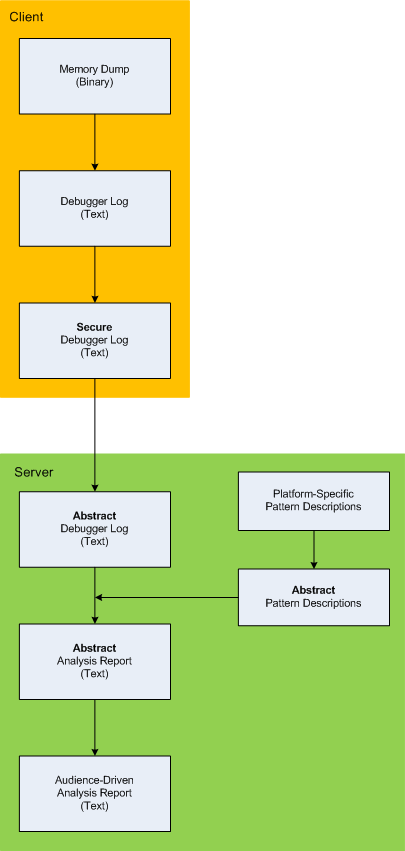
Here is the description of a high-level architecture of the previously announced project CARE (Crash Analysis Report Environment). To remind, the main idea of the project is to process memory dumps on a client to save debugger logs. They can be sent to a server for pattern-driven analysis of software behaviour. Textual logs can also be inspected by a client security team before sending. Certain sensitive information can be excluded or modified to have generic meaning according to the built-in processing rules like renaming (for example, server names and folders). Before processing, verified secured logs are converted to abstract debugger logs. Abstracting platform-specific debugger log format allows reuse of the same architecture for different computer platforms. We call it CIA (Computer Independent Architecture). Do not confuse it with ICA (Independent Computer Architecture) and CIA acronym is more appropriate for memory analysis (like similar MAFIA acronym, Memory Analysis Forensics and Intelligence Architecture). These abstract logs are checked for various patterns (in abstracted form) using abstract debugger commands and an abstract report is generated according to various checklists. Abstract reports are then converted to structured reports for the required audience level. Abstract memory analysis pattern descriptions are prepared from platform-specific pattern descriptions. In certain architectural component deployment configurations both client and server parts can reside on the same machine. Here’s the simple diagram depicting the flow of processing:

- Dmitry Vostokov @ DumpAnalysis.org + TraceAnalysis.org -
I detour for MARS expedition. You may also call it Memory Analysis Report System as malware analysis is always exploration of memory (in general). Why is this sudden change of course? After reading Gilles Deleuze I want to broaden the concept of “malware” and give it new orientation and direction of thinking. Beside that I also want new challenges after many years of research in pattern-driven memory dump and software trace analysis of abnormal software behaviour.
You may have also noticed small restructuring (rebranding) of this blog and DumpAnalysis.org headers.
See you there
- Dmitry Vostokov @ DumpAnalysis.org + TraceAnalysis.org -
Today we introduce an icon for False Function Parameters pattern:
B/W
![]()
Color
![]()
- Dmitry Vostokov @ DumpAnalysis.org + TraceAnalysis.org -
As a practical example of applying behavioral and structural pattern analysis of computer memory and traces OpenTask plans to publish the following title next year:
The inclusion of victimware is necessary because of the effects of defective malware.
- Dmitry Vostokov @ DumpAnalysis.org + TraceAnalysis.org -
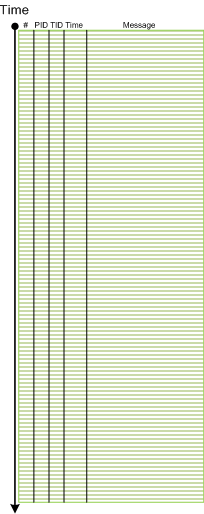
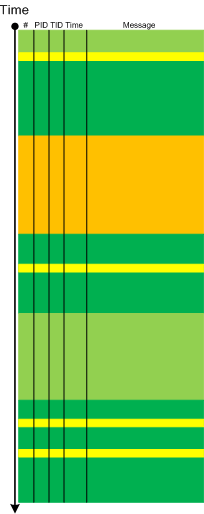
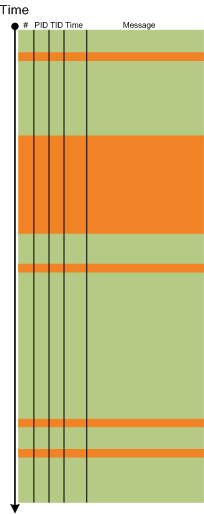
The next pattern with the name borrowed from historiography is Layered Periodization. This periodization of software trace messages includes individual messages, then aggregated messages from threads, then processes as wholes and finally individual computers (in client-server or similar sense). This is best illustrated graphically.
Message layer:

Thread layer (different colors correspond to different TID):

Process layer (different colors correspond to different PID):

Please note that it is also possible to have a periodization based on modules, functions and individual messages but it might be complicated because different threads can enter the same module or function and here other patterns more appropriate like Activity Region, Characteristic Message Block, and Background and Foreground Components.
- Dmitry Vostokov @ DumpAnalysis.org + TraceAnalysis.org -
One of my home computers got infected. I confess that I don’t have an antivirus because I’m conscious while browsing Internet (the last infected machine I had was an MSDOS one) so perhaps one of my family members was less careful. I paid attention to the possible infection when IE started crashing when I was pushing a login button on one of online banking websites. However I didn’t pay enough attention because it was a heap corruption (see my previous case study) and simply switched to another non-crashing browser vendor such as Apple Safari. Since then IE was crashing periodically when I was pushing various admin buttons in WordPress but I didn’t pay much attention too because it was still heap corruption and I was thinking it was a script processing defect, waiting for a new IE update. Until one day explorer.exe crashed as well when I was entering a password for an ftp account. Here’s the stack trace that I got after opening a crash dump in WinDbg:
0:030> kL 100
ChildEBP RetAddr
0663e9c4 76f05610 ntdll!KiFastSystemCallRet
0663e9c8 7706a5d7 ntdll!NtWaitForMultipleObjects+0xc
0663ea64 7706a6f0 kernel32!WaitForMultipleObjectsEx+0×11d
0663ea80 770de2a5 kernel32!WaitForMultipleObjects+0×18
0663eaec 770de4d1 kernel32!WerpReportFaultInternal+0×16d
0663eb00 770bff4d kernel32!WerpReportFault+0×70
0663eb8c 76f17fc1 kernel32!UnhandledExceptionFilter+0×1b5
0663eb94 76ea9bdc ntdll!__RtlUserThreadStart+0×6f
0663eba8 76ea4067 ntdll!_EH4_CallFilterFunc+0×12
0663ebd0 76f05f79 ntdll!_except_handler4+0×8e
0663ebf4 76f05f4b ntdll!ExecuteHandler2+0×26
0663eca4 76f05dd7 ntdll!ExecuteHandler+0×24
0663eca4 93181a08 ntdll!KiUserExceptionDispatcher+0xf
WARNING: Frame IP not in any known module. Following frames may be wrong.
0663efa0 0321aaaf 0×93181a08
0663efac 6b887974 0×321aaaf
0663efbc 6b8973ad msieftp!InternetCloseHandleWrap+0×10
0663f810 6b897fbf msieftp!CFtpSite::_QueryServerFeatures+0×57
0663fa50 6b8981ae msieftp!CFtpSite::_LoginToTheServer+0×235
0663fa94 6b88b39e msieftp!CFtpSite::GetHint+0xe8
0663fab4 6b88b412 msieftp!CFtpDir::GetHint+0×1f
0663fae4 6b88ed38 msieftp!CFtpDir::WithHint+0×49
0663fb10 6b88eda4 msieftp!CFtpEidl::_Init+0×6e
0663fb2c 7584ecb4 msieftp!CFtpEidl::Next+0×41
0663fb64 7584f63b shell32!CEnumThread::_EnumFolder+0×65
0663fb80 7584f5ba shell32!CEnumThread::_RunEnum+0×6f
0663fb8c 7645c2c9 shell32!CEnumThread::s_EnumThreadProc+0×14
0663fc10 7706d0e9 shlwapi!WrapperThreadProc+0×11c
0663fc1c 76ee19bb kernel32!BaseThreadInitThunk+0xe
0663fc5c 76ee198e ntdll!__RtlUserThreadStart+0×23
0663fc74 00000000 ntdll!_RtlUserThreadStart+0×1b
Notice 0×321aaaf address. We see that wininet function was hooked by a code running in 0×0321XXXX range:
0:030> ub 6b887974
msieftp!InternetOpenWrap+0×46:
6b887963 cc int 3
msieftp!InternetCloseHandleWrap:
6b887964 8bff mov edi,edi
6b887966 55 push ebp
6b887967 8bec mov ebp,esp
6b887969 56 push esi
6b88796a ff7508 push dword ptr [ebp+8]
6b88796d 33f6 xor esi,esi
6b88796f e82e610100 call msieftp!InternetCloseHandle (6b89daa2)
0:030> u 6b89daa2
msieftp!InternetCloseHandle:
6b89daa2 ff2500278a6b jmp dword ptr [msieftp!_imp__InternetCloseHandle (6b8a2700)]
msieftp!_imp_load__InternetConnectW:
6b89daa8 b834278a6b mov eax,offset msieftp!_imp__InternetConnectW (6b8a2734)
6b89daad e9b4feffff jmp msieftp!_tailMerge_WININET_dll (6b89d966)
6b89dab2 cc int 3
6b89dab3 cc int 3
6b89dab4 cc int 3
6b89dab5 cc int 3
6b89dab6 cc int 3
0:030> dp 6b8a2700 l1
6b8a2700 76dc9088
0:030> u 76dc9088
wininet!InternetCloseHandle:
76dc9088 e9031a458c jmp 0321aa90
76dc908d 51 push ecx
76dc908e 51 push ecx
76dc908f 53 push ebx
76dc9090 56 push esi
76dc9091 57 push edi
76dc9092 33db xor ebx,ebx
76dc9094 33ff xor edi,edi
0:030> u 0321aa90
0321aa90 55 push ebp
0321aa91 8bec mov ebp,esp
0321aa93 837d0800 cmp dword ptr [ebp+8],0
0321aa97 740c je 0321aaa5
0321aa99 8b4508 mov eax,dword ptr [ebp+8]
0321aa9c 50 push eax
0321aa9d e82eedffff call 032197d0
0321aaa2 83c404 add esp,4
This address range was not on a loaded module list so I used image scanning command to detect Hidden Module:
0:030> .imgscan
MZ at 00080000, prot 00000002, type 01000000 - size 2cd000
Name: explorer.exe
MZ at 003d0000, prot 00000002, type 00040000 - size 2000
MZ at 018a0000, prot 00000008, type 00040000 - size 7000
MZ at 031c0000, prot 00000008, type 00040000 - size 3000
MZ at 031d0000, prot 00000002, type 01000000 - size c000
Name: DLAAPI_W.DLL
MZ at 03210000, prot 00000040, type 00020000 - size 1d000
[…]
!dh command was not showing any useful hints so I dumped the whole address range of that Unknown Component and found strange strings inside:
0:030> db 03210000 03210000+1d000
[...]
032246d0 2a 00 00 00 2a 00 00 00-42 6c 61 63 6b 77 6f 6f *...*...Blackwoo
032246e0 64 50 52 4f 00 00 00 00-46 69 6e 61 6d 44 69 72 dPRO....FinamDir
032246f0 65 63 74 00 47 72 61 79-42 6f 78 00 4d 62 74 50 ect.GrayBox.MbtP
03224700 52 4f 00 00 4c 61 73 65-72 00 00 00 4c 69 67 68 RO..Laser...Ligh
03224710 74 53 70 65 65 64 00 00-4c 54 47 72 6f 75 70 00 tSpeed..LTGroup.
03224720 4d 62 74 00 53 63 6f 74-54 72 61 64 65 72 00 00 Mbt.ScotTrader..
03224730 53 61 78 6f 54 72 61 64-65 72 00 00 00 00 00 00 SaxoTrader......
03224740 50 72 6f 67 72 61 6d 3a-20 20 20 25 73 0d 0a 55 Program: %s..U
03224750 73 65 72 6e 61 6d 65 3a-20 20 25 73 0d 0a 50 61 sername: %s..Pa
03224760 73 73 77 6f 72 64 3a 20-20 25 73 0d 0a 41 63 63 ssword: %s..Acc
03224770 6f 75 6e 74 4e 4f 3a 20-25 73 0d 0a 53 65 72 76 ountNO: %s..Serv
03224780 65 72 3a 20 20 20 20 25-73 0d 0a 00 5c 00 00 00 er: %s...\...
03224790 25 73 20 25 73 00 00 00-25 73 00 00 50 52 4f 43 %s %s...%s..PROC
032247a0 45 53 53 4f 52 5f 49 44-45 4e 54 49 46 49 45 52 ESSOR_IDENTIFIER
032247b0 00 00 00 00 25 64 00 00-25 30 32 58 00 00 00 00 ....%d..%02X....
032247c0 30 00 00 00 2c 00 00 00-25 30 32 58 00 00 00 00 0...,...%02X....
[...]
03225000 01 01 00 00 5c 00 63 00-68 00 6b 00 6e 00 74 00 ....\.c.h.k.n.t.
03225010 66 00 73 00 2e 00 65 00-78 00 65 00 00 00 00 00 f.s...e.x.e.....
03225020 5c 00 63 00 68 00 6b 00-6e 00 74 00 66 00 73 00 \.c.h.k.n.t.f.s.
03225030 2e 00 64 00 61 00 74 00-00 00 00 00 a6 b7 04 5e ..d.a.t........^
[...]
I didn’t pay attention to chkntfs.exe but did a search for SaxoTrader string in all files using findstr command and found chkntfs.exe as a system file in Start Menu \ Programs \ Startup folder in roaming user AppData. I couldn’t remove it so I had to boot in command line mode to do that. The crashes were gone since that. I double checked various iexplore.exe crash dumps saved previously and found the same module loaded, for example:
0:005> .imgscan
MZ at 00040000, prot 00000040, type 00020000 - size 1d000
MZ at 00340000, prot 00000002, type 01000000 - size 9c000
Name: iexplore.exe
[…]
Here we consider IE and Explorer as victimware of malware.
- Dmitry Vostokov @ DumpAnalysis.org + TraceAnalysis.org -
In order to start the analysis of a structured memory snapshot a debugger engine needs Anchor Region that describes memory layout and where to start unfolding of analysis. For example, it can be a list of modules (another forthcoming structural pattern). We can observe the importance of such regions when we try to open corrupt or severely truncated memory dumps:
[...]
KdDebuggerDataBlock is not present or unreadable.
[...]
Unable to read PsLoadedModuleList
[...]
For certain types of memory snapshots (like software traces) an anchor region coinsides with its structure description (message trace format for structured snapshots) and a trace file header (if any) for aggregate snapshots.
- Dmitry Vostokov @ DumpAnalysis.org + TraceAnalysis.org -
Shared Buffer Overwrite differs from Local Buffer Overflow and heap / pool memory corruption patterns in not writing over control structures situated at dynamically allocated memory or procedure frame (local call stack) boundaries. Its effect is visible when the buffer data contains pointers that become wild after the overwrite and are later dereferenced resulting in a crash. For example, when the overwriting data contains UNICODE and /or ASCII characters we see them in a pointer data:
1: kd> !analyze -v
[...]
SYSTEM_THREAD_EXCEPTION_NOT_HANDLED (7e)
This is a very common bugcheck. Usually the exception address pinpoints
the driver/function that caused the problem. Always note this address
as well as the link date of the driver/image that contains this address.
Arguments:
Arg1: c0000005, The exception code that was not handled
Arg2: 8086c949, The address that the exception occurred at
Arg3: f78eec54, Exception Record Address
Arg4: f78ee950, Context Record Address
[...]
EXCEPTION_RECORD: f78eec54 -- (.exr 0xfffffffff78eec54)
ExceptionAddress: 8086c949 (nt!ObfDereferenceObject+0x00000023)
ExceptionCode: c0000005 (Access violation)
ExceptionFlags: 00000000
NumberParameters: 2
Parameter[0]: 00000001
Parameter[1]: 006f0058
Attempt to write to address 006f0058
CONTEXT: f78ee950 -- (.cxr 0xfffffffff78ee950)
eax=f78e0001 ebx=ffffffff ecx=006f0070 edx=00000000 esi=006f0058 edi=8087cdae
eip=8086c949 esp=f78eed1c ebp=f78eed2c iopl=0 nv up ei ng nz na pe nc
cs=0008 ss=0010 ds=0023 es=0023 fs=0030 gs=0000 efl=00010286
nt!ObfDereferenceObject+0×23:
8086c949 f00fc11e lock xadd dword ptr [esi],ebx ds:0023:006f0058=????????
[...]
STACK_TEXT:
f78eed2c f707212e 886e6530 f78eed80 f706e04e nt!ObfDereferenceObject+0x23
f78eed38 f706e04e e47b1258 8b2fcb40 808ae5c0 DriverA!CloseConnection+0x16
f78eed80 80880475 8835f248 00000000 8b2fcb40 DriverA!Resume+0x9f
f78eedac 80949c5a 8835f248 00000000 00000000 nt!ExpWorkerThread+0xeb
f78eeddc 8088e0c2 8088038a 00000000 00000000 nt!PspSystemThreadStartup+0x2e
00000000 00000000 00000000 00000000 00000000 nt!KiThreadStartup+0x16
1: kd> ub f707212e
DriverA!CloseConnection+0x2:
f707211a push ebp
f707211b mov ebp,esp
f707211d push esi
f707211e mov esi,dword ptr [ebp+8]
f7072121 mov ecx,dword ptr [esi+14h]
f7072124 test ecx,ecx
f7072126 je DriverA!CloseConnection+0x1a (f7072132)
f7072128 call dword ptr [DriverA!_imp_ObfDereferenceObject (f70610f4)]
1: kd> db e47b1258 L20
e47b1258 61 67 65 20 57 72 69 74-65 72 00 05 77 00 69 00 age Writer..w.i.
e47b1268 6e 00 73 00 70 00 6f 00-6f 00 6c 00 2c 00 4e 00 n.s.p.o.o.l.,.N.
1: kd> !pool e47b1258
Pool page e47b1258 region is Paged pool
e47b1000 size: 108 previous size: 0 (Allocated) CM39
e47b1108 size: 38 previous size: 108 (Free) CMVa
e47b1140 size: 28 previous size: 38 (Allocated) NtFs
e47b1168 size: 8 previous size: 28 (Free) CMDa
e47b1170 size: 80 previous size: 8 (Allocated) FSim
e47b11f0 size: 28 previous size: 80 (Allocated) CMNb (Protected)
*e47b1218 size: 70 previous size: 28 (Allocated) *CMDa
Pooltag CMDa : value data cache pool tag, Binary : nt!cm
e47b1288 size: 58 previous size: 70 (Allocated) Sect (Protected)
e47b12e0 size: 18 previous size: 58 (Allocated) Ntf0
e47b12f8 size: 28 previous size: 18 (Allocated) NtFs
e47b1320 size: 20 previous size: 28 (Allocated) CMNb (Protected)
e47b1340 size: 48 previous size: 20 (Allocated) Ntfc
e47b1388 size: 68 previous size: 48 (Allocated) Sect (Protected)
e47b13f0 size: 30 previous size: 68 (Allocated) CMVa
e47b1420 size: 38 previous size: 30 (Allocated) CMVa
e47b1458 size: 8 previous size: 38 (Free) CMVa
e47b1460 size: 48 previous size: 8 (Allocated) CMVa
e47b14a8 size: d0 previous size: 48 (Allocated) Ntfo
e47b1578 size: 330 previous size: d0 (Allocated) Ntff
e47b18a8 size: 10 previous size: 330 (Free) NtfE
e47b18b8 size: e0 previous size: 10 (Allocated) Ntfo
e47b1998 size: 40 previous size: e0 (Allocated) MmSm
e47b19d8 size: 8 previous size: 40 (Free) Ica
e47b19e0 size: 18 previous size: 8 (Allocated) Ntf0
e47b19f8 size: 68 previous size: 18 (Allocated) CMDa
e47b1a60 size: 28 previous size: 68 (Allocated) ObNm
e47b1a88 size: b8 previous size: 28 (Allocated) Port (Protected)
e47b1b40 size: 58 previous size: b8 (Allocated) Sect (Protected)
e47b1b98 size: 30 previous size: 58 (Allocated) CMVa
e47b1bc8 size: 8 previous size: 30 (Free) NtFA
e47b1bd0 size: 100 previous size: 8 (Allocated) IoNm
e47b1cd0 size: 18 previous size: 100 (Allocated) ObDi
e47b1ce8 size: 38 previous size: 18 (Allocated) CMnb Process: 88469928
e47b1d20 size: 78 previous size: 38 (Free ) NtFI
e47b1d98 size: 68 previous size: 78 (Allocated) CMDa
e47b1e00 size: 18 previous size: 68 (Allocated) PsIm (Protected)
e47b1e18 size: e8 previous size: 18 (Free ) TunP
e47b1f00 size: 100 previous size: e8 (Allocated) IoNm
Another example:
0: kd> !analyze -v
[...]
SYSTEM_THREAD_EXCEPTION_NOT_HANDLED (7e)
This is a very common bugcheck. Usually the exception address pinpoints
the driver/function that caused the problem. Always note this address
as well as the link date of the driver/image that contains this address.
Arguments:
Arg1: c0000005, The exception code that was not handled
Arg2: 8083e4d6, The address that the exception occurred at
Arg3: f78cec54, Exception Record Address
Arg4: f78ce950, Context Record Address
[...]
EXCEPTION_RECORD: f78cec54 -- (.exr 0xfffffffff78cec54)
ExceptionAddress: 8083e4d6 (nt!ObfDereferenceObject+0x00000023)
ExceptionCode: c0000005 (Access violation)
ExceptionFlags: 00000000
NumberParameters: 2
Parameter[0]: 00000001
Parameter[1]: 65696c2b
Attempt to write to address 65696c2b
CONTEXT: f78ce950 -- (.cxr 0xfffffffff78ce950)
eax=f78c0001 ebx=ffffffff ecx=65696c43 edx=00000000 esi=65696c2b edi=8083e407
eip=8083e4d6 esp=f78ced1c ebp=f78ced2c iopl=0 nv up ei ng nz na pe nc
cs=0008 ss=0010 ds=0023 es=0023 fs=0030 gs=0000 efl=00010286
nt!ObfDereferenceObject+0×23:
8083e4d6 f00fc11e lock xadd dword ptr [esi],ebx ds:0023:65696c2b=????????
Resetting default scope
[...]
STACK_TEXT:
f78ced2c f71bd12e 87216470 f78ced80 f71b904e nt!ObfDereferenceObject+0x23
f78ced38 f71b904e e49afb90 8a38eb40 808b70e0 DriverA!CloseConnection+0x16
f78ced80 8082db10 868989e0 00000000 8a38eb40 DriverA!Resume+0x9f
f78cedac 809208bb 868989e0 00000000 00000000 nt!ExpWorkerThread+0xeb
f78ceddc 8083fe9f 8082da53 00000000 00000000 nt!PspSystemThreadStartup+0x2e
00000000 00000000 00000000 00000000 00000000 nt!KiThreadStartup+0x16
[...]
0: kd> .formats 65696c2b
Evaluate expression:
Hex: 65696c2b
Decimal: 1701407787
Octal: 14532266053
Binary: 01100101 01101001 01101100 00101011
Chars: eil+
Time: Fri Dec 01 05:16:27 2023
Float: low 6.88942e+022 high 0
Double: 8.40607e-315
0: kd> db e49afb90 L20
e49afb90 41 41 22 00 1e 00 00 00-00 5f 07 00 01 00 00 00 AA”……_……
e49afba0 01 00 00 00 43 6c 69 65-6e 74 41 2f 41 41 41 41 ….ClientA/AAAA
0: kd> !pool e49afb90
Pool page e49afb90 region is Paged pool
e49af000 size: 330 previous size: 0 (Allocated) Ntff
e49af330 size: 2c0 previous size: 330 (Allocated) Toke (Protected)
e49af5f0 size: 78 previous size: 2c0 (Allocated) NtFU
e49af668 size: 10 previous size: 78 (Free) CMVI
e49af678 size: a8 previous size: 10 (Allocated) Ntfo
e49af720 size: 80 previous size: a8 (Allocated) NtFU
e49af7a0 size: 78 previous size: 80 (Allocated) NtFU
e49af818 size: 18 previous size: 78 (Allocated) Ntf0
e49af830 size: 20 previous size: 18 (Allocated) ObHd
e49af850 size: 38 previous size: 20 (Allocated) MmSm
e49af888 size: 78 previous size: 38 (Allocated) NtFU
e49af900 size: 28 previous size: 78 (Allocated) NtFs
e49af928 size: 48 previous size: 28 (Allocated) Ntfc
e49af970 size: 40 previous size: 48 (Allocated) CMNb (Protected)
e49af9b0 size: 28 previous size: 40 (Allocated) NtFs
e49af9d8 size: 30 previous size: 28 (Allocated) AtmA
e49afa08 size: 108 previous size: 30 (Allocated) CM39
e49afb10 size: 18 previous size: 108 (Allocated) Ntf0
e49afb28 size: 30 previous size: 18 (Allocated) CMVw (Protected)
e49afb58 size: 28 previous size: 30 (Allocated) MPXC
*e49afb80 size: 70 previous size: 28 (Free) *CMDa
Pooltag CMDa : value data cache pool tag, Binary : nt!cm
e49afbf0 size: b8 previous size: 70 (Allocated) Port (Protected)
e49afca8 size: 28 previous size: b8 (Allocated) CMNb (Protected)
e49afcd0 size: 330 previous size: 28 (Allocated) Ntff
Notice that in the latter example the pointer references a freed pool element. If a pointer points to an overwritten buffer the result is similar to a dangling pointer pointing to a reallocated freed buffer. If an object was located in a shared buffer and its data becomes overwritten we can also observe Random Object pattern.
- Dmitry Vostokov @ DumpAnalysis.org + TraceAnalysis.org -
Today we introduce an icon for Frame Pointer Omission pattern:
B/W
![]()
Color
![]()
- Dmitry Vostokov @ DumpAnalysis.org + TraceAnalysis.org -
One of the common mistakes that especially happens during a rush to provide an analysis results is overlooking UNICODE or ASCII fragments on thread stacks and mistakenly assuming that found symbolic references have some significance:
0:001> dds 0bc9e5a8 0bc9e5d4
0bc9e5a8 00b900b8
0bc9e5ac 00bb00ba
0bc9e5b0 00bd00bc
0bc9e5b4 00bf00be ApplicationA!stdext::unchecked_uninitialized_fill_n<std::map<std:: basic_string<unsigned short,std::char_traits<unsigned short>,std::allocator<unsigned short> >,std::basic_string<unsigned short,std::char_traits<unsigned short>,std::allocator<unsigned short> >,std::less<std::basic_string<unsigned short,std::char_traits<unsigned short>,std::allocator<unsigned short> > >,std::allocator<std::pair<std::basic_string<unsigned short,std::char_traits<unsigned short>,std::allocator<unsigned short> > const ,std::basic_string<unsigned short,std::char_traits<unsigned short>,std::allocator<unsigned short> > > > > * *,unsigned int,std::map<std::basic_string<unsigned short,std::char_traits<unsigned short>,std::allocator<unsigned short> >,std::basic_string<unsigned short,std::char_traits<unsigned short>,std::allocator<unsigned short> >,std::less<std::basic_string<unsigned short,std::char_traits<unsigned short>,std::allocator<unsigned short> > >,std::allocator<std::pair<std::basic_string<unsigned short,std::char_traits<unsigned short>,std::allocator<unsigned short> > const ,std::basic_string<unsigned short,std::char_traits<unsigned short>,std::allocator<unsigned short> > > > > *,std::allocator<std::map<std::basic_string<unsigned short,std::char_traits<unsigned short>,std::allocator<unsigned short> >,std::basic_string<unsigned short,std::char_traits<unsigned short>,std::allocator<unsigned short> >,std::less<std::basic_string<unsigned short,std::char_traits<unsigned short>,std::allocator<unsigned short> > >,std::allocator<std::pair<std::basic_string<unsigned short,std::char_traits<unsigned short>,std::allocator<unsigned short> > const ,std::basic_string<unsigned short,std::char_traits<unsigned short>,std::allocator<unsigned short> > > > > *> >+0×1e
0bc9e5b8 00c100c0 ApplicationA!EnumData+0×670
0bc9e5bc 00c300c2 ApplicationA!CloneData+0xe2
0bc9e5c0 00c500c4 ApplicationA!LoadData+0×134
0bc9e5c4 00c700c6 ApplicationA!decompress+0×1ca6
0bc9e5c8 00c900c8 ApplicationA!_TT??_R2?AVout_of_rangestd+0×10c
0bc9e5cc 00cb00ca ApplicationA!AppHandle <PERF> (ApplicationA+0xd00ca)
0bc9e5d0 00cd00cc
0bc9e5d4 00cf00ce
0:001> du 0bc9e5a8
0bc9e5a8 "¸¹º»¼½¾¿ÀÁÂÃÄÅÆÇÈÉÊËÌÍÎÏÐÑÒÓÔÕÖ×"
0bc9e5e8 "ØÙÚÛÜÝÞßÀÁÂÃÄÅÆÇÈÉÊËÌÍÎÏÐÑÒÓÔÕÖ÷"
0bc9e628 "ØÙÚÛÜÝÞŸĀ"
We can see and also double check from disassembly by using u/ub WinDbg command that function names are coincidental. It just happened that ApplicationA module spans the address range including 00bf00be and 00cb00ca UNICODE fragment values (having the pattern 00xx00xx):
0:001> lm m ApplicationA
start end module name
00be0000 00cb8000 ApplicationA (export symbols) ApplicationA.exe
- Dmitry Vostokov @ DumpAnalysis.org + TraceAnalysis.org -
In addition to software narratology we would like to introduce another 2 branches of memoretics (borrowed from “geographical” chorography and chorology), the science of memory snapshots:
Software Chorography
The study and visualization of small memory regions compared to the full memory dumps.
Software Chorology
The spacial equivalent of software narratology where the latter is considered in chronological terms. Studies spatial distribution and causal relations between software behavioral and structural phenomena inside particular memory regions.
To give a perspective where usual software traces and memory dumps reside in terms narrativity and non-narrativity (spatiality) we created this diagram:

Memory dumps have some extension in the dimension of narrativity because it is possible to get stack traces and other execution residue from them that provide partial fragments of a software narrative.
- Dmitry Vostokov @ DumpAnalysis.org + TraceAnalysis.org -
Another important pattern category is Memory Hierarchy. Typical examples include a complete memory dump with a physical to virtual mapping and paged out memory. Please note that page file is optional and paging can be implemented without a page file. There can be several layers of hierarchy, for example:
Another example is from the protected mode x86 architecture:
- Dmitry Vostokov @ DumpAnalysis.org + TraceAnalysis.org -
Sometimes, when we find an Anchor Message related to our problem description (for example, a COM port error) we are interested in its evolution throughout a software narrative:
# PID TID Message
[...]
126303 5768 1272 OpenComPort returns Status = 0x0
[...]
231610 3464 1576 OpenComPort returns Status = 0x0
[...]
336535 5768 4292 OpenComPort returns Status = 0×0
[…]
423508 5252 2544 OpenComPort returns Status = 0xc000000f
[…]
531247 5768 5492 OpenComPort returns Status = 0xc000000f
[…]
639039 772 3404 OpenComPort returns Status = 0xc000000f
[…]
Then we can check activity between changes. We call this pattern Message Change.
- Dmitry Vostokov @ DumpAnalysis.org + TraceAnalysis.org -
In seeking spiritual faith a software generalist views various religious worldviews as packages providing interfaces (IReligion). The methods of such interface will be discussed in the next part but for now, I show a UML diagram.
Today we introduce an icon for Special Process pattern:
B/W
![]()
Color
![]()
- Dmitry Vostokov @ DumpAnalysis.org + TraceAnalysis.org -
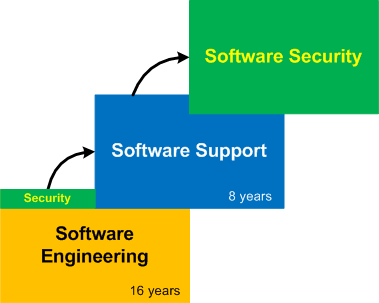
I now transition to 8 similar to 7-to-8 transition from user to kernel space (new dialectical quality):
switch(years_at_citrix)
{
case 5:
write_blog_post(”I’ve just passed 5 year mark … “);
wait_for_certificate();
write_blog_post(”Shortly after celebrating 5 years … “);
break;
case 6:
write_blog_post(”Threads in my process run very fast. Not long ago … “);
break;
case 7:
write_blog_post(”Transition to kernel mode and space … “);
break;
case 8:
// … TBD
}
I also abandoned monthly counting started earlier because in kernel space time is counted in clock cycles per quantum unit where the latter is 1/3 of a clock tick (Windows Internals, 5th edition, pp. 406 - 408) :-)
- Dmitry Vostokov @ DumpAnalysis.org + TraceAnalysis.org -