Archive for the ‘New Words’ Category

Hooksware

Sunday, August 10th, 2008

This is a new word I’ve just coined to describe applications heavily dependent on various hooks that are either injected by normal Windows hooking mechanism, registry or via more elaborate tricks like remote threads or patching code. Originally I thought of hookware but found that this term is already in use for completely different purpose.

Now I list various patterns in memory dumps that help in detection, troubleshooting and debugging of hooksware:

- Hooked Functions (user space)

- Hooked Functions (kernel space)

- Hooking Level

This is the primary detection mechanism for hooks that patch code.

See also Raw Pointer and Out-of-Module Pointer patterns.

Hooked Modules

The WinDbg script to run when you don’t know which module was patched.

- Changed Environment

Loaded hooks shift other DLLs by changing their load address and therefore might expose dormant bugs.

- Insufficient Memory (module fragmentation)

Hooks loaded in the middle of address space limit the maximum amount of memory that can be allocated at once. For example, various virtual machines, like Java, reserve the big chunk of memory at the start up.

- No Component Symbols

We can get an approximate picture of what a 3rd-party hook module does by looking at its import table or in the case of patching by looking at the list of deviations returned by .chkimg command.

- Unknown Component

Might give an idea about the author of the hook.

- Coincidental Symbolic Information

Sometimes hooks are loaded at round addresses like 0×10000000 and these values are very frequently used as flags or constants too.

- Wild Code

When hooking goes wrong the execution path goes into the wild territory.

- Execution Residue

Here we can find various hooks that use normal Windows hooking mechanism. Sometimes the search for “hook” word in symbolic raw stack output of dds command reveals them but beware of Coincidental Symbolic Information. See also Raw Stack Analysis Scripts page.

Message Hooks - Modeling Example

Windows message hooking pattern example.

- Hidden Module

Some hooks may hide themselves.

- Dmitry Vostokov @ DumpAnalysis.org + TraceAnalysis.org -

Bug Entanglement (Bugtanglement)

Monday, July 28th, 2008

Have you ever noticed how software bugs twist together or entwine into a confusing mass of an intricate trap that complicates and confuses debugging? Welcome to Bug Entanglement or just Bugtanglement[1], the new word inspired by quantum mechanics, see Quantum entanglement for analogy. We don’t see a software bug until an observer makes a measurement… And how uncertain these measurements (memory dumps, for example) are! If an observer interferes, it is not the same system, like we see it from observation, anymore. And once we made our measurement, the software system continues to evolve according to its internal design function which we never know fully and only approximate with our requirements specifications.

Welcome to Quantum Theory of Software Bugs :-)

After writing the last paragraph I did Google search and found that I just rediscovered what was already discovered more than 10 years ago by Bernard Robertson-Dunn:

A Quantum Theory of Software

[1] Seems I coined yet another word…, Google is silent.

- Dmitry Vostokov @ DumpAnalysis.org

Citrixware anniversary

Sunday, July 27th, 2008

A year passed since I coined the word Citrixware. Now there are even more Citrix products on the market so definitely this word deserves more widespread use.

 - Dmitry Vostokov @ DumpAnalysis.org -

Software Exceptions: a Paranormal View

Wednesday, July 9th, 2008

Some view minds as software and some view software as minds. There is also mind / body problem for humans and less known mind / body problem for computers. This is what I define as ”Metaphorical Bijection (seems I coined a new term again). Some view minds as constrained by brains. Therefore we can say that software might be constrained by hardware too and exceptions (faults) arise when software is accidentally written for hardware or another software if hardware is virtualized, simulated, without limitations that constrain software execution. The current hardware constrains that accidentally written software and generates faults because it cannot deal with paranormal effects. 

- Dmitry Vostokov @ DumpAnalysis.org -

Memoidealism

Monday, June 9th, 2008

Looking at memory dumps every day and writing about them has an unfortunate implication: every state of the world looks like a gigantic memory dump to me. Everything is memory and every state is memory dump. The current state of the world is an infinite (or an immense) number of memuons*. Infinite can be any cardinal number greater or equal to that of natural numbers. In any case we can say it is N bits where this number is either finite or ∞. Therefore we have 2N possible memory states (S). The set of possible transitions between them (S -> S) has the number of 2N ^ 2N elements. Which is the memory itself and we have transitions between its states too. Ad infinitum we have a limiting process from which arises the perceived flow of events. Anyway there is much to elaborate here. I’ll come back to this later.

(*) Memuon is an indivisible entity similar to a bit of information.

This is my current philosophy :-) I’m dead serious.

- Dmitry Vostokov @ DumpAnalysis.org -

Colorimetric Computer Memory Dating (Part 1)

Wednesday, April 16th, 2008

Similar to radiometric dating using isotopes we can use memory visualization techniques to see distribution of allocated buffers and their retention over time. The key is to allocate colored memory. For example, to append a red buffer that contains RGBA values 0xFF000000 to specific allocations. I call these colored memory marks isomemotopes

We can either inject a different isomemotope for a different data or change the isomemotope over time to mark specific allocation times. I created a test program that allocates buffers marked by a different amount of different isomemotopes every time: 

#include "stdafx.h"
#include <stdlib.h>
#include <memory.h>
#include <windows.h>

typedef unsigned int ISOMEMOTOPE;

void *alloc_and_mark_with_isomemotope(size_t size,
                                     ISOMEMOTOPE color,
                                     size_t amount)
{
  char *p = (char *)malloc(size+amount);

  for (char *isop = p+size;
       p && isop  < p+size+amount;
       isop+=sizeof(ISOMEMOTOPE))
  {
    *(ISOMEMOTOPE *)isop=color;
  }

  return p;
}

int _tmain(int argc, _TCHAR* argv[])
{
  alloc_and_mark_with_isomemotope(0x1000,
                                 0xFF000000, // red 
                                 0x10000);
  alloc_and_mark_with_isomemotope(0x1000,
                                 0x00FF0000, // green
                                 0x20000);
  alloc_and_mark_with_isomemotope(0x1000,
                                 0x0000FF00, // blue
                                 0x30000);
  alloc_and_mark_with_isomemotope(0x1000,
                                 0xFFFFFF00, // white
                                 0x40000);
  alloc_and_mark_with_isomemotope(0x1000,
                                 0xFFFF0000, // yellow
                                 0x50000);

  DebugBreak();

  return 0;
}

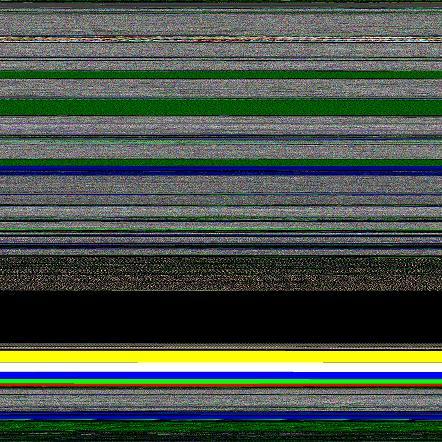
Corresponding Dump2Picture image is this (0×00000000 address is at the bottom):


:-)

- Dmitry Vostokov @ DumpAnalysis.org -

Memoretics

Monday, February 4th, 2008

I’ve been trying to put memory dump analysis on relevant scientific grounds for some time and now this branch of science needs its own name. After considering different alternative names I finally chose the word Memoretics. Here is the brief definition:

Computer Memoretics studies computer memory snapshots and their evolution in time.

Obviously this domain of research has many links with application and system debugging. However its scope is wider than debugging because it doesn’t necessarily study memory snapshots from systems and applications experiencing faulty behaviour.

Initially I was thinking about Memogenics word but its suffix is heavily associated with genes metaphor which I’m currently trying to avoid although I personally re-discovered software genes approach to software disorders when thinking about Memoretics vs. Memogenics. Later I found some research efforts going on but seems they are based on constructing software genes artificially. On the contrary I would try to discover genes in computer memories first.

genic

Also Memoretics has longer prefix almost resembling Memory word. This had the final influence on my decision.

PS. I was also thinking about Memorology word but it has negative connotations with Astrology or Numerology and was coined already by someone like Memology and Memorics

- Dmitry Vostokov @ DumpAnalysis.org -

Citrixware

Sunday, July 8th, 2007

Citrix is a global leader in application delivery and access infrastructure solutions including application streaming and virtualization. There are so many great products developed by this company including WinFrame, MetaFrame, Presentation Server and its clients, Desktop Server, XenServer, XenApp, XenDesktop, Receiver and Dazzle, Access Gateway, Application Firewall, Application Gateway, NetScaler, WANScaler, GoToMeeting, GoToMyPC, GoToWebinar, GoToAssist, EdgeSight and Password Manager.

Citrix is no longer tied to Windows platforms because its products run on Linux, Solaris, FreeBSD, HP-UX, AIX, Symbian and Mac OS X as well. To bind them all together I propose to use the word “Citrixware”.

With more than 180,000 organizations in the world using Citrixware the chances are that you use it too. This is more encompassing word than just simple “accessware”. 

- Dmitry Vostokov @ DumpAnalysis.org -

Citrixofication

Thursday, July 5th, 2007

Following the invention of one of the greatest technological thinkers of our civilization, Thomas Edison, at the beginning of the 20th century, that prompted the electrification of our world, I would like to introduce and coin the word ”Citrixofication”, the electrifying power of Citrix that transforms our lives in the 21st century - instant access to any software application whenever and wherever we want. I am very proud that I work for Citrix, the company that changes the way we work at the beginning of the 21st century, like electricity transformed our lives a century ago. The moment you do remote access to your Windows application you use solutions and technology invented by Citrix. Every Windows computer in the world has the code developed by Citrix, ICA protocol code! To be honest I was thinking about “Citrification” but I found that it is already used in chemistry so I tried  ”Citrixification” but this was already used in one French document. The only word left was “Citrixofication” or just “Citrixfication”, whatever you prefer.

- Dmitry Vostokov @ DumpAnalysis.org -

Crash Dump Analysis AntiPatterns (Part 2)

Wednesday, February 28th, 2007

Let’s define Zippocricy - common sin in software support environments worldwide: someone gets something from a customer in archived form and without checking the contents forwards it further to another person in support chain. By the time the evidence gets unzipped somewhere, checked and found corrupt or irrelevant the customer suffers not hours but days.

Happens not only with crash dumps but with any type of problem evidence. 

- Dmitry Vostokov -