Crash Dump Analysis Patterns (Part 12)
Friday, April 20th, 2007Another pattern that happens so often in crash dumps: No Component Symbols. In this case we can guess what a component does by looking at its name, overall thread stack where it is called and also its import table. Here is an example. We have component.sys driver visible on some thread stack in a kernel dump but we don’t know what that component can potentially do. Because we don’t have symbols we cannot see its imported functions:
kd> x component!*

kd>
We use !dh command to dump its image headers:
kd> lmv m component

start             end                 module name

fffffadf`e0eb5000 fffffadf`e0ebc000   component   (no symbols)

    Loaded symbol image file: component.sys

    Image path: \??\C:\Component\x64\component.sys

    Image name: component.sys

    Timestamp:        Sat Jul 01 19:06:16 2006 (44A6B998)

    CheckSum:         000074EF

    ImageSize:        00007000

    Translations:     0000.04b0 0000.04e0 0409.04b0 0409.04e0

kd> !dh fffffadf`e0eb5000

File Type: EXECUTABLE IMAGE

FILE HEADER VALUES

    8664 machine (X64)

       6 number of sections

44A6B998 time date stamp Sat Jul 01 19:06:16 2006

       0 file pointer to symbol table

       0 number of symbols

      F0 size of optional header

      22 characteristics

            Executable

            App can handle >2gb addresses

OPTIONAL HEADER VALUES

     20B magic #

    8.00 linker version

     C00 size of code

     A00 size of initialized data

       0 size of uninitialized data

    5100 address of entry point

    1000 base of code

         ----- new -----

0000000000010000 image base

    1000 section alignment

     200 file alignment

       1 subsystem (Native)

    5.02 operating system version

    5.02 image version

    5.02 subsystem version

    7000 size of image

     400 size of headers

    74EF checksum

0000000000040000 size of stack reserve

0000000000001000 size of stack commit

0000000000100000 size of heap reserve

0000000000001000 size of heap commit

       0 [       0] address [size] of Export Directory

    51B0 [      28] address [size] of Import Directory

    6000 [     3B8] address [size] of Resource Directory

    4000 [      6C] address [size] of Exception Directory

       0 [       0] address [size] of Security Directory

       0 [       0] address [size] of Base Relocation Directory

    2090 [      1C] address [size] of Debug Directory

       0 [       0] address [size] of Description Directory

       0 [       0] address [size] of Special Directory

       0 [       0] address [size] of Thread Storage Directory

       0 [       0] address [size] of Load Configuration Directory

       0 [       0] address [size] of Bound Import Directory

    2000 [      88] address [size] of Import Address Table Directory

       0 [       0] address [size] of Delay Import Directory

       0 [       0] address [size] of COR20 Header Directory

       0 [       0] address [size] of Reserved Directory

…

…

…
Then we display the contents of Import Address Table Directory using dps command:
kd> dps fffffadf`e0eb5000+2000 fffffadf`e0eb5000+2000+88

fffffadf`e0eb7000  fffff800`01044370 nt!IoCompleteRequest

fffffadf`e0eb7008  fffff800`01019700 nt!IoDeleteDevice

fffffadf`e0eb7010  fffff800`012551a0 nt!IoDeleteSymbolicLink

fffffadf`e0eb7018  fffff800`01056a90 nt!MiResolveTransitionFault+0x7c2

fffffadf`e0eb7020  fffff800`0103a380 nt!ObDereferenceObject

fffffadf`e0eb7028  fffff800`0103ace0 nt!KeWaitForSingleObject

fffffadf`e0eb7030  fffff800`0103c570 nt!KeSetTimer

fffffadf`e0eb7038  fffff800`0102d070 nt!IoBuildPartialMdl+0x3

fffffadf`e0eb7040  fffff800`012d4480 nt!PsTerminateSystemThread

fffffadf`e0eb7048  fffff800`01041690 nt!KeBugCheckEx

fffffadf`e0eb7050  fffff800`010381b0 nt!KeInitializeTimer

fffffadf`e0eb7058  fffff800`0103ceb0 nt!ZwClose

fffffadf`e0eb7060  fffff800`012b39f0 nt!ObReferenceObjectByHandle

fffffadf`e0eb7068  fffff800`012b7380 nt!PsCreateSystemThread

fffffadf`e0eb7070  fffff800`01251f90 nt!FsRtlpIsDfsEnabled+0x114

fffffadf`e0eb7078  fffff800`01275160 nt!IoCreateDevice

fffffadf`e0eb7080  00000000`00000000

fffffadf`e0eb7088  00000000`00000000
We see that this driver under certain circumstances could bugcheck the system using KeBugCheckEx, it creates system thread(s) (PsCreateSystemThread) and uses timer(s) (KeInitializeTimer, KeSetTimer).
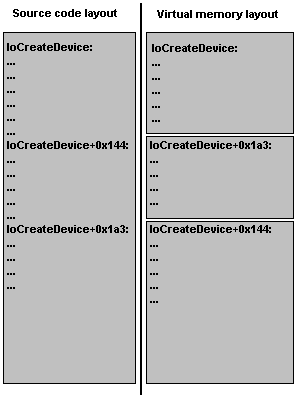
If you see name+offset in import table (I think this is an effect of OMAP code optimization) you can get the function by using ln command (list nearest symbols):
kd> ln fffff800`01056a90

(fffff800`01056760)   nt!MiResolveTransitionFault+0x7c2   |  (fffff800`01056a92)   nt!RtlInitUnicodeString

kd> ln fffff800`01251f90

(fffff800`01251e90)   nt!FsRtlpIsDfsEnabled+0×114   |  (fffff800`01251f92)   nt!IoCreateSymbolicLink
This technique is useful if you have a bugcheck that happens when a driver calls certain functions or must call certain function in pairs, like bugcheck 0×20:
kd> !analyze -show 0x20

KERNEL_APC_PENDING_DURING_EXIT (20)

The key data item is the thread's APC disable count. If this is non-zero, then this is the source of the problem. The APC disable count is decremented each time a driver calls KeEnterCriticalRegion, KeInitializeMutex, or FsRtlEnterFileSystem. The APC disable count is incremented each time a driver calls KeLeaveCriticalRegion, KeReleaseMutex, or FsRtlExitFileSystem.  Since these calls should always be in pairs, this value should be zero when a thread exits. A negative value indicates that a driver has disabled APC calls without re-enabling them. A positive value indicates that the reverse is true. If you ever see this error, be very suspicious of all drivers installed on the machine — especially unusual or non-standard drivers. Third party file system redirectors are especially suspicious since they do not generally receive the heavy duty testing that NTFS, FAT, RDR, etc receive. This current IRQL should also be 0.  If it is not, that a driver’s cancelation routine can cause this bugcheck by returning at an elevated IRQL.  Always attempt to note what you were doing/closing at the time of the crash, and note all of the installed drivers at the time of the crash.  This symptom is usually a severe bug in a third party driver.
Then you can see at least whether the suspicious driver could have potentially used those functions and if it imports one of them you can see whether it imports the corresponding counterpart function.
- Dmitry Vostokov @ DumpAnalysis.org -