Archive for the ‘Debugging’ Category

Memory Dump Analysis Anthology, Volume 4 is available for download

Saturday, November 6th, 2010

I’m pleased to announce that MDAA, Volume 4 is available in PDF format:

www.dumpanalysis.org/Memory+Dump+Analysis+Anthology+Volume+4

It features:

- 15 new crash dump analysis patterns
- 13 new pattern interaction case studies
- 10 new trace analysis patterns
- 6 new Debugware patterns and case study
- Workaround patterns
- Updated checklist
- Fully cross-referenced with Volume 1, Volume 2 and Volume 3
- Memory visualization tutorials
- Memory space art

Its table of contents is available here:

http://www.dumpanalysis.org/MDAA/MDA-Anthology-V4-TOC.pdf

Paperback and hardcover versions should be available in a week or two. I also started working on Volume 5 that should be available in December.

- Dmitry Vostokov @ DumpAnalysis.org + TraceAnalysis.org -

Trace Analysis Patterns (Part 32)

Thursday, November 4th, 2010

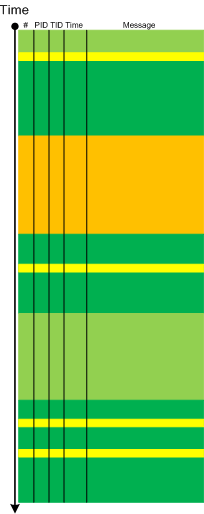
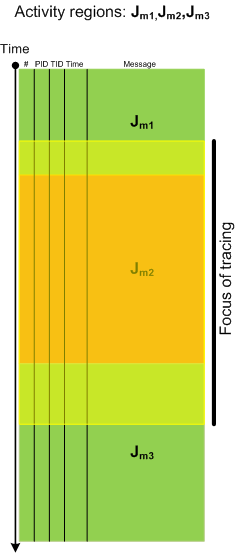
Activity Region pattern highlights “mechanical” and syntactical aspects of trace analysis whereas Focus of Tracing brings attention to changing semantics of trace message flow, for example in Citrix terminal services environment, from logon messages during session initialization to LHC database search. Here is a graphical illustration of this pattern where tracing focus region spans 3 regions of activity:

- Dmitry Vostokov @ DumpAnalysis.org + TraceAnalysis.org -

A Periodic Table of Software Defects (Part 0)

Wednesday, November 3rd, 2010

I have discovered rules that make it possible to devise a memory dump and software trace analysis equivalent of the Periodic Table of Elements in Chemistry. It allows prediction of abnormal software behaviour and structural defects and what patterns to look for after deploying software and collecting its artifacts. More on this is in the next part of these series.

- Dmitry Vostokov @ DumpAnalysis.org + TraceAnalysis.org -

Close and Deconstructive Readings of a Software Trace

Wednesday, November 3rd, 2010

There are two trace reading practices with techniques borrowed from structuralist and post-structuralist narratology:

1. Close reading

- emphasizes structural patterns

- looks at a software trace as a unity of messages

- searches for similarities, repetitions and contrasts

- reveals code reflections in message texts

2. Deconstructive reading

- reveals subconscious exposed in message texts

- searches for conflicting and absent messages

- looks at a software trace as a disunity of messages from conflicting components

- Dmitry Vostokov @ DumpAnalysis.org + TraceAnalysis.org -

Bugtation No.129

Monday, November 1st, 2010

On the value of study and perseverance. It all started with dumb 0xc0000005 (resulted in a dump) and ended up with 5 volumes of Summa Memorianica (Memory Dump Analysis Anthology):

The Dumb 0x.

Albertus Magnus said of Thomas Aquinas

- Dmitry Vostokov @ DumpAnalysis.org + TraceAnalysis.org -

Moving to Kernel Space (updated references with an eye on security)

Saturday, October 30th, 2010

If you develop and debug user space applications (and/or doing crash dump analysis in user space) or specialize in user space security and you want to understand Windows kernel dumps and device drivers better (and probably start writing your own kernel tools) or understand malware rootkits better here is the reading list I found the most effective over the last 7 years:

0.0. Read and re-read Windows Internals book in parallel while reading all other books. I read all editions by the way. It will show you the big picture and useful WinDbg commands and techniques but you need to read device driver books to fill the gaps and be confident in kernel space:

Buy from Amazon

0.1. Start with The Windows 2000 Device Driver Book: A Guide for Programmers. This short book will show you the basics and you can start writing your drivers and kernel tools immediately.

Buy from Amazon

0.2. Next read Windows NT Device Driver Development book to consolidate your knowledge. This book has been reprinted by OSR (I own the original New Riders Press edition):

Buy from Amazon

0.3. Don’t stop here. Read Developing Windows NT Device Drivers: A Programmer’s Handbook. This is the very good book explaining everything in great detail and good pictures. You will finally understand various buffering methods.

Buy from Amazon

0.4. Continue with WDM drivers and modern presentation: Programming the Microsoft Windows Driver Model. Must read even if your drivers are not WDM.

Buy from Amazon

0.5. Finally read Developing Drivers with the Windows Driver Foundation book. It also covers ETW (event tracing for Windows), WinDbg extensions, PREfast and static driver verifier.

Buy from Amazon

0.6. There is a forthcoming book Windows 7 Device Driver at the time of this writing that also covers WDF so you might want to start with #0.6 and continue with #0.5 as a reference:

Additional reading (not including DDK Help which you will use anyway) can be done in parallel after finishing “Windows NT Device Driver Development” book:

1.1. OSR NT Insider articles. I have their full printed collection 1996 - 2006 plus all the latest issues (looks like print editions are discontinued and the new ones are only digital):

http://www.osronline.com/

1.2. Windows NT File System Internals reprinted by OSR (I have the original O’Reilly edition):

Buy from Amazon

1.3. Windows NT/2000 Native API Reference is fun to browse occasionally and indispensable if you don’t have access to Windows source code:

Buy from Amazon

1.4. Rootkits: Subverting the Windows Kernel book will show you Windows kernel from the hacker perspective. In addition you will find the overview of kernel areas not covered in other books.

Buy from Amazon

1.5. The Rootkit Arsenal: Escape and Evasion in the Dark Corners of the System is another excellent book that is up to date and explains kernel staff from ab initio. I’m reading it at the time of this writing and recommend it to read first or in parallel to all other books:

Buy from Amazon

Of course, you must know C language and its idioms really well. Really know it down to assembly language level! I’ll publish other reading lists soon including reverse engineering classics. Stay tuned.

- Dmitry Vostokov @ DumpAnalysis.org + TraceAnalysis.org -

Crash Dump Analysis Patterns (Part 113)

Friday, October 29th, 2010

Sometimes we have very similar abnormal software behaviour dispositions (like crashes with similar stack traces) for different applications or services. In such cases, we should also check application or service vendor and copyright in the output of lmv command. Similar to Template Module Same Vendor pattern can be useful to relate such different incidents. Usually, in the same company, code and people reuse tends to distribute code fragments and code construction styles across different product lines, and software defects might surface in different images. For example:

0:000> lmv m ApplicationA
start    end        module name
00400000 00d99000   ApplicationA   (deferred)
[...]
Image name: ApplicationA.exe
Timestamp:        [...]
CheckSum:         00000000
[...]
CompanyName:      CompanyA
ProductName:      CompanyA Application
LegalCopyright:   Copyright (c) CompanyA
[…]

0:000> lmv m ApplicationB
start    end        module name
00400000 019d0000   ApplicationB  C (no symbols)
Image name: ApplicationB.exe
[...]
CompanyName:      CompanyA
ProductName:      ApplicationB
LegalCopyright:   Copyright (c) CompanyA
[…]

- Dmitry Vostokov @ DumpAnalysis.org + TraceAnalysis.org -

Icons for Memory Dump Analysis Patterns (Part 83)

Wednesday, October 27th, 2010

Today we introduce an icon for Deadlock (self) pattern:

B/W

Color

- Dmitry Vostokov @ DumpAnalysis.org + TraceAnalysis.org -

Crash Dump Analysis Patterns (Part 9f)

Wednesday, October 27th, 2010

This is a variation of a deadlock pattern where a thread that owns a resource (either in shared or exclusive mode) attempts to acquire it exclusively again. This results in a self-deadlock:

Resource @ 0x85d9c018    Shared 1 owning threads
    Contention Count = 2
    NumberOfExclusiveWaiters = 2
     Threads: 85db0030-02<*>
     Threads Waiting On Exclusive Access:
              85f07d78       85db0030

- Dmitry Vostokov @ DumpAnalysis.org + TraceAnalysis.org -

Crash Dump Analysis Patterns (Part 112)

Wednesday, October 27th, 2010

When I started getting several process memory dumps with very similar crash dispositions I decided to factor them into a separate pattern called Problem Exception Handler. This usually happens with custom exception handlers not written according to prescribed rules (for example, a handler for a non-continuable exception) or have other defects common to normal code.

In the example below we have a different stack trace epilogue for a similar issue that shows a relationship with a custom exception handler:

0:000> kv 1000
ChildEBP RetAddr  Args to Child
0003300c 77af9904 77b8929c 792ea99b 00000000 ntdll!RtlAcquireSRWLockShared+0x1a
00033058 77af9867 00406ef8 00033098 000330a0 ntdll!RtlLookupFunctionTable+0×2a
000330a8 77af97f9 00406ef8 00000000 00000000 ntdll!RtlIsValidHandler+0×26
00033128 77b25dd7 01033140 00033154 00033140 ntdll!RtlDispatchException+0×10b
00033128 77b40726 01033140 00033154 00033140 ntdll!KiUserExceptionDispatcher+0xf (CONTEXT @ 00033154)
00033490 77b25dd7 010334a8 000334bc 000334a8 ntdll!RtlDispatchException+0×18a
00033490 77b40726 010334a8 000334bc 000334a8 ntdll!KiUserExceptionDispatcher+0xf (CONTEXT @ 000334bc)
000337f8 77b25dd7 01033810 00033824 00033810 ntdll!RtlDispatchException+0×18a
[…]
0012f228 77b40726 0112f240 0012f254 0012f240 ntdll!KiUserExceptionDispatcher+0xf (CONTEXT @ 0012f254)
0012f590 77b25dd7 0112f5a8 0012f5d8 0012f5a8 ntdll!RtlDispatchException+0×18a
0012f590 768bfbae 0112f5a8 0012f5d8 0012f5a8 ntdll!KiUserExceptionDispatcher+0xf (CONTEXT @ 0012f5d8)
0012f8f4 0059ecad 0eedfade 00000001 00000007 kernel32!RaiseException+0×58
WARNING: Stack unwind information not available. Following frames may be wrong.
0012f918 00473599 0eedfade 00000001 00000007 Application+0×19ecad
[…]
0012ff88 768cd0e9 7ffdf000 0012ffd4 77b019bb Application+0×70f8
0012ff94 77b019bb 7ffdf000 793f6617 00000000 kernel32!BaseThreadInitThunk+0xe
0012ffd4 77b0198e 011263c0 7ffdf000 ffffffff ntdll!__RtlUserThreadStart+0×23
0012ffec 00000000 011263c0 7ffdf000 00000000 ntdll!_RtlUserThreadStart+0×1b

0:000> !exchain
00033048: ntdll!_except_handler4+0 (77ac99fa)
0012ff78: Application+6ef8 (00406ef8)
0012ffc4: ntdll!_except_handler4+0 (77ac99fa)
0012ffe4: ntdll!FinalExceptionHandler+0 (77b66f9b)
Invalid exception stack at ffffffff

- Dmitry Vostokov @ DumpAnalysis.org + TraceAnalysis.org -

Architecture of CARE

Saturday, October 23rd, 2010

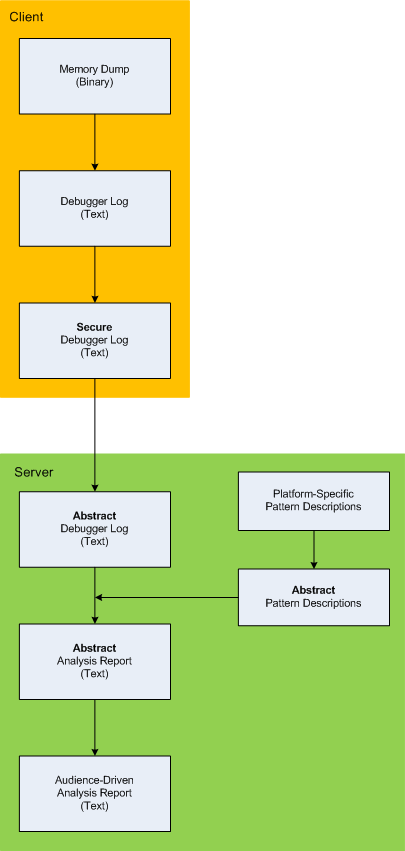
Here is the description of a high-level architecture of the previously announced project CARE (Crash Analysis Report Environment). To remind, the main idea of the project is to process memory dumps on a client to save debugger logs. They can be sent to a server for pattern-driven analysis of software behaviour. Textual logs can also be inspected by a client security team before sending. Certain sensitive information can be excluded or modified to have generic meaning according to the built-in processing rules like renaming (for example, server names and folders). Before processing, verified secured logs are converted to abstract debugger logs. Abstracting platform-specific debugger log format allows reuse of the same architecture for different computer platforms. We call it CIA (Computer Independent Architecture). Do not confuse it with ICA (Independent Computer Architecture) and CIA acronym is more appropriate for memory analysis (like similar MAFIA acronym, Memory Analysis Forensics and Intelligence Architecture). These abstract logs are checked for various patterns (in abstracted form) using abstract debugger commands and an abstract report is generated according to various checklists. Abstract reports are then converted to structured reports for the required audience level. Abstract memory analysis pattern descriptions are prepared from platform-specific pattern descriptions. In certain architectural component deployment configurations both client and server parts can reside on the same machine. Here’s the simple diagram depicting the flow of processing:

- Dmitry Vostokov @ DumpAnalysis.org + TraceAnalysis.org -

Icons for Memory Dump Analysis Patterns (Part 82)

Thursday, October 21st, 2010

Today we introduce an icon for False Function Parameters pattern:

B/W

Color

- Dmitry Vostokov @ DumpAnalysis.org + TraceAnalysis.org -

Trace Analysis Patterns (Part 31)

Wednesday, October 20th, 2010

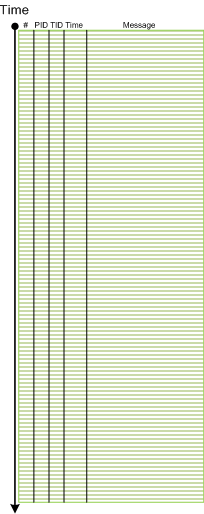
The next pattern with the name borrowed from historiography is Layered Periodization. This periodization of software trace messages includes individual messages, then aggregated messages from threads, then processes as wholes and finally individual computers (in client-server or similar sense). This is best illustrated graphically.

Message layer:

Thread layer (different colors correspond to different TID):

Process layer (different colors correspond to different PID):

Please note that it is also possible to have a periodization based on modules, functions and individual messages but it might be complicated because different threads can enter the same module or function and here other patterns more appropriate like Activity Region, Characteristic Message Block, and Background and Foreground Components.

- Dmitry Vostokov @ DumpAnalysis.org + TraceAnalysis.org -

Structural Memory Patterns (Part 7)

Monday, October 18th, 2010

In order to start the analysis of a structured memory snapshot a debugger engine needs Anchor Region that describes memory layout and where to start unfolding of analysis. For example, it can be a list of modules (another forthcoming structural pattern). We can observe the importance of such regions when we try to open corrupt or severely truncated memory dumps:

[...]
KdDebuggerDataBlock is not present or unreadable.
[...]
Unable to read PsLoadedModuleList
[...]

For certain types of memory snapshots (like software traces) an anchor region coinsides with its structure description (message trace format for structured snapshots) and a trace file header (if any) for aggregate snapshots.

- Dmitry Vostokov @ DumpAnalysis.org + TraceAnalysis.org -

Crash Dump Analysis Patterns (Part 110)

Monday, October 18th, 2010

Shared Buffer Overwrite differs from Local Buffer Overflow and heap / pool memory corruption patterns in not writing over control structures situated at dynamically allocated memory or procedure frame (local call stack) boundaries. Its effect is visible when the buffer data contains pointers that become wild after the overwrite and are later dereferenced resulting in a crash. For example, when the overwriting data contains UNICODE and /or ASCII characters we see them in a pointer data:

1: kd> !analyze -v

[...]

SYSTEM_THREAD_EXCEPTION_NOT_HANDLED (7e)
This is a very common bugcheck.  Usually the exception address pinpoints
the driver/function that caused the problem.  Always note this address
as well as the link date of the driver/image that contains this address.
Arguments:
Arg1: c0000005, The exception code that was not handled
Arg2: 8086c949, The address that the exception occurred at
Arg3: f78eec54, Exception Record Address
Arg4: f78ee950, Context Record Address

[...]

EXCEPTION_RECORD:  f78eec54 -- (.exr 0xfffffffff78eec54)
ExceptionAddress: 8086c949 (nt!ObfDereferenceObject+0x00000023)
ExceptionCode: c0000005 (Access violation)
ExceptionFlags: 00000000
NumberParameters: 2
Parameter[0]: 00000001
   Parameter[1]: 006f0058
Attempt to write to address 006f0058

CONTEXT:  f78ee950 -- (.cxr 0xfffffffff78ee950)
eax=f78e0001 ebx=ffffffff ecx=006f0070 edx=00000000 esi=006f0058 edi=8087cdae
eip=8086c949 esp=f78eed1c ebp=f78eed2c iopl=0  nv up ei ng nz na pe nc
cs=0008  ss=0010  ds=0023  es=0023  fs=0030  gs=0000     efl=00010286
nt!ObfDereferenceObject+0×23:
8086c949 f00fc11e        lock xadd dword ptr [esi],ebx ds:0023:006f0058=????????

[...]

STACK_TEXT:
f78eed2c f707212e 886e6530 f78eed80 f706e04e nt!ObfDereferenceObject+0x23
f78eed38 f706e04e e47b1258 8b2fcb40 808ae5c0 DriverA!CloseConnection+0x16
f78eed80 80880475 8835f248 00000000 8b2fcb40 DriverA!Resume+0x9f
f78eedac 80949c5a 8835f248 00000000 00000000 nt!ExpWorkerThread+0xeb
f78eeddc 8088e0c2 8088038a 00000000 00000000 nt!PspSystemThreadStartup+0x2e
00000000 00000000 00000000 00000000 00000000 nt!KiThreadStartup+0x16

1: kd> ub f707212e
DriverA!CloseConnection+0x2:
f707211a push    ebp
f707211b mov     ebp,esp
f707211d push    esi
f707211e mov     esi,dword ptr [ebp+8]
f7072121 mov     ecx,dword ptr [esi+14h]
f7072124 test    ecx,ecx
f7072126 je      DriverA!CloseConnection+0x1a (f7072132)
f7072128 call    dword ptr [DriverA!_imp_ObfDereferenceObject (f70610f4)]

1: kd> db e47b1258 L20
e47b1258  61 67 65 20 57 72 69 74-65 72 00 05 77 00 69 00  age Writer..w.i.
e47b1268  6e 00 73 00 70 00 6f 00-6f 00 6c 00 2c 00 4e 00  n.s.p.o.o.l.,.N.

1: kd> !pool e47b1258
Pool page e47b1258 region is Paged pool
e47b1000 size:  108 previous size:    0  (Allocated)  CM39
e47b1108 size:   38 previous size:  108  (Free)       CMVa
e47b1140 size:   28 previous size:   38  (Allocated)  NtFs
e47b1168 size:    8 previous size:   28  (Free)       CMDa
e47b1170 size:   80 previous size:    8  (Allocated)  FSim
e47b11f0 size:   28 previous size:   80  (Allocated)  CMNb (Protected)
*e47b1218 size:   70 previous size:   28  (Allocated) *CMDa
Pooltag CMDa : value data cache pool tag, Binary : nt!cm

e47b1288 size:   58 previous size:   70  (Allocated)  Sect (Protected)
e47b12e0 size:   18 previous size:   58  (Allocated)  Ntf0
e47b12f8 size:   28 previous size:   18  (Allocated)  NtFs
e47b1320 size:   20 previous size:   28  (Allocated)  CMNb (Protected)
e47b1340 size:   48 previous size:   20  (Allocated)  Ntfc
e47b1388 size:   68 previous size:   48  (Allocated)  Sect (Protected)
e47b13f0 size:   30 previous size:   68  (Allocated)  CMVa
e47b1420 size:   38 previous size:   30  (Allocated)  CMVa
e47b1458 size:    8 previous size:   38  (Free)       CMVa
e47b1460 size:   48 previous size:    8  (Allocated)  CMVa
e47b14a8 size:   d0 previous size:   48  (Allocated)  Ntfo
e47b1578 size:  330 previous size:   d0  (Allocated)  Ntff
e47b18a8 size:   10 previous size:  330  (Free)       NtfE
e47b18b8 size:   e0 previous size:   10  (Allocated)  Ntfo
e47b1998 size:   40 previous size:   e0  (Allocated)  MmSm
e47b19d8 size:    8 previous size:   40  (Free)       Ica
e47b19e0 size:   18 previous size:    8  (Allocated)  Ntf0
e47b19f8 size:   68 previous size:   18  (Allocated)  CMDa
e47b1a60 size:   28 previous size:   68  (Allocated)  ObNm
e47b1a88 size:   b8 previous size:   28  (Allocated)  Port (Protected)
e47b1b40 size:   58 previous size:   b8  (Allocated)  Sect (Protected)
e47b1b98 size:   30 previous size:   58  (Allocated)  CMVa
e47b1bc8 size:    8 previous size:   30  (Free)       NtFA
e47b1bd0 size:  100 previous size:    8  (Allocated)  IoNm
e47b1cd0 size:   18 previous size:  100  (Allocated)  ObDi
e47b1ce8 size:   38 previous size:   18  (Allocated)  CMnb Process: 88469928
e47b1d20 size:   78 previous size:   38  (Free )  NtFI
e47b1d98 size:   68 previous size:   78  (Allocated)  CMDa
e47b1e00 size:   18 previous size:   68  (Allocated)  PsIm (Protected)
e47b1e18 size:   e8 previous size:   18  (Free )  TunP
e47b1f00 size:  100 previous size:   e8  (Allocated)  IoNm

Another example:

0: kd> !analyze -v

[...]

SYSTEM_THREAD_EXCEPTION_NOT_HANDLED (7e)
This is a very common bugcheck.  Usually the exception address pinpoints
the driver/function that caused the problem.  Always note this address
as well as the link date of the driver/image that contains this address.
Arguments:
Arg1: c0000005, The exception code that was not handled
Arg2: 8083e4d6, The address that the exception occurred at
Arg3: f78cec54, Exception Record Address
Arg4: f78ce950, Context Record Address

[...]

EXCEPTION_RECORD:  f78cec54 -- (.exr 0xfffffffff78cec54)
ExceptionAddress: 8083e4d6 (nt!ObfDereferenceObject+0x00000023)
ExceptionCode: c0000005 (Access violation)
ExceptionFlags: 00000000
NumberParameters: 2
Parameter[0]: 00000001
   Parameter[1]: 65696c2b
Attempt to write to address 65696c2b

CONTEXT:  f78ce950 -- (.cxr 0xfffffffff78ce950)
eax=f78c0001 ebx=ffffffff ecx=65696c43 edx=00000000 esi=65696c2b edi=8083e407
eip=8083e4d6 esp=f78ced1c ebp=f78ced2c iopl=0  nv up ei ng nz na pe nc
cs=0008  ss=0010  ds=0023  es=0023  fs=0030  gs=0000     efl=00010286
nt!ObfDereferenceObject+0×23:
8083e4d6 f00fc11e        lock xadd dword ptr [esi],ebx ds:0023:65696c2b=????????
Resetting default scope

[...]

STACK_TEXT:
f78ced2c f71bd12e 87216470 f78ced80 f71b904e nt!ObfDereferenceObject+0x23
f78ced38 f71b904e e49afb90 8a38eb40 808b70e0 DriverA!CloseConnection+0x16
f78ced80 8082db10 868989e0 00000000 8a38eb40 DriverA!Resume+0x9f
f78cedac 809208bb 868989e0 00000000 00000000 nt!ExpWorkerThread+0xeb
f78ceddc 8083fe9f 8082da53 00000000 00000000 nt!PspSystemThreadStartup+0x2e
00000000 00000000 00000000 00000000 00000000 nt!KiThreadStartup+0x16

[...]

0: kd> .formats 65696c2b
Evaluate expression:
Hex:     65696c2b
Decimal: 1701407787
Octal:   14532266053
Binary:  01100101 01101001 01101100 00101011
  Chars:   eil+
Time:    Fri Dec 01 05:16:27 2023
Float:   low 6.88942e+022 high 0
Double:  8.40607e-315

0: kd> db e49afb90 L20
e49afb90  41 41 22 00 1e 00 00 00-00 5f 07 00 01 00 00 00  AA”……_……
e49afba0  01 00 00 00 43 6c 69 65-6e 74 41 2f 41 41 41 41  ….ClientA/AAAA

0: kd> !pool e49afb90
Pool page e49afb90 region is Paged pool
e49af000 size:  330 previous size:    0  (Allocated)  Ntff
e49af330 size:  2c0 previous size:  330  (Allocated)  Toke (Protected)
e49af5f0 size:   78 previous size:  2c0  (Allocated)  NtFU
e49af668 size:   10 previous size:   78  (Free)       CMVI
e49af678 size:   a8 previous size:   10  (Allocated)  Ntfo
e49af720 size:   80 previous size:   a8  (Allocated)  NtFU
e49af7a0 size:   78 previous size:   80  (Allocated)  NtFU
e49af818 size:   18 previous size:   78  (Allocated)  Ntf0
e49af830 size:   20 previous size:   18  (Allocated)  ObHd
e49af850 size:   38 previous size:   20  (Allocated)  MmSm
e49af888 size:   78 previous size:   38  (Allocated)  NtFU
e49af900 size:   28 previous size:   78  (Allocated)  NtFs
e49af928 size:   48 previous size:   28  (Allocated)  Ntfc
e49af970 size:   40 previous size:   48  (Allocated)  CMNb (Protected)
e49af9b0 size:   28 previous size:   40  (Allocated)  NtFs
e49af9d8 size:   30 previous size:   28  (Allocated)  AtmA
e49afa08 size:  108 previous size:   30  (Allocated)  CM39
e49afb10 size:   18 previous size:  108  (Allocated)  Ntf0
e49afb28 size:   30 previous size:   18  (Allocated)  CMVw (Protected)
e49afb58 size:   28 previous size:   30  (Allocated)  MPXC
*e49afb80 size:   70 previous size:   28  (Free) *CMDa
Pooltag CMDa : value data cache pool tag, Binary : nt!cm

e49afbf0 size:   b8 previous size:   70  (Allocated)  Port (Protected)
e49afca8 size:   28 previous size:   b8  (Allocated)  CMNb (Protected)
e49afcd0 size:  330 previous size:   28  (Allocated)  Ntff

Notice that in the latter example the pointer references a freed pool element. If a pointer points to an overwritten buffer the result is similar to a dangling pointer pointing to a reallocated freed buffer. If an object was located in a shared buffer and its data becomes overwritten we can also observe Random Object pattern.

- Dmitry Vostokov @ DumpAnalysis.org + TraceAnalysis.org -
Icons for Memory Dump Analysis Patterns (Part 81)

Monday, October 18th, 2010

Today we introduce an icon for Frame Pointer Omission pattern:

B/W

Color

- Dmitry Vostokov @ DumpAnalysis.org + TraceAnalysis.org -

10 Common Mistakes in Memory Analysis (Part 9)

Thursday, October 14th, 2010

One of the common mistakes that especially happens during a rush to provide an analysis results is overlooking UNICODE or ASCII fragments on thread stacks and mistakenly assuming that found symbolic references have some significance: 

0:001> dds 0bc9e5a8 0bc9e5d4
0bc9e5a8  00b900b8
0bc9e5ac  00bb00ba
0bc9e5b0  00bd00bc
0bc9e5b4  00bf00be ApplicationA!stdext::unchecked_uninitialized_fill_n<std::map<std:: basic_string<unsigned short,std::char_traits<unsigned short>,std::allocator<unsigned short> >,std::basic_string<unsigned short,std::char_traits<unsigned short>,std::allocator<unsigned short> >,std::less<std::basic_string<unsigned short,std::char_traits<unsigned short>,std::allocator<unsigned short> > >,std::allocator<std::pair<std::basic_string<unsigned short,std::char_traits<unsigned short>,std::allocator<unsigned short> > const ,std::basic_string<unsigned short,std::char_traits<unsigned short>,std::allocator<unsigned short> > > > > * *,unsigned int,std::map<std::basic_string<unsigned short,std::char_traits<unsigned short>,std::allocator<unsigned short> >,std::basic_string<unsigned short,std::char_traits<unsigned short>,std::allocator<unsigned short> >,std::less<std::basic_string<unsigned short,std::char_traits<unsigned short>,std::allocator<unsigned short> > >,std::allocator<std::pair<std::basic_string<unsigned short,std::char_traits<unsigned short>,std::allocator<unsigned short> > const ,std::basic_string<unsigned short,std::char_traits<unsigned short>,std::allocator<unsigned short> > > > > *,std::allocator<std::map<std::basic_string<unsigned short,std::char_traits<unsigned short>,std::allocator<unsigned short> >,std::basic_string<unsigned short,std::char_traits<unsigned short>,std::allocator<unsigned short> >,std::less<std::basic_string<unsigned short,std::char_traits<unsigned short>,std::allocator<unsigned short> > >,std::allocator<std::pair<std::basic_string<unsigned short,std::char_traits<unsigned short>,std::allocator<unsigned short> > const ,std::basic_string<unsigned short,std::char_traits<unsigned short>,std::allocator<unsigned short> > > > > *> >+0×1e
0bc9e5b8  00c100c0 ApplicationA!EnumData+0×670
0bc9e5bc  00c300c2 ApplicationA!CloneData+0xe2
0bc9e5c0  00c500c4 ApplicationA!LoadData+0×134
0bc9e5c4  00c700c6 ApplicationA!decompress+0×1ca6
0bc9e5c8  00c900c8 ApplicationA!_TT??_R2?AVout_of_rangestd+0×10c
0bc9e5cc  00cb00ca ApplicationA!AppHandle <PERF> (ApplicationA+0xd00ca)
0bc9e5d0  00cd00cc
0bc9e5d4  00cf00ce

0:001> du 0bc9e5a8
0bc9e5a8  "¸¹º»¼½¾¿ÀÁÂÃÄÅÆÇÈÉÊËÌÍÎÏÐÑÒÓÔÕÖ×"
0bc9e5e8  "ØÙÚÛÜÝÞßÀÁÂÃÄÅÆÇÈÉÊËÌÍÎÏÐÑÒÓÔÕÖ÷"
0bc9e628  "ØÙÚÛÜÝÞŸĀ"

We can see and also double check from disassembly by using u/ub WinDbg command that function names are coincidental. It just happened that ApplicationA module spans the address range including 00bf00be and 00cb00ca UNICODE fragment values (having the pattern 00xx00xx):

0:001> lm m ApplicationA
start    end      module name
00be0000 00cb8000 ApplicationA (export symbols) ApplicationA.exe

- Dmitry Vostokov @ DumpAnalysis.org + TraceAnalysis.org

Structural Memory Patterns (Part 6)

Wednesday, October 13th, 2010

Another important pattern category is Memory Hierarchy. Typical examples include a complete memory dump with a physical to virtual mapping and paged out memory. Please note that page file is optional and paging can be implemented without a page file. There can be several layers of hierarchy, for example:

  1. physical memory
  2. virtualized physical memory
  3. virtual memory

Another example is from the protected mode x86 architecture:

  1. physical memory
  2. linear memory (paging, virtual)
  3. logical memory (segments)

- Dmitry Vostokov @ DumpAnalysis.org + TraceAnalysis.org -

Trace Analysis Patterns (Part 30)

Wednesday, October 13th, 2010

Sometimes, when we find an Anchor Message related to our problem description (for example, a COM port error) we are interested in its evolution throughout a software narrative:

#       PID     TID     Message
[...]
126303  5768    1272    OpenComPort returns Status = 0x0
[...]
231610  3464    1576    OpenComPort returns Status = 0x0
[...]
336535  5768    4292    OpenComPort returns Status = 0×0
[…]
423508  5252    2544    OpenComPort returns Status = 0xc000000f
[…]
531247  5768    5492    OpenComPort returns Status = 0xc000000f
[…]
639039  772     3404    OpenComPort returns Status = 0xc000000f
[…]

Then we can check activity between changes. We call this pattern Message Change.

- Dmitry Vostokov @ DumpAnalysis.org + TraceAnalysis.org -

Icons for Memory Dump Analysis Patterns (Part 80)

Wednesday, October 13th, 2010

Today we introduce an icon for Special Process pattern:

B/W

Color

- Dmitry Vostokov @ DumpAnalysis.org + TraceAnalysis.org -