Multiple Exceptions (user mode) - Modeling Example
 Multiple Exceptions (kernel mode)
 Multiple Exceptions (managed space)
- Multiple Exceptions (stowed)
 Dynamic Memory Corruption (process heap)
 Dynamic Memory Corruption (kernel pool)
- Dynamic Memory Corruption (managed heap)
 False Positive Dump
 Lateral Damage (general)
- Lateral Damage (CPU mode)
 Optimized Code (function parameter reuse)
 Invalid Pointer (general)
- Invalid Pointer (objects)
 NULL Pointer (code)
 NULL Pointer (data)
 Inconsistent Dump
 Hidden Exception (user space)
- Hidden Exception (kernel space)
- Hidden Exception (managed space)
 Deadlock (critical sections)
 Deadlock (executive resources)
 Deadlock (mixed objects, user space)
 Deadlock (LPC)
 Deadlock (mixed objects, kernel space)
 Deadlock (self)
- Deadlock (managed space)
- Deadlock (.NET Finalizer)
 Changed Environment
 Incorrect Stack Trace
 OMAP Code Optimization
 No Component Symbols
 Insufficient Memory (committed memory)
 Insufficient Memory (handle leak)
 Insufficient Memory (kernel pool)
 Insufficient Memory (PTE)
 Insufficient Memory (module fragmentation)
 Insufficient Memory (physical memory)
 Insufficient Memory (control blocks)
- Insufficient Memory (reserved virtual memory)
- Insufficient Memory (session pool)
- Insufficient Memory (stack trace database)
- Insufficient Memory (region)
- Insufficient Memory (stack)
 Spiking Thread
 Module Variety
 Stack Overflow (kernel mode)
 Stack Overflow (user mode)
 Stack Overflow (software implementation)
- Stack Overflow (insufficient memory)
- Stack Overflow (managed space)
 Managed Code Exception
- Managed Code Exception (Scala)
- Managed Code Exception (Python)
 Truncated Dump
 Waiting Thread Time (kernel dumps)
 Waiting Thread Time (user dumps)
 Memory Leak (process heap) - Modeling Example
 Memory Leak (.NET heap)
- Memory Leak (page tables)
- Memory Leak (I/O completion packets)
- Memory Leak (regions)
 Missing Thread (user space)
- Missing Thread (kernel space)
 Unknown Component
 Double Free (process heap)
 Double Free (kernel pool)
 Coincidental Symbolic Information
 Stack Trace
- Stack Trace (I/O request)
- Stack Trace (file system filters)
- Stack Trace (database)
- Stack Trace (I/O devices)
 Virtualized Process (WOW64)
- Virtualized Process (ARM64EC and CHPE)
 Stack Trace Collection (unmanaged space)
- Stack Trace Collection (managed space)
- Stack Trace Collection (predicate)
- Stack Trace Collection (I/O requests)
- Stack Trace Collection (CPUs)
 Coupled Processes (strong)
 Coupled Processes (weak)
 Coupled Processes (semantics)
 High Contention (executive resources)
 High Contention (critical sections)
 High Contention (processors)
- High Contention (.NET CLR monitors)
- High Contention (.NET heap)
- High Contention (sockets)
 Accidental Lock
 Passive Thread (user space)
 Passive System Thread (kernel space)
 Main Thread
 Busy System
 Historical Information
 Object Distribution Anomaly (IRP)
- Object Distribution Anomaly (.NET heap)
 Local Buffer Overflow (user space)
- Local Buffer Overflow (kernel space)
 Early Crash Dump
 Hooked Functions (user space)
 Hooked Functions (kernel space)
- Hooked Modules
 Custom Exception Handler (user space)
 Custom Exception Handler (kernel space)
 Special Stack Trace
 Manual Dump (kernel)
 Manual Dump (process)
 Wait Chain (general)
 Wait Chain (critical sections)
 Wait Chain (executive resources)
 Wait Chain (thread objects)
 Wait Chain (LPC/ALPC)
 Wait Chain (process objects)
 Wait Chain (RPC)
 Wait Chain (window messaging)
 Wait Chain (named pipes)
- Wait Chain (mutex objects)
- Wait Chain (pushlocks)
- Wait Chain (CLR monitors)
- Wait Chain (RTL_RESOURCE)
- Wait Chain (modules)
- Wait Chain (nonstandard synchronization)
- Wait Chain (C++11, condition variable)
- Wait Chain (SRW lock)
 Corrupt Dump
 Dispatch Level Spin
 No Process Dumps
 No System Dumps
 Suspended Thread
 Special Process
 Frame Pointer Omission
 False Function Parameters
 Message Box
 Self-Dump
 Blocked Thread (software)
 Blocked Thread (hardware)
- Blocked Thread (timeout)
 Zombie Processes
 Wild Pointer
 Wild Code
 Hardware Error
 Handle Limit (GDI, kernel space)
- Handle Limit (GDI, user space)
 Missing Component (general)
 Missing Component (static linking, user mode)
 Execution Residue (unmanaged space, user)
- Execution Residue (unmanaged space, kernel)
- Execution Residue (managed space)
 Optimized VM Layout
- Invalid Handle (general)
- Invalid Handle (managed space)
- Overaged System
- Thread Starvation (realtime priority)
- Thread Starvation (normal priority)
- Duplicated Module
- Not My Version (software)
- Not My Version (hardware)
- Data Contents Locality
- Nested Exceptions (unmanaged code)
- Nested Exceptions (managed code)
- Affine Thread
- Self-Diagnosis (user mode)
- Self-Diagnosis (kernel mode)
- Self-Diagnosis (registry)
- Inline Function Optimization (unmanaged code)
- Inline Function Optimization (managed code)
- Critical Section Corruption
- Lost Opportunity
- Young System
- Last Error Collection
- Hidden Module
- Data Alignment (page boundary)
- C++ Exception
- Divide by Zero (user mode)
- Divide by Zero (kernel mode)
- Swarm of Shared Locks
- Process Factory
- Paged Out Data
- Semantic Split
- Pass Through Function
- JIT Code (.NET)
- JIT Code (Java)
- Ubiquitous Component (user space)
- Ubiquitous Component (kernel space)
- Nested Offender
- Virtualized System
- Effect Component
- Well-Tested Function
- Mixed Exception
- Random Object
- Missing Process
- Platform-Specific Debugger
- Value Deviation (stack trace)
- Value Deviation (structure field)
- Runtime Thread (CLR)
- Runtime Thread (Python, Linux)
- Coincidental Frames
- Fault Context
- Hardware Activity
- Incorrect Symbolic Information
- Message Hooks - Modeling Example
- Coupled Machines
- Abridged Dump
- Exception Stack Trace
- Distributed Spike
- Instrumentation Information
- Template Module
- Invalid Exception Information
- Shared Buffer Overwrite
- Pervasive System
- Problem Exception Handler
- Same Vendor
- Crash Signature
- Blocked Queue (LPC/ALPC)
- Fat Process Dump
- Invalid Parameter (process heap)
- Invalid Parameter (runtime function)
- String Parameter
- Well-Tested Module
- Embedded Comment
- Hooking Level
- Blocking Module
- Dual Stack Trace
- Environment Hint
- Top Module
- Livelock
- Technology-Specific Subtrace (COM interface invocation)
- Technology-Specific Subtrace (dynamic memory)
- Technology-Specific Subtrace (JIT .NET code)
- Technology-Specific Subtrace (COM client call)
- Dialog Box
- Instrumentation Side Effect
- Semantic Structure (PID.TID)
- Directing Module
- Least Common Frame
- Truncated Stack Trace
- Data Correlation (function parameters)
- Data Correlation (CPU times)
- Module Hint
- Version-Specific Extension
- Cloud Environment
- No Data Types
- Managed Stack Trace
- Managed Stack Trace (Scala)
- Managed Stack Trace (Python)
- Coupled Modules
- Thread Age
- Unsynchronized Dumps
- Pleiades
- Quiet Dump
- Blocking File
- Problem Vocabulary
- Activation Context
- Stack Trace Set
- Double IRP Completion
- Caller-n-Callee
- Annotated Disassembly (JIT .NET code)
- Annotated Disassembly (unmanaged code)
- Handled Exception (user space)
- Handled Exception (.NET CLR)
- Handled Exception (kernel space)
- Duplicate Extension
- Special Thread (.NET CLR)
- Hidden Parameter
- FPU Exception
- Module Variable
- System Object
- Value References
- Debugger Bug
- Empty Stack Trace
- Problem Module
- Disconnected Network Adapter
- Network Packet Buildup
- Unrecognizable Symbolic Information
- Translated Exception
- Regular Data
- Late Crash Dump
- Blocked DPC
- Coincidental Error Code
- Punctuated Memory Leak
- No Current Thread
- Value Adding Process
- Activity Resonance
- Stored Exception
- Spike Interval
- Stack Trace Change
- Unloaded Module
- Deviant Module
- Paratext
- Incomplete Session
- Error Reporting Fault
- First Fault Stack Trace
- Frozen Process
- Disk Packet Buildup
- Hidden Process
- Active Thread (Mac OS X)
- Active Thread (Windows)
- Critical Stack Trace
- Handle Leak
- Module Collection
- Module Collection (predicate)
- Deviant Token
- Step Dumps
- Broken Link
- Debugger Omission
- Glued Stack Trace
- Reduced Symbolic Information
- Injected Symbols
- Distributed Wait Chain
- One-Thread Process
- Module Product Process
- Crash Signature Invariant
- Small Value
- Shared Structure
- Thread Cluster
- False Effective Address
- Screwbolt Wait Chain
- Design Value
- Hidden IRP
- Tampered Dump
- Memory Fluctuation (process heap)
- Last Object
- Rough Stack Trace (unmanaged space)
- Rough Stack Trace (managed space)
- Past Stack Trace
- Ghost Thread
- Dry Weight
- Exception Module
- Reference Leak
- Origin Module
- Hidden Call
- Corrupt Structure
- Software Exception
- Crashed Process
- Variable Subtrace
- User Space Evidence
- Internal Stack Trace
- Distributed Exception (managed code)
- Thread Poset
- Stack Trace Surface
- Hidden Stack Trace
- Evental Dumps
- Clone Dump
- Parameter Flow
- Critical Region
- Diachronic Module
- Constant Subtrace
- Not My Thread
- Window Hint
- Place Trace
- Stack Trace Signature
- Relative Memory Leak
- Quotient Stack Trace
- Module Stack Trace
- Foreign Module Frame
- Unified Stack Trace
- Mirror Dump Set
- Memory Fibration
- Aggregated Frames
- Frame Regularity
- Stack Trace Motif
- System Call
- Stack Trace Race
- Hyperdump
- Disassembly Ambiguity
- Exception Reporting Thread
- Active Space
- Subsystem Modules
- Region Profile
- Region Clusters
- Source Stack Trace
- Hidden Stack
- Interrupt Stack
- False Memory
- Frame Trace
- Pointer Cone
- Context Pointer
- Pointer Class
- False Frame
- Procedure Call Chain
- C++ Object
- COM Exception
- Structure Sheaf
- Saved Exception Context (.NET)
- Shared Thread
- Spiking Interrupts
- Structure Field Collection
- Black Box
- Rough Stack Trace Collection (unmanaged space)
- COM Object
- Shared Page
- Exception Collection
- Dereference Nearpoint
- Address Representations
- Near Exception
- Shadow Stack Trace
- Past Process
- Foreign Stack
- Annotated Stack Trace
- Disassembly Summary
- Region Summary
- Analysis Summary
- Region Spectrum
- Normalized Region
- Function Pointer
- Interrupt Stack Collection
- DPC Stack Collection
- Dump Context
- False Local Address
- Encoded Pointer
- Latent Structure
- ISA-Specific Code
Structural and Behavioral Patterns for Diagnostics, Anomaly Detection, Forensics, Prognostics, Root Cause Analysis, Debugging
Our tools are only as good as our pattern language.
Analysis patterns for the quality of software diagnostics and observability in endpoint devices, enterprise and cloud environments, AI/ML systems and agentic AI.
Diagnostics Science
Diagnostics is the mother of problem solving.
All areas of human activity involve the use of diagnostics. Proper diagnostics identifies the right problems to solve. We are now a part of a non-profit organization dedicated to the developing and promoting the application of such diagnostics: systemic and pattern-oriented (pattern-driven and pattern-based).
The Software Diagnostics and Anomaly Detection Group
Please join LinkedIn The Software Diagnostics and Anomaly Detection Group.
Codesign: Between Code and Design
Codesign with LLMs and the Software Codesigner Profession

PDF: https://www.dumpanalysis.org/files/Codesign_Between_Code_and_Design-Vers...
I now rarely code explicitly and spend much more time on design. I use Codesign to describe this activity between code and design, nearer the design side. Coding assistants produce much of the source text, while I develop requirements, examine proposed implementations, and decide what evidence would support their acceptance.
History of Diagnostics, Observability, and Debugging in Engineering Sciences
From control and systems integration to security and resilience

PDF: https://www.dumpanalysis.org/files/History_of_Diagnostics_Observability_...

History of Diagnostics, Observability, and Debugging in Arts
Artistic evidence and the examination of change

PDF: https://www.dumpanalysis.org/files/History_of_Diagnostics_Observability_...
History of Diagnostics, Observability, and Debugging in Humanities
Humanistic evidence and the examination of interpretations

PDF: https://www.dumpanalysis.org/files/History_of_Diagnostics_Observability_...
History of Diagnostics, Observability, and Debugging in Social Sciences
Social evidence and the examination of explanations

PDF: https://www.dumpanalysis.org/files/History_of_Diagnostics_Observability_...
Let us consider a social indicator that appears to improve. The change may come from different behavior, a revised recording procedure, or a new definition of success. Before explaining the result, we need to examine how the evidence was produced.
History of Diagnostics, Observability, and Debugging in Formal Sciences
Mathematical arguments and machine checked evidence

PDF: https://www.dumpanalysis.org/files/History_of_Diagnostics_Observability_...
History of Diagnostics, Observability, and Debugging in Natural Sciences
From recorded observations and laboratory experiments to distributed observatories and computational evidence

PDF: https://www.dumpanalysis.org/files/History_of_Diagnostics_Observability_...
Mathematical Concepts in Software Diagnostics and Software Data Analysis

This book was AI-synthesized from our catalog of mathematical concepts used in memory dump analysis and trace and log analysis.
Applied Set Theory: Foundations and Practice for Computing, Data, and Engineering

This pocket-size book introduces set theory and its applications to computing, data, and engineering. We start with basic concepts such as membership, equality, subsets, relations, and functions. We then consider equivalence, order, cardinality, induction, and recursion. We also discuss infinite sets and the axioms of set theory, along with their consequences for representation and computation.
Category Theory for Software Diagnostics, Observability, and Debugging

This book is AI-synthesized from our published work, including bits and pieces of CT applied to software diagnostics and debugging from 10-15 years ago: https://www.dumpanalysis.org/files/Category_Theory_for_Software_Diagnost... (ISBN-13: 978-1919135014).
Optimization in Software Diagnostics and Observability

AI-synthesized from our published books, Optimization in Software Diagnostics, Observability, Memory Dump Analysis, Trace and Log Analysis, and Debugging: An Evidence-Governed Framework for Better Diagnostic Decisions, is included in the AI-created Optimization Across Disciplines: A Transdisciplinary Field Guide to Better Choices, Designs, Systems, and Works book (ISBN-13: 978-1919135007).

History of Technical Diagnostics, Observability, and Debugging
From proof testing, strain measurement, and failure analysis to nondestructive evaluation, structural health monitoring, digital twins, and AI-assisted prognosis

PDF: https://www.dumpanalysis.org/files/History_of_Technical_Diagnostics_Obse...
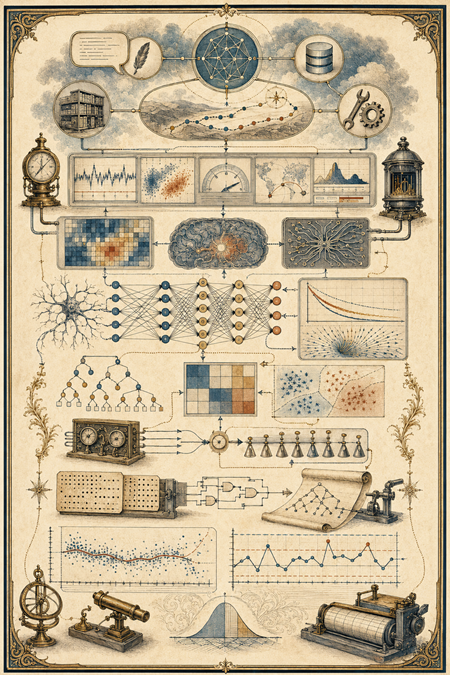
History of ML and AI Diagnostics, Observability, and Debugging
From residuals, validation sets, and reasoning traces to model monitoring, mechanistic interpretability, foundation-model evaluation, and agentic observability
PDF: https://www.dumpanalysis.org/files/History_of_ML_and_AI_Diagnostics_Obse...
History of Medical Diagnostics, Observability, and Debugging
From bedside signs, pulse, and urine inspection to laboratory medicine, medical imaging, molecular testing, continuous monitoring, and AI-assisted diagnosis

PDF: https://www.dumpanalysis.org/files/History_of_Medical_Diagnostics_Observ...
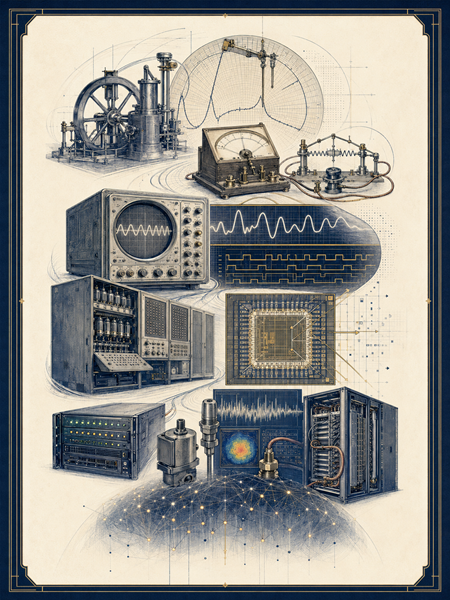
History of Hardware Diagnostics, Observability, and Debugging
From sensory inspection, checking circuits, and test points to built-in self-test, remote management, digital twins, and AI-assisted fault isolation
PDF: https://www.dumpanalysis.org/files/History_of_Hardware_Diagnostics_Obser...
History of Software Diagnostics, Observability, and Debugging
From machine fault finding and post-mortem dumps to distributed telemetry, time-travel debugging, and AI-assisted root-cause analysis

PDF: https://www.dumpanalysis.org/files/History_of_Software_Diagnostics_Obser...
Twenty-One Grammars of Diagnostic Evidence
Memory Dumps, Traces, and Logs through Chinese, Korean, Japanese, Arabic, Sanskrit, Russian, German, Irish, French, Classical Greek, Latin, Southern Quechua, Swahili, Turkish, Māori, Cherokee, Tibetan, Tamil, Ancient Egyptian, Basque, and Udmurt

PDF: https://www.dumpanalysis.org/files/Twenty-One-Grammars-Diagnostic-Eviden...
Seven-Layer Observability Design Model: Based on an OSI Analogy
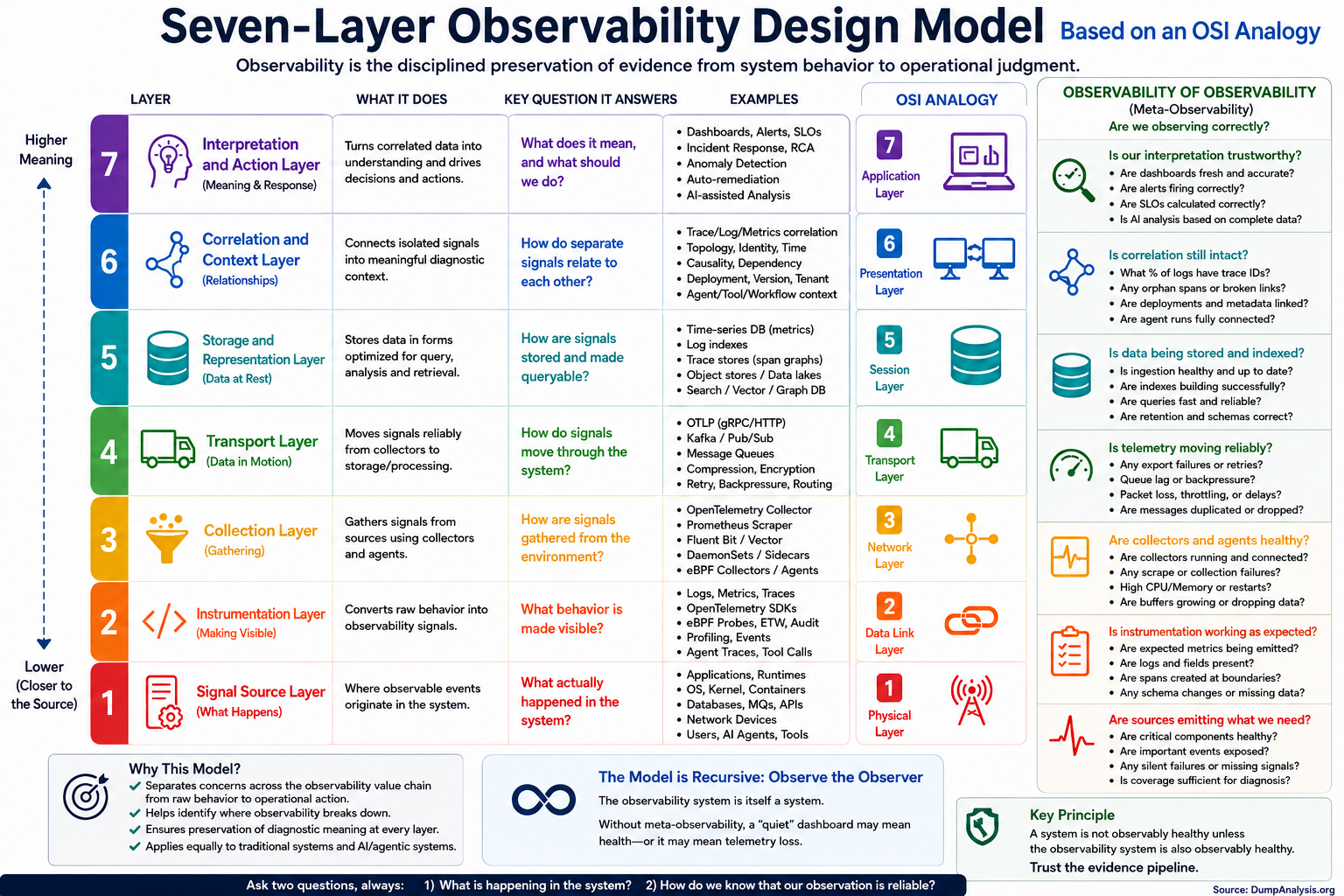
The Seven-Layer Observability Design Model is a conceptual framework for designing observability in modern software systems, modeled on the OSI networking model. It does not claim that observability literally has the same layers as networking. Instead, it uses the OSI-style layered thinking to separate concerns, clarify responsibilities, and make observability systems easier to reason about, build, debug, and evolve.
Layer 1: Signal Source Layer - the lowest layer of the model. It corresponds to where observable events originate.
Layer 2: Instrumentation Layer - turns raw system behavior into explicit observability signals.
Layer 3: Collection Layer - gathers observability signals from different sources.
Layer 4: Transport Layer - moves observability data from collectors to processing and storage systems.
Layer 5: Storage and Representation Layer - stores observability data in forms suitable for retrieval, querying, correlation, and analysis.
Layer 6: Correlation and Context Layer - connects isolated signals into meaningful diagnostic structures.
Layer 7: Interpretation and Action Layer - converts observability data into understanding and response.
Meta-observability: Observability of Observability - A production observability stack should itself be observable across the same seven layers.
Training: Advanced Linux Core Dump Analysis with Data Structures and Generative AI
Software Diagnostics Services organizes this online training course.

Learn how to navigate the process and kernel core memory dump space, and use Linux data structures to diagnose, troubleshoot, and debug complex software incidents. The training uses a unique, innovative pattern-oriented analysis approach to accelerate learning. It consists of practical step-by-step exercises using GDB and the Linux kernel crash utility. Additional topics include kernel structures navigation, practical scripting, kernel modules, drivers, and files. The training builds on the bestselling Accelerated Linux Core Dump Analysis and includes a crash course in essential C for the Linux kernel and a relevant Unified Modeling Language tutorial. The course also covers Generative AI to aid and automate core dump analysis and visualization.
To avoid repeating some topics and save time, the training includes the Accelerated Linux Core Dump Analysis PDF book.
You get:
- Accelerated Linux Core Dump Analysis PDF book
- Full slides
- Training sessions recording
- Personalized Certificate with unique CID
- The course PDF book (available later this year)
Prerequisites:
Basic and intermediate level Linux core dump analysis: the ability to list tasks, threads, libraries, modules, apply symbols, walk through backtraces and raw stack data, diagnose patterns such as heap corruption, CPU spike, memory leaks, segmentation faults, wait chains, and deadlocks. If you are not comfortable with the prerequisites, Accelerated Linux Core Dump Analysis training or the corresponding book (included) is recommended before attending this training.
Audience:
Software technical support and escalation engineers, cloud engineers, DevOps and DevSecOps, site reliability engineers, system administrators, security researchers, reverse engineers, malware and memory forensics analysts, software developers, and quality assurance engineers.