Trace Analysis Patterns (Part 264)
A single trace may reveal only a partial diagnostic world. An application trace may show requests and exceptions. A security trace may show tokens, scopes, and access decisions. An operations trace may show retries, timeouts, latency, and resource pressure. An AI/ML trace may show prompts, tool calls, agent decisions, model responses, and memory updates:
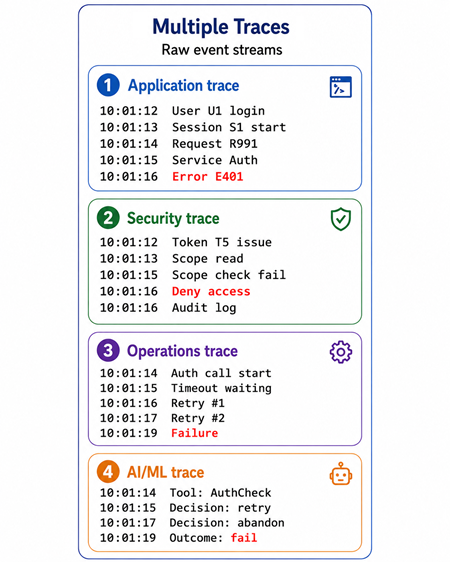
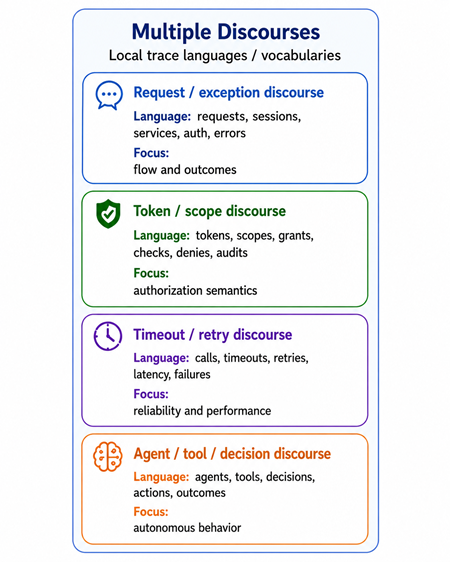
However, different traces are not only different in content. They may also belong to different Implementation Discourses. The earlier Implementation Discourse analysis pattern observes that non-trivial traces contain different discourses because components are written in different languages and follow different runtime environments, binary models, and interface frameworks. These implementation variations influence the structure, syntax, and semantics of trace messages; for example, .NET traces differ from file system driver traces or COM debugging messages:
Trace World builds on this idea: it is a trace and log analysis pattern in which multiple traces, logs, telemetry streams, and diagnostic Trace Viewpoints contribute to a shared ontology of entities, relations, events, and narratives. The key idea is that multiple traces do not merely sit side by side. They share and enrich the same diagnostic ontology. As more traces are added, the Trace World becomes richer: new entities appear, existing entities are connected, relations become clearer, and the common narrative becomes more complete:
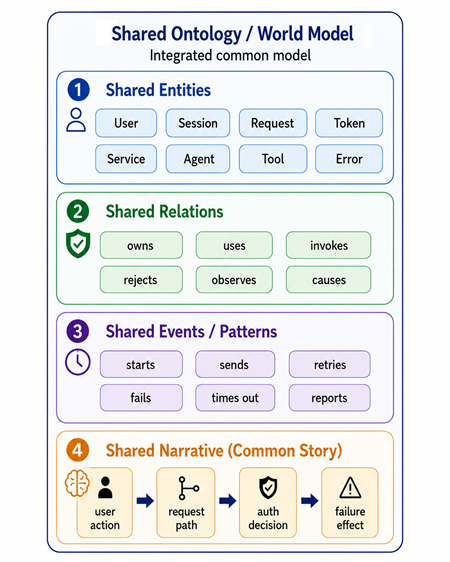
Therefore, Implementation Discourse is the local linguistic form of trace evidence, while Trace World is the shared world model that allows those local discourses to be translated, aligned, and used together. Implementation Discourse: How this component, runtime, framework, or language speaks in the trace. Trace World: How many such trace languages contribute to one shared diagnostic world. This also clarifies the relationship to Trace Ontology, which extracts entities, events, and relations from a trace, whereas Trace World allows multiple traces and multiple implementation discourses to share and enrich the same ontology.
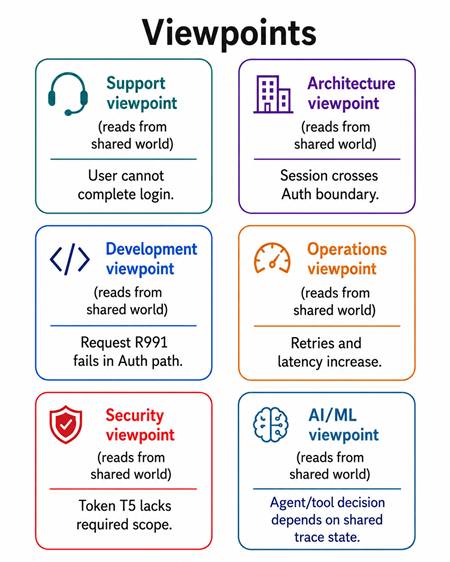
Compared to Trace Viewpoints, which are different ways of reading the same trace world, and Implementation Discourses, which are different trace languages used to express evidence, Trace World is the common diagnostic world that persists when we move across both viewpoints and implementation discourses:
In agentic AI systems, this becomes especially important. Prompt traces, tool-call traces, memory traces, policy traces, model inference traces, application logs, and infrastructure telemetry may all speak different implementation discourses. Trace World provides the common diagnostic world where agents, tools, prompts, observations, memories, users, services, policies, and failures can be connected.
In summary, Trace World is the shared diagnostic world formed when multiple trace discourses enrich the same ontology, allowing analysts to move across viewpoints without losing entity identity, relations, or narrative continuity.
This analysis pattern is useful when:
- Several traces describe the same incident from different systems.
- Components use different trace languages, formats, and conventions.
- Different runtimes or frameworks produce structurally different messages, including Embedded Traces.
- The same entity appears under different names in different traces.
- A failure crosses application, infrastructure, security, data, or AI boundaries.
- A single trace discourse is insufficient to reconstruct the diagnostic story.
For constructing the Trace World, typical analysis steps may be these:
- Identify the Implementation Discourse of each trace.
- Extract Basic Facts from each discourse.
- Identify local entities, events, and relations.
- Map equivalent entities across discourses.
- Merge them into a shared Trace World ontology.
- Add relations that become visible only across traces.
- Build a common narrative across implementation boundaries.
- Use Trace Viewpoints to read the same world from different skill perspectives.
However, there might be some problems when using Trace World analysis pattern:
- Discourse isolation: each trace language remains separate.
- Translation gap: no mapping exists between local trace terms.
- Identity mismatch: the same entity has different names in different discourses.
- Semantic drift or incompatible Semantic Mappings: similar words mean different things in different traces.
- Partial or incompatible Trace Ontologies: one discourse lacks entities needed to explain another.
- Conflicting narrative: traces imply different causal stories.
- Unenriched world: traces are collected but not integrated.
- Dmitry Vostokov @ DumpAnalysis.org + TraceAnalysis.org -