Trace Analysis Patterns (Part 265)
Even when all relevant events are present in traces and logs, they may still remain opaque because the analyst lacks the specialized skill needed to interpret their messages, abstractions, timing, domain vocabulary, failure semantics, or their role in the broader Trace World:
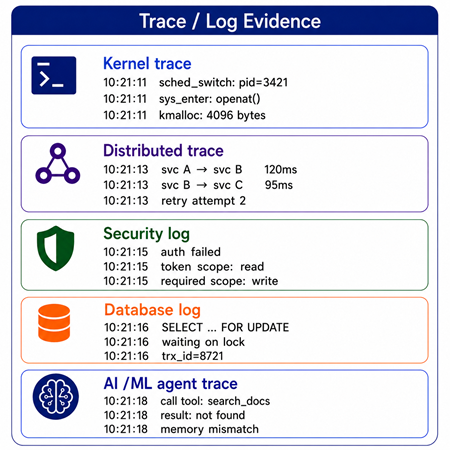
Trace Skill is a trace and log analysis pattern in which successful interpretation depends on a specific skill set required by the trace domain or Trace Ontology:
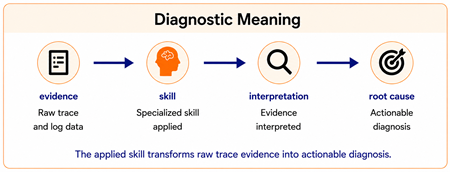
Some traces can be read with general diagnostic experience, especially if domain-independent analysis patterns are used. Others require specialist knowledge:
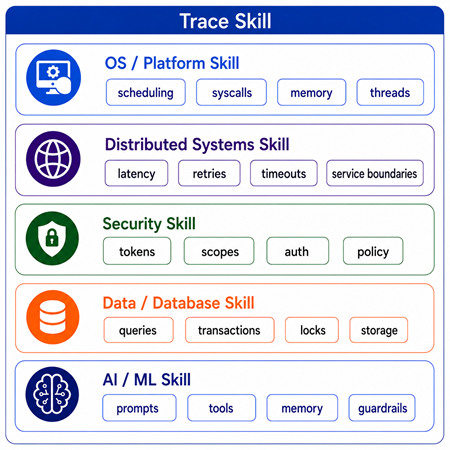
- Kernel tracing requires OS internals skill.
- Distributed traces require distributed systems skill.
- Database logs require query, transaction, and storage skill.
- Security logs require identity, policy, token, and threat-modeling skill.
- ML/AI traces require model, prompt, embedding, evaluation, and agentic workflow skill.
- Performance traces require latency, contention, scheduling, and resource-analysis skill.
- Business-process traces require domain workflow knowledge.
The same trace may therefore be simple for one analyst and almost invisible for another. Even the same analysis pattern may be applied differently. The problem is not the absence of data but the absence of the interpretive skill needed to turn trace data into diagnostic meaning:
Trace Skill analysis pattern may be useful in the following situations:
- The trace contains relevant evidence, but the analyst does not recognize it.
- Messages are dismissed as noise because their domain meaning is unknown.
- A team reads only the parts of the trace matching its own expertise.
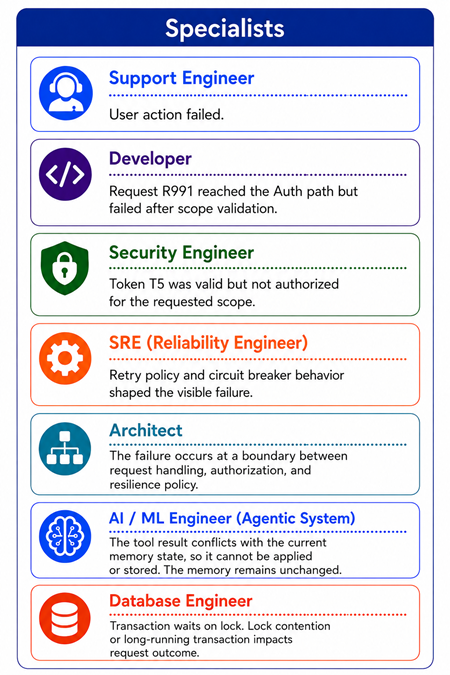
- Different specialists disagree because each understands only one layer.
- The trace crosses technical boundaries: application, infrastructure, security, data, ML, business logic.
- The incident is repeatedly escalated because no one possesses the required combination of skills.
Compared to other analysis patterns, Trace Viewpoints are perspectives from which the trace is read. Trace Skill is the competence needed to read from a viewpoint correctly. So a viewpoint can be chosen quickly, but a skill has to be possessed, acquired, or borrowed from someone else. Trace World allows movement across skill sets by creating a common diagnostic language, but Trace Skill explains why this is necessary: traces are often multi-skill artifacts. No single narrow skill may be enough. The analyst either needs multiple skills or needs to collaborate across skill boundaries using a shared Trace World.
We can also say that Trace Skill is needed to navigate traces and logs and their Trace World. Trace World provides the shared diagnostic terrain constructed from trace and log evidence, entities, relations, events, timelines, and viewpoints. Trace Skill is the specialized competence required to navigate both the raw evidence and the reconstructed world accurately, recognize relevant signals, switch between viewpoints, and avoid misinterpretation.
In summary, Trace Skill is a trace and log analysis pattern in which decisive diagnostic evidence can only be recognized by the appropriate specialist skill set.
- Dmitry Vostokov @ DumpAnalysis.org + TraceAnalysis.org -