Trace Analysis Patterns (Part 262)
In trace and log analysis, inductance and capacitance can serve as metaphors for two distinct forms of diagnostic behavior.
Trace Inductance is the tendency of a system to resist sudden changes in behavior. A new input, configuration change, request burst, or failure condition may not immediately appear in the trace as a new stable pattern. The existing execution flow has “momentum.” Threads, queues, retries, caches, locks, connection pools, batching, and background workers continue to reflect the previous state for some time:
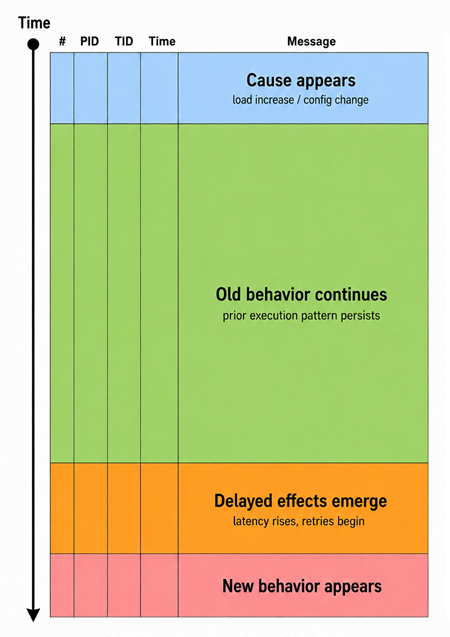
Note that the cause may not be visible in the trace or log but may come from another trace and log, similar to Paratext in memory analysis.
Trace Capacitance is the tendency of a system to accumulate diagnostic potential before a visible discharge occurs. The trace or log may look normal while internal state, queues, memory pressure, retry debt, latency, pending work, or error counters are accumulating. Then the system suddenly emits a burst of Error Messages, warnings, Timeouts, or Phase Transitions.
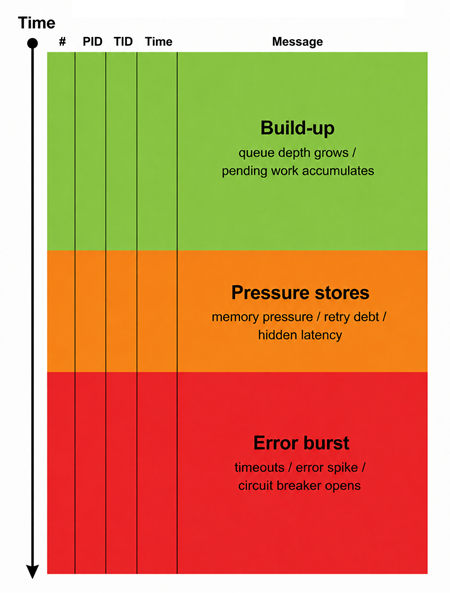
In summary, Trace Inductance explains delayed behavioral response, and Trace Capacitance explains delayed behavioral manifestation. The former asks: Why did the trace not change immediately after the cause? The latter asks: What was accumulating before the visible failure? Together they help avoid a common mistake: assuming that the first visible error is the real beginning of the problem. In many systems, the cause may appear before the symptom, because of inductance, and the symptom may appear suddenly because of capacitance.
We introduce Trace Reactance as a good umbrella analysis pattern name, with Trace Inductance and Trace Capacitance as two specializations of this pattern: Trace Reactance describes how diagnostic signals are delayed, smoothed, accumulated, or released by the system structure before becoming visible in traces and logs.
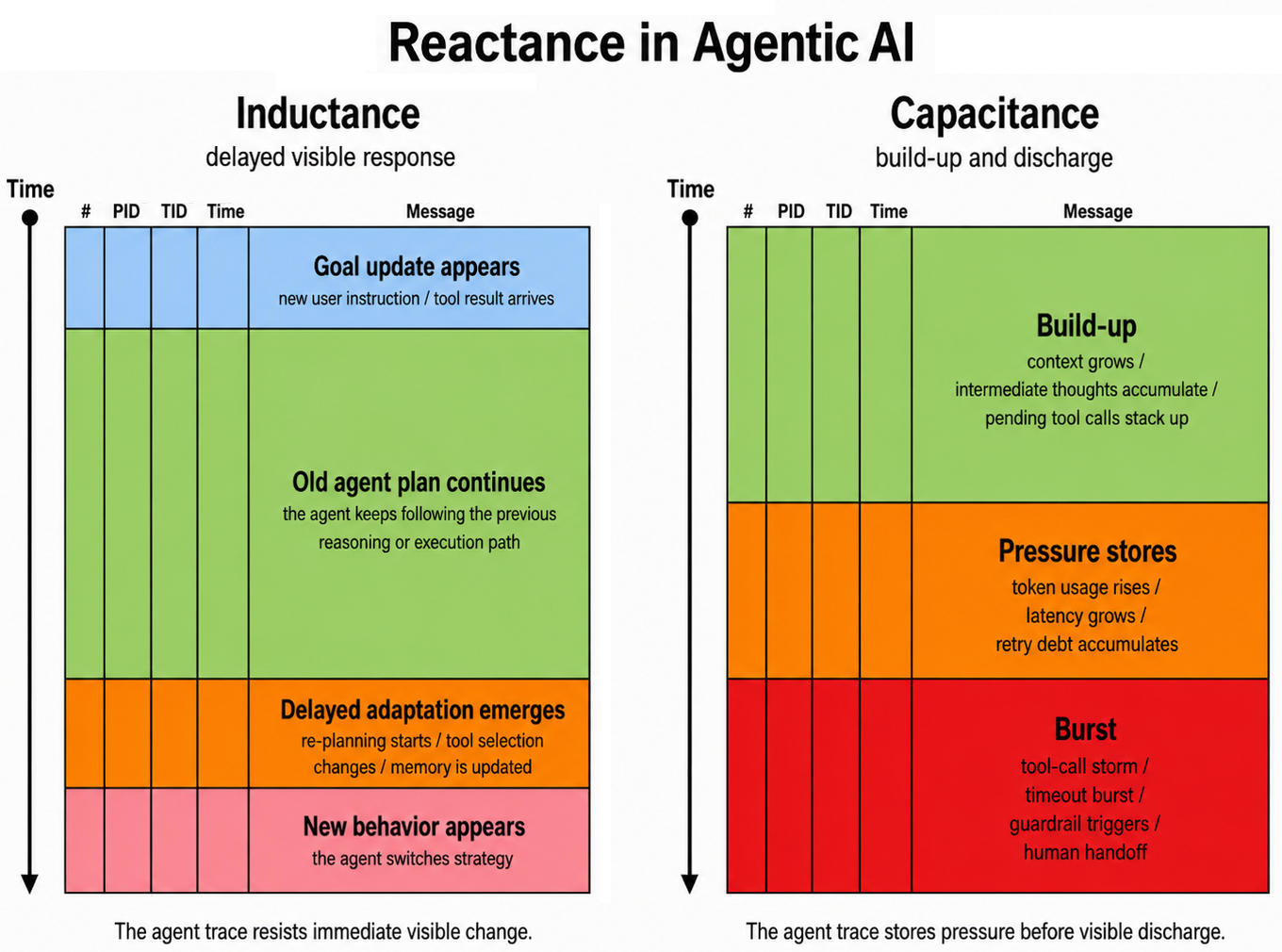
An agentic AI fits naturally here, too: agents accumulate context debt, token pressure, and retry state before a sudden degradation in output or a tool-call cascade both inductance and capacitance effects, for example (click on image to enlarge):
- Dmitry Vostokov @ DumpAnalysis.org + TraceAnalysis.org -