Trace Analysis Patterns (Part 258)
Usually, software traces and logs are sorted by time.
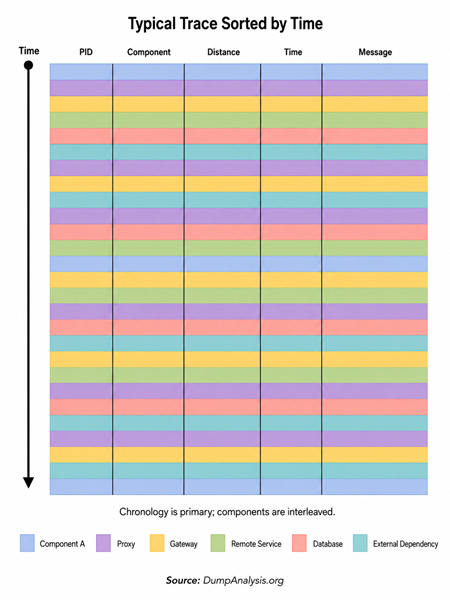
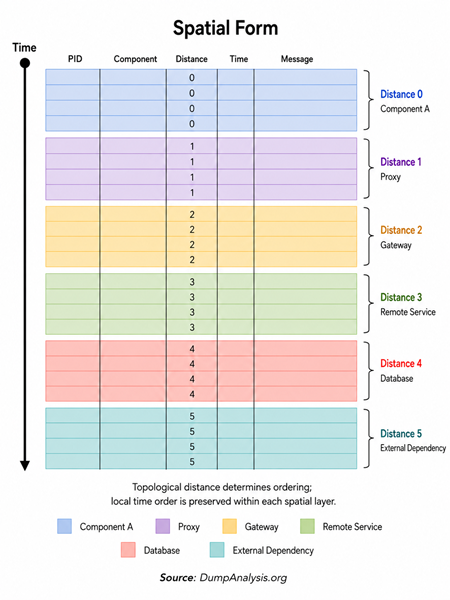
Spatial Form is a specialized Sorted Trace in which trace or log messages are sorted by spatial, topological, or diagnostic proximity to a chosen origin component, device, process, service, or subsystem. Instead of reading the trace solely as a chronological sequence, we choose a diagnostic origin and arrange messages by their distance from that origin. Within each distance layer, the original local time order may still be preserved.
The pattern name comes from Joseph Frank’s The Idea of Spatial Form that is associated with reading narrative structure through juxtaposition and relational arrangement rather than only through linear chronological progression; the concept was introduced into literary discussion through his 1945 essay and later collected with reconsiderations in his book.
Sorted Trace is the more general pattern: messages are sorted according to some attribute value, for example, by TID, ATID, message type, message invariants, or message data.
For Spatial Trace, the distance may come from network topology, service dependency graph, component containment, process/thread ownership, device hierarchy, pipeline stage distance, proxy/gateway chain, address-space relation, storage or shard topology, causal adjacency, and many others. The resulting trace is not anti-temporal. It is spatially primary and temporally secondary.
Spatial Trace analysis pattern may help answer these questions: What happened around this proxy? Which nearby component first showed abnormal behavior? How did the request propagate outward? Was the fault local, adjacent, or remote? It may help distinguish local symptoms, adjacent symptoms, downstream effects, remote dependencies, and external causes. It gives the trace a layered diagnostic structure and spatial Layered Periodization. The pattern is therefore both a sorting technique and a reading strategy.
This pattern is especially useful for distributed systems, microservices, network devices, storage stacks, cloud control planes, request pipelines, proxies, gateways, and agentic AI workflows where activity is spread across many components.
- Dmitry Vostokov @ DumpAnalysis.org + TraceAnalysis.org -