Reverse Engineering Citrix ThinWire
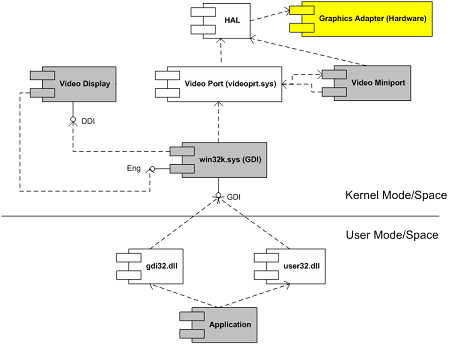
Crash dumps (and live debugging) can be very useful for reverse engineering component dependencies. Let’s look at MS Video Driver Architecture UML component diagram (synthesized after reading various articles from OSR and DDK):
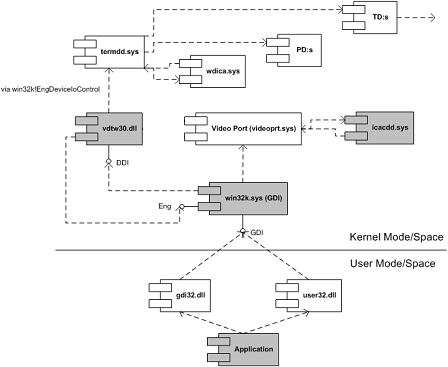
Coupled with this understanding and armed with Citrix symbol files (which are freely downloadable from Citrix support and you don’t really need them to see component dependencies) I was able to transform this thread stack below and other similar stacks into the following UML component diagram (some functions are shown as module!xxx and offsets are removed for clarity):
nt!KiSwapContext

nt!KiSwapThread

nt!KeWaitForSingleObject

tcpip!xxx

tcpip!TCPDispatch

nt!IofCallDriver

nt!xxx

nt!xxx

TDTCP!xxx

TDTCP!xxx

TDTCP!TdIoctl

termdd!_IcaCallSd

termdd!IcaCallNextDriver

pdrframe!xxx

pdrframe!PdIoctl

termdd!_IcaCallSd

termdd!IcaCallNextDriver

pdcrypt1!xxx

pdcrypt1!PdIoctl

termdd!_IcaCallSd

termdd!IcaCallNextDriver

WDICA!xxx

WDICA!xxx

WDICA!xxx

WDICA!xxx

WDICA!xxx

WDICA!xxx

WDICA!WdIoctl

termdd!IcaCallStack

termdd!IcaCallDriver

termdd!IcaDeviceControlChannel

termdd!IcaDeviceControl

termdd!IcaDispatch

win32k!GreDeviceIoControl

win32k!EngDeviceIoControl

vdtw30!xxx

vdtw30!xxx

win32k!vMovePointer

win32k!GreMovePointer

win32k!xxxMoveEventAbsolute

win32k!ProcessMouseInput

win32k!InputApc

nt!KiDeliverApc

nt!KiSwapThread

nt!KeWaitForMultipleObjects

win32k!xxxMsgWaitForMultipleObjects

win32k!xxxDesktopThread

win32k!xxxCreateSystemThreads

win32k!NtUserCallOneParam

nt!KiSystemServiceCopyEnd

nt!KiSwapThread

nt!KeWaitForSingleObject

win32k!EngWaitForSingleObject

vdtw30!xxx

vdtw30!xxx

vdtw30!xxx

vdtw30!DrvTw2SaveScreenBits

win32k!GreSaveScreenBits

win32k!CreateSpb

win32k!zzzChangeStates

win32k!zzzBltValidBits

win32k!xxxEndDeferWindowPosEx

win32k!xxxSetWindowPos

win32k!xxxShowWindow

win32k!NtUserShowWindow

nt!KiSystemService

USER32!NtUserShowWindow

USER32!InternalDialogBox

USER32!DialogBoxIndirectParamAorW

USER32!DialogBoxParamW
We replace MS components with Citrix ones:
- Video Display with vdtw30.dll
- Video Miniport with icacdd.sys
- Hardware and HAL with Terminal Services stack components (MS termdd.sys, Citrix wdica.sys, etc)
- Dmitry Vostokov -
November 5th, 2006 at 11:00 am
The diagram is slightly inaccurate. The video driver only ever directly links against WIN32K and would not call VideoPort.Sys directly without going through WIN32K. There is also another Citrix related path missing which I would not be able to mention in a public forum.
November 5th, 2006 at 2:45 pm
Thanks for pointing this out! This was adopted from the picture in OSR article:
From Andy’s Bookshelf: So you Wanna Write a Video Driver?
Figure 2 - DDI and Miniport Drivers
http://www.osronline.com/article.cfm?id=66
I’ll add a label to that link: “via win32k!EngDeviceIoControl” similar I’ve done for vdtw30.dll and termdd.sys interaction
Thanks,
Dmitry
November 5th, 2006 at 6:29 pm
No problem. The video display driver also directly accesses the hardware and performs things such as DMA transfers. This helps speed things up as it then doesn’t require the display driver to send an IRP to the miniport for every graphic command.
http://www.codeproject.com/system/driverdev6asp.asp
March 1st, 2007 at 5:41 pm
Corrected both diagrams (removed direct link from video display driver to video port driver)
Thanks,
Dmitry
July 24th, 2009 at 12:44 pm
[…] USER and GDI functions (pp. 54 - 55) - Long time ago I created a UML component diagram depicting component dependencies extracted from stack traces: http://www.dumpanalysis.org/blog/index.php/2006/10/24/reverse-engineering-citrix-thinwire/ […]
July 28th, 2009 at 5:45 pm
[…] Terminal services (pp. 19 -20) - an for architectural overview (UML diagram) please see this post: Reverse Engineering Citrix ThinWire […]