Cosmic Rays in Memory
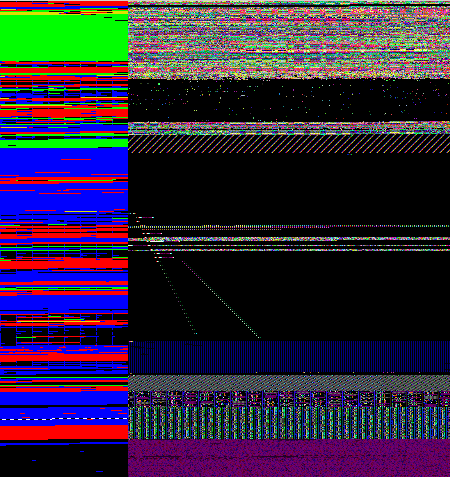
Thanks to the wonderful real-time memory visualization package from Jamie Fenton developed initially as a FreeFrame plugin for FrameLab (a general FreeFrame host adaptor for DirectShow) and now with its own real-time memory viewer GUI front-end I was able to find the evidence for cosmic rays in computer memory! You can see them on this screenshot where the left panel is a condensed virtual memory map of IE process and the right panel is specific page(s) view (I found rays on pages starting from 0×3B4000 address):
- Dmitry Vostokov @ DumpAnalysis.org -
December 23rd, 2008 at 4:54 pm
Interesting observation. I am little bit fuzzy about the process of creation of such tracks in PC memory. Is this an ionization caused by a cosmic ray trace? Are bits damaged? Does it mean that some bits can be lost in any time in the memory because of randomly occurring cosmic rays?
January 10th, 2009 at 3:30 pm
I’m curretly investigating this a bit deeper. This might be an epiphenomenon or an artifact.
January 15th, 2009 at 3:46 pm
[…] 2009 (0×7D9) - The Year of DebuggingLast weekend I spent a few hours devising a cover for the forthcoming computer memory visualization book and finally created this one piece cover featuring a journey to the center of pagefile theme and the discovery of cosmic rays in memory: […]
April 20th, 2009 at 4:38 pm
[…] 14. End of Session (It wasn’t bad after all) 15. Face in the Memory Dump (after applying Natural Memory Visualization techniques: you can see pictures and various artifacts stored in memory […]
June 10th, 2009 at 5:06 pm
I’ve actually done testing of radiation effects on memory for a living. And worked for a VLSI/Memory tester vendor.
It’s possible to get a memory map pattern from cosmic rays but it is actually very, very unlikely to manifest so literally like this. Here’s the reasons:
1. Address Scramble
2. Data Array Layout (and Scramble)
3. Target Cross Section and Energy Deposition
P(seeing trivial track) ~ P(adjacency) * P(low oblique hit) * P(incident cosmic ray in time).
This gives a really small number, plus the effect of scrambles means it would never manifest like this. Nobody publishes scrambles (only internal test engineers even care) so odds are you wouldn’t be able to descramble to see the pattern in the first place.
June 10th, 2009 at 7:15 pm
Very interesting! I cannot believe myself too and I’m in search of another sumilar instance to investigate further whether it is simply a data artifact that looks like a ray by coincidence.
Thanks,
Dmitry
July 18th, 2009 at 7:50 am
Of course it’s an artifact. Consider if each line represents 512 bytes. Suppose some is allocating 514 bytes followed by a 2 byte item, then another 514, followed by another 2 bytes.
If you allocated 510 bytes followed by 2 bytes the line would go straight down the page. And if you allocated 508 bytes + 2 bytes the line would slope the other way. If you allocated 516 bytes + 2 then the line would have a different slope.
This accounts for a single line. To get multiple lines the allocations must simply add up to the numbers above and change in a linear fashion. Consider the single line case of 514 + 2. Now consider if we allocate 4 structures at a time:
500 + 2 + 12 + 2 = 514 bytes
498 + 2 + 14 + 2 = 514
496 + 2 + 16 + 2 = 514
and so on.
This would generate 2 lines (although I’m not sure what the slope of the second line would be).
Of course they look like a picture that someone might draw of a cosmic ray, but I hope you were only joking about the cosmic rays, alhthough it sound like you were not. If not, you really need to acquaint yourself with computer hardware a little better.
July 18th, 2009 at 10:41 am
I agree, it makes sense. If I didn’t sound serious you wouldn’t have replied, right? But this artifact is rare indeed - “cosmic coincidence”
July 23rd, 2009 at 4:49 pm
[…] & Barn Burner I use for mining curious pictures from virtual memory space, like cosimc rays. Beside artistic pleasure, real-time memory visualization can have other numerous […]