Interrupts and exceptions explained (Part 1)
So far we have seen various bugchecks depicted. What I left there is the explanation of how exceptions happen in the first place and how the execution flow reaches KiDispatchException. When some abnormal condition happens such as breakpoint, division by zero or memory protection violation then normal CPU execution flow (code stream) is interrupted (therefore I use the terms “interrupt” and “exception” interchangeably here). The type of interrupt is specified by a number called interrupt vector number. Obviously CPU has to transfer execution to some procedure in memory to handle that interrupt. CPU has to find that procedure, theoretically either having one procedure for all interrupts and specifying interrupt vector number as a parameter or having a table containing pointers to various procedures that correspond to different interrupt vectors. Intel x86 and x64 CPUs use the latter approach which is depicted on the following diagram:

When an exception happens (divide by zero, for example) CPU gets the address of the procedure table from IDTR (Interrupt Descriptor Table Register). This IDT (Interrupt Descriptor Table) is a zero-based array of 8-byte descriptors (x86) or 16-byte descriptors (x64). CPU calculates the location of the necessary procedure to call and does some necessary steps like saving appropriate registers before calling it.
The same happens when some external I/O device interrupts. We will talk about external interrupts later. For I/O devices the term “interrupt” is more appropriate. On the picture above I/O hardware interrupt vector numbers were taken from some dump. These are OS and user-defined numbers. The first 32 vectors are reserved by Intel.
Before Windows switches CPU to protected mode during boot process it creates IDT table in memory and sets IDTR to point to it by using SIDT instruction.
Let me now illustrate this by using a UML class diagram annotated by pseudo-code that shows what CPU does before calling the appropriate procedure. The pseudo-code on the diagram below is valid for interrupts and exceptions happening when the current CPU execution mode is kernel. For interrupts and exceptions generated when CPU executes code in user mode the picture is a little more complicated because the processor has to switch the current user-mode stack to kernel mode stack.
The following diagram is for 32-bit x86 processor (x64 will be illustrated later):
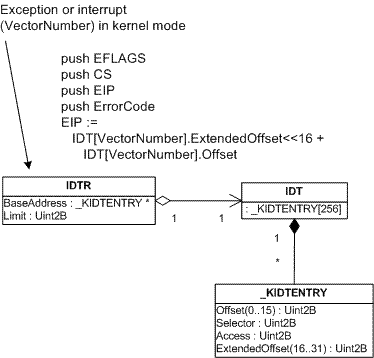
Let’s see all this in some dump. The address of IDT can be found by using !pcr [processor number] command. Every processor on a multiprocessor machine has its own IDT:
0: kd> !pcr 0

KPCR for Processor 0 at ffdff000:

    Major 1 Minor 1

 NtTib.ExceptionList: f2178b8c

     NtTib.StackBase: 00000000

    NtTib.StackLimit: 00000000

  NtTib.SubSystemTib: 80042000

       NtTib.Version: 0005c645

   NtTib.UserPointer: 00000001

       NtTib.SelfTib: 7ffdf000

             SelfPcr: ffdff000

                Prcb: ffdff120

                Irql: 0000001f

                 IRR: 00000000

                 IDR: ffffffff

       InterruptMode: 00000000

                 IDT: 8003f400

                 GDT: 8003f000

                 TSS: 80042000

       CurrentThread: 88c1d3c0

          NextThread: 00000000

          IdleThread: 808a68c0

           DpcQueue:
Every entry in IDT has the type _KIDTENTRY and we can get the first entry for divide by zero exception which has vector number 0:
0: kd> dt _KIDTENTRY 8003f400

   +0x000 Offset           : 0x47ca

   +0x002 Selector         : 8

   +0x004 Access           : 0x8e00

   +0x006 ExtendedOffset   : 0x8083
By gluing together ExtendedOffset and Offset fields we get the address of the interrupt handling procedure (0×808347ca) which is KiTrap00:
0: kd> ln 0x808347ca

(808347ca)   nt!KiTrap00   |  (808348a5)   nt!Dr_kit1_a

Exact matches:

    nt!KiTrap00
We can also see the interrupt trace in raw stack. For example, we can open the kernel dump and see the following stack trace and registers in the output of !analyze -v command:
ErrCode = 00000000

eax=00001b00 ebx=00001b00 ecx=00000000 edx=00000000 esi=f2178cb4 edi=bc15a838

eip=bf972586 esp=f2178c1c ebp=f2178c90 iopl=0 nv up ei ng nz ac po cy

cs=0008 ss=0010 ds=0023 es=0023 fs=0030 gs=0000 efl=00010293

driver!foo+0xf9:

bf972586 f77d10 idiv eax,dword ptr [ebp+10h] ss:0010:f2178ca0=00000000

STACK_TEXT:

f2178b44 809989be nt!KeBugCheck+0×14

f2178b9c 8083484f nt!Ki386CheckDivideByZeroTrap+0×41

f2178b9c bf972586 nt!KiTrap00+0×88

f2178c90 bf94c23c driver!foo+0xf9

f2178d54 80833bdf driver!bar+0×11c
The dumping memory around ESP value (f2178c1c) shows the values processor pushes when divide by zero exception happens:
0: kd> dds f2178c1c-100 f2178c1c+100

...

...

...

f2178b80  00000000

f2178b84  f2178b50

f2178b88  00000000

f2178b8c  f2178d44

f2178b90  8083a8cc nt!_except_handler3

f2178b94  80870828 nt!`string'+0xa4

f2178b98  ffffffff

f2178b9c  f2178ba8

f2178ba0  8083484f nt!KiTrap00+0x88

f2178ba4  f2178ba8

f2178ba8  f2178c90

f2178bac  bf972586 driver!foo+0xf9

f2178bb0  badb0d00

f2178bb4  00000000

f2178bb8  0000006d

f2178bbc  bf842315

f2178bc0  f2178c6c

f2178bc4  f2178bec

f2178bc8  bf844154

f2178bcc  f2178c88

f2178bd0  f2178c88

f2178bd4  00000000

f2178bd8  bc150000

f2178bdc  f2170023

f2178be0  f2170023

f2178be4  00000000

f2178be8  00000000

f2178bec  00001b00

f2178bf0  f2178c0c

f2178bf4  f2178d44

f2178bf8  f2170030

f2178bfc  bc15a838

f2178c00  f2178cb4

f2178c04  00001b00

f2178c08  f2178c90

f2178c0c  00000000 ; ErrorCode

f2178c10  bf972586 driver!foo+0xf9 ; EIP

f2178c14  00000008 ; CS

f2178c18  00010293 ; EFLAGS

f2178c1c  00000000 ; <- ESP before interrupt

f2178c20  0013c220

f2178c24  00000000

f2178c28  60000000

f2178c2c  00000001

f2178c30  00000000

f2178c34  00000000

…

…

…
ErrorCode is not the same as interrupt vector number although it is the same number here (0). I won’t cover interrupt error codes here. If you are interested please consult Intel Architecture Software Developer’s Manual.
If we try to execute !idt extension command it will show you only user-defined hardware interrupt vectors:
0: kd> !idt

Dumping IDT:

37: 80a7d1ac hal!PicSpuriousService37

50: 80a7d284 hal!HalpApicRebootService

51: 89495044 serial!SerialCIsrSw (KINTERRUPT 89495008)

52: 89496044 i8042prt!I8042MouseInterruptService (KINTERRUPT 89496008)

53: 894ea044 USBPORT!USBPORT_InterruptService (KINTERRUPT 894ea008)

63: 894f2044 USBPORT!USBPORT_InterruptService (KINTERRUPT 894f2008)

72: 89f59044 atapi!IdePortInterrupt (KINTERRUPT 89f59008)

73: 89580044 NDIS!ndisMIsr (KINTERRUPT 89580008)

83: 899e7824 NDIS!ndisMIsr (KINTERRUPT 899e77e8)

92: 89f56044 atapi!IdePortInterrupt (KINTERRUPT 89f56008)

93: 89f1e044 SCSIPORT!ScsiPortInterrupt (KINTERRUPT 89f1e008)

a3: 894fa044 USBPORT!USBPORT_InterruptService (KINTERRUPT 894fa008)

a4: 894a3044 cpqcidrv+0×22AE (KINTERRUPT 894a3008)

b1: 89f697dc ACPI!ACPIInterruptServiceRoutine (KINTERRUPT 89f697a0)

b3: 89498824 i8042prt!I8042KeyboardInterruptService (KINTERRUPT 894987e8)

b4: 894a2044 cpqasm2+0×5B99 (KINTERRUPT 894a2008)

c1: 80a7d410 hal!HalpBroadcastCallService

d1: 80a7c754 hal!HalpClockInterrupt

e1: 80a7d830 hal!HalpIpiHandler

e3: 80a7d654 hal!HalpLocalApicErrorService

fd: 80a7e11c hal!HalpProfileInterrupt
In the next part I’m going to cover x64 specifics.
- Dmitry Vostokov -
July 18th, 2008 at 4:22 pm
Interesting the initial interrupt handler code runs in dynamically created code in a nonpagedd pool Ioin block
before setting the irql’s etc and passing control to the real device driver interrupt routine
July 18th, 2008 at 6:44 pm
Interesting, I haven’t yet looked at hardware device intrupt processing only at CPU interrupts