UML and Device drivers
I got the impression after reading numerous books and articles about device drivers that UML is almost never used in describing kernel and device driver design and architecture. Everything is described either by words or using proprietary notations. If you don’t know about UML (Unified Modeling Language) it is time to learn because it is an industry standard general purpose modeling language with graphical notation. You can find many good tutorials on the Web and I can recommend the book to start:
UML Distilled: A Brief Guide to the Standard Object Modeling Language, Third Edition


Recently I created some diagrams based on my past experience in using UML to describe and communicate architecture and design:
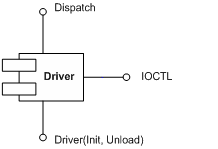
0. Component diagram depicting major driver interfaces
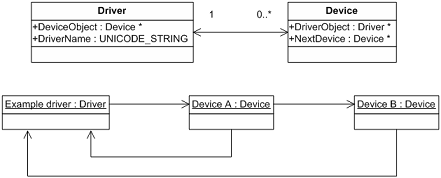
1. Class and object diagram depicting relationship between drivers and devices
2. Component diagram showing dependencies and interfaces when calling Win32 API function ReadFile
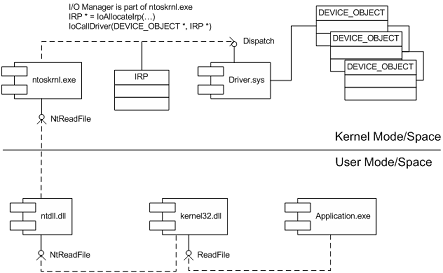
3. Component diagram showing IRP flow in a driver stack (driver-to-driver communication)

Actually I found that some driver books incorrectly depict the ordering of I/O stack locations in IRP stack corresponding to driver or device stack. The correct layout is depicted above. IRP I/O stack locations grow down (to lower addresses) in memory like any other Wintel stack. You can see it from kernel dumps or the following macro from DDK header file wdm.h which shows that next IRP I/O stack location is down in memory (1 is subtracted from current stack location pointer):
#define IoGetNextIrpStackLocation( Irp ) (\

    (Irp)->Tail.Overlay.CurrentStackLocation - 1 )
Dumps (and live debugging) are good in studying component relationships, reconstructing sequence diagrams, etc. For example, this edited fragment below is from crash dump and it shows who calls whom and component dependencies be reconstructed from call stack of Win32 API function GetDriveType: SHELL32 (calls it) -> kernel32 -> ntdll -> nt (ntoskrnl.exe). You can also see various Citrix hooks and filters here (CtxSbxXXX):
kd> kL

CtxSbx!xxx

nt!IovCallDriver

nt!IofCallDriver

CtxAltStr!xxx

nt!IovCallDriver

nt!IofCallDriver

nt!IopParseDevice

nt!ObpLookupObjectName

nt!ObOpenObjectByName

nt!IopCreateFile

nt!IoCreateFile

nt!NtOpenFile

nt!KiSystemService

SharedUserData!SystemCallStub

ntdll!ZwOpenFile

CtxSbxHook!xxx

kernel32!GetDriveTypeW

SHELL32!CMountPoint::_EnumMountPoints
- Dmitry Vostokov -
July 22nd, 2010 at 4:23 pm
[…] Relationship between device and driver objects (pp. 553 - 554) - long time ago when I was preparing a presentation about Windows drivers for escalation engineers I created some UML diagrams you can see in the following blog post: http://www.dumpanalysis.org/blog/index.php/2006/10/08/uml-and-device-drivers/ […]
August 10th, 2010 at 5:00 pm
[…] IRP and layered drivers (pp. 578 - 586) - here’s a UML-style diagram (#3) for IRP flow: http://www.dumpanalysis.org/blog/index.php/2006/10/08/uml-and-device-drivers/ […]