Crash Dump Analysis Patterns (Part 35)

Sponsored link: Memory Dump Analysis Services

Debugging Experts Magazine Online

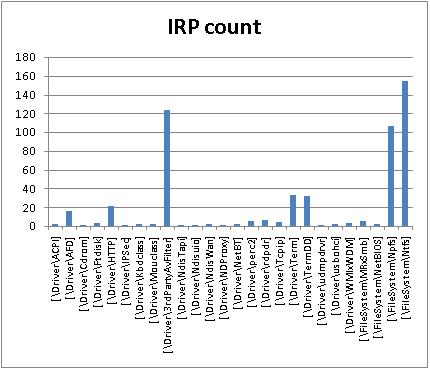
In kernel or complete memory dumps coming from hanging or slow workstations and servers !irpfind WinDbg command may show IRP Distribution Anomaly pattern when certain drivers have excessive count of active IRPs not observed under normal circumstances. I created two IRP distribution graphs from two problem kernel dumps by preprocessing command output using Visual Studio keyboard macros to eliminate completed IRPs and then using Excel. In one case it was a big number of I/O request packets from 3rd-party antivirus filter driver:

\Driver\3rdPartyAvFilter
In the second case it was the huge number of active IRPs targeted to kernel socket ancillary function driver:

\Driver\AFD
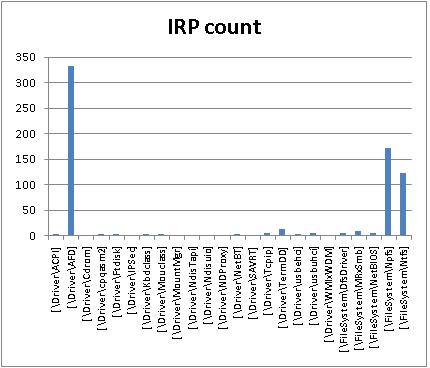
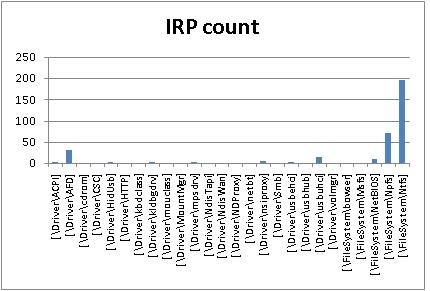
Two other peaks on both graphs are related to NTPS and NTFS, pipes and file system and usually normal. Here is IRP distribution graph from my Vista workstation captured while I was writing this post:
- Dmitry Vostokov @ DumpAnalysis.org -


Museum of Debugging and Memory Dumps

7/7/2010 - 8/8/2010 Annual Competition: Tell Your Windows Debugging Story

Crash and Hang Analysis Audit Service

CARE: Crash Analysis Report Environment

Crash Dump and Software Trace Analysis Training and Seminars

Access OpenTask Titles on Safari Books Online

DATA (Dump Analysis + Trace Analysis) Facebook group
Please join the community of memory (dump) and trace analysis engineers. This group promotes scientific methods and memory dump-based worldview.

Twitter @ DumpAnalysis
You can now follow portal and blog news at DumpAnalysis on Twitter

LinkedIn Group Dr. Watson Enthusiasts
All about Dr. Watson errors and more. Get news, excerpts and progress reports about the forthcoming book The Science of Dr. Watson: An Illustrated History of Debugging (ISBN 978-1906717070)

2010 (0x7DA) - The Year of Dump Analysis
2011 (0x7DB) - 2020 (0x7E4) The Debugging Decade

International Memory Analysts and Debuggers Day:
07.07 and/or 08.08 starting from The Year of Dump Analysis, 2010, 7DA

Announcements

Coming Soon:

Management Bits: An Anthology from Reductionist Manager

Crash Dump Analysis: Practical Foundations (Windows Edition, Systematic Software Fault Analysis Series)

Debugging Notebook: Essential Concepts, WinDbg Commands and Tools

Crash Dump Analysis for System Administrators and Support Engineers

New Magazines:

Debugged! MZ/PE: MagaZine for/from Practicing Engineers


New Books:

Memory Dump Analysis Anthology: Color Supplement for Volumes 1-3

Memory Dump Analysis Anthology, Volume 3

First Fault Software Problem Solving: A Guide for Engineers, Managers and Users

x64 Windows Debugging: Practical Foundations

Also available:

Windows Debugging: Practical Foundations

DLL List Landscape: The Art from Computer Memory Space

Dumps, Bugs and Debugging Forensics: The Adventures of Dr. Debugalov

WinDbg: A Reference Poster and Learning Cards

Memory Dump Analysis Anthology, Volume 2

Memory Dump Analysis Anthology, Volume 1

New Children's Book:

Baby Turing

3 Responses to “Crash Dump Analysis Patterns (Part 35)”

  1. Crash Dump Analysis » Blog Archive » IRP distribution anomaly, inconsistent dump, execution residue, hardware activity, coincidental symbolic information, not my version, virtualized system: pattern cooperation Says:

    […] A complete memory dump was collected. We open it and look at an IRP list. We find statistically higher number of IRPs belonging to Disk and DriverA device […]

  2. Crash Dump Analysis » Blog Archive » Icons for Memory Dump Analysis Patterns (Part 57) Says:

    […] we introduce an icon for IRP Distribution Anomaly […]

  3. Crash Dump Analysis » Blog Archive » Stack trace collection, special process, LPC and critical section wait chains, blocked thread, coupled machines, thread waiting time and IRP distribution anomaly: pattern cooperation Says:

    […] threads have various Windows socket modules on their thread stacks and we check if there is any IRP distribution anomaly using !irpfind command. Counting IRPs we find the most of them are directed towards HTTP, Tcpip and […]

Leave a Reply