Crash Dump Analysis Patterns (Part 6)
Now it’s time to ”introduce” Invalid Pointer pattern. It’s just a number saved in a register or in a memory location and when we try to interpret it as a memory address itself and follow it (dereference) to fetch memory contents (value) it points to, OS with the help of hardware tells us that the address doesn’t exist or inaccessible due to security restrictions. The following two slides from my old presentation depict the concept of a pointer:
Pointer definition
Pointers depicted
In Windows you have your process memory partitioned into two big regions: kernel space and process space. Space partition is a different concept than execution mode (kernel or user, ring 0 or ring 3) which is a processor state. Code executing in kernel mode (a driver or OS, for example) can access memory that belongs to user space.
Based on this we can make distinction between invalid pointers containing kernel space addresses (start from 0×80000000 on x86, no /3Gb switch) and invalid pointers containing user space addresses (below 0×7FFFFFFF).
On Windows x64 user space addresses are below 0×0000070000000000 and kernel space addresses start from 0xFFFF080000000000.
When you dereference invalid kernel space address you get bugcheck immediately:
UNEXPECTED_KERNEL_MODE_TRAP (7f)
PAGE_FAULT_IN_NONPAGED_AREA (50)
There is no way you can catch it in your code (by using SEH).
However when you dereference user space address the course of action depends on whether your processor is in kernel mode (ring 0) or in user mode (ring 3). In any mode you can catch the exception (by using appropriate SEH handler) or leave this to the operating system or debugger. If there was no component willing to process the exception when it happened in user mode you get your process crash and in kernel mode you get bugchecks:
SYSTEM_THREAD_EXCEPTION_NOT_HANDLED (7e)
KERNEL_MODE_EXCEPTION_NOT_HANDLED (8e)
I summarized all of this on the following diagram:
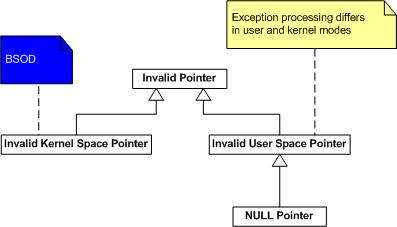
NULL pointer is a special class of user space pointers. Usually its value is in the range of 0×00000000 - 0×0000FFFF. You can see them used in instructions like
mov esi, dword ptr [ecx+0×10]
and ecx value is 0×00000000 so you try to access the value located at 0×00000010 memory address.
When you get a crash dump and you see an invalid pointer pattern the next step is to interpret the pointer value which should help in understanding possible steps that led to the crash. Pointer value interpretation is the subject of the next part.
- Dmitry Vostokov @ DumpAnalysis.org -
April 28th, 2008 at 6:22 pm
[…] is a specialization of Invalid Pointer pattern called NULL Pointer. This is the most easily recognized pattern with a straightforward fix […]
September 17th, 2008 at 9:56 am
[…] http://www.dumpanalysis.org/blog/index.php/2006/12/18/crash-dump-analysis-patterns-part-6/ […]
April 14th, 2009 at 6:21 pm
[…] (0×7DA) - The Year of Dump Analysis NULL Data Pointer is a special version of the more general Invalid Pointer pattern like NULL Code Pointer. The effective address is below 0xFFFF and it is usually a register […]
May 13th, 2009 at 2:48 pm
[…] looking at a stack trace of one crashed process we noticed an invalid code pointer. It is not a NULL code pointer but has the same stack trace […]
May 13th, 2009 at 4:23 pm
[…] although NULL pointers having 0 value are usually used. Also -1 value can be used to assign an invalid pointer […]
March 19th, 2010 at 1:39 pm
[…] Today we introduce an icon for Invalid Pointer (general) pattern: […]