Assembling code in WinDbg
I was recently asked why the following code used byte ptr modifier for MOV instruction when assigning a number to a memory location pointed to by a register:
C/C++ code:
int a;

int *pa = &a;
void foo()

{

    __asm

    {

        // ...

        mov eax,   [pa]

        mov [eax], 1

        // ...

    }

}
Generated x86 assembly language code:
0:000:x86> uf foo

[...]

0042d64e c60001 mov byte ptr [eax],1

[…]
It looks like by default Visual C++ inline assembler treats MOV as “byte ptr” because it doesn’t know about C or C++ language semantics. Originally I thought that was the sign of a code optimization because the resulted binary code is smaller than the one generated by dword ptr. In order to check that I used a WinDbg command:
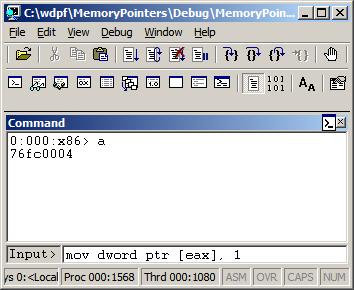
0:000> a

77067dfe mov dword ptr [eax], 1

mov dword ptr [eax], 1

77067e04
0:000> u 77067dfe

ntdll!DbgBreakPoint:

77067dfe c70001000000    mov     dword ptr [eax],1

77067e04 0c8b            or      al,8Bh

77067e06 54              push    esp

77067e07 2408            and     al,8

77067e09 c70200000000    mov     dword ptr [edx],0

77067e0f 897a04          mov     dword ptr [edx+4],edi

77067e12 0bff            or      edi,edi

77067e14 741e            je      ntdll!RtlInitString+0×34 (77067e34)
This could be possible because the variable “a” is global, initialized to 0 during the program startup, so it is safe to change just one byte. If “a” was a local variable (on stack) than other 3 bytes of DWORD could contain garbage from the previously used stack memory. However, I noticed that the program was compiled as Debug target with all optimization turned off. If Visual C++ compiler was used it should have assumed that the variable “a” could have been referenced from other compilation units and no longer contained 0 before the assignment in foo function. I recreated the same code in C/C++, built the new Debug executable, and indeed, it used dword ptr instead of byte ptr as expected from C/C++ semantics.
- Dmitry Vostokov @ DumpAnalysis.org -