Applying API Wrapper Pattern
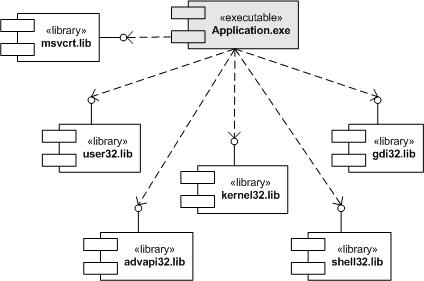
Recently I had been porting my old Win32 legacy project (more than 100,000 lines) to Windows Mobile. Here I summarize the approach I used and I can say now that it was very successful (no single crash since I finished my porting - the original Win32 program was very stable indeed but we all know that hidden bugs surface or introduced when project is ported to another platform). The project was written in Windows 3.x 16-bit era and then it was already ported to Win32 in Windows 95 era. Win32 interface is huge and it contains many legacy Win16 functions (mainly for easy portability and compatibility with existing Win16 code base). The following UML component diagram depicts application dependencies on many Win32 API and runtime libraries from build perspective:
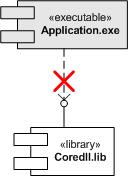
Windows Mobile (in essence Windows CE) has smaller interface and many functions available in Win32 API (especially legacy Win16) and many C runtime functions are absent. My project uses many such functions (due to its history) so the interface becomes broken. The following UML component diagram depicts this dependency:
First I ported my project to use UNICODE strings and UNICODE function equivalents throughout. This was a huge task already. Then instead of further rewriting my code which uses many absent functions and therefore quite possibly to introduce new bugs due to changed semantics I decided to apply a variant of Adapter or Wrapper pattern (for non-object-oriented API). My application now still uses old functions but links to a set of libraries translating these calls into existing Windows CE API. The following UML component depicts the final component infrastructure from build perspective:
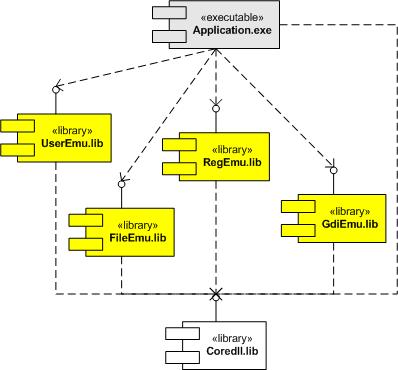
Here is the list of functions I had to translate:
- RegEmu.lib: translates INI file calls into registry
- GetProfileString
- GetProfileInt
- GetPrivateProfileString
- GetPrivateProfileInt
- WriteProfileString
- WritePrivateProfileString
- FileEmu.lib: various file system related calls
- _lcreatW
- _lopenW
- OpenFileW
- WinExecW
- _wsplitpath
- _wsplitpathparam
- _waccess
- _wmkdir
- _wrename
- _wfindfirst
- _wfindnext
- _findclose
- _wunlink
- _wrmdir
- _llseek
- _lclose
- _hread
- _hwrite
- _lread
- _lwrite
- _wstat
- _wgetcwd
- _wmakepath
- _chdrive
- _wchdir
- ShellExecute
- GetWindowsDirectory
- GetSystemDirectory
- GdiEmu.lib: various graphics functions
- SetMapMode
- CreateFont
- CreateDIBitmap
- UserEmu.lib: various UI related functions
- GetKeyNameText
- GetScrollPos
- GetScrollRange
- GetLastActivePopup
- IsIconic
- IsZoomed
- IsBadStringPtr
- IsMenu
- VkKeyScan
- GetKeyboardState
- SetKeyboardState
- ToAscii
- MulDiv
PS. If you are interested in applying patterns to your C++ projects or simply in using them to describe your design and architecture these books are good place to start:
Design Patterns: Elements of Reusable Object-Oriented Software

Pattern-Oriented Software Architecture, Volume 1: A System of Patterns

Pattern-Oriented Software Architecture, Volume 2, Patterns for Concurrent and Networked Objects


- Dmitry Vostokov -